



![Banner [BCM] [E3] [BIA] [P1] Identification of Business Functions](https://no-cache.hubspot.com/cta/default/3893111/206ddd7e-615a-42c8-aa2a-3416a1ad06b3.png)
CBF-4 Health, Safety, and Safeguarding Management
![[BCM] [MINDS] [E3] [BIA] [T1] [CBF] [4] Health, Safety, and Safeguarding Management](https://no-cache.hubspot.com/cta/default/3893111/6a8cd730-1d27-49ce-b643-57937e31660a.png)
CBF-4 focuses on Health, Safety, and Safeguarding Management within MINDS, which is essential for ensuring the well-being of clients, staff, and stakeholders.
This function encompasses all activities required to maintain a safe environment, deliver quality care, and comply with regulatory requirements.
The ability of MINDS to continue delivering these critical services without interruption is crucial, as any disruption could impact the health, development, and safety of clients.
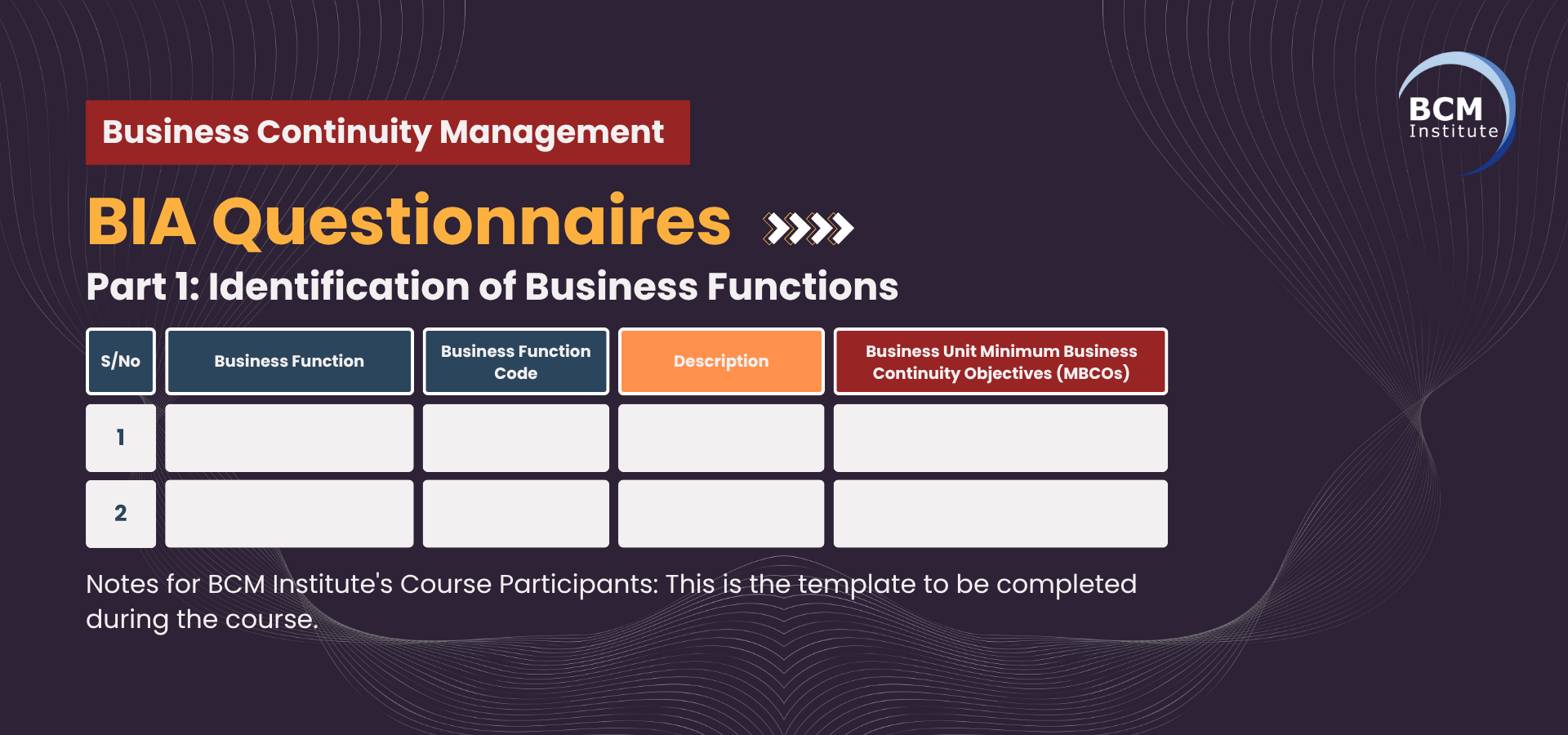
This chapter identifies the sub-critical business functions (Sub-CBFs) under CBF-4, describing their purpose and defining the Business Unit Minimum Business Continuity Objective (MBCO). The MBCO specifies the minimum level of service that must be maintained during a disruption to prevent unacceptable consequences to clients, staff, and the organisation.
![Banner [Table] [BCM] [E3] [BIA] [P1] Identification of Critical Business Functions](https://no-cache.hubspot.com/cta/default/3893111/4fe499c9-0c19-46b4-8b6f-75450dba07d8.png)
Table P1: Critical Business Functions for CBF-4
|
Sub-CBF Code |
Sub-CBF |
Description of Process / Activity |
Examples (in MINDS context) |
|
4.1 |
Special Education Delivery |
Delivery of educational programmes tailored to the abilities of clients with intellectual disabilities, ensuring continuity of learning and development. |
Ensure core educational activities continue for all enrolled clients, with alternative delivery methods (e.g., blended or remote learning) if normal operations are disrupted. |
|
4.2 |
Individualised Learning Planning |
Development and monitoring of personalised learning plans to meet each client’s educational and developmental goals. |
Maintain essential planning and progress review for high-priority clients within acceptable timelines to prevent learning regression. |
|
4.3 |
Life Skills and Independent Living Training |
Teaching clients essential life skills such as hygiene, money management, cooking, and safe community participation. |
Continue critical training for all clients requiring immediate support, prioritising those at risk of harm or regression. |
|
4.4 |
Vocational Preparation and Work Exposure |
Provision of training and exposure to work environments to enhance employability and independence. |
Maintain essential work-readiness training and supervised exposure for clients actively engaged in vocational programmes. |
|
4.5 |
Allied Support Services Integration |
Coordination of services such as physiotherapy, occupational therapy, speech therapy, and psychological support. |
Ensure critical allied services are delivered to clients with urgent care needs or developmental requirements. |
|
4.6 |
Special Student Care and Enrichment Activities |
Organising recreational, enrichment, and therapeutic activities to promote overall development and wellbeing. |
Continue essential enrichment activities that impact client safety, mental health, and social development. |
|
4.7 |
Assessment & Progress Monitoring |
Regular evaluation of client progress to adjust care and educational plans. |
Ensure ongoing assessment for high-priority clients to prevent regression or compromise in care standards. |
|
4.8 |
Training Staff Capability & Development |
Training staff to maintain competency in specialised care, safeguarding, and health procedures. |
Maintain essential training for staff to ensure safety-critical operations and regulatory compliance. |
|
4.9 |
Parent and Caregiver Engagement |
Engaging with parents and caregivers to support client development and share progress. |
Ensure communication channels remain operational for urgent updates, safety notices, and care instructions. |
![Banner [BCM] [E3] [BIA] [Summing Up] [P1] Identification of Critical Business Functions](https://no-cache.hubspot.com/cta/default/3893111/22330ab3-0a0f-4efd-9da7-43032e1e6573.png)
The identification of CBF-4 Health, Safety, and Safeguarding Management and its sub-critical business functions highlights MINDS’ commitment to protecting clients’ wellbeing while maintaining continuity of care and educational services.
By defining the MBCOs for each Sub-CBF, MINDS can prioritise critical activities during disruptions, ensuring that essential services are maintained, risks are mitigated, and clients’ health, safety, and development are safeguarded.
This framework provides a clear understanding of operational priorities and forms the foundation for subsequent chapters on risk assessment, business impact analysis, and continuity planning.
![Banner [BCM] [E3] [BIA] [P2] Impact Area of Business Functions](https://no-cache.hubspot.com/cta/default/3893111/182e67c2-aa89-4b0b-b3e9-144293680ea4.png)
CBF-4 Health, Safety, and Safeguarding Management
CBF-4, Health, Safety, and Safeguarding Management, ensures the safety, well-being, and development of MINDS’ clients while maintaining compliance with regulatory and safeguarding standards.
Any disruption in this function can have significant consequences on client health, operational continuity, regulatory compliance, and organisational reputation.
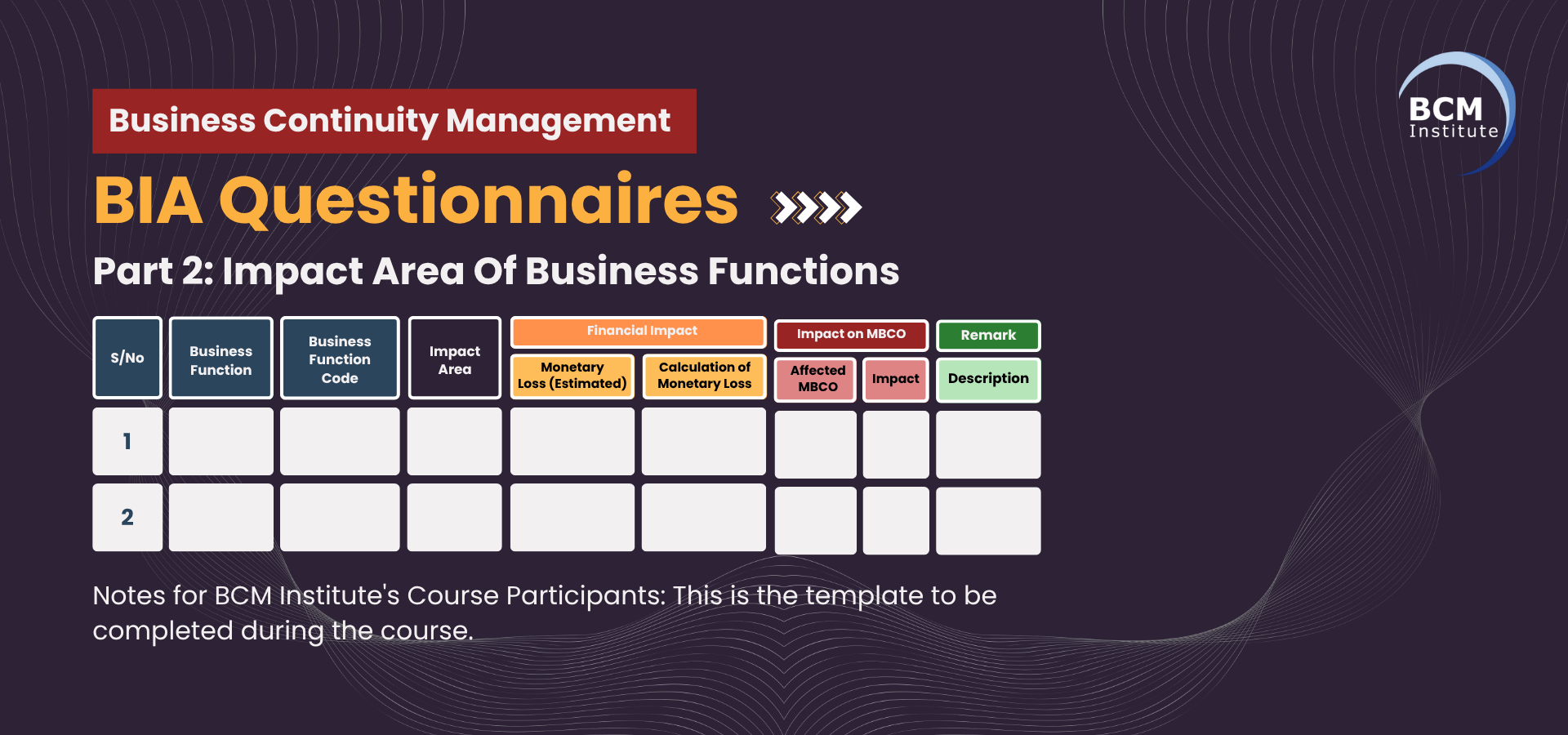
This chapter analyses the impact areas of each sub-critical business function (Sub-CBF) under CBF-4, estimates potential financial losses, and evaluates the effect on the Business Unit Minimum Business Continuity Objective (MBCO).
By understanding these impacts, MINDS can prioritise critical activities, allocate resources effectively, and implement risk mitigation strategies during disruptions
![Banner [Table] [BCM] [E3] [BIA] [P2] Impact Areas of Business Functions [BIAQ]](https://no-cache.hubspot.com/cta/default/3893111/91582408-03ad-40e1-90e8-43ce62079aa6.png)
Table P2: Impact Area Assessment for CBF-1
|
Sub-CBF Code |
Sub-CBF |
Impact Area |
Financial Impact – Monetary Loss (Estimated) |
Financial Impact – Calculation of Monetary Loss (State Formula for Calculations) |
Impact on MBCO – Affect MBCO |
Impact on MBCO – Impact |
Remarks – Description |
|
4.1 |
Special Education Delivery |
Client Education & Development, Regulatory Compliance |
SGD 50,000/day |
Number of affected students × daily programme cost per student |
Yes |
Delayed or interrupted learning outcomes |
Disruption leads to inability to deliver structured lessons, affecting client development and regulatory compliance. |
|
4.2 |
Individualised Learning Planning |
Personalised Education, Client Progress |
SGD 20,000/day |
Number of affected plans × average hourly cost of staff time |
Yes |
Learning plans not updated, regression in development |
Delays in updating or implementing plans may result in clients falling behind their learning objectives. |
|
4.3 |
Life Skills & Independent Living Training |
Client Wellbeing & Independence |
SGD 15,000/day |
Number of affected clients × cost per training session |
Yes |
Regression in life skills development |
Critical skills training for daily living is interrupted, affecting client independence and safety. |
|
4.4 |
Vocational Preparation & Work Exposure |
Client Employability, Community Integration |
SGD 10,000/day |
Number of clients in vocational programme × cost per session |
Yes |
Reduced vocational readiness |
Disruption may prevent clients from gaining work experience, delaying employability objectives. |
|
4.5 |
Allied Support Services Integration |
Health & Therapy, Client Development |
SGD 25,000/day |
Number of therapy sessions missed × average session cost |
Yes |
Critical health or therapy needs unmet |
Delay or cancellation of allied services can impact client health, physical development, and therapy outcomes. |
|
4.6 |
Special Student Care & Enrichment Activities |
Client Wellbeing, Social Development |
SGD 12,000/day |
Number of enrichment activities missed × average activity cost |
Yes |
Limited social interaction & mental health support |
Disruption affects clients’ social engagement and mental wellbeing. |
|
4.7 |
Assessment & Progress Monitoring |
Quality of Care, Compliance |
SGD 18,000/day |
Number of assessments delayed × staff cost per assessment |
Yes |
Reduced monitoring & delayed interventions |
Lack of timely progress monitoring affects personalised planning and quality assurance. |
|
4.8 |
Training Staff Capability & Development |
Staff Competence, Regulatory Compliance |
SGD 8,000/day |
Number of staff × daily training cost |
Yes |
Staff skills gap & compliance risk |
Disruption delays staff training, potentially impacting care standards and compliance obligations. |
|
4.9 |
Parent & Caregiver Engagement |
Stakeholder Communication, Client Support |
SGD 5,000/day |
Number of affected families × cost per communication intervention |
Yes |
Delayed communication & support |
Disruption in engagement reduces coordination with caregivers, affecting client support and safety. |
![Banner [BCM] [E3] [BIA] [Summing Up] [P2] Impact Areas of Business Functions [BIAQ]](https://no-cache.hubspot.com/cta/default/3893111/76188041-e1c9-43d9-8efa-e550f46ad04d.png)
Analysing the impact areas of CBF-4 highlights the critical nature of Health, Safety, and Safeguarding Management within MINDS.
Disruptions to any sub-critical business function can affect client safety, educational outcomes, staff performance, regulatory compliance, and organisational reputation.
By estimating financial losses and assessing effects on the MBCO, MINDS can prioritise resource allocation and implement mitigation strategies to maintain essential services.
This impact assessment ensures that during any operational disruption, high-priority services continue, risks are minimised, and the well-being of clients is safeguarded.
Implementing Business Continuity Management for MINDS: Ensuring Continuity of Care and Services |
||||||
| eBook 3: Starting Your BCM Implementation |
||||||
![[BCM] [MINDS] [E3] [BIA] MBCO Corporate MBCO](https://no-cache.hubspot.com/cta/default/3893111/47babf68-4665-40bc-8db7-f34c7a717f49.png) |
![[BCM] [MINDS] [E3] [BIA] [PS] Key Product and Services](https://no-cache.hubspot.com/cta/default/3893111/1d6fd982-7a1c-4245-a1f0-bdd7a3155cc7.png) |
![[BCM] [MINDS] [E3] [RAR] [T1] List of Threats](https://no-cache.hubspot.com/cta/default/3893111/3262c956-93e2-45d4-850e-fa4cb7fab302.png) |
![[BCM] [MINDS] [E3] [RAR] [T2] Treatment and Control](https://no-cache.hubspot.com/cta/default/3893111/32464d64-b115-41e7-98be-850950580336.png) |
![[BCM] [MINDS] [E3] [RAR] [T3] Risk Impact and Likelihood Assessment](https://no-cache.hubspot.com/cta/default/3893111/cf5354bd-6256-4a23-ac6d-14bacb075337.png) |
![BCM] [MINDS] [E3] [BCS] [T1] Mitigation Strategies and Justification](https://no-cache.hubspot.com/cta/default/3893111/0bada7ae-abc1-4a42-bcd7-35ea2895a4d7.png) |
![[BCM] [MINDS] [E1] [C10] Identifying Critical Business Functions](https://no-cache.hubspot.com/cta/default/3893111/cfa9c1eb-7960-4442-8ef7-3ae5faeb4c8b.png) |
| CBF-4 Health, Safety, and Safeguarding Management |
||||||
| DP | BIAQ T1 | BIAQ T2 | BIAQ T3 | BCS T2 | BCS T3 | PD |
![[BCM] [MINDS] [E3] [BIA] [DP] [CBF] [4] Health, Safety, and Safeguarding Management](https://no-cache.hubspot.com/cta/default/3893111/85dc1f61-c96a-4512-ba95-84bff34e075d.png) |
|
![[BCM] [MINDS] [E3] [BIA] [T2] [CBF] [4] Health, Safety, and Safeguarding Management](https://no-cache.hubspot.com/cta/default/3893111/7b789da1-ea13-49b6-b85a-fe1de0c3267d.png) |
![[BCM] [MINDS] [E3] [BIA] [T3] [CBF] [4] Health, Safety, and Safeguarding Management](https://no-cache.hubspot.com/cta/default/3893111/feec1a3e-0df4-44b2-8fc6-f5e0894fc348.png) |
![[BCM] [MINDS] [E3] [BCS] [T2] [CBF] [4] Health, Safety, and Safeguarding Management](https://no-cache.hubspot.com/cta/default/3893111/5c34dc86-4fab-422a-94ec-8c15991c766e.png) |
![[BCM] [MINDS] [E3] [BCS] [T3] [CBF] [4] Health, Safety, and Safeguarding Management](https://no-cache.hubspot.com/cta/default/3893111/83276c43-7a39-4048-87ce-28da1685684b.png) |
![[BCM] [MINDS] [E3] [PD] [CBF] [4] Health, Safety, and Safeguarding Management](https://no-cache.hubspot.com/cta/default/3893111/0a807d93-089f-41c7-85f3-a93c353a440b.png) |
More Information About Business Continuity Management Courses
To learn more about the course and schedule, click the buttons below for the BCM-300 Business Continuity Management Implementer [BCM-3] and the BCM-5000 Business Continuity Management Expert Implementer [BCM-5].


![Register [BL-B-3]*](https://no-cache.hubspot.com/cta/default/3893111/ac6cf073-4cdd-4541-91ed-889f731d5076.png)



![FAQ [BL-B-3]](https://no-cache.hubspot.com/cta/default/3893111/b3824ba1-7aa1-4eb6-bef8-94f57121c5ae.png)
![Email to Sales Team [BCM Institute]](https://no-cache.hubspot.com/cta/default/3893111/3c53daeb-2836-4843-b0e0-645baee2ab9e.png)


