



![Banner [BCM] [E3] [BIA] [P1] Identification of Business Functions](https://no-cache.hubspot.com/cta/default/3893111/206ddd7e-615a-42c8-aa2a-3416a1ad06b3.png)
CBF-3 Special Education, Training, and Development Programmes
![[BCM] [MINDS] [E3] [BIA] [T1] [CBF] [3] Special Education, Training, and Development Programmes](https://no-cache.hubspot.com/cta/default/3893111/a83ef742-9681-4bc3-a5f4-99c635fbcca6.png)
Special Education, Training, and Development Programmes form one of the core mission-critical functions of MINDS.
These programmes directly support persons with intellectual disabilities (PWIDs) across different life stages by providing structured education, skills development, vocational readiness, and holistic support services.
From a business continuity management (BCM) perspective, disruption to these programmes can have immediate and lasting developmental, behavioural, and psychosocial impacts on students and beneficiaries.
Therefore, it is essential to identify the Sub-Critical Business Functions (Sub-CBFs) and establish clear Business Unit Minimum Business Continuity Objectives (BU-MBCOs).
The BU-MBCO defines the minimum level of service that each responsible business unit must maintain during a disruption, ensuring that essential educational and developmental outcomes continue even under constrained conditions.
This differs from a corporate MBCO, which reflects organisation-wide priorities rather than service-level delivery needs.
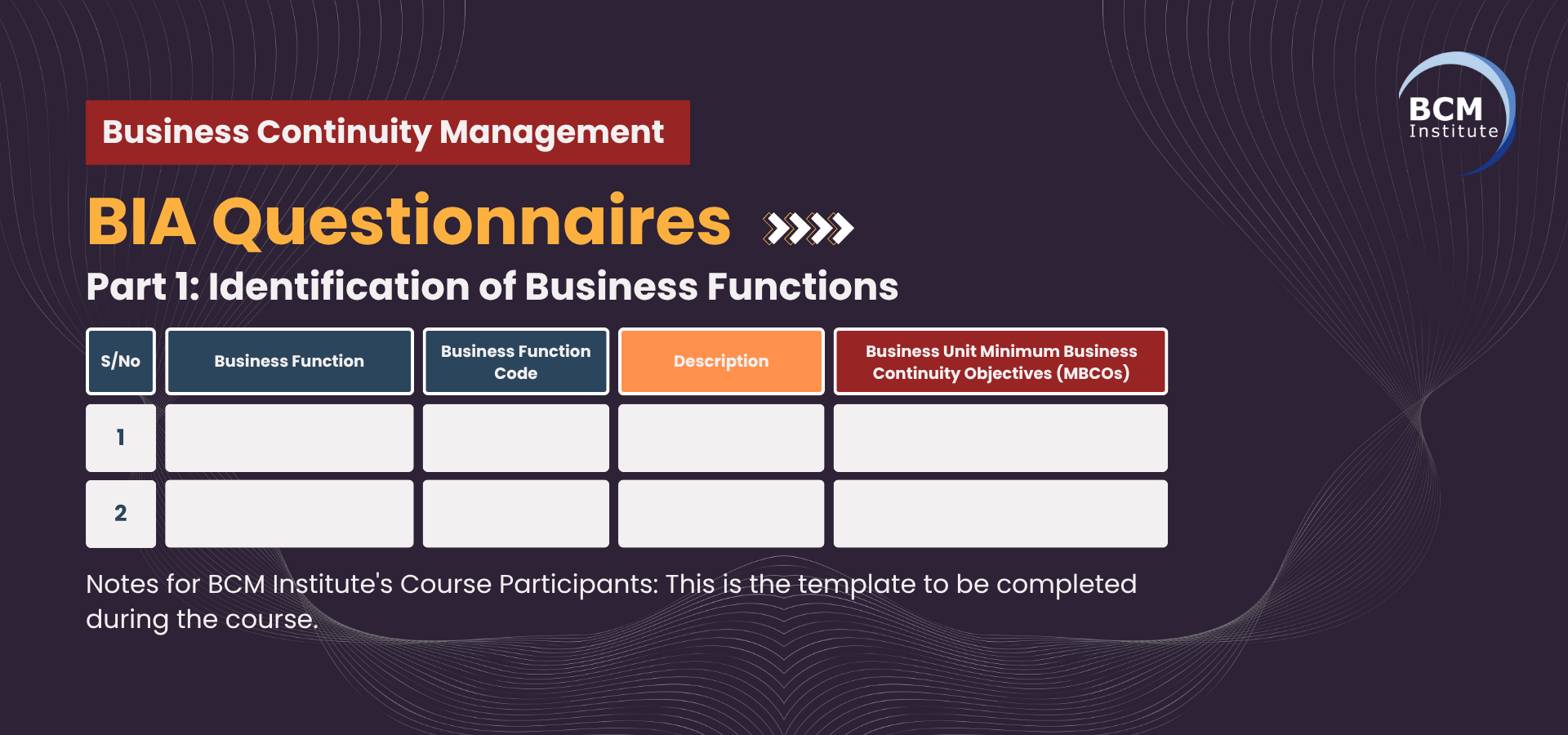
![Banner [Table] [BCM] [E3] [BIA] [P1] Identification of Critical Business Functions](https://no-cache.hubspot.com/cta/default/3893111/4fe499c9-0c19-46b4-8b6f-75450dba07d8.png)
Table P1: Critical Business Functions for CBF-3
|
Sub-CBF Code |
Sub-CBF |
Description of Process / Activity |
Examples (in MINDS context) |
|
3.1 |
Special Education Delivery |
Delivery of structured special education curricula aligned with MOE and MINDS frameworks, including classroom-based and adapted learning approaches for students with intellectual disabilities. |
Maintain essential instructional delivery for core learning subjects at a reduced class size or alternative mode (e.g. staggered sessions, simplified lesson plans) to ensure learning continuity. |
|
3.2 |
Individualised Learning Planning |
Development, review, and updating of Individualised Education Plans (IEPs) tailored to each student’s cognitive, behavioural, and functional needs. |
Ensure minimum review and validity of existing IEPs, prioritising students with high support needs; defer non-critical plan enhancements if required. |
|
3.3 |
Life Skills and Independent Living Training |
Training students in daily living skills such as self-care, communication, mobility, and basic community interaction. |
Continue critical life-skills training that supports safety, hygiene, and basic independence, even if enrichment elements are temporarily suspended. |
|
3.4 |
Vocational Preparation and Work Exposure |
Preparation of students for employment through vocational training, work simulations, internships, and supported employment pathways. |
Maintain core vocational readiness activities and essential workplace routines; postpone external attachments if access is restricted. |
|
3.5 |
Allied Support Services Integration |
Integration of services such as speech therapy, occupational therapy, physiotherapy, and psychological support into education programmes. |
Sustain priority therapeutic interventions for students with critical developmental or behavioural needs; non-urgent sessions may be rescheduled. |
|
3.6 |
Special Student Care and Enrichment Activities |
Provision of care routines, social interaction, recreational activities, and enrichment programmes that support emotional well-being. |
Ensure basic care, supervision, and emotional support, while scaling down non-essential enrichment activities during disruptions. |
|
3.7 |
Assessment & Progress Monitoring |
Ongoing assessment of student development, learning outcomes, and functional progress using formal and informal tools. |
Maintain minimum monitoring and documentation required to identify regression or critical issues; comprehensive assessments may be deferred. |
|
3.8 |
Training Staff Capability & Development |
Training and professional development of special education teachers, instructors, and support staff to maintain service quality. |
Ensure essential staff competency and cross-skilling to support continuity; suspend non-essential training programmes temporarily. |
|
3.9 |
Parent and Caregiver Engagement |
Engagement with parents and caregivers through communication, counselling, training, and progress updates. |
Maintain regular critical communication channels with parents/caregivers to manage expectations, safety, and student well-being. |
![Banner [BCM] [E3] [BIA] [Summing Up] [P1] Identification of Critical Business Functions](https://no-cache.hubspot.com/cta/default/3893111/22330ab3-0a0f-4efd-9da7-43032e1e6573.png)
CBF-3 Special Education, Training, and Development Programmes represent a high-impact and time-sensitive critical business function for MINDS.
The Sub-CBFs identified above collectively ensure that students continue to receive safe, meaningful, and developmentally appropriate support, even during disruptive events.
By defining Business Unit Minimum Business Continuity Objectives (BU-MBCOs) for each Sub-CBF, MINDS can strike a balance between service resilience and operational practicality, ensuring that essential educational and developmental outcomes are protected while allowing flexibility in non-critical areas.
This structured identification provides a strong foundation for subsequent BCM phases, including impact analysis, recovery prioritisation, and continuity strategy development, in alignment with recognised BCM planning methodologies.
![Banner [BCM] [E3] [BIA] [P2] Impact Area of Business Functions](https://no-cache.hubspot.com/cta/default/3893111/182e67c2-aa89-4b0b-b3e9-144293680ea4.png)
CBF-3 Special Education, Training, and Development Programmes
The critical business function CBF-3: Special Education, Training, and Development Programmes forms the cornerstone of MINDS’ mission to empower individuals with intellectual disabilities.
This function encompasses a range of specialised services designed to address the educational, vocational, life skills, and social development needs of students.
By delivering personalised learning programmes, vocational preparation, allied support services, and engagement with parents and caregivers, MINDS ensures holistic development and maximises student potential.
Understanding the impact areas of this business function is crucial for effective Business Continuity Management (BCM).
Disruptions in any of the sub-functions can have significant operational, financial, and reputational consequences, directly affecting students’ progress, staff productivity, and stakeholder confidence.
This chapter identifies and analyses the sub-critical business functions (Sub-CBFs) of CBF-3, assessing their potential financial impact, effect on mission-critical business continuity objectives (MBCO), and operational significance.
By systematically examining these impact areas, MINDS can prioritise risk mitigation strategies, allocate resources effectively, and ensure uninterrupted delivery of essential educational and developmental services.
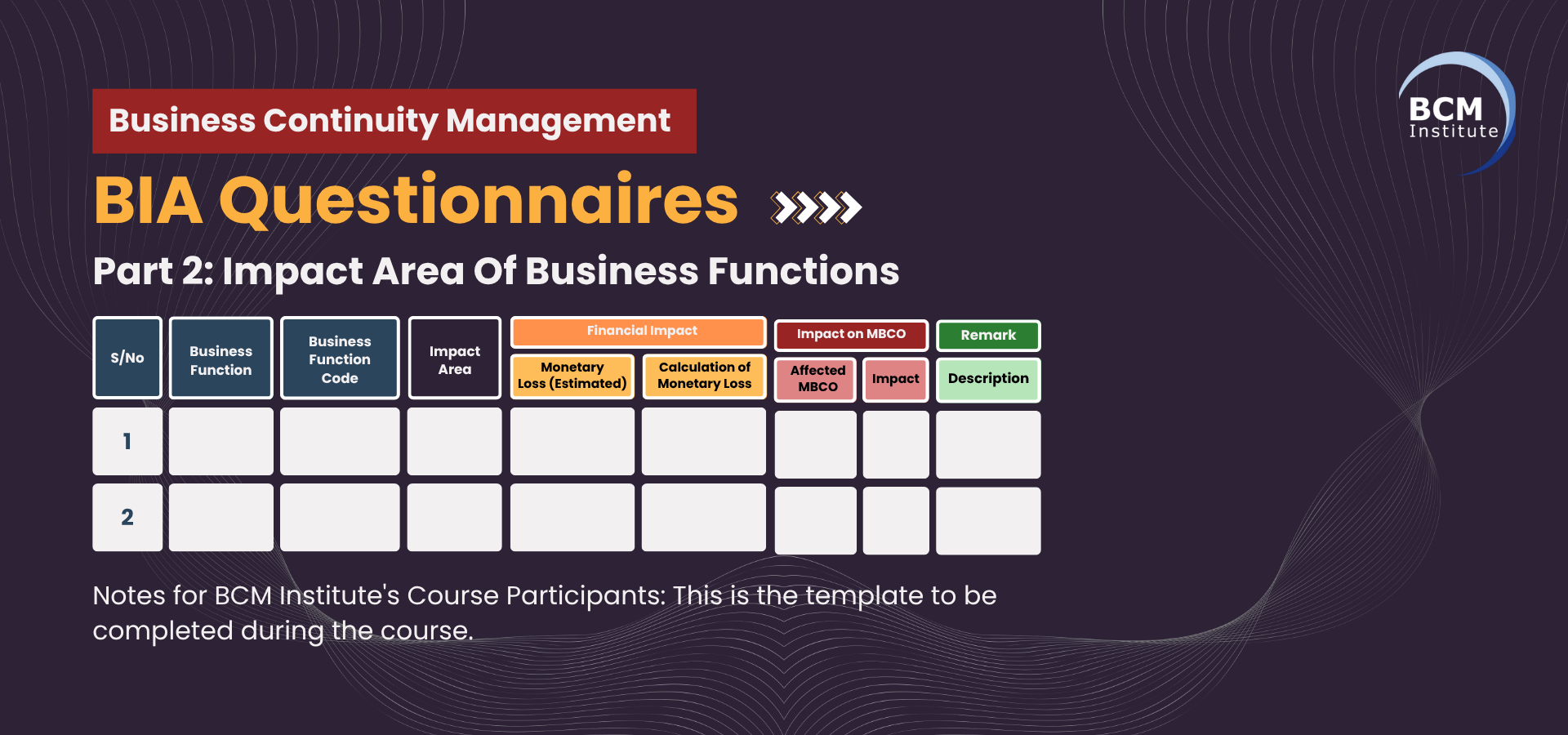
![Banner [Table] [BCM] [E3] [BIA] [P2] Impact Areas of Business Functions [BIAQ]](https://no-cache.hubspot.com/cta/default/3893111/91582408-03ad-40e1-90e8-43ce62079aa6.png)
Table P2: Impact Area Assessment for CBF-3
|
Sub-CBF Code |
Sub-CBF |
Impact Area |
Financial Impact – Monetary Loss (Estimated) |
Financial Impact – Calculation of Monetary Loss (State Formula for Calculations) |
Impact on MBCO – Affect MBCO |
Impact on MBCO – Impact |
Remarks – Description |
|
3.1 |
Special Education Delivery |
Service Delivery |
Medium-High |
Loss of tuition/fees per student × number of affected students × duration of disruption |
Yes |
Delay in educational programmes, reduced student satisfaction |
Disruption in delivering core curriculum to students with intellectual disabilities |
|
3.2 |
Individualised Learning Planning |
Operational |
Medium |
Cost to reassign staff × hours lost × hourly rate |
Yes |
Learning plans not implemented, affects student progress |
Planning tailored programmes for each student; delays affect outcomes |
|
3.3 |
Life Skills and Independent Living Training |
Service Delivery |
Medium |
Loss of programme fees × number of students × programme sessions missed |
Yes |
Students unable to acquire key life skills, impacting independence |
Includes daily living, hygiene, social skills training |
|
3.4 |
Vocational Preparation and Work Exposure |
Service Delivery / Reputational |
Medium-High |
Loss of grants/funding + potential fines or penalties for missed milestones |
Funding × % of programme incomplete + penalties |
Yes |
Students miss vocational placements; potential reputational risk with employers |
|
3.5 |
Allied Support Services Integration |
Operational |
High |
Cost of outsourced allied services × duration of disruption |
Yes |
Key allied services like OT, PT, speech therapy unavailable |
Integration of therapies essential for student development |
|
3.6 |
Special Student Care and Enrichment Activities |
Service Delivery |
Medium |
Programme cost × students × sessions missed |
Yes |
Reduced engagement, student satisfaction drops |
Includes extracurricular, enrichment, and recreational activities |
|
3.7 |
Assessment & Progress Monitoring |
Compliance / Operational |
High |
Penalty costs for missed reporting + staff reallocation cost |
Penalty/fine + (staff hours × hourly rate) |
Yes |
Delays in assessments affect learning plans and funding compliance |
|
3.8 |
Training Staff Capability & Development |
Human Resource / Operational |
Medium |
Training budget × duration of cancelled sessions |
Training cost × number of staff × missed sessions |
Yes |
Staff skills stagnate, affecting teaching quality |
|
3.9 |
Parent and Caregiver Engagement |
Reputational / Service Delivery |
Medium |
Cost of compensatory sessions × number of families affected |
Session cost × number of families × sessions missed |
Yes |
Poor communication affects trust and cooperation with families |
![Banner [BCM] [E3] [BIA] [Summing Up] [P2] Impact Areas of Business Functions [BIAQ]](https://no-cache.hubspot.com/cta/default/3893111/76188041-e1c9-43d9-8efa-e550f46ad04d.png)
The analysis of CBF-3 highlights the interdependent nature of special education, training, and development programmes and underscores their criticality to MINDS’ overall mission.
Each Sub-CBF, from personalised learning planning to parent engagement and staff development, plays a vital role in ensuring students receive comprehensive support tailored to their needs.
Disruptions to these functions carry not only financial implications but also operational, compliance, and reputational risks that could affect the continuity of service delivery and student outcomes.
Recognising the potential impact areas enables MINDS to implement robust business continuity strategies, safeguard critical services, and maintain stakeholder confidence.
Ultimately, a thorough understanding of the impact areas of CBF-3 equips MINDS to maintain resilience, ensuring that students continue to receive high-quality education and development support even in the face of operational challenges.
Implementing Business Continuity Management for MINDS: Ensuring Continuity of Care and Services |
||||||
| eBook 3: Starting Your BCM Implementation |
||||||
![[BCM] [MINDS] [E3] [BIA] MBCO Corporate MBCO](https://no-cache.hubspot.com/cta/default/3893111/47babf68-4665-40bc-8db7-f34c7a717f49.png) |
![[BCM] [MINDS] [E3] [BIA] [PS] Key Product and Services](https://no-cache.hubspot.com/cta/default/3893111/1d6fd982-7a1c-4245-a1f0-bdd7a3155cc7.png) |
![[BCM] [MINDS] [E3] [RAR] [T1] List of Threats](https://no-cache.hubspot.com/cta/default/3893111/3262c956-93e2-45d4-850e-fa4cb7fab302.png) |
![[BCM] [MINDS] [E3] [RAR] [T2] Treatment and Control](https://no-cache.hubspot.com/cta/default/3893111/32464d64-b115-41e7-98be-850950580336.png) |
![[BCM] [MINDS] [E3] [RAR] [T3] Risk Impact and Likelihood Assessment](https://no-cache.hubspot.com/cta/default/3893111/cf5354bd-6256-4a23-ac6d-14bacb075337.png) |
![BCM] [MINDS] [E3] [BCS] [T1] Mitigation Strategies and Justification](https://no-cache.hubspot.com/cta/default/3893111/0bada7ae-abc1-4a42-bcd7-35ea2895a4d7.png) |
![[BCM] [MINDS] [E1] [C10] Identifying Critical Business Functions](https://no-cache.hubspot.com/cta/default/3893111/cfa9c1eb-7960-4442-8ef7-3ae5faeb4c8b.png) |
| CBF-3 Special Education, Training, and Development Programmes |
||||||
| DP | BIAQ T1 | BIAQ T2 | BIAQ T3 | BCS T2 | BCS T3 | PD |
![[BCM] [MINDS] [E3] [BIA] [DP] [CBF] [3] Special Education, Training, and Development Programmes](https://no-cache.hubspot.com/cta/default/3893111/8e8b48b5-a558-4e6c-ad2e-a04dd8d7378b.png) |
|
![[BCM] [MINDS] [E3] [BIA] [T2] [CBF] [3] Special Education, Training, and Development Programmes](https://no-cache.hubspot.com/cta/default/3893111/0479d9c8-dd2d-46d6-9fa8-ea352d57d17d.png) |
![[BCM] [MINDS] [E3] [BIA] [T3] [CBF] [3] Special Education, Training, and Development Programmes](https://no-cache.hubspot.com/cta/default/3893111/c0e75c6c-f779-4e99-a590-333f1671de05.png) |
![[BCM] [MINDS] [E3] [BCS] [T2] [CBF] [3] Special Education, Training, and Development Programmes](https://no-cache.hubspot.com/cta/default/3893111/a5a8c929-b6f9-4211-8010-f9e998f65cfd.png) |
![[BCM] [MINDS] [E3] [BCS] [T3] [CBF] [3] Special Education, Training, and Development Programmes](https://no-cache.hubspot.com/cta/default/3893111/34c08859-ae14-4af8-b2bb-245c5235055f.png) |
![[BCM] [MINDS] [E3] [PD] [CBF] [3] Special Education, Training, and Development Programmes](https://no-cache.hubspot.com/cta/default/3893111/ddebbdec-874e-4605-9038-318ec6db0ca5.png) |
More Information About Business Continuity Management Courses
To learn more about the course and schedule, click the buttons below for the BCM-300 Business Continuity Management Implementer [BCM-3] and the BCM-5000 Business Continuity Management Expert Implementer [BCM-5].


![Register [BL-B-3]*](https://no-cache.hubspot.com/cta/default/3893111/ac6cf073-4cdd-4541-91ed-889f731d5076.png)



![FAQ [BL-B-3]](https://no-cache.hubspot.com/cta/default/3893111/b3824ba1-7aa1-4eb6-bef8-94f57121c5ae.png)
![Email to Sales Team [BCM Institute]](https://no-cache.hubspot.com/cta/default/3893111/3c53daeb-2836-4843-b0e0-645baee2ab9e.png)


