



![Banner [BCM] [E3] [BIA] [P1] Identification of Business Functions](https://no-cache.hubspot.com/cta/default/3893111/206ddd7e-615a-42c8-aa2a-3416a1ad06b3.png)
CBF-2 Residential and Community Living Services
![[BCM] [MINDS] [E3] [BIA] [T1] [CBF] [2] Residential and Community Living Services](https://no-cache.hubspot.com/cta/default/3893111/eb7dc055-0650-4b9b-b3bb-475ea0381ff6.png)
Residential and Community Living Services form a core pillar of MINDS’ mission to support persons with intellectual disabilities (PWIDs) to live with dignity, safety, and inclusion.
These services ensure that residents’ essential daily living, health, safety, and social integration needs are consistently met across residential homes, community-based facilities, and home-based support settings.
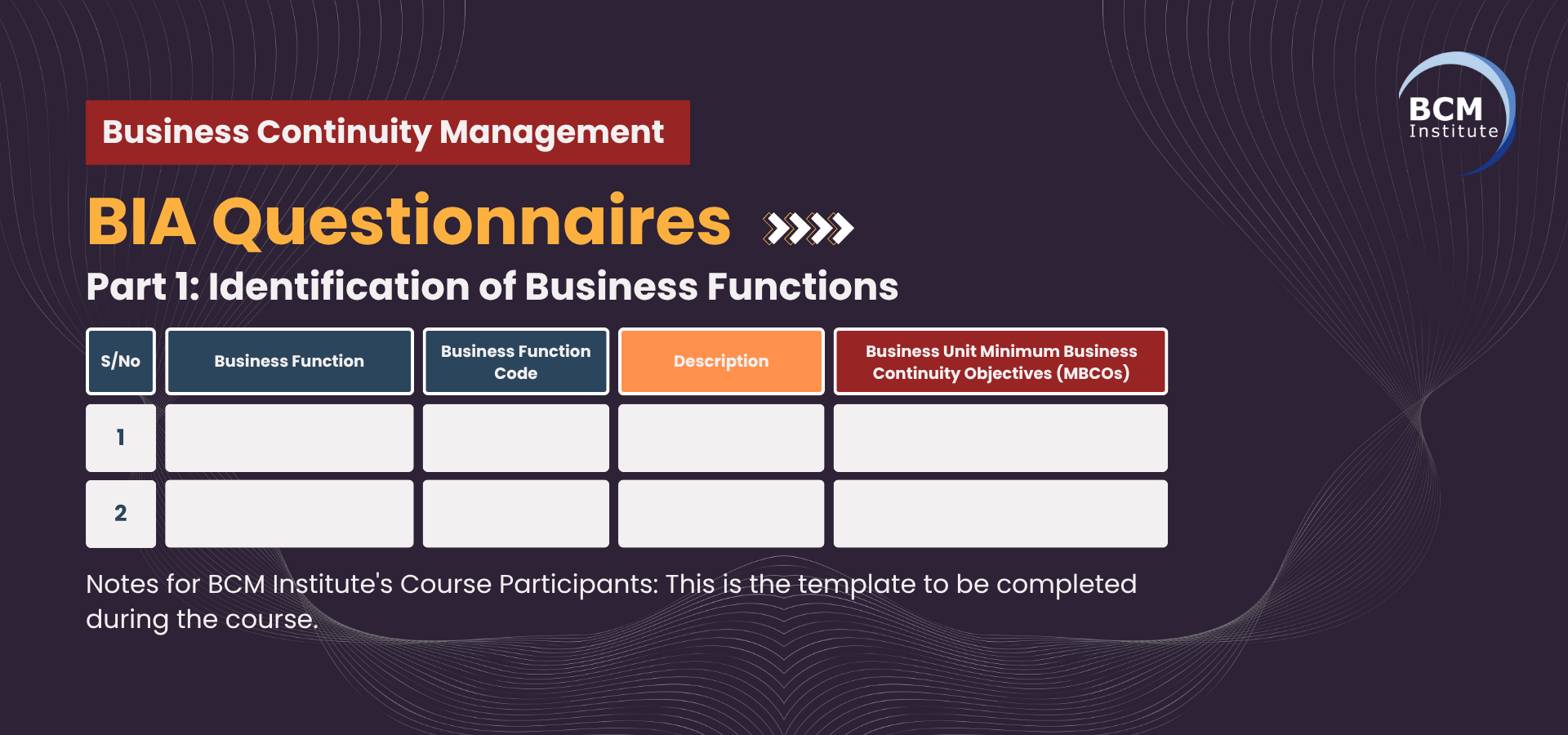
This chapter identifies Critical Business Function 2 (CBF-2): Residential and Community Living Services, and its associated Sub-Critical Business Functions (Sub-CBFs).
Each Sub-CBF is assessed with a Business Unit Minimum Business Continuity Objective (BU MBCO), which defines the minimum level of service that must be maintained during a disruption to prevent unacceptable impact to residents’ well-being, regulatory compliance, and MINDS’ organisational reputation.
![Banner [Table] [BCM] [E3] [BIA] [P1] Identification of Critical Business Functions](https://no-cache.hubspot.com/cta/default/3893111/4fe499c9-0c19-46b4-8b6f-75450dba07d8.png)
Table P1: Critical Business Functions for CBF-2
|
Sub-CBF Code |
Sub-CBF |
Description of Process / Activity |
Examples (in MINDS context) |
|
2.1 |
Residential Admission & Intake |
Manages referral processing, eligibility assessment, placement decisions, and onboarding of residents into residential or community living programmes. |
Admission activities may be deferred, but critical intake for high-risk or urgent cases must continue at a reduced capacity to ensure resident safety and compliance with regulatory requirements. |
|
2.2 |
Accommodation & Daily Care |
Provides safe housing, meals, hygiene support, mobility assistance, and supervision for residents on a daily basis. |
Essential accommodation, meals, hygiene, and supervision must be sustained continuously, even at reduced service levels, to safeguard residents’ basic living needs. |
|
2.3 |
Health & Allied Health Services |
Coordinates medical care, medication administration, therapy services, and referrals to healthcare providers. |
Life-sustaining medical support, medication administration, and urgent health interventions must be maintained without interruption; non-critical therapies may be temporarily scaled down. |
|
2.4 |
Safety, Security & Emergency Preparedness |
Ensures resident safety through access control, incident response, emergency evacuation, and crisis management. |
Safety monitoring, emergency response, and incident management must operate at all times to prevent harm to residents, staff, and visitors. |
|
2.5 |
Staffing & Workforce Management |
Oversees staff deployment, rostering, relief staffing, and staff welfare to support residential and community services. |
Minimum safe staffing levels must be maintained to ensure continuity of care, even if non-essential administrative functions are temporarily suspended. |
|
2.6 |
Community Integration & Day Programmes |
Facilitates social inclusion, skills development, and structured daytime activities within the community. |
Core engagement activities may be reduced or modified, but basic psychosocial support and structured routines should continue where feasible. |
|
2.7 |
Family & Caregiver Engagement |
Maintains communication, coordination, and support for families and caregivers of residents. |
Regular communication with families must be sustained, with priority given to updates related to resident safety, health, and service changes. |
|
2.8 |
Home-Based Support Continuity |
Provides support services for residents living at home, including care guidance, monitoring, and crisis support. |
Essential support for high-dependency and vulnerable clients must continue, while non-urgent visits or activities may be deferred. |
|
2.9 |
Community Hub Partnership & Outreach |
Manages collaboration with community partners, volunteers, and external agencies to support residents’ inclusion and care continuity. |
Key partnerships required for resident safety and care continuity must remain active; outreach activities may be scaled down during disruptions. |
![Banner [BCM] [E3] [BIA] [Summing Up] [P1] Identification of Critical Business Functions](https://no-cache.hubspot.com/cta/default/3893111/22330ab3-0a0f-4efd-9da7-43032e1e6573.png)
The identification of CBF-2 Residential and Community Living Services highlights the essential functions required to protect the safety, health, and dignity of persons with intellectual disabilities under MINDS’ care.
By defining clear Sub-CBFs and corresponding Business Unit Minimum Business Continuity Objectives (BU MBCOs), MINDS establishes a structured foundation for resilience planning that prioritises life-sustaining services while allowing flexibility to scale non-critical activities during disruptions.
This structured identification enables subsequent Business Impact Analysis and continuity strategy development to be aligned with real operational priorities, ensuring that even in adverse situations, MINDS can continue to deliver compassionate, safe, and inclusive care to its residents and the wider community.
![Banner [BCM] [E3] [BIA] [P2] Impact Area of Business Functions](https://no-cache.hubspot.com/cta/default/3893111/182e67c2-aa89-4b0b-b3e9-144293680ea4.png)
CBF-2 Residential and Community Living Services
Residential and Community Living Services are mission-critical to MINDS as they directly support the safety, health, dignity, and quality of life of persons with intellectual disabilities (PWIDs).
Any disruption to these services may result in immediate harm to residents, regulatory non-compliance, reputational damage, and financial consequences for the organisation.
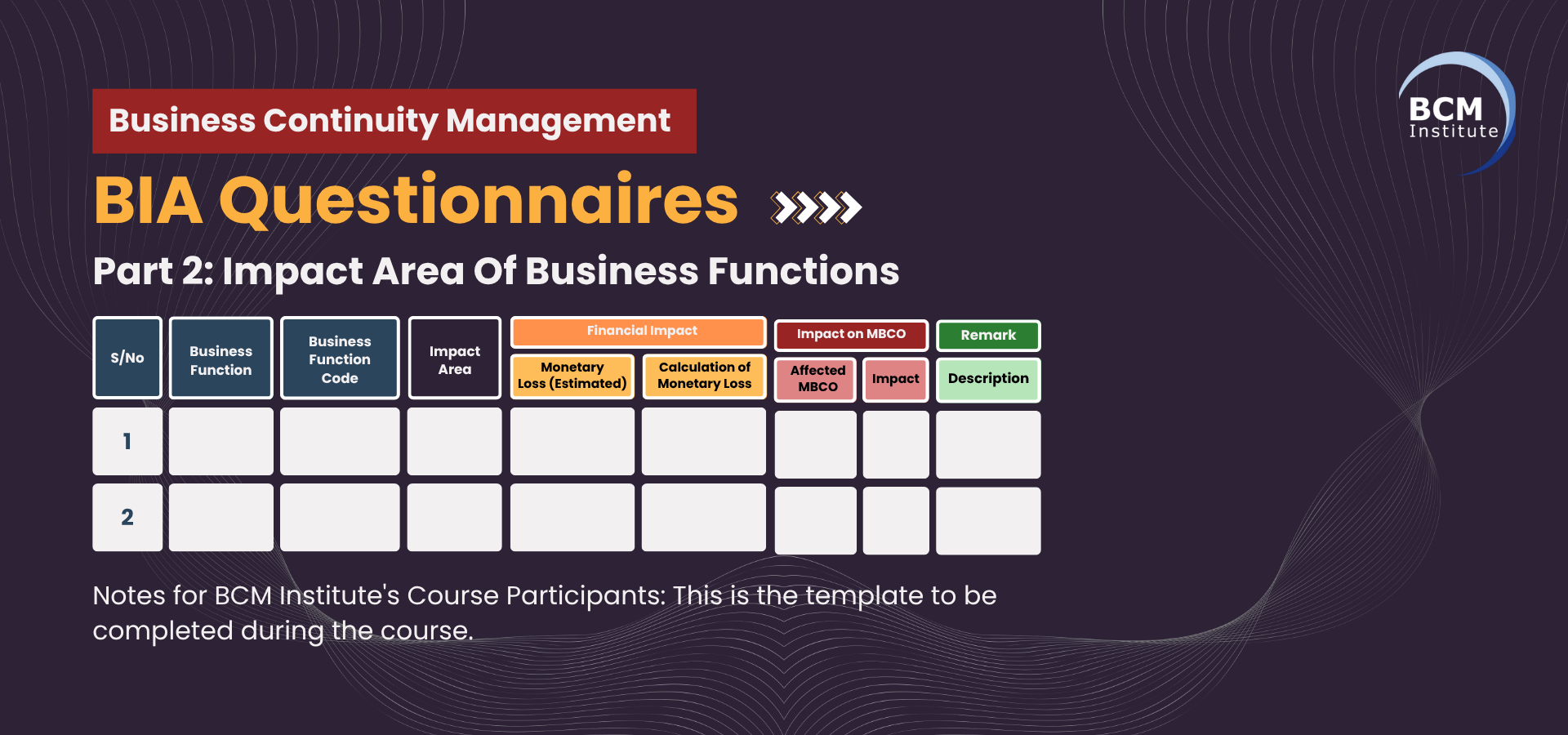
This chapter analyses the impact areas of CBF-2 Residential and Community Living Services by breaking the function into detailed Sub-Critical Business Functions (Sub-CBFs).
Each Sub-CBF is assessed across financial and non-financial impact areas, with particular emphasis on how disruptions affect the Business Unit Minimum Business Continuity Objective (BU MBCO). The analysis provides a structured foundation for prioritising recovery strategies and continuity planning.
![Banner [Table] [BCM] [E3] [BIA] [P2] Impact Areas of Business Functions [BIAQ]](https://no-cache.hubspot.com/cta/default/3893111/91582408-03ad-40e1-90e8-43ce62079aa6.png)
Table P2: Impact Area Assessment for CBF-1
|
Sub-CBF Code |
Sub-CBF |
Impact Area |
Financial Impact – Monetary Loss (Estimated) |
Financial Impact – Calculation of Monetary Loss (State Formula for Calculations) |
Impact on MBCO – Affect MBCO |
Impact on MBCO – Impact |
Remarks – Description |
|
2.1 |
Residential Admission & Intake |
Regulatory, Reputational, Service Delivery |
Low to Medium |
(Delayed admissions × average daily subsidy per resident) |
Moderate |
Delay in meeting minimum service commitments |
Non-urgent admissions may be deferred, but prolonged delays may affect funding utilisation and stakeholder confidence. |
|
2.2 |
Accommodation & Daily Care |
Life, Safety, Service Delivery, Legal |
High |
(Number of residents × daily operating cost × downtime days) |
Severe |
Immediate breach of MBCO |
Disruption directly affects residents’ basic needs such as shelter, meals, hygiene, and supervision. |
|
2.3 |
Health & Allied Health Services |
Life, Safety, Legal, Reputational |
High |
(Emergency medical costs + penalties + additional staffing costs) |
Severe |
Critical MBCO breach |
Failure may lead to medical emergencies, injury, or loss of life, with serious legal and reputational consequences. |
|
2.4 |
Safety, Security & Emergency Preparedness |
Life, Safety, Legal, Reputational |
High |
(Incident response cost + liability claims + asset damage) |
Severe |
Immediate and unacceptable impact |
Any lapse may result in injury, abuse, or uncontrolled emergencies within residential facilities. |
|
2.5 |
Staffing & Workforce Management |
Service Delivery, Legal, Financial |
Medium to High |
(Overtime + agency staff costs + productivity loss) |
High |
MBCO at risk |
Inadequate staffing affects supervision, care quality, and compliance with mandated staff-to-resident ratios. |
|
2.6 |
Community Integration & Day Programmes |
Reputational, Psychosocial, Service Delivery |
Low to Medium |
(Programme cancellation cost + unused funding) |
Low to Moderate |
Manageable within MBCO |
Activities can be scaled down, but prolonged disruption impacts residents’ mental well-being and inclusion goals. |
|
2.7 |
Family & Caregiver Engagement |
Reputational, Stakeholder Confidence |
Low |
(Additional communication resources + complaint handling costs) |
Low |
Minimal direct MBCO impact |
Poor communication increases complaints and erodes trust, especially during incidents or disruptions. |
|
2.8 |
Home-Based Support Continuity |
Life, Safety, Service Delivery |
Medium |
(Emergency interventions + travel and manpower cost) |
High |
Significant MBCO impact |
Vulnerable clients may deteriorate rapidly without timely support, increasing crisis interventions. |
|
2.9 |
Community Hub Partnership & Outreach |
Reputational, Operational, Service Dependency |
Low to Medium |
(Replacement service cost + coordination overheads) |
Moderate |
Indirect impact on MBCO |
Loss of partner support affects service capacity and community-based care continuity. |
![Banner [BCM] [E3] [BIA] [Summing Up] [P2] Impact Areas of Business Functions [BIAQ]](https://no-cache.hubspot.com/cta/default/3893111/76188041-e1c9-43d9-8efa-e550f46ad04d.png)
The impact analysis of CBF-2 Residential and Community Living Services demonstrates that disruptions to core care, health, safety, and staffing functions carry high to severe consequences, particularly in the areas of life safety, legal compliance, and reputational trust.
Sub-CBFs such as Accommodation & Daily Care, Health & Allied Health Services, and Safety, Security & Emergency Preparedness are directly tied to the BU MBCO and must be prioritised for immediate recovery.
By clearly identifying impact areas and linking them to financial implications and MBCO thresholds, MINDS is better positioned to make informed decisions on recovery timeframes, resource allocation, and continuity strategies.
This structured assessment supports the next phases of Business Continuity Management, ensuring that MINDS can continue to protect its residents and uphold its social mission even during disruptive events.
Implementing Business Continuity Management for MINDS: Ensuring Continuity of Care and Services |
||||||
| eBook 3: Starting Your BCM Implementation |
||||||
![[BCM] [MINDS] [E3] [BIA] MBCO Corporate MBCO](https://no-cache.hubspot.com/cta/default/3893111/47babf68-4665-40bc-8db7-f34c7a717f49.png) |
![[BCM] [MINDS] [E3] [BIA] [PS] Key Product and Services](https://no-cache.hubspot.com/cta/default/3893111/1d6fd982-7a1c-4245-a1f0-bdd7a3155cc7.png) |
![[BCM] [MINDS] [E3] [RAR] [T1] List of Threats](https://no-cache.hubspot.com/cta/default/3893111/3262c956-93e2-45d4-850e-fa4cb7fab302.png) |
![[BCM] [MINDS] [E3] [RAR] [T2] Treatment and Control](https://no-cache.hubspot.com/cta/default/3893111/32464d64-b115-41e7-98be-850950580336.png) |
![[BCM] [MINDS] [E3] [RAR] [T3] Risk Impact and Likelihood Assessment](https://no-cache.hubspot.com/cta/default/3893111/cf5354bd-6256-4a23-ac6d-14bacb075337.png) |
![BCM] [MINDS] [E3] [BCS] [T1] Mitigation Strategies and Justification](https://no-cache.hubspot.com/cta/default/3893111/0bada7ae-abc1-4a42-bcd7-35ea2895a4d7.png) |
![[BCM] [MINDS] [E1] [C10] Identifying Critical Business Functions](https://no-cache.hubspot.com/cta/default/3893111/cfa9c1eb-7960-4442-8ef7-3ae5faeb4c8b.png) |
| CBF-1 Client Care and Support Services |
||||||
| DP | BIAQ T1 | BIAQ T2 | BIAQ T3 | BCS T2 | BCS T3 | PD |
![[BCM] [MINDS] [E3] [BIA] [DP] [CBF] [2] Residential and Community Living Services](https://no-cache.hubspot.com/cta/default/3893111/8d1ece79-63a0-4c58-9af2-9c41f70c96bc.png) |
|
![[BCM] [MINDS] [E3] [BIA] [T2] [CBF] [2] Residential and Community Living Services](https://no-cache.hubspot.com/cta/default/3893111/cda64d6f-899e-46f5-b504-92139884d87a.png) |
![[BCM] [MINDS] [E3] [BIA] [T3] [CBF] [2] Residential and Community Living Services](https://no-cache.hubspot.com/cta/default/3893111/21b15d91-d4d8-4cac-bcf4-03b17602f924.png) |
![[BCM] [MINDS] [E3] [BCS] [T2] [CBF] [2] Residential and Community Living Services](https://no-cache.hubspot.com/cta/default/3893111/554e6190-68f5-4bc5-b7b1-37c04d106b7b.png) |
![[BCM] [MINDS] [E3] [BCS] [T3] [CBF] [2] Residential and Community Living Services](https://no-cache.hubspot.com/cta/default/3893111/15505492-dd0d-48c8-b499-53c30ea49bac.png) |
![[BCM] [MINDS] [E3] [PD] [CBF] [2] Residential and Community Living Services](https://no-cache.hubspot.com/cta/default/3893111/1aa1440c-5054-4be5-97ae-b828f86709a2.png) |
More Information About Business Continuity Management Courses
To learn more about the course and schedule, click the buttons below for the BCM-300 Business Continuity Management Implementer [BCM-3] and the BCM-5000 Business Continuity Management Expert Implementer [BCM-5].


![Register [BL-B-3]*](https://no-cache.hubspot.com/cta/default/3893111/ac6cf073-4cdd-4541-91ed-889f731d5076.png)



![FAQ [BL-B-3]](https://no-cache.hubspot.com/cta/default/3893111/b3824ba1-7aa1-4eb6-bef8-94f57121c5ae.png)
![Email to Sales Team [BCM Institute]](https://no-cache.hubspot.com/cta/default/3893111/3c53daeb-2836-4843-b0e0-645baee2ab9e.png)


