



![Banner [BCM] [E3] [BIA] [P5] Inter-dependencies](https://no-cache.hubspot.com/cta/default/3893111/c7d00b8b-77c0-43ee-a2cf-76ea43b26fe8.png)
CBF-6 Workforce Management and Staff Deployment
![[BCM] [MINDS] [E3] [BIA] [T3] [CBF] [6] Workforce Management and Staff Deployment](https://no-cache.hubspot.com/cta/default/3893111/f37a8618-5208-44c5-8e3e-36fd9190d4cd.png)
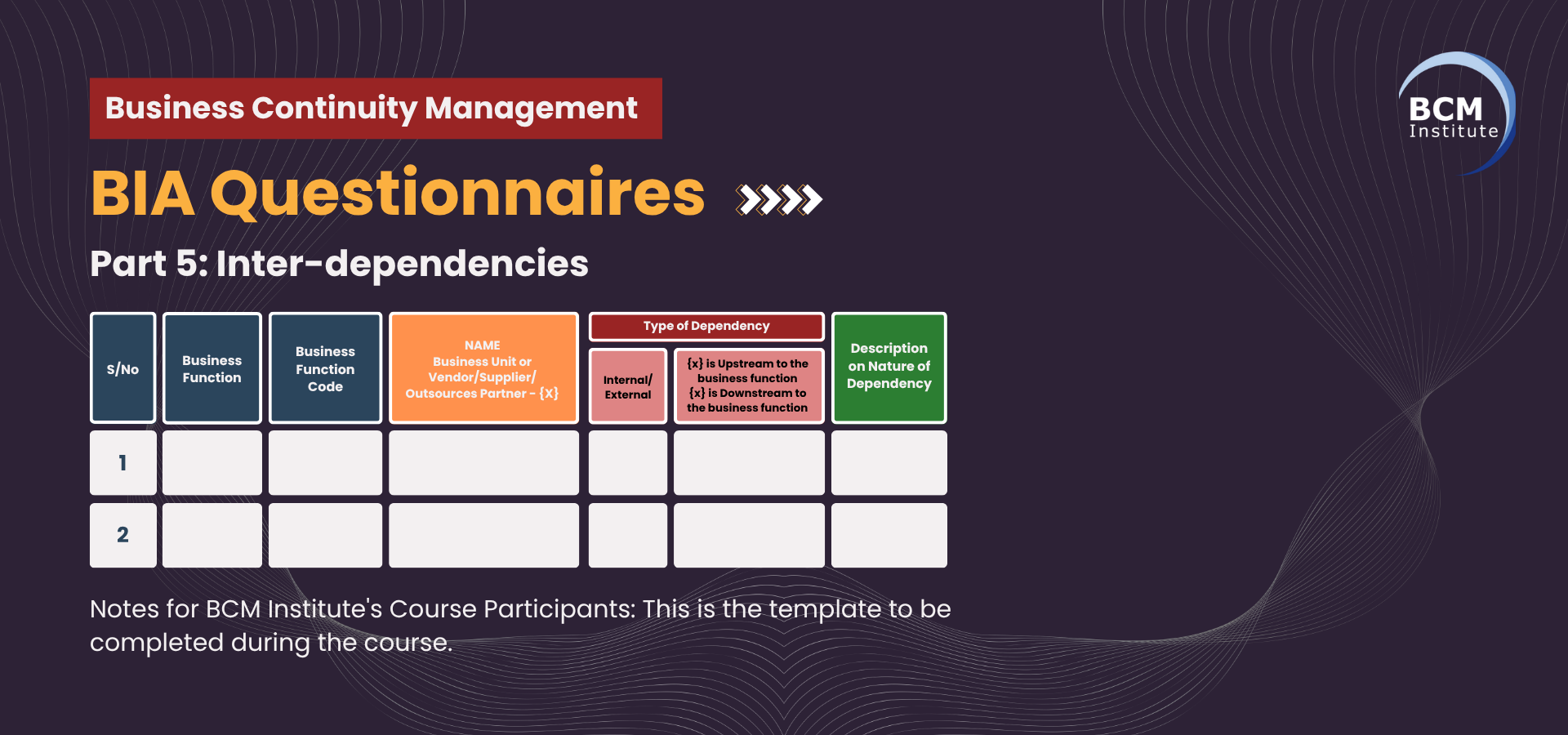
This chapter examines the inter-dependencies associated with CBF-6: Workforce Management and Staff Deployment, which underpins MINDS’ ability to deliver continuous, safe, and quality services to persons with intellectual disabilities.
The effectiveness of this critical business function is highly dependent on coordinated interactions between internal departments, external partners, regulatory bodies, and support service providers.
Workforce-related activities—such as planning, recruitment, training, deployment, and staff well-being—are not standalone processes.
They rely on upstream inputs, including organisational strategy, regulatory requirements, and operational demand forecasts, while simultaneously serving as downstream enablers of programme delivery, care services, and organisational resilience.
In addition, several workforce processes exhibit mutual dependencies, where feedback loops between HR functions and service operations are essential to sustain workforce capability and morale.
Understanding these inter-dependencies is critical for Business Continuity Management (BCM), as disruptions to workforce availability, competency, or engagement can have immediate and cascading impacts on MINDS’ service continuity, regulatory compliance, and stakeholder confidence.
This analysis supports the identification of single points of failure and informs the development of appropriate continuity and recovery strategies.
![Banner [Table] [BCM] [E3] [BIA] [P5] Inter-dependencies [BIAQ]](https://no-cache.hubspot.com/cta/default/3893111/ed6152ff-4926-4fae-bd6b-ba572bcc781b.png)
Table P5: Inter‑dependencies for CBF-6
|
Sub-CBF Code |
Sub-CBF |
Name of Business Unit or Vendor / Supplier / Outsource Partner |
Type of Dependency – Internal |
Type of Dependency – External |
Dependency Direction (Upstream / Downstream / Mutual) |
Description of Nature of Dependency |
|
6.1 |
Workforce Planning & Forecasting |
HR Department; Programme Operations |
✔ |
– |
Upstream |
Workforce plans depend on operational demand forecasts, service delivery models, and programme capacity requirements to determine staffing levels and skill mix. |
|
6.2 |
Recruitment & Selection |
HR Department; Recruitment Agencies; MOM |
✔ |
✔ |
Upstream |
Recruitment relies on approved manpower plans, regulatory hiring requirements, and external recruitment partners to source and onboard suitable staff. |
|
6.3 |
Training & Competency Development |
HR / Learning & Development; External Training Providers; WSQ Providers |
✔ |
✔ |
Mutual |
Training programmes support service delivery capability, while operational units provide competency requirements and feedback to refine training needs. |
|
6.4 |
Workforce Scheduling & Deployment |
HR Operations; Programme Managers |
✔ |
– |
Downstream |
Service continuity depends on timely staff scheduling and deployment to schools, residential facilities, and community programmes based on roster plans. |
|
6.5 |
Performance Management & Appraisals |
HR Department; Line Managers |
✔ |
– |
Mutual |
Performance outcomes influence workforce development and retention strategies, while managers rely on HR frameworks and tools to assess staff performance. |
|
6.6 |
Staff Well-Being & Support Systems |
HR; Counselling Services; Occupational Health Providers |
✔ |
✔ |
Mutual |
Staff well-being services depend on internal policies and external professional support, directly affecting workforce availability and morale during disruptions. |
|
6.7 |
Workforce Communication & Engagement |
HR; Corporate Communications; IT Systems |
✔ |
– |
Mutual |
Effective workforce communication relies on internal communication platforms and engagement strategies to ensure staff awareness during normal and crisis operations. |
|
6.8 |
Succession & Contingency Planning |
HR; Senior Management; Programme Heads |
✔ |
– |
Upstream |
Succession planning depends on leadership direction and risk assessments to ensure critical roles are covered during staff unavailability or emergencies. |
|
6.9 |
Volunteer & Auxiliary Workforce Integration |
Volunteer Management Unit; Community Partners; VWOs |
✔ |
✔ |
Downstream |
Service continuity may rely on trained volunteers and auxiliary staff coordinated through external community partners during manpower shortages. |
|
6.10 |
Compliance & Workforce Risk Management |
HR; Risk Management; MOM; Regulatory Bodies |
✔ |
✔ |
Upstream |
Workforce compliance depends on regulatory requirements, employment laws, and risk assessments that shape HR policies and operational workforce controls. |
![Banner [BCM] [E3] [BIA] [Summing Up] [P5] Inter-dependencies [BIAQ]](https://no-cache.hubspot.com/cta/default/3893111/117996e6-4a68-4449-880f-d8a48ff3071d.png)
The inter-dependency analysis for CBF-6 Workforce Management and Staff Deployment highlights the central role of the workforce as both a critical enabler and a potential vulnerability within MINDS’ service delivery ecosystem.
Strong internal coordination between Human Resources, programme operations, senior management, and support functions is essential, while external dependencies—such as regulatory authorities, training providers, and volunteer partners—must be actively managed and monitored.
By clearly identifying upstream, downstream, and mutual dependencies, MINDS is better positioned to anticipate workforce-related risks and implement targeted mitigation measures.
These may include succession planning, cross-training, volunteer integration, and staff well-being support to enhance workforce resilience during disruptions.
Overall, this inter-dependency assessment strengthens MINDS’ BCM framework by ensuring that workforce considerations are fully integrated into continuity planning, thereby supporting the organisation’s mission to deliver consistent, safe, and compassionate services even in the face of operational challenges.
![Banner [BCM] [E3] [BIA] [P6] Vital Records](https://no-cache.hubspot.com/cta/default/3893111/6d3e4359-14f4-4816-b274-3f61b92be858.png)
CBF-6 Workforce Management and Staff Deployment
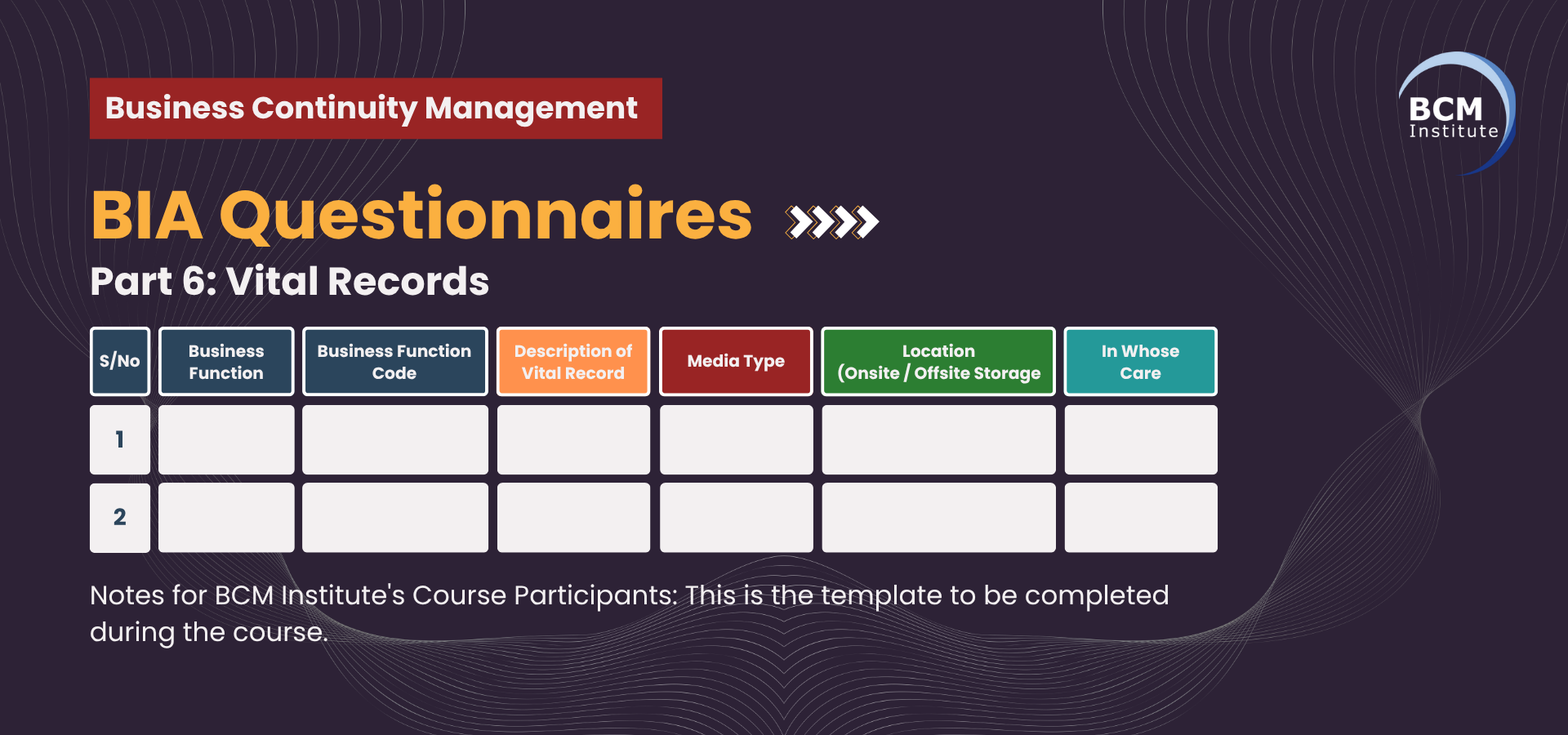
This chapter identifies the vital records required to support CBF-6: Workforce Management and Staff Deployment within the Movement for the Intellectually Disabled of Singapore (MINDS).
Vital records are those documents and information assets that are essential for the organisation to continue, recover, and restore workforce-related operations during and following a disruption, as well as to meet legal, regulatory, and contractual obligations.
Workforce management relies heavily on accurate, timely, and secure records such as manpower plans, employee information, training certifications, deployment schedules, and compliance documentation.
These records enable MINDS to make informed staffing decisions, ensure staff safety and well-being, maintain service continuity, and comply with statutory requirements.
Given the sensitive nature of personal and employment data, the protection, accessibility, and integrity of these records are critical considerations within the BCM framework.
By identifying and documenting vital workforce records, MINDS can prioritise appropriate protection measures, define ownership and custodianship, and ensure that essential information remains available within acceptable recovery time objectives during disruption scenarios.
![Banner [Table] [BCM] [E3] [BIA] [P6] Vital Records [BIAQ]](https://no-cache.hubspot.com/cta/default/3893111/b44d6d49-dfb5-42a1-bc91-c0c701fc0724.png)
Table P6: Vital Records for CBF-6
|
Sub-CBF Code |
Sub-CBF |
Description of Vital Records |
Media Type |
Location |
In Whose Care |
|
6.1 |
Workforce Planning & Forecasting |
Approved manpower plans, staffing forecasts, skills matrix, workforce gap analysis reports |
Electronic documents |
HR system / Secure shared drive |
Human Resources Department |
|
6.2 |
Recruitment & Selection |
Employee personnel files, employment contracts, offer letters, interview records, background checks |
Electronic records; limited hardcopy |
HR system; locked HR files |
Human Resources Department |
|
6.3 |
Training & Competency Development |
Training records, competency certifications, WSQ records, mandatory training completion logs |
Electronic records |
Learning Management System (LMS) / HR system |
HR / Learning & Development |
|
6.4 |
Workforce Scheduling & Deployment |
Staff rosters, duty schedules, deployment plans, emergency staffing lists |
Electronic records |
Workforce scheduling system / secure shared drive |
HR Operations / Programme Managers |
|
6.5 |
Performance Management & Appraisals |
Performance appraisal forms, KPI records, disciplinary records, promotion recommendations |
Electronic records |
HR system |
Human Resources Department |
|
6.6 |
Staff Well-Being & Support Systems |
Leave records, medical certificates, employee assistance programme (EAP) usage records, incident reports |
Electronic records; restricted access |
HR system / secure confidential folders |
HR Department |
|
6.7 |
Workforce Communication & Engagement |
Staff contact lists, emergency communication trees, internal communication advisories |
Electronic records |
HR system / corporate communication platform |
HR / Corporate Communications |
|
6.8 |
Succession & Contingency Planning |
Succession plans, role backup lists, delegation of authority, emergency role assignments |
Electronic documents |
Secure shared drive / HR system |
HR / Senior Management |
|
6.9 |
Volunteer & Auxiliary Workforce Integration |
Volunteer profiles, agreements, training records, deployment rosters |
Electronic records |
Volunteer management system / shared drive |
Volunteer Management Unit |
|
6.10 |
Compliance & Workforce Risk Management |
Employment policies, MOM compliance records, audit reports, workforce risk assessments |
Electronic records |
HR compliance repository |
HR / Risk Management |
![Banner [BCM] [E3] [BIA] [Summing Up] [P6] Vital Records [BIAQ]](https://no-cache.hubspot.com/cta/default/3893111/06d76589-ebcf-4c9f-8e5b-c27f02938eed.png)
The identification of vital records for CBF-6 Workforce Management and Staff Deployment underscores the central role of workforce information in sustaining MINDS’ operational resilience.
Records related to staffing, competency, deployment, and compliance form the foundation for effective decision-making and rapid recovery during incidents that affect workforce availability or organisational operations.
Ensuring that these records are properly maintained, securely stored, and readily accessible supports both business continuity and regulatory compliance, while reducing the risk of service disruption to beneficiaries.
Clear assignment of record ownership and custodianship further strengthens accountability and supports the timely retrieval of information when needed.
Overall, this vital records assessment enhances MINDS’ BCM capability by safeguarding critical workforce information, enabling the organisation to respond effectively to disruptions and continue delivering essential services to the community it serves.
Implementing Business Continuity Management for MINDS: Ensuring Continuity of Care and Services |
||||||
| eBook 3: Starting Your BCM Implementation |
||||||
![[BCM] [MINDS] [E3] [BIA] MBCO Corporate MBCO](https://no-cache.hubspot.com/cta/default/3893111/47babf68-4665-40bc-8db7-f34c7a717f49.png) |
![[BCM] [MINDS] [E3] [BIA] [PS] Key Product and Services](https://no-cache.hubspot.com/cta/default/3893111/1d6fd982-7a1c-4245-a1f0-bdd7a3155cc7.png) |
![[BCM] [MINDS] [E3] [RAR] [T1] List of Threats](https://no-cache.hubspot.com/cta/default/3893111/3262c956-93e2-45d4-850e-fa4cb7fab302.png) |
![[BCM] [MINDS] [E3] [RAR] [T2] Treatment and Control](https://no-cache.hubspot.com/cta/default/3893111/32464d64-b115-41e7-98be-850950580336.png) |
![[BCM] [MINDS] [E3] [RAR] [T3] Risk Impact and Likelihood Assessment](https://no-cache.hubspot.com/cta/default/3893111/cf5354bd-6256-4a23-ac6d-14bacb075337.png) |
![BCM] [MINDS] [E3] [BCS] [T1] Mitigation Strategies and Justification](https://no-cache.hubspot.com/cta/default/3893111/0bada7ae-abc1-4a42-bcd7-35ea2895a4d7.png) |
![[BCM] [MINDS] [E1] [C10] Identifying Critical Business Functions](https://no-cache.hubspot.com/cta/default/3893111/cfa9c1eb-7960-4442-8ef7-3ae5faeb4c8b.png) |
| CBF-6 Workforce Management and Staff Deployment |
||||||
| DP | BIAQ T1 | BIAQ T2 | BIAQ T3 | BCS T2 | BCS T3 | PD |
![[BCM] [MINDS] [E3] [BIA] [DP] [CBF] [6] Workforce Management and Staff Deployment](https://no-cache.hubspot.com/cta/default/3893111/344fe1c3-c46f-4e3f-880c-413adc3e045c.png) |
![[BCM] [MINDS] [E3] [BIA] [T1] [CBF] [6] Workforce Management and Staff Deployment](https://no-cache.hubspot.com/cta/default/3893111/18ab1d1e-7828-4739-8ffa-a5230606e71e.png) |
![[BCM] [MINDS] [E3] [BIA] [T2] [CBF] [6] Workforce Management and Staff Deployment](https://no-cache.hubspot.com/cta/default/3893111/2e9063ac-7136-4d9f-8d73-9aa948a8e010.png) |
|
![[BCM] [MINDS] [E3] [BCS] [T2] [CBF] [6] Workforce Management and Staff Deployment](https://no-cache.hubspot.com/cta/default/3893111/9ad68711-6fb6-4e4e-9a15-82de5fc94177.png) |
![[BCM] [MINDS] [E3] [BCS] [T3] [CBF] [6] Workforce Management and Staff Deployment](https://no-cache.hubspot.com/cta/default/3893111/b539993c-5898-45b5-af05-45e316d0b4f3.png) |
![[BCM] [MINDS] [E3] [PD] [CBF] [6] Workforce Management and Staff Deployment](https://no-cache.hubspot.com/cta/default/3893111/573e0e77-d175-4388-b1d0-fba52b6d38e8.png) |
More Information About Business Continuity Management Courses
To learn more about the course and schedule, click the buttons below for the BCM-300 Business Continuity Management Implementer [BCM-3] and the BCM-5000 Business Continuity Management Expert Implementer [BCM-5].


![Register [BL-B-3]*](https://no-cache.hubspot.com/cta/default/3893111/ac6cf073-4cdd-4541-91ed-889f731d5076.png)



![FAQ [BL-B-3]](https://no-cache.hubspot.com/cta/default/3893111/b3824ba1-7aa1-4eb6-bef8-94f57121c5ae.png)
![Email to Sales Team [BCM Institute]](https://no-cache.hubspot.com/cta/default/3893111/3c53daeb-2836-4843-b0e0-645baee2ab9e.png)


