



![Banner [BCM] [E3] [BCS] [T1] Mitigation Strategies](https://no-cache.hubspot.com/cta/default/3893111/fdc7087d-c996-4bf1-9dbb-59f7d2ba89c5.png)
Introduction
![BCM] [MINDS] [E3] [BCS] [T1] Mitigation Strategies and Justification](https://no-cache.hubspot.com/cta/default/3893111/0bada7ae-abc1-4a42-bcd7-35ea2895a4d7.png)
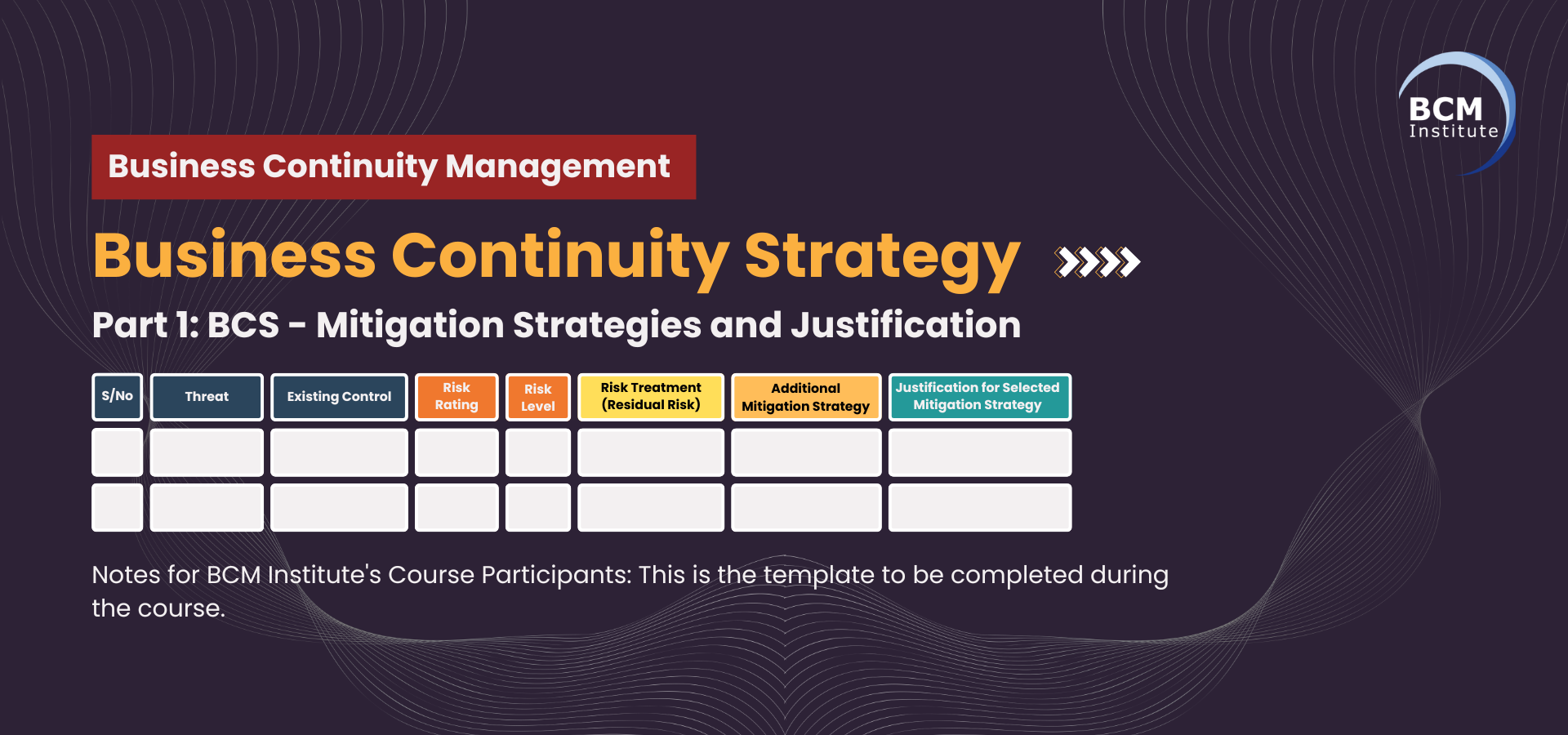
Mitigation strategies form a critical component of the Business Continuity Strategy (BCS) by addressing risks before a disruption occurs.
In accordance with BCMpedia guidance, mitigation focuses on identifying credible threats, evaluating existing controls, determining residual risk, and implementing cost-effective measures to reduce the likelihood and/or impact of disruptions on critical business functions.
For the Movement for the Intellectually Disabled of Singapore (MINDS), mitigation planning is particularly important due to its responsibility for the safety, wellbeing, and continuity of care for persons with intellectual disabilities across residential, educational, vocational, and community-based settings.
This chapter documents the mitigation strategies adopted by MINDS to manage key threats that could disrupt essential services, ensuring operational resilience, regulatory compliance, and stakeholder confidence.
Table S1: Mitigation Strategies
![Banner [Table] [BCM] [E3] [BCS] [T1] Mitigation Strategies](https://no-cache.hubspot.com/cta/default/3893111/126d86fd-4977-4d69-8e44-fe000291f236.png)
|
Threat |
Existing Controls |
Risk Rating |
Risk Level |
Risk Treatment (Residual Risk) |
Additional Mitigation Strategy |
Justification for Selected Mitigation Strategy |
|
Pandemic / Infectious Disease Outbreak |
Infection control SOPs, vaccination programmes, MOH advisories compliance, PPE stockpiles |
High |
High |
Risk Reduction |
Expand tele-services, cohort segregation plans, pandemic staffing rosters |
Reduces service disruption and protects vulnerable clients while maintaining essential care delivery |
|
Loss of Key Care Staff / Manpower Shortage |
Cross-training, relief staff pool, HR contingency plans |
High |
High |
Risk Reduction |
Formal succession planning and standby staffing agreements |
Ensures continuity of care services and prevents burnout during prolonged disruptions |
|
IT System Failure / Cyber Incident |
Firewalls, backups, antivirus, user access controls |
Medium-High |
High |
Risk Reduction |
Implement secondary data centre and enhanced cyber incident response drills |
Supports timely restoration of client, HR, and operational systems critical to service continuity |
|
Power Outage at Residential or Training Facilities |
Emergency lighting, UPS, basic generator coverage |
Medium |
Medium |
Risk Reduction |
Upgrade generators to support critical care equipment and ICT systems |
Prevents immediate safety risks to residents and enables sustained operations |
|
Fire at MINDS Facilities |
Fire detection systems, drills, SCDF compliance |
Medium |
Medium |
Risk Reduction |
Conduct more frequent evacuation drills for PWD clients and staff |
Enhances preparedness and reduces evacuation time for high-dependency clients |
|
Supply Chain Disruption (Food, Medical, PPE) |
Approved vendors, buffer stock |
Medium |
Medium |
Risk Reduction |
Dual sourcing and minimum stock level monitoring |
Reduces dependency on single suppliers and ensures continuity of essential supplies |
|
Transport Disruption (Fleet Breakdown, Driver Shortage) |
Preventive maintenance, outsourced transport |
Medium |
Medium |
Risk Reduction |
Pre-contract alternative transport providers |
Ensures uninterrupted client transport to schools, training centres, and residences |
|
Regulatory Non-Compliance During Disruption |
Compliance checks, internal audits |
Low-Medium |
Medium |
Risk Acceptance |
Periodic BCM-compliance reviews during disruptions |
Residual risk is acceptable with monitoring due to strong governance controls |
|
Physical Security Breach |
CCTV, access control, security patrols |
Low-Medium |
Medium |
Risk Reduction |
Integrate security alerts with incident management system |
Improves response time and safeguards vulnerable beneficiaries |
|
Data Privacy Breach (Client Records) |
PDPA policies, staff training |
Medium |
Medium |
Risk Reduction |
Encryption of sensitive client data and enhanced audit logs |
Protects sensitive beneficiary data and maintains trust with stakeholders |
![Banner [BCM] [E3] [BCS] [Summing Up] [T1] Mitigation Strategies](https://no-cache.hubspot.com/cta/default/3893111/c2542a7f-6d92-4371-93ba-348e87d8c1ce.png)
The mitigation strategies identified for MINDS demonstrate a proactive and structured approach to reducing risks that could disrupt critical services for persons with intellectual disabilities.
By leveraging existing controls, assessing residual risks, and implementing targeted additional mitigation measures, MINDS strengthens its organisational resilience while balancing operational feasibility and cost-effectiveness.
These mitigation strategies support the continuity of essential care, education, residential, and community services, and align with BCMpedia best practices by focusing on prevention, preparedness, and impact reduction.
This chapter provides a solid foundation for subsequent Business Continuity Plan (BCP) development, response strategies, and recovery planning, ensuring that MINDS remains capable of fulfilling its mission even under adverse conditions.
![[BCM] [MINDS] [E3] [BIA] MBCO Corporate MBCO](https://no-cache.hubspot.com/cta/default/3893111/47babf68-4665-40bc-8db7-f34c7a717f49.png)
![[BCM] [MINDS] [E3] [BIA] [PS] Key Product and Services](https://no-cache.hubspot.com/cta/default/3893111/1d6fd982-7a1c-4245-a1f0-bdd7a3155cc7.png)
![[BCM] [MINDS] [E3] [RAR] [T1] List of Threats](https://no-cache.hubspot.com/cta/default/3893111/3262c956-93e2-45d4-850e-fa4cb7fab302.png)
![[BCM] [MINDS] [E3] [RAR] [T2] Treatment and Control](https://no-cache.hubspot.com/cta/default/3893111/32464d64-b115-41e7-98be-850950580336.png)
![[BCM] [MINDS] [E3] [RAR] [T3] Risk Impact and Likelihood Assessment](https://no-cache.hubspot.com/cta/default/3893111/cf5354bd-6256-4a23-ac6d-14bacb075337.png)
![[BCM] [MINDS] [E1] [C10] Identifying Critical Business Functions](https://no-cache.hubspot.com/cta/default/3893111/cfa9c1eb-7960-4442-8ef7-3ae5faeb4c8b.png)
More Information About Business Continuity Management Courses
To learn more about the course and schedule, click the buttons below for the BCM-300 Business Continuity Management Implementer [BCM-3] and the BCM-5000 Business Continuity Management Expert Implementer [BCM-5].


![Register [BL-B-3]*](https://no-cache.hubspot.com/cta/default/3893111/ac6cf073-4cdd-4541-91ed-889f731d5076.png)



![FAQ [BL-B-3]](https://no-cache.hubspot.com/cta/default/3893111/b3824ba1-7aa1-4eb6-bef8-94f57121c5ae.png)
![Email to Sales Team [BCM Institute]](https://no-cache.hubspot.com/cta/default/3893111/3c53daeb-2836-4843-b0e0-645baee2ab9e.png)


