

![[BCM] [KKH] [Full Banner] Implementing Business Continuity Management for KKH](https://no-cache.hubspot.com/cta/default/3893111/1f88d53c-b518-44bc-a9d0-ba7d040b5378.png)

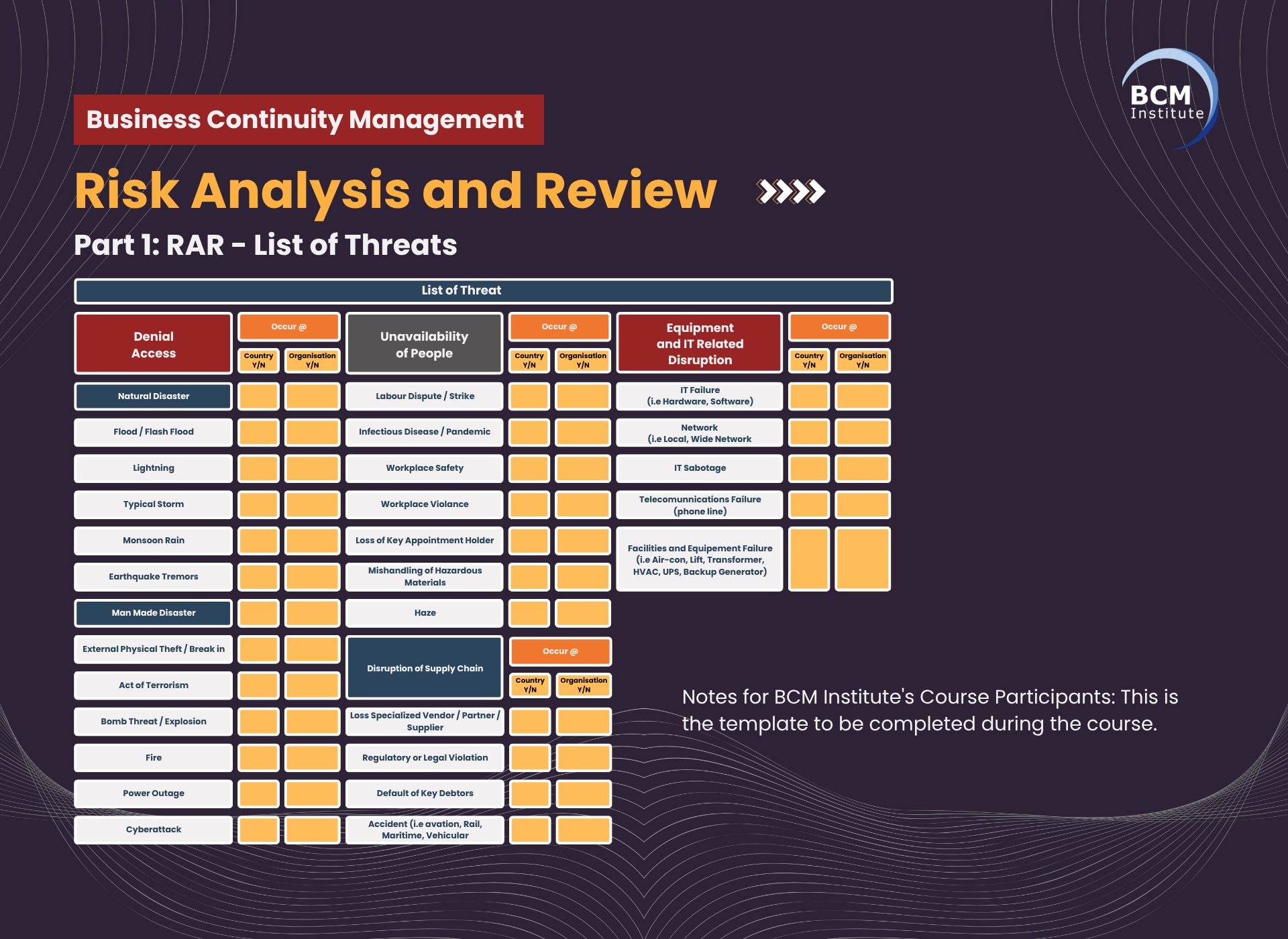
![Banner [BCM] [E3] [RAR] [T1] List of Threats](https://no-cache.hubspot.com/cta/default/3893111/65957ea5-03c3-451d-aabe-bbf23d32c897.png)
Introduction
![BCM] [KKH] [E3] [RAR] [T1] List of Threats](https://no-cache.hubspot.com/cta/default/3893111/684e108e-12b3-4872-99e4-6b61ce39596e.png)
An effective Business Continuity Management (BCM) programme begins with a systematic identification of the threats that could disrupt the organisation's ability to deliver its Critical Business Functions.
Before evaluating risks, it is necessary to understand the events or conditions that could interrupt healthcare services, affect personnel, damage facilities, compromise technology, or disrupt supporting infrastructure.
This Threat Register establishes the foundation for subsequent Risk Assessment, Business Impact Analysis (BIA), Business Continuity Strategy development, Crisis Management, and Business Continuity Planning.
Threats are only one component of risk.
A threat becomes a business risk when it exploits an organisational vulnerability and results in consequences affecting operations, people, assets, information, reputation, or regulatory obligations.
By identifying threats before assessing their likelihood and impact, KKH can develop a structured understanding of the potential sources of disruption without prematurely assigning risk priorities.
For a tertiary specialist hospital such as KKH, threats originate from both external and internal sources.
External threats include natural hazards, public infrastructure failures, pandemics, cyber attacks targeting healthcare, supply chain disruption, and geopolitical developments.
Internal threats include equipment failures, clinical system outages, staff shortages, human error, and physical incidents affecting hospital facilities.
Both national operating conditions within Singapore and organisation-specific factors must therefore be considered when establishing a comprehensive Threat Register.
This chapter identifies credible sources of disruption only. It does not evaluate likelihood, business impact, existing controls, or treatment measures. These analyses will be performed in subsequent Risk Assessment chapters.

Table T1: List of Threats
|
Category of Threats |
Types of Threats |
Description of Threat |
Country-Level Relevance |
Organisation-Level Relevance |
|
Denial of Access – Natural Disaster |
Flash Flood |
Intense rainfall causes localised flooding that restricts access to hospital entrances, roads and transport routes. |
Occasionally encountered due to Singapore's tropical climate and intense rainfall events. |
Delays staff reporting, ambulance arrivals, patient access and supplier deliveries. |
|
Severe Storm / Thunderstorm |
Heavy rain, strong winds and lightning disrupt transport, utilities and outdoor operations. |
Common seasonal weather event. |
May interrupt access, damage external infrastructure and affect emergency operations. |
|
|
Lightning Strike |
Direct or nearby strikes damage electrical infrastructure or communication systems. |
Common in Singapore due to high lightning density. |
May affect power systems, ICT infrastructure and medical equipment. |
|
|
Extreme Heat |
Prolonged high temperatures affect facilities, equipment and workforce wellbeing. |
Emerging concern due to climate change. |
Increased cooling demand, equipment stress and staff fatigue. |
|
|
Haze |
Regional transboundary haze reduces air quality and visibility. |
Occasional regional occurrence. |
Increased respiratory cases, staff health concerns and possible reduction in outdoor activities. |
|
|
Pandemic Movement Restrictions |
Public health restrictions limit travel and workforce mobility. |
Credible based on recent global experience. |
Reduces staffing availability and affects suppliers, contractors and patient access. |
|
|
Earthquake (Regional Effects) |
Distant regional earthquakes cause tremors affecting infrastructure. |
Low historical occurrence but credible due to regional seismic activity. |
May require precautionary inspections and temporary suspension of clinical activities. |
|
|
Denial of Access – Man-made Disaster
|
Fire |
Fire within or adjacent to hospital premises requires evacuation or closure of affected areas. |
Common risk for large facilities. |
Disrupts patient care, operating theatres, wards and essential support services. |
|
Explosion |
Explosion involving utilities, medical gases or nearby facilities. |
Low occurrence but credible. |
Causes immediate evacuation, infrastructure damage and clinical disruption. |
|
|
Chemical Spill |
Hazardous material release within or near the hospital. |
Occasional due to industrial transport and healthcare operations. |
May contaminate facilities and require isolation of affected areas. |
|
|
Medical Gas Leak |
Leakage of oxygen or other medical gases affecting patient care areas. |
Credible within healthcare environments. |
Directly affects critical care, operating theatres and emergency services. |
|
|
Structural Failure |
Failure of building components requiring closure of clinical areas. |
Low historical occurrence. |
Interrupts healthcare delivery and necessitates relocation of services. |
|
|
Bomb Threat |
Threat requiring precautionary evacuation and security response. |
Credible although infrequent. |
Disrupts patient care and emergency operations. |
|
|
Terrorism |
Deliberate attack targeting public infrastructure or healthcare facilities. |
Low occurrence but remains a national security consideration. |
Could affect patients, staff, infrastructure and public confidence. |
|
|
Active Assailant |
Violent individual entering hospital premises. |
Credible but infrequent. |
Immediate threat to life requiring emergency lockdown and response. |
|
|
Public Transport Disruption |
Failure of MRT or bus services affecting workforce mobility. |
Occasionally encountered. |
Delays staff reporting and shift changes. |
|
|
Major Traffic Incident |
Major road accident blocks access routes. |
Common in urban environments. |
Delays emergency vehicles, patients, suppliers and staff. |
|
|
Unavailability of People |
Pandemic |
Widespread infectious disease affecting workforce availability. |
Established national planning scenario. |
Reduces availability of clinicians and support personnel. |
|
Infectious Disease Outbreak |
Local outbreak affecting healthcare workers or patients. |
Recurring healthcare risk. |
Increased absenteeism and surge in patient demand. |
|
|
Mass Illness |
Simultaneous illness affecting multiple employees. |
Credible in healthcare settings. |
Reduces staffing below safe operating levels. |
|
|
Loss of Key Personnel |
Sudden absence of critical specialists or leaders. |
Occasional organisational risk. |
Delays clinical decisions and continuity of specialised services. |
|
|
Skills Shortage |
Insufficient specialist clinicians or technical staff. |
Emerging challenge in healthcare sector. |
Limits delivery of highly specialised services such as NICU and emergency obstetrics. |
|
|
Staff Fatigue |
Extended emergency operations result in physical and mental exhaustion. |
Common during prolonged incidents. |
Increases likelihood of clinical errors and reduced productivity. |
|
|
Psychological Stress |
Traumatic events affect workforce wellbeing. |
Increasing area of concern across healthcare. |
Impacts decision-making, retention and operational effectiveness. |
|
|
Mandatory Quarantine |
Staff isolated following exposure to infectious diseases. |
Credible under public health legislation. |
Rapid reduction in available workforce. |
|
|
Family Emergencies |
Employees unavailable due to personal or family crises. |
Common organisational occurrence. |
Reduces staffing flexibility during incidents. |
|
|
Disruption to the Supply Chain |
Supplier Failure |
Critical supplier unable to fulfil contractual obligations. |
Credible across all sectors. |
Interrupts supply of medicines, consumables or equipment. |
|
Cloud Service Provider Failure |
Failure of hosted healthcare platforms. |
Emerging concern due to cloud adoption. |
Impacts clinical applications and business systems. |
|
|
Telecommunications Failure |
Loss of external telecommunications services. |
Occasional infrastructure disruption. |
Interrupts voice, internet and remote connectivity. |
|
|
Utility Failure |
External disruption to electricity, water or gas supplies. |
Credible although national infrastructure is resilient. |
Directly affects clinical operations and patient safety. |
|
|
Logistics Disruption |
Transport delays affecting medical deliveries. |
Common during regional disruptions. |
Delays essential supplies and pharmaceuticals. |
|
|
Fuel Supply Disruption |
Reduced availability of transport fuel. |
Low occurrence but credible. |
Affects emergency transport and backup generators. |
|
|
Vendor Insolvency |
Key supplier ceases operations. |
Occasional commercial risk. |
Interrupts maintenance, support and equipment availability. |
|
|
Third-Party Cyber Incident |
Supplier experiences cyber attack affecting services delivered to KKH. |
Increasing concern globally. |
May interrupt outsourced ICT or healthcare support services. |
|
|
Single Source Dependency |
Essential product available from only one supplier. |
Common within specialised healthcare procurement. |
Increases operational vulnerability during supply disruption. |
|
|
Regulatory Import Restrictions |
Controls affecting import of medicines or medical devices. |
Credible during global crises. |
May reduce availability of specialised clinical supplies. |
|
|
Equipment and IT-Related Disruption |
Cyber Attack |
Malicious attack targeting hospital ICT infrastructure. |
Increasing concern across Singapore's critical sectors. |
Interrupts clinical systems and hospital operations. |
|
Ransomware |
Malware encrypts systems and data, preventing access. |
Significant threat to healthcare organisations globally. |
Loss of access to EMR, laboratory and imaging systems. |
|
|
Malware Infection |
Malicious software compromises endpoints or servers. |
Common cybersecurity threat. |
Degrades system performance and compromises clinical operations. |
|
|
Distributed Denial of Service (DDoS) |
External traffic overwhelms internet-facing systems. |
Credible for public-facing services. |
Disrupts patient portals and online services. |
|
|
Insider Threat |
Authorised user intentionally or accidentally compromises systems or information. |
Increasing organisational concern. |
Data loss, service disruption or regulatory non-compliance. |
|
|
Data Breach |
Unauthorised disclosure of sensitive health information. |
Significant concern due to digital healthcare. |
Impacts patient confidentiality, trust and legal obligations. |
|
|
Network Failure |
Failure of hospital network infrastructure. |
Occasional technical risk. |
Prevents access to clinical systems across departments. |
|
|
Server Failure |
Failure of critical application servers. |
Credible within any ICT environment. |
Interrupts multiple clinical and business applications. |
|
|
Database Corruption |
Corruption of patient or operational databases. |
Low occurrence but high operational significance. |
Loss of critical clinical information affecting patient care. |
|
|
Cloud Service Outage |
Hosted services become temporarily unavailable. |
Emerging technology dependency. |
Interrupts cloud-based collaboration and healthcare applications. |
|
|
Power Failure |
Electrical interruption affecting ICT and medical equipment. |
Credible despite resilient national infrastructure. |
Requires backup power to sustain critical healthcare services. |
|
|
Hardware Failure |
Failure of medical devices or ICT equipment. |
Common operational issue. |
Interrupts diagnostics, monitoring or communications. |
|
|
Software Failure |
Application malfunction or upgrade failure. |
Common technology risk. |
Affects clinical workflows and patient management. |
|
|
Backup Failure |
Data backup cannot be restored successfully. |
Credible technology risk. |
Compromises disaster recovery and business continuity. |
|
|
Data Centre Failure |
Failure of primary data centre infrastructure. |
Low historical occurrence but credible. |
Interrupts multiple enterprise applications simultaneously. |
|
|
Identity and Access Management Failure |
Authentication services unavailable or compromised. |
Increasing dependency in digital environments. |
Prevents authorised staff from accessing critical clinical systems. |
|
|
Artificial Intelligence System Failure |
Failure or incorrect output from AI-assisted diagnostic or decision-support tools. |
Emerging risk as AI adoption increases. |
May delay clinical decision-making and require manual validation processes. |
![Banner [Table] [BCM] [E3] [RAR] [Summing Up] [T1] List of Threats](https://no-cache.hubspot.com/cta/default/3893111/d4dc8faf-623d-4f0d-acf8-26776beec0f4.png)
A comprehensive Threat Register is fundamental to Business Continuity Management because it establishes a structured inventory of credible events that could disrupt the delivery of critical healthcare services.
By identifying threats before assessing their likelihood and impact, KKH can develop a consistent basis for evaluating operational vulnerabilities and prioritising continuity planning activities.
The threats identified in this chapter provide essential inputs to subsequent Risk Assessment activities, where each threat will be evaluated against organisational vulnerabilities, existing controls, business impacts, and recovery priorities.
They also support the Business Impact Analysis by highlighting the events that may affect Critical Business Functions, supporting services, facilities, personnel, technology, suppliers, and stakeholders.
Understanding credible threats enables KKH to design appropriate Business Continuity Strategies, strengthen Crisis Management arrangements, improve Operational Resilience, and enhance preparedness for both traditional and emerging risks.
The Threat Register should be reviewed regularly to reflect changes in the healthcare environment, technology landscape, climate conditions, regulatory requirements, and geopolitical developments.
Particular attention should be given to evolving cyber threats, climate-related events, healthcare supply chain dependencies, and emerging technologies such as artificial intelligence.
A well-maintained Threat Register strengthens organisational resilience by ensuring that continuity planning remains aligned with the hospital's operating environment and risk landscape.
Identifying threats is the first step in protecting KKH's critical services.
The subsequent Risk Assessment chapters will evaluate the likelihood, impact, and appropriate treatment of each identified threat, providing the basis for informed continuity and resilience planning.
![[BCM] [KKH] [3/4 Banner] Implementing Business Continuity Management for KKH](https://no-cache.hubspot.com/cta/default/3893111/141669d3-f654-4e57-9ccd-2d2ab49f536d.png)
![BCM] [KKH] [E3] [BIA] MBCO Corporate MBCO](https://no-cache.hubspot.com/cta/default/3893111/55ac38bc-d349-4faf-a6dc-cbc3d3f5431b.png)
![BCM] [KKH] [E3] [BIA] [PS] Key Product and Services](https://no-cache.hubspot.com/cta/default/3893111/b28ee275-3bf7-4832-a3a0-0bcca82d2522.png)
![BCM] [KKH] [E3] [RAR] [T2] Treatment and Control](https://no-cache.hubspot.com/cta/default/3893111/6c690eb5-e7da-4206-ac6b-fb88a8966a69.png)
![BCM] [KKH] [E3] [RAR] [T3] Risk Impact and Likelihood Assessment](https://no-cache.hubspot.com/cta/default/3893111/a9730f15-ebd1-4e30-b308-6d574be794a1.png)
![BCM] [KKH] [E3] [BCS] [T1] Mitigation Strategies and Justification](https://no-cache.hubspot.com/cta/default/3893111/28b77d9a-b16b-44e7-9abf-965d3db4f803.png)
![x eBook Cover [BCM] [KKH] [E1] [2D]](https://no-cache.hubspot.com/cta/default/3893111/89ff2234-56e5-4251-9fee-cd7a4d53ab9b.png)
More Information About Business Continuity Management Courses
To learn more about the course and schedule, click the buttons below for the BCM-300 Business Continuity Management Implementer [BCM-3] and the BCM-5000 Business Continuity Management Expert Implementer [BCM-5].


![Register [BL-B-3]*](https://no-cache.hubspot.com/cta/default/3893111/ac6cf073-4cdd-4541-91ed-889f731d5076.png)



![FAQ [BL-B-3]](https://no-cache.hubspot.com/cta/default/3893111/b3824ba1-7aa1-4eb6-bef8-94f57121c5ae.png)
![Email to Sales Team [BCM Institute]](https://no-cache.hubspot.com/cta/default/3893111/3c53daeb-2836-4843-b0e0-645baee2ab9e.png)


