

![[BCM] [KKH] [Full Banner] Implementing Business Continuity Management for KKH](https://no-cache.hubspot.com/cta/default/3893111/1f88d53c-b518-44bc-a9d0-ba7d040b5378.png)

![Banner [BCM] [E3] [BIA] [P5] Inter-dependencies](https://no-cache.hubspot.com/cta/default/3893111/c7d00b8b-77c0-43ee-a2cf-76ea43b26fe8.png)
CBF-1 Emergency Obstetric Processes
![[BCM] [KKH] [E3] [BIA] [T5] [CBF] [1] Emergency Obstetric Services](https://no-cache.hubspot.com/cta/default/3893111/f6eaac47-7206-4cba-b6f4-b58245fa9111.png)
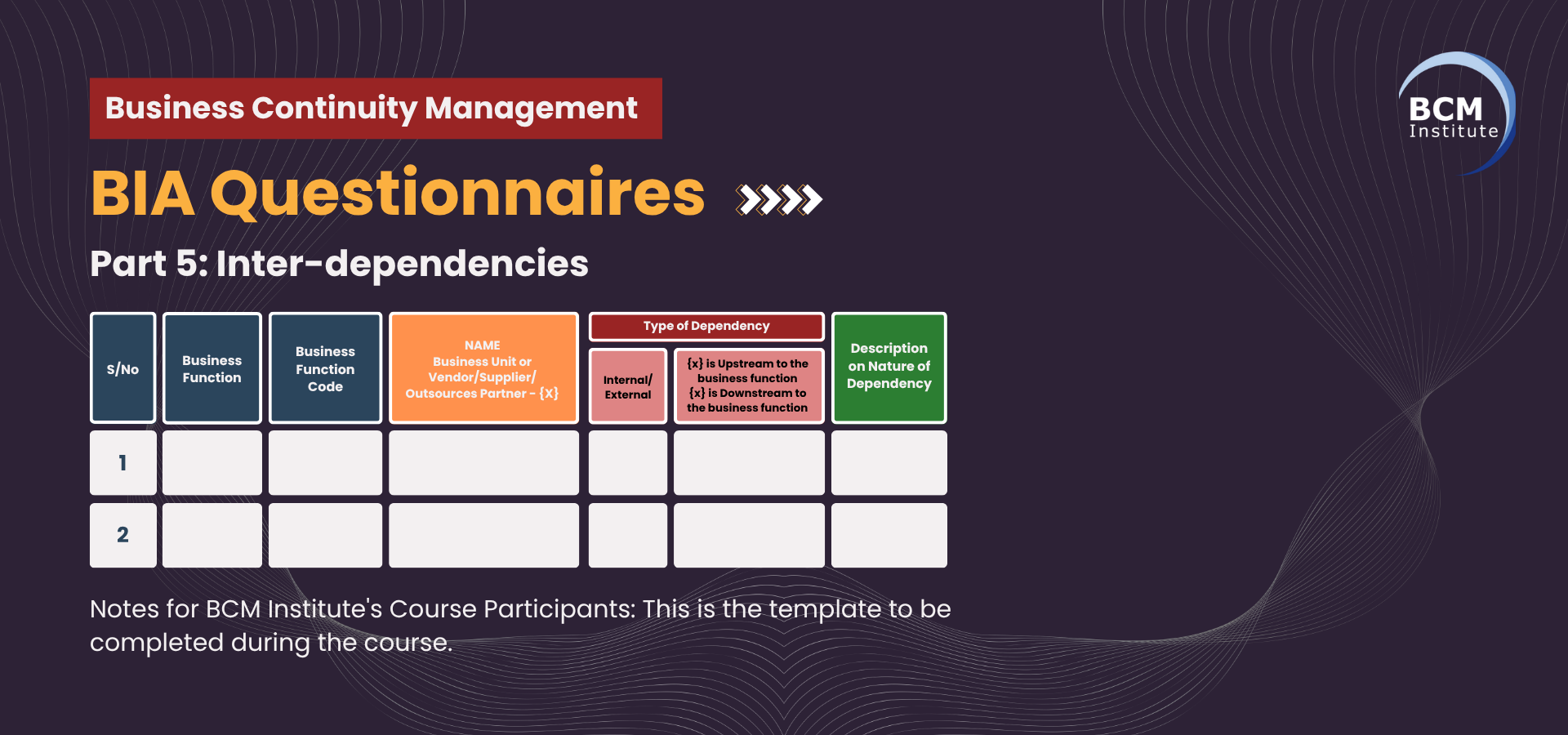
Business Continuity Management extends beyond individual business processes to include the network of internal and external dependencies that enable critical services to operate.
For Emergency Obstetric Services at KK Women's and Children's Hospital (KKH), every stage of the patient journey depends on coordinated support from clinical departments, diagnostic services, information technology, facilities management, and specialist external providers.
A disruption affecting any of these dependencies may significantly impair the hospital's ability to deliver timely and safe emergency obstetric care.
During the Business Impact Analysis (BIA), dependency mapping identifies the organisations, business units, suppliers, and service providers that support each Sub-Critical Business Function (Sub-CBF).
Understanding these relationships enables KKH to recognise potential single points of failure, assess concentration risks, and implement appropriate continuity arrangements.
Dependencies can be classified according to their operational relationship. Upstream dependencies provide the resources, information, technology, or services required before a Sub-CBF can operate.
Downstream dependencies rely on the outputs generated by the Sub-CBF to continue subsequent clinical activities.
Mutual dependencies exist where both parties rely continuously on one another to maintain coordinated service delivery.
Analysing these relationships strengthens Business Continuity Planning (BCP), Third-Party Risk Management (TPRM), supplier resilience, and overall operational resilience.
![Banner [Table] [BCM] [E3] [BIA] [P5] Inter-dependencies [BIAQ]](https://no-cache.hubspot.com/cta/default/3893111/ed6152ff-4926-4fae-bd6b-ba572bcc781b.png)
Table P5: Inter‑dependencies for CBF-1
|
Sub-CBF Code |
Sub-Critical Business Function |
Business Unit / Vendor / Supplier / Outsourcing Partner |
Internal Dependency |
External Dependency |
Dependency Direction |
Description of the Nature of Dependency |
|
1.1 |
Emergency Patient Arrival and Registration |
Emergency Department (ED) / Patient Registration Unit |
Yes |
No |
Upstream |
Provides patient registration, identity verification, and admission records required before emergency clinical care can commence. Failure delays patient admission and downstream treatment. |
|
1.2 |
Obstetric Triage and Clinical Prioritisation |
Obstetrics & Gynaecology Department |
Yes |
No |
Mutual |
Midwives and obstetric clinicians collaborate continuously to assess patient acuity and prioritise treatment. Delays affect all subsequent emergency interventions. |
|
1.3 |
Emergency Clinical Assessment |
Specialist Obstetric Consultants |
Yes |
No |
Mutual |
Clinical assessment depends on specialist expertise while treatment teams depend on assessment outcomes to initiate emergency care. Loss of specialist availability delays diagnosis. |
|
1.4 |
Diagnostic and Laboratory Support |
Pathology Laboratory & Diagnostic Imaging Department |
Yes |
No |
Upstream |
Laboratory results, blood investigations, ultrasound imaging, and fetal monitoring support diagnosis and emergency treatment decisions. Service disruption delays clinical intervention. |
|
1.5 |
Emergency Obstetric Decision-Making |
Senior Obstetric Consultant / Multidisciplinary Clinical Team |
Yes |
No |
Mutual |
Clinical decisions rely on diagnostic information while theatre, neonatal, and anaesthetic teams depend on timely treatment decisions. |
|
1.6 |
Emergency Theatre Preparation |
Operating Theatre Services |
Yes |
No |
Upstream |
Theatre readiness depends on operating theatre staff, sterile supplies, equipment preparation, and facilities support before surgery can begin. |
|
1.7 |
Emergency Obstetric Surgery and Delivery |
Surgical Services & Sterile Supply Department |
Yes |
No |
Mutual |
Surgical teams depend on sterile instruments and theatre support, while operating theatre utilisation depends on coordinated surgical workflows. |
|
1.8 |
Anaesthesia and Perioperative Care |
Department of Anaesthesiology |
Yes |
No |
Mutual |
Anaesthesia services support emergency surgery while surgical teams depend on safe perioperative management throughout the procedure. |
|
1.9 |
Neonatal Emergency Support |
Neonatology Department / Neonatal Intensive Care Unit (NICU) |
Yes |
No |
Downstream |
Neonatal teams receive newborns immediately following delivery and provide specialised stabilisation and intensive care when required. |
|
1.10 |
Maternal Critical Care and Stabilisation |
High Dependency Unit (HDU) / Intensive Care Unit (ICU) |
Yes |
No |
Downstream |
Critically ill mothers require transfer to HDU or ICU for advanced monitoring and ongoing treatment after emergency intervention. |
|
1.11 |
Blood Products and Medication Management |
Hospital Blood Bank / National Blood Supply Provider |
No |
Yes |
Upstream |
Emergency transfusions depend on continuous availability of compatible blood products and essential medications. Supply disruption directly affects life-saving treatment. |
|
1.12 |
Clinical Communication and Care Coordination |
Hospital ICT & Telecommunications Services |
Yes |
No |
Mutual |
Clinical coordination depends on communication systems, while ICT requires clinical feedback to prioritise restoration during incidents. Communication failure delays multidisciplinary response. |
|
1.13 |
Patient Monitoring and Ongoing Clinical Management |
Biomedical Engineering Department |
Yes |
No |
Upstream |
Monitoring equipment must remain operational and maintained to support continuous observation of mothers and newborns. Equipment failure increases clinical risk. |
|
1.14 |
Patient Transfer and Continuity of Care |
Bed Management Office & Patient Transport Services |
Yes |
No |
Downstream |
Patient transfers depend on bed availability, transport coordination, and receiving clinical units. Delays reduce emergency treatment capacity. |
|
1.15 |
Clinical Documentation and Regulatory Reporting |
Health Information Management (HIM) & Medical Records Department |
Yes |
No |
Downstream |
Clinical documentation supports continuity of care, medico-legal requirements, coding, audit, and statutory reporting. Incomplete records affect patient safety and compliance. |
![Banner [BCM] [E3] [BIA] [Summing Up] [P5] Inter-dependencies [BIAQ]](https://no-cache.hubspot.com/cta/default/3893111/117996e6-4a68-4449-880f-d8a48ff3071d.png)
Dependency mapping provides a comprehensive understanding of the operational ecosystem supporting Emergency Obstetric Services.
By identifying the internal business units, specialist clinical departments, and external suppliers that enable each Sub-Critical Business Function, KKH gains greater visibility of critical operational interrelationships and potential single points of failure.
This analysis strengthens the Business Impact Analysis by highlighting where disruptions in supporting services could affect emergency obstetric care.
Understanding dependency direction—whether upstream, downstream, or mutual—enables continuity planners to develop recovery strategies that restore not only individual processes but also the supporting services on which they rely.
External dependencies, such as blood product suppliers and other essential healthcare partners, should be incorporated into Business Continuity Plans through supplier resilience measures, contractual continuity requirements, and contingency arrangements.
Likewise, internal dependencies should be reflected in coordinated recovery procedures across clinical, ICT, facilities, and support functions to ensure integrated restoration of hospital operations.
Ultimately, dependency analysis enhances supplier resilience, operational resilience, enterprise risk management, and incident response by enabling KKH to prioritise critical recovery activities, allocate resources effectively, and maintain the safe delivery of emergency obstetric services during major disruptions.
![[BCM] [KKH] [3/4 Banner] Implementing Business Continuity Management for KKH](https://no-cache.hubspot.com/cta/default/3893111/141669d3-f654-4e57-9ccd-2d2ab49f536d.png)
![BCM] [KKH] [E3] [BIA] MBCO Corporate MBCO](https://no-cache.hubspot.com/cta/default/3893111/55ac38bc-d349-4faf-a6dc-cbc3d3f5431b.png)
![BCM] [KKH] [E3] [BIA] [PS] Key Product and Services](https://no-cache.hubspot.com/cta/default/3893111/b28ee275-3bf7-4832-a3a0-0bcca82d2522.png)
![BCM] [KKH] [E3] [RAR] [T1] List of Threats](https://no-cache.hubspot.com/cta/default/3893111/684e108e-12b3-4872-99e4-6b61ce39596e.png)
![BCM] [KKH] [E3] [RAR] [T2] Treatment and Control](https://no-cache.hubspot.com/cta/default/3893111/6c690eb5-e7da-4206-ac6b-fb88a8966a69.png)
![BCM] [KKH] [E3] [RAR] [T3] Risk Impact and Likelihood Assessment](https://no-cache.hubspot.com/cta/default/3893111/a9730f15-ebd1-4e30-b308-6d574be794a1.png)
![BCM] [KKH] [E3] [BCS] [T1] Mitigation Strategies and Justification](https://no-cache.hubspot.com/cta/default/3893111/28b77d9a-b16b-44e7-9abf-965d3db4f803.png)
![[BCM] [KKH] [E1] [C10] Identifying Critical Business Functions](https://no-cache.hubspot.com/cta/default/3893111/0d1cbf1e-59f6-43c8-a15e-6b34233e632f.png)
![[BCM] [KKH] [E3] [BIA] [DP] [CBF] [1] Emergency Obstetric Services](https://no-cache.hubspot.com/cta/default/3893111/e497eed8-773b-4e86-bbf8-8e9c3032365b.png)
![[BCM] [KKH] [E3] [BIA] [T1] [CBF] [1] Emergency Obstetric Services](https://no-cache.hubspot.com/cta/default/3893111/7bda08a6-461a-4c89-8806-4d6d1216e9f4.png)
![[BCM] [KKH] [E3] [BIA] [T2] [CBF] [1] Emergency Obstetric Services](https://no-cache.hubspot.com/cta/default/3893111/0724500a-3544-46b8-af30-f31b292e5eb9.png)
![[BCM] [KKH] [E3] [BIA] [T3] [CBF] [1] Emergency Obstetric Services](https://no-cache.hubspot.com/cta/default/3893111/dc455c8b-0db4-45c4-8f33-e81d69d35344.png)
![[BCM] [KKH] [E3] [BIA] [T4] [CBF] [1] Emergency Obstetric Services](https://no-cache.hubspot.com/cta/default/3893111/f4e64c69-124b-40a8-b224-dded90e5631b.png)
![[BCM] [KKH] [E3] [BIA] [T6] [CBF] [1] Emergency Obstetric Services](https://no-cache.hubspot.com/cta/default/3893111/5aa80ea6-6214-44b6-92a2-4156d7d4cfe5.png)
![[BCM] [KKH] [E3] [BCS] [T2] [CBF] [1] Emergency Obstetric Services](https://no-cache.hubspot.com/cta/default/3893111/8d32e264-3e43-4d37-be2a-1382e798c916.png)
![[BCM] [KKH] [E3] [BCS] [T3] [CBF] [1] Emergency Obstetric Services](https://no-cache.hubspot.com/cta/default/3893111/b53ff102-21b1-4f31-b47e-5b721028ee65.png)
![[BCM] [KKH] [E3] [PD] [CBF] [1] Emergency Obstetric Services](https://no-cache.hubspot.com/cta/default/3893111/f9da91f2-6ad8-4c19-b25f-ef7b136c8a04.png)
More Information About Business Continuity Management Courses
To learn more about the course and schedule, click the buttons below for the BCM-300 Business Continuity Management Implementer [BCM-3] and the BCM-5000 Business Continuity Management Expert Implementer [BCM-5].


![Register [BL-B-3]*](https://no-cache.hubspot.com/cta/default/3893111/ac6cf073-4cdd-4541-91ed-889f731d5076.png)



![FAQ [BL-B-3]](https://no-cache.hubspot.com/cta/default/3893111/b3824ba1-7aa1-4eb6-bef8-94f57121c5ae.png)
![Email to Sales Team [BCM Institute]](https://no-cache.hubspot.com/cta/default/3893111/3c53daeb-2836-4843-b0e0-645baee2ab9e.png)


