
![[BCM] [KKH] [Full Banner] Implementing Business Continuity Management for KKH](https://no-cache.hubspot.com/cta/default/3893111/1f88d53c-b518-44bc-a9d0-ba7d040b5378.png)

![Banner [BCM] [E3] [BCS] [T3] Minimum Resources Required during a Disaster](https://no-cache.hubspot.com/cta/default/3893111/8969ce47-38c2-4b89-88da-727979f12c39.png)
CBF-1 Emergency Obstetric Processes
![[BCM] [GEN] [E3] [BCS] [T3] [CBF] [1] BCS Minimum Resources Required](https://no-cache.hubspot.com/cta/default/3893111/c8fc6d5f-21fe-4a7d-8860-b4cd1ef79c80.png)
An effective Business Continuity Plan (BCP) identifies the minimum resources required to sustain critical operations during a disruption rather than attempting to replicate normal operating capacity.
For Emergency Obstetric Services at KK Women's and Children's Hospital (KKH), the objective is to maintain the Minimum Business Continuity Objective (MBCO) by preserving life-saving maternal and neonatal services using the minimum personnel, facilities, equipment, and technology necessary until full operations are restored.
The minimum resource requirements are derived from the Business Impact Analysis (BIA), which identifies critical business functions, Recovery Time Objectives (RTOs), and operational priorities, as well as the selected recovery strategies.
Resource planning ensures that recovery arrangements are practical, achievable, and aligned with the level of service that must be maintained during a disruption.
During major incidents, resources such as clinical staff, operating theatres, ICT systems, communications, and medical equipment may be constrained.
Rather than attempting to recover every capability simultaneously, KKH should optimise available resources by prioritising critical Sub-Critical Business Functions (Sub-CBFs), deploying cross-trained personnel, sharing workspaces where appropriate, and utilising alternate recovery locations and manual workarounds.
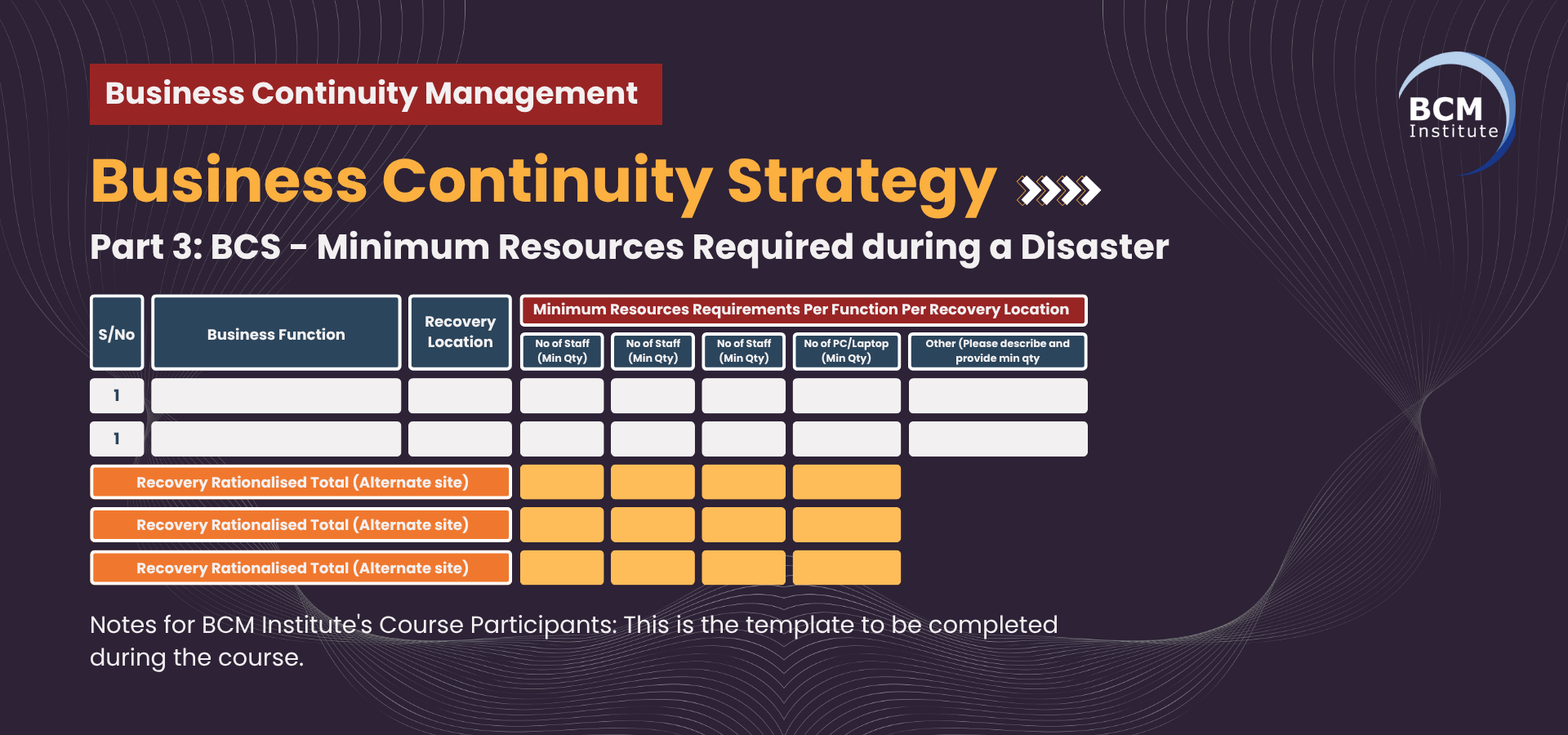
The following table identifies the minimum resources required to sustain each Sub-CBF supporting Emergency Obstetric Services during a disaster.
These estimates represent the minimum operational capability required to safely maintain emergency obstetric care and should be validated through exercises, operational reviews, and periodic Business Continuity Plan maintenance.
![Banner [Table] [BCM] [E3] [BCS] [T3] Minimum Resources Required during a Disaster](https://no-cache.hubspot.com/cta/default/3893111/7456e7dd-9e1f-4c07-a6f9-a39e58f74746.png)
Table S3: Minimum Resources Required During a Disaster for CBF-1
|
Sub-CBF Code |
Sub-Critical Business Function |
Recovery Location |
Minimum Resource Requirements per Function per Recovery Location |
Staff (Min.) |
Seats (Min.) |
Telephones (Min.) |
PCs/Laptops (Min.) |
Other Resources (Description and Minimum Quantity) |
|
1.1 |
Emergency Patient Arrival and Registration |
Emergency Department Registration Area |
Registration officers, admission procedures, EMR/PAS access, manual registration forms |
3 |
3 |
2 |
3 |
2 barcode scanners, 1 ID label printer, 1 downtime registration kit |
|
1.2 |
Obstetric Triage and Clinical Prioritisation |
Obstetric Emergency Unit |
Midwives, triage protocols, portable documentation, clinical access |
4 |
4 |
2 |
2 |
2 CTG monitors, 2 vital signs monitors, 1 emergency trolley |
|
1.3 |
Emergency Clinical Assessment |
Labour Ward / Emergency Obstetric Unit |
Obstetricians, nurses, EMR access or paper records, clinical guidelines |
5 |
5 |
2 |
3 |
2 ultrasound machines, 2 examination beds, 1 emergency drug trolley |
|
1.4 |
Diagnostic and Laboratory Support |
Hospital Laboratory / Alternate Laboratory |
Laboratory scientists, emergency analyser access, specimen transport |
4 |
4 |
2 |
3 |
1 emergency blood analyser, 1 specimen transport trolley, 1 backup LIS terminal |
|
1.5 |
Emergency Obstetric Decision-Making |
Emergency Obstetric Unit |
Senior obstetric consultant, multidisciplinary coordination, clinical decision support |
3 |
3 |
2 |
2 |
1 clinical dashboard workstation, 1 secure video conferencing unit |
|
1.6 |
Emergency Theatre Preparation |
Designated Backup Operating Theatre |
Theatre nurses, sterile services, equipment preparation, inventory access |
6 |
6 |
2 |
2 |
1 fully equipped operating theatre, 2 sterile instrument sets, 1 portable suction unit |
|
1.7 |
Emergency Obstetric Surgery and Delivery |
Emergency Operating Theatre |
Obstetric surgeons, theatre nurses, anaesthesia support, surgical systems |
8 |
8 |
2 |
2 |
1 operating table, 1 surgical lighting system, 1 electrosurgical unit, 1 medical gas supply |
|
1.8 |
Anaesthesia and Perioperative Care |
Operating Theatre |
Anaesthetists, anaesthesia technicians, monitoring capability |
3 |
3 |
2 |
2 |
2 anaesthesia machines, 2 ventilators, 2 patient monitors |
|
1.9 |
Neonatal Emergency Support |
Delivery Suite / NICU |
Neonatologist, neonatal nurses, neonatal monitoring |
4 |
4 |
2 |
2 |
2 neonatal resuscitation stations, 2 transport incubators, 2 infant ventilators |
|
1.10 |
Maternal Critical Care and Stabilisation |
HDU / ICU |
Critical care physicians, ICU nurses, monitoring systems |
5 |
5 |
2 |
3 |
2 ICU beds, 2 ventilators, 4 infusion pumps |
|
1.11 |
Blood Products and Medication Management |
Blood Bank / Pharmacy |
Blood bank staff, pharmacists, emergency inventory management |
3 |
3 |
2 |
2 |
Minimum 10 emergency blood units, 1 blood refrigerator, 1 emergency medication cart |
|
1.12 |
Clinical Communication and Care Coordination |
Hospital Command Centre |
Duty manager, clinical coordinator, communications personnel |
3 |
3 |
4 |
3 |
4 secure mobile phones, 2 radios, 1 incident management dashboard |
|
1.13 |
Patient Monitoring and Ongoing Clinical Management |
Labour Ward / ICU / NICU |
Nurses, clinicians, continuous monitoring capability |
6 |
6 |
2 |
2 |
6 bedside monitors, 2 portable monitors, 1 nurse call system |
|
1.14 |
Patient Transfer and Continuity of Care |
Clinical Wards / Bed Management Office |
Bed coordinators, patient transport personnel, clinical handover |
4 |
4 |
2 |
2 |
2 patient transport trolleys, 2 wheelchairs, 1 patient tracking workstation |
|
1.15 |
Clinical Documentation and Regulatory Reporting |
Medical Records Department |
HIM officers, clinical coders, documentation support |
3 |
3 |
2 |
3 |
1 multifunction printer/scanner, 1 secure document cabinet, 1 downtime documentation kit |
![Banner [BCM] [E3] [BCS] [Summing Up] [T3] Minimum Resources Required during a Disaster](https://no-cache.hubspot.com/cta/default/3893111/6cebfa28-ed8a-49d6-8978-797c3a577f9e.png)
Determining the minimum recovery resources for Emergency Obstetric Services ensures that KKH can sustain essential maternal and neonatal care during disruptive events without attempting to restore full operational capacity immediately.
By identifying the minimum personnel, workspaces, communications, computing devices, and specialised clinical equipment required for each Sub-Critical Business Function, the hospital can establish realistic continuity arrangements that support the defined Minimum Business Continuity Objectives (MBCOs).
Resource optimisation is a key principle of Business Continuity Management. During major disruptions, staffing levels, facilities, technology, and medical equipment may be limited. Prioritising the allocation of scarce resources to the most critical clinical activities enables KKH to maintain life-saving services while progressively restoring supporting functions.
This approach aligns with the recovery strategies identified during the BCS phase and ensures that available resources are used effectively to achieve the required Recovery Time Objectives (RTOs).
The documented relationship between MBCOs, recovery strategies, recovery locations, and minimum resource requirements provides a practical foundation for Business Continuity Plans, emergency response procedures, and disaster recovery exercises.
Regular validation of these resource assumptions through training, simulation exercises, and operational reviews will help ensure that KKH remains prepared to respond effectively to disruptive incidents while supporting Singapore public healthcare resilience objectives and the principles of ISO 22301 and ISO 22313.
![[BCM] [KKH] [3/4 Banner] Implementing Business Continuity Management for KKH](https://no-cache.hubspot.com/cta/default/3893111/141669d3-f654-4e57-9ccd-2d2ab49f536d.png)
![BCM] [KKH] [E3] [BIA] MBCO Corporate MBCO](https://no-cache.hubspot.com/cta/default/3893111/55ac38bc-d349-4faf-a6dc-cbc3d3f5431b.png)
![BCM] [KKH] [E3] [BIA] [PS] Key Product and Services](https://no-cache.hubspot.com/cta/default/3893111/b28ee275-3bf7-4832-a3a0-0bcca82d2522.png)
![BCM] [KKH] [E3] [RAR] [T1] List of Threats](https://no-cache.hubspot.com/cta/default/3893111/684e108e-12b3-4872-99e4-6b61ce39596e.png)
![BCM] [KKH] [E3] [RAR] [T2] Treatment and Control](https://no-cache.hubspot.com/cta/default/3893111/6c690eb5-e7da-4206-ac6b-fb88a8966a69.png)
![BCM] [KKH] [E3] [RAR] [T3] Risk Impact and Likelihood Assessment](https://no-cache.hubspot.com/cta/default/3893111/a9730f15-ebd1-4e30-b308-6d574be794a1.png)
![BCM] [KKH] [E3] [BCS] [T1] Mitigation Strategies and Justification](https://no-cache.hubspot.com/cta/default/3893111/28b77d9a-b16b-44e7-9abf-965d3db4f803.png)
![[BCM] [KKH] [E1] [C10] Identifying Critical Business Functions](https://no-cache.hubspot.com/cta/default/3893111/0d1cbf1e-59f6-43c8-a15e-6b34233e632f.png)
![[BCM] [KKH] [E3] [BIA] [DP] [CBF] [1] Emergency Obstetric Services](https://no-cache.hubspot.com/cta/default/3893111/e497eed8-773b-4e86-bbf8-8e9c3032365b.png)
![[BCM] [KKH] [E3] [BIA] [T1] [CBF] [1] Emergency Obstetric Services](https://no-cache.hubspot.com/cta/default/3893111/7bda08a6-461a-4c89-8806-4d6d1216e9f4.png)
![[BCM] [KKH] [E3] [BIA] [T2] [CBF] [1] Emergency Obstetric Services](https://no-cache.hubspot.com/cta/default/3893111/0724500a-3544-46b8-af30-f31b292e5eb9.png)
![[BCM] [KKH] [E3] [BIA] [T3] [CBF] [1] Emergency Obstetric Services](https://no-cache.hubspot.com/cta/default/3893111/dc455c8b-0db4-45c4-8f33-e81d69d35344.png)
![[BCM] [KKH] [E3] [BIA] [T4] [CBF] [1] Emergency Obstetric Services](https://no-cache.hubspot.com/cta/default/3893111/f4e64c69-124b-40a8-b224-dded90e5631b.png)
![[BCM] [KKH] [E3] [BIA] [T5] [CBF] [1] Emergency Obstetric Services](https://no-cache.hubspot.com/cta/default/3893111/f6eaac47-7206-4cba-b6f4-b58245fa9111.png)
![[BCM] [KKH] [E3] [BIA] [T6] [CBF] [1] Emergency Obstetric Services](https://no-cache.hubspot.com/cta/default/3893111/5aa80ea6-6214-44b6-92a2-4156d7d4cfe5.png)
![[BCM] [KKH] [E3] [BCS] [T2] [CBF] [1] Emergency Obstetric Services](https://no-cache.hubspot.com/cta/default/3893111/8d32e264-3e43-4d37-be2a-1382e798c916.png)
![[BCM] [KKH] [E3] [BCS] [T3] [CBF] [1] Emergency Obstetric Services](https://no-cache.hubspot.com/cta/default/3893111/b53ff102-21b1-4f31-b47e-5b721028ee65.png)
![[BCM] [KKH] [E3] [PD] [CBF] [1] Emergency Obstetric Services](https://no-cache.hubspot.com/cta/default/3893111/f9da91f2-6ad8-4c19-b25f-ef7b136c8a04.png)
More Information About Business Continuity Management Courses
To learn more about the course and schedule, click the buttons below for the BCM-300 Business Continuity Management Implementer [BCM-3] and the BCM-5000 Business Continuity Management Expert Implementer [BCM-5].


![Register [BL-B-3]*](https://no-cache.hubspot.com/cta/default/3893111/ac6cf073-4cdd-4541-91ed-889f731d5076.png)



![FAQ [BL-B-3]](https://no-cache.hubspot.com/cta/default/3893111/b3824ba1-7aa1-4eb6-bef8-94f57121c5ae.png)
![Email to Sales Team [BCM Institute]](https://no-cache.hubspot.com/cta/default/3893111/3c53daeb-2836-4843-b0e0-645baee2ab9e.png)


