



![[BCM] [KKH] Legal Disclaimer Banner](https://no-cache.hubspot.com/cta/default/3893111/4346f362-a039-4e97-91c4-3d6790692fc6.png)
eBook 1: Chapter 8
Business Continuity Management Planning Methodology for KK Women's and Children's Hospital
Introduction
Implementing an effective Business Continuity Management System (BCMS) requires![[BCM] [KKH] [E1] [C8] Implementing the BCM Planning Methodology](https://no-cache.hubspot.com/cta/default/3893111/9b6eb3fa-4f97-4f04-a6e1-493011c4badc.png) a structured, disciplined methodology to ensure all aspects of organisational resilience are addressed systematically.
a structured, disciplined methodology to ensure all aspects of organisational resilience are addressed systematically.
ISO 22301:2019 provides the requirements for establishing, implementing, maintaining, and continually improving a BCMS, but it does not prescribe a specific implementation methodology.
Organisations therefore adopt structured frameworks that translate the standard's requirements into practical implementation activities.
For KK Women's and Children's Hospital (KKH), the implementation of BCM must recognise the complexity of healthcare delivery, the interdependencies between clinical and support services, and the overriding priority of patient safety.
A structured planning methodology enables KKH to identify critical healthcare services, assess operational risks, develop appropriate recovery strategies, prepare practical Business Continuity Plans (BCPs), validate their effectiveness through exercises, and sustain organisational resilience through continual improvement.
This eBook adopts a Seven-Phase Business Continuity Management Planning Methodology, which aligns with ISO 22301 and reflects internationally recognised BCM good practices.
The methodology provides a logical sequence for planning, implementing, maintaining, and improving the BCMS while ensuring that every stage builds upon the previous one.
Although presented sequentially, BCM is a continuous management process, with regular reviews and updates to respond to organisational changes, emerging risks, and lessons learned.
Overview of the Seven-Phase BCM Planning Methodology
The BCM Planning Methodology consists of the following seven phases:
- Project Management (PM)
- Risk Analysis and Review (RAR)
- Business Impact Analysis (BIA)
- Business Continuity Strategy (BCS)
- Plan Development (PD)
- Testing and Exercising (TE)
- Programme Management (PgM)
Together, these phases establish a comprehensive Business Continuity Management lifecycle that supports continual improvement and organisational resilience.
|
Phase |
Primary Purpose |
Key Deliverables |
|
Project Management |
Establish and govern the BCM project |
Project Charter, Scope, Governance Structure |
|
Risk Analysis and Review |
Identify threats and vulnerabilities |
Risk Register, Risk Assessment Report |
|
Business Impact Analysis |
Identify critical business functions and recovery requirements |
BIA Reports, Recovery Priorities |
|
Business Continuity Strategy |
Determine recovery solutions |
Continuity Strategy, Resource Requirements |
|
Plan Development |
Prepare continuity and recovery plans |
Business Continuity Plans, Incident Management Plans |
|
Testing and Exercising |
Validate plans and capabilities |
Exercise Reports, Improvement Actions |
|
Programme Management |
Sustain and continually improve the BCMS |
Programme Reviews, KPIs, Audit Reports |
The Seven-Phase BCM Planning Methodology
 Phase 1: Project Management (PjM)
Project Management establishes the foundation for implementing the BCMS by defining governance, objectives, scope, responsibilities, timelines, and resource requirements.
Objectives
- Obtain executive sponsorship.
- Define project scope.
- Establish BCM governance.
- Allocate project resources.
- Develop implementation schedules.
- Engage stakeholders.
- Monitor project progress.
Key Activities
- Develop the BCM Project Charter.
- Establish the BCM Steering Committee.
- Appoint the BCM Manager and Department Coordinators.
- Define project milestones.
- Develop communication plans.
- Identify project risks.
Deliverables
- BCM Project Charter
- Project Plan
- Governance Structure
- Stakeholder Register
- Communication Plan
Example – KKH
KKH establishes a BCMS implementation project covering all clinical and corporate departments.
Senior management appoints an Executive Sponsor, forms a BCM Steering Committee, and develops a phased implementation schedule beginning with high-priority clinical services such as the Neonatal Intensive Care Unit (NICU), Labour and Delivery, and Children's Emergency Department.

Phase 2: Risk Analysis and Review (RAR)
Purpose
Risk Analysis and Review identifies threats, vulnerabilities, and risks that may disrupt healthcare operations.
Objectives
- Identify operational threats.
- Evaluate organisational vulnerabilities.
- Assess risk likelihood and consequences.
- Determine risk treatment priorities.
Key Activities
- Conduct risk workshops.
- Identify internal and external threats.
- Assess existing controls.
- Evaluate residual risks.
- Develop a Risk Register.
Deliverables
- Risk Assessment Report
- Risk Register
- Threat Catalogue
- Risk Treatment Recommendations
Examples of Risks for KKH
- Cyberattacks affecting Electronic Medical Records.
- Pandemic outbreaks increasing patient demand.
- Utility failures affecting operating theatres.
- Medical gas supply interruptions.
- Pharmaceutical shortages.
- Flooding affecting hospital infrastructure.

Phase 3: Business Impact Analysis (BIA)
Purpose
The Business Impact Analysis determines the consequences of disruptions and identifies the hospital's Critical Business Functions.
Objectives
- Identify critical business functions.
- Determine operational impacts.
- Establish Recovery Time Objectives (RTOs).
- Identify resource requirements.
- Prioritise recovery.
Key Activities
- Conduct departmental interviews.
- Identify business processes.
- Determine operational dependencies.
- Assess financial, clinical, legal, and reputational impacts.
- Establish recovery priorities.
Deliverables
- Business Impact Analysis Reports
- Critical Business Function Register
- Recovery Priority Matrix
- Resource Requirements
Example – KKH
The BIA identifies that the Neonatal Intensive Care Unit (NICU), Emergency Obstetric Services, Children's Emergency Department, Pharmacy, Laboratory Services, and Electronic Medical Records are Priority 1 services requiring rapid recovery to minimise patient safety risks.

Phase 4: Business Continuity Strategy (BCS)
Purpose
Business Continuity Strategy identifies practical solutions that enable critical services to continue or recover within established recovery objectives.
Objectives
- Select recovery strategies.
- Determine resource requirements.
- Reduce operational vulnerabilities.
- Improve resilience.
Key Activities
- Evaluate recovery options.
- Identify alternate facilities.
- Develop workforce continuity strategies.
- Strengthen supply chain resilience.
- Enhance ICT resilience.
Deliverables
- Business Continuity Strategy Document
- Recovery Resource Plan
- Alternate Site Strategy
- ICT Recovery Strategy
- Workforce Continuity Strategy
Example – KKH
To ensure continuity of critical maternity and neonatal services, KKH develops strategies that include redundant power supplies, emergency medical gas systems, alternative suppliers for essential neonatal medications, cross-trained clinical staff, and high-availability ICT infrastructure.
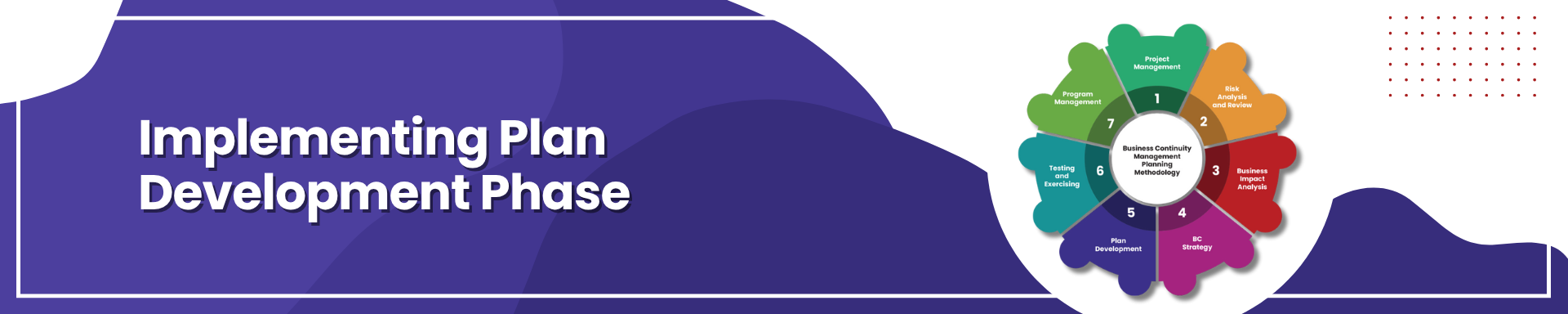
Phase 5: Plan Development (PD)
Purpose
Plan Development documents the procedures required to respond to and recover from disruptive incidents.
Objectives
- Prepare Business Continuity Plans.
- Develop Incident Management Plans.
- Document recovery procedures.
- Assign responsibilities.
- Establish communication protocols.
Key Activities
- Develop departmental BCPs.
- Prepare Incident Response Plans.
- Document manual workarounds.
- Develop notification procedures.
- Establish escalation criteria.
Deliverables
- Business Continuity Plans
- Incident Management Plan
- Department Recovery Procedures
- Emergency Contact Lists
- Communication Templates
Example – KKH
The Pharmacy Department develops a Business Continuity Plan that details emergency medication dispensing procedures, alternative storage arrangements, communication with suppliers, and manual documentation processes during prolonged system outages.
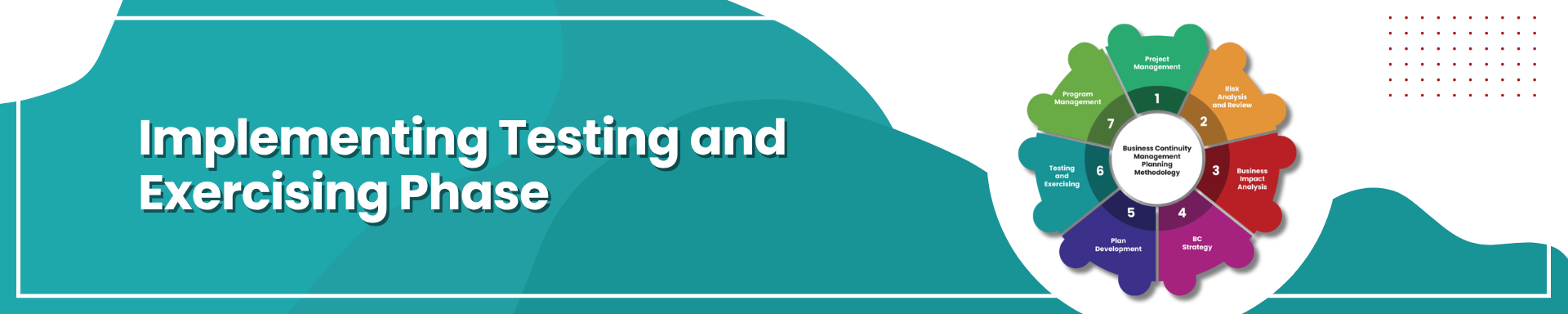
Phase 6: Testing and Exercising (TE)
Purpose
Plan Development documents the procedures required to respond to and recover from disruptive incidents.
Objectives
- Prepare Business Continuity Plans.
- Develop Incident Management Plans.
- Document recovery procedures.
- Assign responsibilities.
- Establish communication protocols.
Key Activities
- Develop departmental BCPs.
- Prepare Incident Response Plans.
- Document manual workarounds.
- Develop notification procedures.
- Establish escalation criteria.
Deliverables
- Business Continuity Plans
- Incident Management Plan
- Department Recovery Procedures
- Emergency Contact Lists
- Communication Templates
Example – KKH
The Pharmacy Department develops a Business Continuity Plan that details emergency medication dispensing procedures, alternative storage arrangements, communication with suppliers, and manual documentation processes during prolonged system outages.

Phase 7: Programme Management (PgM)
Purpose
Programme Management ensures the BCMS remains effective through governance, monitoring, review, and continual improvement.
Objectives
- Maintain BCM documentation.
- Monitor programme performance.
- Conduct internal audits.
- Review management performance.
- Coordinate continual improvement.
Key Activities
- Annual BCMS reviews.
- Internal audits.
- KPI monitoring.
- Management reviews.
- Updating BIA and Risk Assessments.
- Training and awareness.
- Regulatory compliance reviews.
Deliverables
- BCMS Performance Reports
- Audit Reports
- Management Review Minutes
- Improvement Plans
- Updated BCM Documentation
Example – KKH
Following an annual BCM exercise, KKH reviews recovery performance, updates departmental continuity plans, revises recovery priorities where necessary, and incorporates new cybersecurity measures into the BCMS.
Relationship Between the Seven Phases
The seven phases are interdependent.
Project Management
│
▼
Risk Analysis & Review
│
▼
Business Impact Analysis
│
▼
Business Continuity Strategy
│
▼
Plan Development
│
▼
Testing & Exercising
│
▼
Programme Management
│
└───────────────► Continual Improvement
The methodology supports the Plan–Do–Check–Act (PDCA) cycle that underpins ISO 22301.
Alignment with ISO 22301
The seven-phase methodology aligns closely with the major requirements of ISO 22301.
|
BCM Phase |
ISO 22301 Alignment |
|
Project Management |
Clauses 4, 5 and 6 – Context, Leadership, Planning |
|
Risk Analysis and Review |
Clause 6 – Planning and Risk Management |
|
Business Impact Analysis |
Clause 8 – Operational Planning and Control |
|
Business Continuity Strategy |
Clause 8 – Business Continuity Strategies and Solutions |
|
Plan Development |
Clause 8 – Business Continuity Procedures |
|
Testing and Exercising |
Clause 8 – Exercising and Testing |
|
Programme Management |
Clauses 9 and 10 – Performance Evaluation and Improvement |
This alignment ensures that KKH's BCMS implementation is consistent with internationally recognised business continuity practices.
Practical Example
KKH decides to strengthen the resilience of its Labour and Delivery services.
Using the seven-phase methodology:
- Project Management establishes the project team and defines implementation milestones.
- Risk Analysis and Review identifies potential disruptions such as power failures, ICT outages, infectious disease outbreaks, and medical gas interruptions.
- Business Impact Analysis confirms Labour and Delivery as a Priority 1 Critical Business Function and establishes recovery requirements.
- Business Continuity Strategy recommends redundant utilities, emergency staffing arrangements, alternative pharmaceutical suppliers, and backup communication systems.
- Plan Development documents response procedures, escalation processes, and manual clinical workflows.
- Testing and Exercising validates the plan through a simulated utility outage affecting delivery suites.
- Programme Management reviews lessons learned, updates documentation, monitors performance indicators, and schedules future exercises.
This structured methodology ensures that BCM implementation is comprehensive, repeatable, and continually improved.
Summary of the Seven-Phase BCM Planning Methodology
|
Phase |
Focus |
Primary Outcome |
|
Project Management |
Governance and project planning |
Organised implementation programme |
|
Risk Analysis and Review |
Threat identification |
Understanding of organisational risks |
|
Business Impact Analysis |
Criticality assessment |
Recovery priorities established |
|
Business Continuity Strategy |
Recovery solutions |
Resilient operational strategies |
|
Plan Development |
Documentation |
Practical continuity and recovery plans |
|
Testing and Exercising |
Validation |
Proven recovery capability |
|
Programme Management |
Governance and improvement |
Sustainable and continually improving BCMS |
![Banner [Summary] [BCM] [E1] [C8] Implementing the BCM Planning Methodology](https://no-cache.hubspot.com/cta/default/3893111/e44be53e-a156-4a00-b518-a7714cf21ce3.png)
A structured planning methodology is essential for implementing an effective and sustainable Business Continuity Management System.
The Seven-Phase BCM Planning Methodology presented in this chapter provides KK Women's and Children's Hospital with a practical framework for translating the requirements of ISO 22301 into a comprehensive programme of governance, risk assessment, impact analysis, strategy development, plan preparation, testing, and continual improvement.
Each phase builds upon the previous one, ensuring that continuity planning is systematic, evidence-based, and aligned with the hospital's strategic priorities.
For KKH, this methodology supports more than regulatory compliance—it strengthens the hospital's ability to safeguard patients, maintain critical maternity, neonatal, paediatric, and specialist healthcare services, and respond effectively to disruptive events.
By embedding the seven phases into routine organisational management and continually reviewing their effectiveness, KKH can enhance its operational resilience, adapt to emerging risks, and sustain the delivery of safe, reliable, and high-quality healthcare services for the communities it serves.
![[BCM] [KKH] [3/4 Banner] Implementing Business Continuity Management for KKH](https://no-cache.hubspot.com/cta/default/3893111/141669d3-f654-4e57-9ccd-2d2ab49f536d.png)
![[BCM] [KKH] [E1] [C1] Overview of BCM Case Study](https://no-cache.hubspot.com/cta/default/3893111/d80c1c6f-ac90-4853-8993-06ce5e66ded4.png)
![[BCM] [KKH] [E1] [C2] Understanding Your Organisation](https://no-cache.hubspot.com/cta/default/3893111/4a73e6ef-891a-4ddd-8e84-f91455f9acf4.png)
![[BCM] [KKH] [E1] [C3] Establishing Organisational Goals](https://no-cache.hubspot.com/cta/default/3893111/3c5da49d-9ea0-4387-8771-eac41dc94e15.png)
![[BCM] [KKH] [E1] [C4] Establishing Business Continuity Objectives](https://no-cache.hubspot.com/cta/default/3893111/f88a7494-e8e5-4f34-87a4-2927037af0bf.png)
![[BCM] [KKH] [E1] [C5] Determining BC Assumptions](https://no-cache.hubspot.com/cta/default/3893111/8aac857c-a03f-4df0-a00a-24aaad353f1b.png)
![[BCM] [KKH] [E1] [C6] Composing BCM Team](https://no-cache.hubspot.com/cta/default/3893111/87e9c53a-d7fe-49e3-b3e0-8e081622c7c5.png)
![[BCM] [KKH] [E1] [C7] Analysing Operating Environment](https://no-cache.hubspot.com/cta/default/3893111/a22cd99f-be08-48c2-a043-968e56a57e29.png)
![[BCM] [KKH] [E1] [C9] Assessing Risks and Threats](https://no-cache.hubspot.com/cta/default/3893111/062e7210-8f1c-4db8-bf2e-04ad16eabc66.png)
![[BCM] [KKH] [E1] [C10] Identifying Critical Business Functions](https://no-cache.hubspot.com/cta/default/3893111/0d1cbf1e-59f6-43c8-a15e-6b34233e632f.png)
![[BCM] [KKH] [E1] [C11] Summary](https://no-cache.hubspot.com/cta/default/3893111/d50b6cba-6f7f-4a19-91ac-59610e4d5d51.png)
![[BCM] [KKH] [E1] [C12] Back Cover](https://no-cache.hubspot.com/cta/default/3893111/509cde14-6e70-4f58-9297-1d236005973a.png)
More Information About Business Continuity Management Courses
To learn more about the course and schedule, click the buttons below for BCM-300 Business Continuity Management Implementer [BCM-3] and BCM-5000 Business Continuity Management Expert Implementer [BCM-5].


![Register [BL-B-3]*](https://no-cache.hubspot.com/cta/default/3893111/ac6cf073-4cdd-4541-91ed-889f731d5076.png)



![FAQ [BL-B-3]](https://no-cache.hubspot.com/cta/default/3893111/b3824ba1-7aa1-4eb6-bef8-94f57121c5ae.png)
![Email to Sales Team [BCM Institute]](https://no-cache.hubspot.com/cta/default/3893111/3c53daeb-2836-4843-b0e0-645baee2ab9e.png)


