


![[BCM] [E3] [BIA] [P1] [P2] [P3] [P4] {P5] [P6] Template](https://no-cache.hubspot.com/cta/default/3893111/d0508ed9-8fef-4cbe-a91b-337f2f8a2463.png)

CBF-1 Residential Care and Resident Safety
Introduction

A Business Impact Analysis (BIA) requires an organisation to understand not only the consequences of disrupting its critical business functions but also the resources, supporting activities, and external services those functions depend on.
For Jamiyah Singapore (JS), CBF-1 Residential Care and Resident Safety involves an interconnected network of residential care personnel, healthcare support, facilities, information systems, emergency services, suppliers and management functions.
Delivering safe residential care depends on these resources working together.
For example, resident supervision requires appropriately trained personnel, accurate resident information, safe premises and effective communication arrangements. Essential meals depend on food suppliers, catering arrangements, utilities and personnel responsible for distribution.
Emergency relocation may require coordinated support from residential care management, transport providers, alternative accommodation operators, healthcare personnel and emergency services.
A disruption affecting any of these dependencies may prevent Jamiyah Singapore from achieving the Business Unit Minimum Business Continuity Objectives (BU MBCOs) established in BIA Part 1.
Consequently, dependency mapping is essential to BCM implementation.
This chapter identifies the principal internal and external dependencies associated with the 26 Sub-Critical Business Functions supporting Residential Care and Resident Safety.
It also examines the direction and nature of these dependencies to support recovery planning, supplier resilience, third-party risk management and operational resilience.
Purpose of Dependency Mapping
BIA Part 5 identifies the organisations, business units, service providers, and supporting functions required to sustain each Sub-CBF.
The assessment enables Jamiyah Singapore to:
- Identify essential internal support functions.
- Recognise reliance on external suppliers and service providers.
- Determine which resources or information must be available before an activity can operate.
- Identify outputs required by other business functions.
- Understand reciprocal dependencies between operational teams.
- Identify potential single points of failure.
- Establish appropriate recovery sequencing.
- Determine where alternative suppliers, resources or service arrangements may be required.
- Support coordinated continuity planning across the organisation.
Internal Dependencies
Internal dependencies arise when a Sub-CBF relies on another function, department, team or resource within Jamiyah Singapore.
Examples include Human Resources, Finance, ICT, Facilities Management, Residential Care Management, Safeguarding, Communications and senior management.
For instance, Sub-CBF 1.6 Determine and Assign Residential Care Staffing depends on HR support for workforce availability, staffing information and contingency personnel arrangements.
Similarly, Sub-CBF 1.17 Maintain Resident Records and Essential Information depends on ICT and Records Management to maintain secure access to essential information.
External Dependencies
External dependencies arise when a Sub-CBF relies on organisations or resources outside Jamiyah Singapore.
These may include healthcare providers, emergency services, food suppliers, telecommunications providers, utility providers, transport operators, external staffing agencies and alternative accommodation providers.
For example, Sub-CBF 1.9, Provide Essential Meals and Hydration may depend on an external catering or food supplier.
A supplier disruption may therefore affect the ability to maintain the minimum meal and hydration requirements established in the BU MBCO.
Dependency Direction
Dependencies can be classified according to the direction of reliance.
|
Dependency Direction |
Definition |
Example for JS |
|
Upstream |
A business function depends on resources, information, approvals or services supplied by another party. |
Residential care depends on an external food supplier to provide meals. |
|
Downstream |
Another function depends on the outputs or information produced by the assessed Sub-CBF. |
Resident assessment produces care requirements used by care planning personnel. |
|
Mutual |
Two parties depend on each other through ongoing exchanges of information, services or operational support. |
Residential Care and Healthcare Support coordinate resident observations, clinical instructions and care follow-up. |
A single Sub-CBF may have multiple dependencies with different directions.
For the principal assessment table, select the most significant dependency relationship for each row.
Relationship with BCM and Operational Resilience
Dependency mapping provides an important link between BIA, Business Continuity Strategy, and Business Continuity Plan
Development and Third-Party Risk Management.
It helps Jamiyah Singapore identify whether recovery arrangements depend on the availability of other functions or suppliers.
For example, a recovery strategy involving alternative accommodation may be ineffective if transport providers, staffing arrangements or essential resident information are unavailable.
Dependency mapping, therefore, supports the development of coordinated and realistic continuity arrangements.
Dependency Assessment Methodology
The assessment identifies the principal supporting dependency for each Sub-CBF.
The following criteria are applied.
|
Assessment Component |
Description |
|
Business Unit / Vendor / Supplier / Outsourcing Partner |
Principal party providing or receiving essential support |
|
Internal Dependency |
Indicates whether the identified party is an internal JS function |
|
External Dependency |
Indicates whether the identified party is outside JS |
|
Dependency Direction |
Upstream, Downstream or Mutual |
|
Nature of Dependency |
Information, services, resources or operational support exchanged and the consequences of unavailability |
Assessment Assumptions
The following assumptions apply:
- Jamiyah Singapore operates residential care services supported by internal administrative, care, facilities and management functions.
- Certain services, such as food provision, utilities, emergency transportation and healthcare referrals, may depend on external organisations.
- The dependencies identified represent proposed operational relationships, not existing contractual arrangements.
- Each row identifies one principal dependency for clarity, although a Sub-CBF may depend on multiple parties.
- The actual dependency register should identify named owners, suppliers, contractual arrangements, service levels, recovery capabilities and alternative resources.

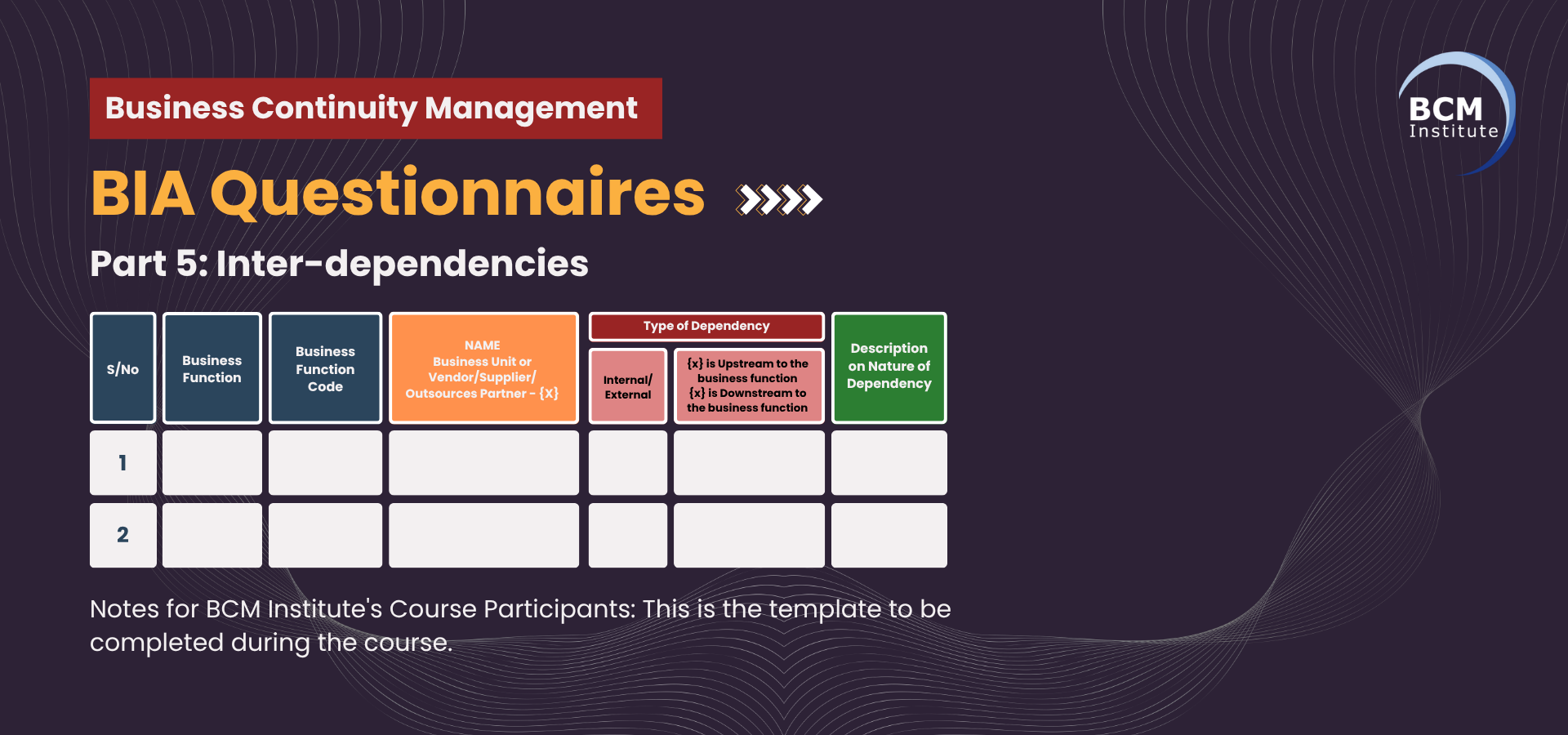
Table BIA Part 5: Inter-dependencies for CBF-1 Residential Care and Resident Safety
|
Sub-CBF Code |
Sub-Critical Business Function |
Business Unit / Vendor / Supplier / Outsourcing Partner |
Internal Dependency |
External Dependency |
Dependency Direction (Upstream / Downstream / Mutual) |
Description of the Nature of Dependency |
|
1.1 |
Receive and Assess Resident Referrals |
Referring Social Service Agencies and Relevant Community Partners |
No |
Yes |
Upstream |
JS receives referrals, applicant information and supporting assessments from referring organisations. Unavailability may delay urgent placement assessment and safeguarding decisions. |
|
1.2 |
Coordinate Resident Admission and Registration |
Residential Care Administration / Records Management |
Yes |
No |
Mutual |
Admission personnel exchange resident details, authorisations and essential registration information with Records Management. Disruption may delay admission or leave critical information incomplete. |
|
1.3 |
Assess Resident Care and Support Requirements |
Residential Care Assessment Team |
Yes |
No |
Downstream |
Resident assessments produce dependency, supervision and care requirements used by care planning and staffing functions. Delays may result in inappropriate care arrangements. |
|
1.4 |
Develop and Maintain Individual Resident Care Plans |
Residential Care Operations Team |
Yes |
No |
Mutual |
Care planners receive resident observations and provide operational personnel with updated care instructions. Loss of coordination may result in outdated or inconsistent care. |
|
1.5 |
Allocate Residential Accommodation and Facilities |
Facilities Management |
Yes |
No |
Upstream |
Facilities Management provides information on accommodation availability, room suitability, and safety. Unavailability may prevent safe resident placement or room allocation. |
|
1.6 |
Determine and Assign Residential Care Staffing |
Human Resources |
Yes |
No |
Mutual |
HR provides staffing availability, personnel records and contingency staffing support, while residential management provides shift and competency requirements. Disruption may compromise safe staffing coverage. |
|
1.7 |
Maintain Resident Supervision and Accountability |
Residential Care Duty Teams |
Yes |
No |
Mutual |
Duty teams exchange shift handover information, resident whereabouts and supervision responsibilities. Failure may create gaps in accountability and safeguarding. |
|
1.8 |
Provide Essential Daily Living Assistance |
Residential Care Personnel |
Yes |
No |
Upstream |
Essential daily living assistance depends on trained care personnel and current resident support instructions. Staff unavailability may interrupt necessary personal care. |
|
1.9 |
Provide Essential Meals and Hydration |
Food and Catering Suppliers |
No |
Yes |
Upstream |
External suppliers provide meals, food ingredients or catering services according to resident dietary requirements. Disruption may affect nutrition and hydration provision. |
|
1.10 |
Maintain Personal Hygiene and Sanitation Support |
Facilities and Housekeeping Services |
Yes |
No |
Mutual |
Residential care personnel coordinate hygiene needs with housekeeping and facilities support. Service interruption may compromise sanitation, personal care and infection prevention. |
|
1.11 |
Coordinate Essential Medication and Healthcare Support |
CBF-2 Nursing and Essential Healthcare Support |
Yes |
No |
Mutual |
Residential care personnel observe residents and receive authorised care instructions and medication-related support. Disruption may delay time-critical care or clinical escalation. |
|
1.12 |
Monitor Resident Welfare and Changes in Condition |
CBF-2 Nursing and Essential Healthcare Support |
Yes |
No |
Mutual |
Residential staff communicate changes in a resident's condition to healthcare personnel, who assess and provide follow-up guidance. Delayed coordination may prevent timely intervention. |
|
1.13 |
Maintain Resident Safeguarding and Protection |
Designated Safeguarding Personnel / Service Management |
Yes |
No |
Mutual |
Residential personnel report safeguarding concerns and receive direction on protective actions, escalation and case follow-up. Unavailability may delay intervention and required reporting. |
|
1.14 |
Maintain Residential Facility Safety and Security |
Facilities Management and Security Support |
Yes |
No |
Upstream |
Residential operations rely on safe premises, access controls, fire protection and security support. Failure may make facilities unsuitable for continued occupancy. |
|
1.15 |
Maintain Essential Utilities and Environmental Conditions |
Electricity, Water and Essential Utility Providers |
No |
Yes |
Upstream |
Utility providers supply electricity, water and other essential services. Prolonged interruption may affect lighting, sanitation, ventilation and safe residential care. |
|
1.16 |
Manage Resident Incidents and Immediate Emergencies |
Singapore Civil Defence Force / Emergency Response Services |
No |
Yes |
Mutual |
JS provides incident information and requests emergency assistance; emergency responders provide protective intervention and coordination. Delays may worsen incident consequences. |
|
1.17 |
Maintain Resident Records and Essential Information |
ICT and Records Management |
Yes |
No |
Mutual |
Residential care personnel create and retrieve resident information while ICT and Records Management maintain system availability, access and data protection. Disruption may affect care decisions and accountability. |
|
1.18 |
Coordinate Resident and Family Communications |
Corporate Communications / Designated Residential Care Communications Personnel |
Yes |
No |
Mutual |
Residential care teams provide verified incident and service information; communications personnel support approved messages and stakeholder contact. Failure may delay family notification and increase uncertainty. |
|
1.19 |
Coordinate External Healthcare and Emergency Services |
Hospitals, Ambulance Services and External Healthcare Providers |
No |
Yes |
Mutual |
JS communicates resident needs and transfer information while external providers deliver emergency assessment, treatment or transfer support. Unavailability may delay necessary healthcare intervention. |
|
1.20 |
Maintain Essential Residential Supplies and Equipment |
Procurement and Finance Support |
Yes |
No |
Mutual |
Residential care identifies essential resource requirements while Procurement and Finance support sourcing, approvals and expenditure. Delays may cause shortages of care supplies or equipment. |
|
1.21 |
Manage Resident Activities and Essential Welfare Support |
Residential Welfare and Programme Personnel |
Yes |
No |
Mutual |
Care personnel communicate resident welfare needs while programme personnel coordinate appropriate activities and support. Disruption may affect psychosocial well-being and daily routines. |
|
1.22 |
Activate Residential Care Continuity Arrangements |
BCM Coordinator / Crisis Management Team |
Yes |
No |
Mutual |
Residential care management provides incident assessments and resource needs; BCM and crisis management personnel coordinate activation, escalation and recovery support. Failure may delay continuity actions. |
|
1.23 |
Coordinate Emergency Resident Relocation and Alternative Accommodation |
Alternative Accommodation and Transport Providers |
No |
Yes |
Upstream |
JS depends on suitable alternative premises and transport capability to relocate residents. Unavailability may prevent timely evacuation or safe alternative placement. |
|
1.24 |
Maintain Essential Care at the Recovery Location |
Recovery-Site Operator / Alternative Accommodation Provider |
No |
Yes |
Mutual |
The provider supplies suitable accommodation and facilities while JS supplies care personnel, resident information and operating requirements. Poor coordination may prevent safe care at the recovery location. |
|
1.25 |
Restore Normal Residential Care Operations |
Facilities Management / Residential Care Management |
Yes |
No |
Mutual |
Facilities Management confirms premises readiness, while Residential Care Management verifies staffing, care arrangements, and resident return requirements. Premature restoration may create safety risks. |
|
1.26 |
Conduct Post-Incident Review and Care Continuity Improvement |
BCM Coordinator / Risk Management Function |
Yes |
No |
Mutual |
Residential care provides incident evidence and lessons learned while BCM and Risk Management coordinate corrective actions and follow-up. Failure may leave recurring weaknesses unresolved. |
The table identifies one principal relationship per Sub-CBF. It is not an exhaustive supplier or dependency register.
Named organisations and service arrangements must be confirmed against JS's actual operating model, contracts and approved governance structure.
Analysis of Internal Dependencies
Internal dependencies support the coordination of residential care activities across Jamiyah Singapore.
The most significant internal relationships are likely to involve Residential Care Management, Healthcare Support,
Human Resources, Facilities Management, ICT, Records Management, Procurement, Finance and BCM coordination.
Table 4.1: Key Internal Dependency Groups
|
Internal Supporting Function |
Relevant Sub-CBFs |
Principal Dependency |
|
Residential Care Management and Duty Teams |
1.2–1.8, 1.12, 1.21, 1.25 |
Care planning, supervision, staffing coordination and operational decisions |
|
CBF-2 Nursing and Essential Healthcare Support |
1.11, 1.12, 1.19 |
Healthcare coordination, clinical escalation and care continuity |
|
Human Resources |
1.6, 1.8, 1.22–1.24 |
Staffing availability, contingency deployment and competency management |
|
Facilities Management |
1.5, 1.10, 1.14, 1.15, 1.25 |
Safe premises, utilities, sanitation and facility restoration |
|
ICT and Records Management |
1.2–1.4, 1.7, 1.11–1.13, 1.17, 1.23, 1.24 |
Resident information, technology availability and secure records |
|
Procurement and Finance |
1.9, 1.15, 1.20, 1.23, 1.24 |
Emergency supplies, procurement approvals and recovery expenditure |
|
Communications |
1.18, 1.22, 1.23 |
Family notifications, stakeholder communications and escalation |
|
BCM and Crisis Management |
1.16, 1.22–1.26 |
Continuity activation, recovery coordination and improvement |
Shared Internal Resources
Some internal functions support multiple Sub-CBFs.
For example, ICT and Records Management may support admission, care planning, supervision, safeguarding, emergency response and relocation.
A single technology disruption may therefore affect several residential care activities simultaneously.
Similarly, a severe workforce shortage may affect supervision, daily living assistance, resident welfare monitoring and recovery-site operations.
Identify these shared dependencies as potential concentration risks.
Recovery Sequencing
Recovery sequencing should recognise that certain supporting activities must be available before others can operate effectively.
For example, emergency relocation may require access to resident information, transport arrangements, staffing and alternative premises.
Jamiyah Singapore should coordinate the recovery of these supporting capabilities rather than manage them as isolated activities.
Analysis of External Dependencies
External dependencies can be particularly significant because Jamiyah Singapore may have limited direct control over third-party providers' availability and recovery capabilities.
Table 5.1: Key External Dependency Categories
|
External Dependency |
Supporting Sub-CBFs |
Potential Disruption Consequence |
Continuity Consideration |
|
Referring Social Service Agencies |
1.1 |
Delayed referral information and urgent placement assessment |
Alternative referral channels and essential information requirements |
|
Food and Catering Suppliers |
1.9 |
Interruption to meals and dietary provision |
Emergency food stocks and alternative catering |
|
Utility Providers |
1.15 |
Loss of power, water or other essential services |
Backup utilities and alternative premises |
|
Emergency Response Services |
1.16 |
Delayed emergency assistance |
Immediate protective measures and reliable emergency communications |
|
Hospitals and Healthcare Providers |
1.19 |
Delayed assessment, treatment or transfer |
Alternative referral arrangements and emergency escalation |
|
Alternative Accommodation Providers |
1.23, 1.24 |
Inability to relocate or sustain care at another location |
Pre-identified suitable premises and documented arrangements |
|
Transport Providers |
1.19, 1.23 |
Delayed healthcare transfer or resident relocation |
Alternative transport capacity and priority mobilisation |
|
Telecommunications Providers |
1.17, 1.18, 1.22 |
Reduced communications and system connectivity |
Secondary communication methods and alternative connectivity |
|
ICT and Cloud Service Providers |
1.4, 1.7, 1.17, 1.22 |
Unavailability of essential resident information or recovery coordination systems |
Recovery commitments, backups and secure downtime procedures |
Expand the table during supplier assessment to identify actual vendors, contractual obligations, recovery capabilities, and alternative service options.
Dependency Direction and Recovery Implications
Upstream Dependencies
Upstream dependencies are inputs required before a Sub-CBF can operate.
For example, essential meal provision depends on food supplies, suitable preparation arrangements and personnel.
If an upstream dependency fails, the affected process may be unable to achieve its BU MBCO.
Continuity strategies should therefore address alternative sources, emergency reserves and substitute operating arrangements.
Downstream Dependencies
Downstream dependencies arise when another activity relies on the outputs of the assessed Sub-CBF.
For example, resident assessment provides essential information for care planning, staffing and accommodation decisions.
If assessment outputs are unavailable or inaccurate, downstream activities may be affected even if their own personnel and systems remain operational.
The BIA should therefore identify the consequences of delayed or incomplete information handovers.
Mutual Dependencies
Mutual dependencies involve continuous exchanges of information or operational support.
For example, residential care and healthcare support depend on each other for resident observations, care instructions and follow-up.
These relationships require coordinated recovery arrangements.
Restoring only one party may be insufficient if the other remains unavailable.
Dependency Criticality and Single Points of Failure
Dependency mapping should be followed by an assessment of dependency criticality.
Not all dependencies affect the BU MBCO equally.
Table 7.1: Preliminary Dependency Criticality
|
Dependency |
Potential Criticality |
Reason |
|
Residential Care Personnel |
Very High |
Essential supervision and daily care require appropriately trained personnel |
|
Healthcare Support |
Very High |
Necessary clinical coordination and time-critical care |
|
Safe Residential Premises |
Very High |
Required for safe accommodation and care |
|
Emergency Response Capability |
Very High |
Required for immediate protection and escalation |
|
Essential Resident Information |
Very High |
Supports safe care decisions, accountability and relocation |
|
Electricity and Water |
Very High |
Necessary for safe environmental conditions and essential care |
|
Food and Drinking Water |
Very High |
Required for resident nutrition and hydration |
|
Alternative Accommodation and Transport |
High to Very High |
Critical when existing premises are unsafe |
|
Telecommunications |
High |
Supports emergency coordination and stakeholder communications |
|
Procurement and Finance |
High |
Enables emergency sourcing and recovery expenditure |
|
Routine Programme Support |
Moderate |
Some activities may be temporarily deferred without compromising essential care |
These ratings are preliminary and should be validated through the BIA and Risk Analysis and Review process.
Identifying Single Points of Failure
Potential single points of failure may include:
- Reliance on one residential facility without a suitable alternative.
- Dependence on one catering supplier.
- Limited availability of personnel with essential competencies.
- A single resident information system without accessible downtime records.
- Dependence on one telecommunications provider.
- Lack of suitable transport for emergency relocation.
- Reliance on a single person to authorise continuity activation.
The BCM Coordinator should work with the relevant process owners to determine whether these vulnerabilities require additional mitigation or recovery arrangements.
Third-Party Risk Management and Supplier Resilience
Jamiyah Singapore should incorporate third-party dependencies into its broader supplier and operational risk management arrangements.
Supplier Resilience Assessment
For critical external providers, the assessment should consider:
|
Assessment Area |
Key Question |
|
Service Criticality |
Which Sub-CBFs depend on the supplier? |
|
Recovery Capability |
Can the supplier continue or restore essential services within the required timeframes? |
|
Alternative Providers |
Is a suitable replacement available? |
|
Concentration Risk |
Does JS depend on a single supplier or shared service provider? |
|
Geographic Exposure |
Could the same incident affect JS and the supplier? |
|
Communication |
How will service disruption be reported and escalated? |
|
Contractual Arrangements |
Are continuity, notification and recovery expectations documented? |
|
Testing and Assurance |
Has the supplier demonstrated relevant continuity capability? |
|
Exit and Substitution |
Can JS transfer essential services if the supplier becomes unavailable? |
Integrating Supplier Arrangements into BCPs
Critical supplier arrangements should be reflected in the relevant Business Continuity Plans.
For example, the residential care plan should identify the approved alternative catering arrangement, emergency transport contacts, alternative accommodation options and procedures for obtaining essential supplies.
Maintain and periodically verify contact information, activation authority, and resource requirements.
Relationship with Business Continuity Strategy Development
The dependency assessment supports recovery strategy development by identifying the capabilities needed to maintain each BU MBCO.
Table 9.1: Dependency-Driven Recovery Strategies
|
Dependency Risk |
Potential Business Continuity Strategy |
|
Residential care workforce shortage |
Contingency staffing, cross-training and approved replacement personnel |
|
Healthcare support disruption |
Alternative authorised healthcare arrangements and emergency referral pathways |
|
Catering supplier failure |
Emergency meal stocks and alternative suppliers |
|
Utility failure |
Backup power, emergency water and alternative premises |
|
ICT system unavailability |
Secure downtime records, protected backups and ITDR recovery |
|
Telecommunications failure |
Secondary communications and offline contact information |
|
Transport unavailability |
Alternative transport providers and pre-arranged mobilisation |
|
Alternative accommodation unavailable |
Multiple suitable recovery-site options |
|
Procurement delays |
Emergency purchasing authority and pre-approved suppliers |
|
Loss of continuity coordination |
Delegated activation authority and alternative coordination personnel |
Assess the selected strategies for feasibility, cost, availability, and ability to meet the approved recovery requirements.
Integrating Dependencies into Business Continuity Plans
The Business Continuity Plan for CBF-1 should document the critical dependencies required to maintain residential care.
For each significant dependency, the plan should identify:
- The supporting business unit or external provider.
- The essential service, resource or information required.
- The dependency owner and contact details.
- The relevant BU MBCO and recovery requirement.
- The consequence of dependency failure.
- The alternative resource or recovery arrangement.
- Activation and escalation procedures.
- Communication requirements.
- Testing and maintenance responsibilities.
For example, the emergency relocation procedure should not merely state that residents will be transferred to another location.
It should identify the alternative premises, transport arrangements, staffing requirements, resident information, essential supplies and coordination responsibilities needed to make relocation operationally achievable.
Operational Resilience and Enterprise Risk Management Implications
Dependency mapping supports operational resilience by showing how multiple activities rely on shared resources.
It enables Jamiyah Singapore to evaluate disruption scenarios involving the simultaneous loss of several supporting capabilities.
For example, a severe weather event may affect electricity, telecommunications, transport and supplier deliveries at the same time.
Similarly, a cyber incident may simultaneously affect resident records, workforce scheduling, communications, and procurement systems.
These scenarios demonstrate why dependency risks should not be assessed only at the level of individual suppliers or departments.
The organisation should consider the combined effect on delivering essential residential care.
Integration with Enterprise Risk Management
The dependency register should support the Risk Analysis and Review process by identifying:
- Shared-resource vulnerabilities.
- Supplier concentration risks.
- Facility and geographic dependencies.
- Workforce and competency constraints.
- ICT and information dependencies.
- Emergency response and healthcare dependencies.
- Recovery-site limitations.
Assess significant risks, assign them to accountable owners, and address them through appropriate mitigation or continuity arrangements.
Validation and Approval
The dependency assessment should be reviewed by relevant process owners and supporting functions.
Table 12.1: Recommended Review Responsibilities
|
Assessment Activity |
Responsible Contributor |
Required Review |
|
Identify internal dependencies |
Residential Care Process Owners |
Head of Residential Care |
|
Validate healthcare dependencies |
Residential Care and Healthcare Representatives |
Relevant Healthcare Lead |
|
Validate workforce dependencies |
HR Representatives |
BCM Coordinator |
|
Validate facility and utility dependencies |
Facilities Representatives |
BCM Coordinator |
|
Validate ICT and information dependencies |
ICT and Records Management |
ICT Manager |
|
Validate supplier and procurement dependencies |
Procurement and Finance |
BCM Coordinator |
|
Validate emergency relocation dependencies |
Residential Care and Facilities Management |
BCM Steering Committee |
|
Consolidate the dependency register |
BCM Coordinator |
BCM Steering Committee |
|
Approve critical dependency requirements |
Designated Senior Management |
Authorised Management Approver |
Maintain the approved dependency register as controlled BCM documentation and review it when significant changes occur in operations, suppliers, facilities, technology, or recovery arrangements.

Identifying and assessing interdependencies is an essential component of Business Impact Analysis because it shows how critical business functions rely on internal support activities, external organisations, suppliers, and shared resources.
For Jamiyah Singapore, CBF-1 Residential Care and Resident Safety depends on an interconnected network of residential care personnel, healthcare support, facilities, utilities, information systems, communications, emergency services, suppliers and recovery partners.
The assessment of the 26 Sub-Critical Business Functions demonstrates that no single activity operates entirely independently.
Each process relies on the timely availability of information, personnel, facilities, equipment, services or decisions provided by another function or organisation.
Understanding upstream dependencies helps Jamiyah Singapore identify the resources and services that must be available before essential residential care activities can operate.
Understanding downstream dependencies shows how interrupting one process may affect other activities.
Understanding mutual dependencies supports coordinated recovery planning between functions that continuously exchange information and operational support.
The findings provide a strong foundation for Business Continuity Strategy development by identifying where alternative suppliers, contingency staffing, backup utilities, secure information access, emergency transport, and alternative accommodation arrangements may be required.
They also support Business Continuity Plan Development by ensuring that recovery procedures address the practical dependencies necessary to sustain minimum service levels.
From a Third-Party Risk Management perspective, the assessment highlights the importance of evaluating supplier continuity capabilities, concentration risks, contractual arrangements and alternative sourcing options.
From an operational resilience perspective, dependency mapping enables Jamiyah Singapore to identify shared vulnerabilities and evaluate severe but plausible disruption scenarios that may affect multiple supporting resources simultaneously.
The ultimate objective is to ensure Jamiyah Singapore can maintain essential residential care, resident safety, and safeguarding even when key internal functions, external suppliers, or supporting services become unavailable.
The next stage of the Business Impact Analysis will focus on BIA Part 6 — Vital Records, identifying the essential documents, information and records required to support the 26 Sub-Critical Business Functions and maintain residential care during disruption.


More Information About Business Continuity Management Courses
To learn more about the course and schedule, click the buttons below for the BCM-300 Business Continuity Management Implementer [BCM-3] and the BCM-5000 Business Continuity Management Expert Implementer [BCM-5].