


CBF-1 Residential Care and Resident Safety
Introduction

Developing a Business Continuity Strategy (BCS) is a critical stage of Business Continuity Management (BCM).
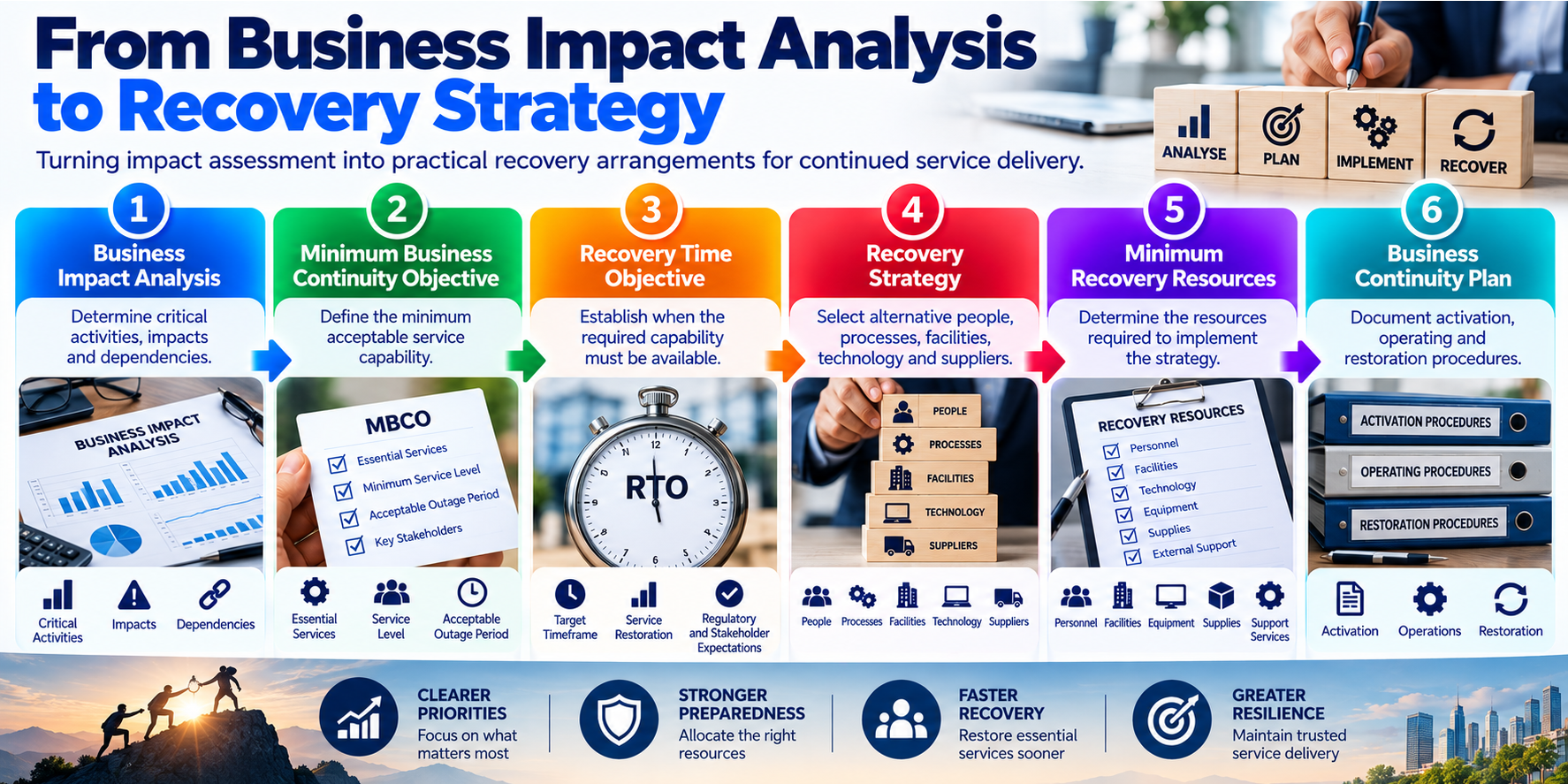
It translates the Business Impact Analysis (BIA) findings into practical arrangements that enable an organisation to maintain or restore essential activities after a disruption.
For Jamiyah Singapore (JS), CBF-1 Residential Care and Resident Safety involves services where interruption may directly affect the safety, welfare, health and protection of residents.
Unlike administrative functions that may tolerate temporary delays, essential residential care activities often require continuous operational capability.
Resident supervision, safeguarding, emergency response, time-critical healthcare coordination and essential daily living assistance must therefore be supported by recovery strategies that preserve safe care even when normal premises, personnel, technology or external services become unavailable.
This chapter identifies appropriate recovery strategies for the 26 Sub-Critical Business Functions (Sub-CBFs) supporting Residential Care and Resident Safety.
The proposed strategies are practical, proportionate, resource-efficient, and consistent with the recovery requirements established during BIA.
Purpose of Recovery Strategy Development
Recovery strategies establish how essential activities will continue or recover when normal operating arrangements cannot be maintained.
They identify alternative service delivery methods, supporting resources, recovery locations, and operational arrangements.
For JS, the objectives are to:
- Preserve resident safety, supervision and safeguarding.
- Maintain essential accommodation, meals, hydration, hygiene and healthcare coordination.
- Enable urgent decisions and communications.
- Provide alternative facilities, personnel and suppliers when necessary.
- Maintain access to essential resident information.
- Restore normal residential care in a controlled and safe manner.
Select recovery strategies based on the consequences of disruption, not simply the availability of a particular technology or recovery facility.
Relationship Between BIA and Recovery Strategies
The BIA establishes the minimum service level that must be maintained and the maximum acceptable time to restore disrupted activities.
Recovery strategy development uses these findings to determine how to achieve the required service capability.
Relationship Between RTO and MTPD
The Recovery Time Objective (RTO) defines the targeted time within which an activity must be restored to its approved minimum service level.
The Maximum Tolerable Period of Disruption (MTPD) represents the period beyond which the consequences of disruption would become unacceptable.
The RTO should normally be shorter than the MTPD to provide a margin for uncertainty, recovery delays and unforeseen complications.
For safety-critical residential care, however, the acceptable interruption may be effectively zero.
A recorded RTO of Immediate means the essential service must be maintained continuously through approved contingency arrangements. It does not imply that unsafe care may be interrupted while recovery activities are organised.
For example, if resident supervision must continue without interruption, JS should maintain supervision through available staff and immediate contingency arrangements rather than waiting for a replacement team to arrive.
Why Different Sub-CBFs Require Different Recovery Strategies
Recovery strategies must reflect the operational characteristics of individual Sub-CBFs.
For example, urgent referral assessments may be conducted through secure remote work or manual procedures.
Essential meals may require an alternative catering supplier.
Resident supervision may require cross-trained personnel and immediate redeployment.
Emergency relocation requires suitable accommodation, transport and coordinated care.
A single recovery strategy is therefore unlikely to address all residential care activities effectively.
Recovery Strategy Assessment Basis
The assessment uses the BIA recovery requirements previously established for CBF-1.
Table 2.1: Recovery Strategy Planning Assumptions
|
Planning Parameter |
Assumption |
|
Recovery objective |
Maintain approved BU MBCOs for essential residential care |
|
Recovery scenario |
Loss of premises, personnel, technology, utilities or external services |
|
Recovery population |
Illustrative residential population of 40 residents |
|
Recovery approach |
Risk-based, resource-optimised and safety-focused |
|
Primary recovery principle |
Maintain essential care at a safe location |
|
Alternative operating arrangements |
Manual procedures, cross-trained personnel, alternate accommodation, supplier substitution and secure remote access |
|
Recovery location |
Unaffected primary facility, suitable alternative residential premises or secure administrative recovery location |
|
ICT recovery |
Coordinated with BIA Part 4 System RTO and RPO requirements |
|
Recovery resources |
Subject to validation through BCS P3 |
|
Approval |
All strategies require JS operational and management approval |
The 40-resident assumption is illustrative and does not represent a verified JS residential population.
Strategy Selection Criteria
Each proposed recovery strategy should be evaluated against its ability to:
- Maintain resident safety and safeguarding.
- Meet the approved RTO and BU MBCO.
- Operate with realistically available personnel and resources.
- Meet applicable service, safety and regulatory requirements.
- Avoid excessive reliance on a single facility, supplier or technology.
- Remain financially proportionate to the risk.
- Activate through clear, tested procedures.

Table BCS T2: Recovery Strategies for CBF-1 Residential Care and Resident Safety
|
Sub-CBF Code |
Sub-Critical Business Function |
Recovery Time Objective (RTO) |
Recovery Strategy |
Recovery Location |
Details of Recovery Strategy |
Justification for Selected Recovery Strategy |
|
1.1 |
Receive and Assess Resident Referrals |
8 Hours |
Remote Working / Manual Workaround |
Secure Remote Working Location / Alternate Office |
Authorised intake personnel use secure referral channels, controlled electronic forms or manual intake records. Prioritise urgent and safeguarding-related referrals; defer routine cases. |
Maintains urgent intake capability without requiring a dedicated recovery office. Secure remote access and controlled manual procedures offer a proportionate, low-cost solution. |
|
1.2 |
Coordinate Resident Admission and Registration |
8 Hours |
Manual Workaround / Alternate Processing Site |
Recovery-Site Administration Station |
Use controlled admission forms and essential resident identification, care and emergency contact information. Record urgent admissions manually and reconcile information when systems recover. |
Supports urgent admissions within the RTO without dependence on the primary registration application. |
|
1.3 |
Assess Resident Care and Support Requirements |
4 Hours |
Cross-trained Personnel / Manual Workaround |
Safe Primary Residential Area / Alternative Residential Care Facility |
Deploy competent assessment personnel using controlled assessment templates and essential resident information. Prioritise new residents and material changes in care needs. |
Preserves timely safety and care assessment while allowing temporary operation without the normal electronic assessment system. |
|
1.4 |
Develop and Maintain Individual Resident Care Plans |
8 Hours |
Manual Workaround / Secure Cloud-based Recovery |
Recovery-Site Care Station |
Maintain approved minimum care summaries and controlled paper updates when the electronic system is unavailable. Authorised care personnel validate changes and reconcile records after restoration. |
Ensures essential care instructions remain accessible while avoiding the cost of a fully duplicated care-planning platform. |
|
1.5 |
Allocate Residential Accommodation and Facilities |
2 Hours |
Alternate Processing Site / Reciprocal Arrangement |
Safe Primary Residential Area / Alternative Residential Care Facility |
Facilities and residential management verify safe room capacity, accessibility and resident needs. Allocate suitable accommodation through a controlled occupancy register and activate pre-arranged alternatives when necessary. |
Accommodation is essential for resident safety. Pre-identified suitable premises provide faster recovery than searching for accommodation after an incident. |
|
1.6 |
Determine and Assign Residential Care Staffing |
Immediate; contingency deployment within 30 Minutes |
Cross-trained Personnel / Workload Prioritisation |
Primary or Alternative Residential Care Facility |
Duty management maintains immediate safe staffing, activates approved standby personnel and reallocates competent staff according to resident dependency and required supervision. |
Workforce arrangements must preserve care continuously. Pre-approved redeployment is faster than relying on external recruitment after disruption. |
|
1.7 |
Maintain Resident Supervision and Accountability |
Immediate — No Safety Gap |
Cross-trained Personnel / Manual Workaround |
Safe Primary Residential Area / Alternative Residential Care Facility |
Maintain continuous supervision, current resident accountability lists, designated duty coverage and immediate missing-resident escalation. Use manual registers and portable communications during ICT outages. |
Direct supervision cannot wait for technology recovery. Competent personnel and controlled manual records provide immediate operational continuity. |
|
1.8 |
Provide Essential Daily Living Assistance |
1 Hour |
Cross-trained Personnel / Workload Prioritisation |
Alternative Residential Care Facility |
Prioritise residents requiring assistance with mobility, toileting, feeding and other essential activities. Deploy competent care personnel and essential care equipment. |
Prioritised direct care provides a rapid, practical response without attempting to restore non-essential routines first. |
|
1.9 |
Provide Essential Meals and Hydration |
2 Hours |
Third-party Recovery Support / Alternative Supplier |
Alternative Residential Care Facility / Approved Catering Location |
Activate emergency food stocks or an approved alternative catering arrangement. Confirm dietary restrictions, safe food handling and drinking-water provision. |
Supplier substitution and emergency reserves are more practical than establishing a complete temporary kitchen operation during a short disruption. |
|
1.10 |
Maintain Personal Hygiene and Sanitation Support |
2 Hours |
Manual Workaround / Third-party Recovery Support |
Safe Primary Residential Area / Alternative Residential Care Facility |
Deploy essential hygiene supplies, accessible sanitation facilities and trained personnel. Use alternative cleaning or sanitation services if normal arrangements fail. |
Basic hygiene can be maintained through portable supplies and alternative services, reducing dependence on normal housekeeping infrastructure. |
|
1.11 |
Coordinate Essential Medication and Healthcare Support |
Immediate for time-critical needs; contingency within 15 Minutes |
Cross-trained Authorised Personnel / Third-party Recovery Support |
Residential Care Station / Approved Healthcare Facility |
Maintain access to current medication information and essential clinical instructions. Authorised personnel provide or coordinate time-critical support, with emergency referral or transfer where necessary. |
Time-critical healthcare cannot be deferred. Immediate authorised support and external escalation are more appropriate than waiting for normal systems to recover. |
|
1.12 |
Monitor Resident Welfare and Changes in Condition |
Immediate — No Monitoring Gap |
Manual Workaround / Cross-trained Personnel |
Primary or Alternative Residential Care Facility |
Continue essential observations using approved manual records and available monitoring equipment. Escalate deterioration through designated healthcare channels. |
Direct observation and manual documentation maintain essential monitoring despite ICT disruption. |
|
1.13 |
Maintain Resident Safeguarding and Protection |
Immediate — No Safeguarding Gap |
Cross-trained Personnel / Manual Workaround |
Primary or Alternative Residential Care Facility |
Maintain designated safeguarding coverage, immediate protective action, secure incident documentation and approved escalation arrangements. |
Safeguarding obligations require uninterrupted protective capability; reliance on later system restoration would be inappropriate. |
|
1.14 |
Maintain Residential Facility Safety and Security |
Immediate protective action; contingency within 30 Minutes |
Alternate Processing Site / Third-party Recovery Support |
Safe Primary Residential Area / Alternative Residential Care Facility |
Isolate unsafe areas, maintain essential security and fire safety measures, and relocate residents if premises cannot remain safely occupied. |
Moving residents away from unsafe conditions is preferable to continuing operations in a facility awaiting repair. |
|
1.15 |
Maintain Essential Utilities and Environmental Conditions |
30 Minutes |
Backup Utilities / Alternate Processing Site |
Safe Primary Residential Area / Alternative Residential Care Facility |
Activate suitable backup power, emergency water and environmental controls. Relocate affected residents before conditions become unsafe if essential utilities cannot be maintained. |
Immediate backup capability protects residents while alternative premises provide a contingency against prolonged utility failure. |
|
1.16 |
Manage Resident Incidents and Immediate Emergencies |
Immediate — No Emergency Response Gap |
Manual Workaround / Third-party Recovery Support |
Incident Location / Mobile Incident Coordination Point |
Activate approved emergency procedures, protect residents, account for affected persons and contact emergency services. Use portable communications and manual incident logs. |
Immediate on-site action is essential; external responders provide additional capability but cannot replace initial protective measures. |
|
1.17 |
Maintain Resident Records and Essential Information |
1 Hour |
Secure Cloud-based Recovery / Manual Workaround |
Recovery-Site Care Station / Secure Cloud Environment |
Retrieve protected essential resident records through approved secure access or controlled offline copies. Record changes during downtime and reconcile after system restoration. |
Secure alternative access preserves essential information without requiring full recovery of every administrative application. |
|
1.18 |
Coordinate Resident and Family Communications |
2 Hours |
Alternative Communications / Remote Working |
Alternate Office / Recovery-Site Coordination Point |
Use controlled emergency contact lists, approved notification templates and secondary telecommunications. Prioritise serious incidents, relocation and urgent care changes. |
Secondary communications and secure remote working provide rapid notification capability at relatively low cost. |
|
1.19 |
Coordinate External Healthcare and Emergency Services |
Immediate for emergencies; contingency within 15 Minutes |
Third-party Recovery Support / Manual Workaround |
Residential Care Facility / Approved Healthcare Facility |
Maintain emergency contact channels, essential resident handover information and access to appropriate healthcare transfer arrangements. |
Established healthcare and emergency pathways provide specialist capabilities that JS cannot economically duplicate internally. |
|
1.20 |
Maintain Essential Residential Supplies and Equipment |
4 Hours |
Alternative Supplier / Emergency Stock Reserve |
Alternative Residential Care Facility / Temporary Storage Area |
Activate essential supply reserves, use approved alternative suppliers and authorise emergency procurement. Prioritise care, hygiene and safety-related supplies. |
Emergency stock and supplier substitution reduce the likelihood that a single supplier failure interrupts essential care. |
|
1.21 |
Manage Resident Activities and Essential Welfare Support |
24 Hours |
Workload Prioritisation / Temporary Suspension of Non-critical Activities |
Alternative Residential Care Facility |
Suspend non-essential recreational activities while maintaining essential psychosocial support, welfare checks and resident engagement through available personnel. |
Protects essential welfare while releasing personnel and facilities for higher-priority care activities. |
|
1.22 |
Activate Residential Care Continuity Arrangements |
15 Minutes |
Manual Workaround / Alternate Coordination Site |
Mobile Incident Coordination Point / Alternate Office |
Authorised personnel assess the disruption, activate the Residential Care BCP, communicate priorities and mobilise recovery resources using controlled offline procedures if necessary. |
A small, empowered coordination team can activate recovery rapidly without waiting for full restoration of normal management systems. |
|
1.23 |
Coordinate Emergency Resident Relocation and Alternative Accommodation |
Immediate initiation; mobilisation within 30 Minutes |
Alternate Processing Site / Reciprocal Arrangement / Third-party Recovery Support |
Mobile Incident Coordination Point / Alternative Residential Care Facility |
Activate approved relocation plans, suitable alternative accommodation, transport and care personnel. Maintain resident accountability, essential care information and safe handovers. |
Pre-arranged accommodation and transport reduce mobilisation delays and uncertainty compared with ad hoc arrangements. |
|
1.24 |
Maintain Essential Care at the Recovery Location |
Immediate upon transfer — No Care Gap |
Alternate Processing Site / Cross-trained Personnel |
Alternative Residential Care Facility |
Establish essential supervision, accommodation, meals, hygiene, safeguarding, healthcare coordination and secure resident records at the recovery site. |
A suitably prepared alternative facility allows essential residential care to continue while the primary premises remain unavailable. |
|
1.25 |
Restore Normal Residential Care Operations |
7 Days |
Phased Restoration / Workload Prioritisation |
Restored Primary Residential Facility |
Verify premises safety, utilities, staffing, supplies, records and resident readiness. Return residents through approved staged arrangements while maintaining care at the recovery location. |
Phased restoration reduces the risk of premature return and avoids unnecessary expenditure on immediate full reinstatement. |
|
1.26 |
Conduct Post-Incident Review and Care Continuity Improvement |
7 Days |
Remote Working / Secure Cloud-based Recovery |
Alternate Office / Remote Working Location |
Collect incident evidence, conduct a structured review, assign corrective actions and track management-approved improvements. Escalate urgent unresolved safety hazards immediately. |
Secure remote collaboration supports timely review without diverting essential recovery resources from resident care. |
The recovery objectives are aligned with the previously developed illustrative BIA Part 3 values.
Jamiyah Singapore must validate and approve actual RTOs, locations, supplier arrangements, and recovery capabilities. Where the RTO is immediate, the strategy must preserve essential service without an unsafe interruption.
Classification of Recovery Strategies
The proposed strategies fall into several practical categories.
Table 4.1: Recovery Strategy Categories
|
Recovery Strategy Category |
Application to JS |
Relevant Sub-CBFs |
|
Manual Workaround |
Maintain essential activities using controlled paper records and offline procedures |
1.1–1.4, 1.7, 1.12, 1.13, 1.16–1.19, 1.22 |
|
Cross-trained Personnel |
Redeploy competent personnel to sustain essential care |
1.3, 1.6–1.8, 1.11–1.13, 1.24 |
|
Alternate Residential Facility |
Maintain accommodation and care when the primary premises are unavailable |
1.5, 1.14, 1.15, 1.23–1.25 |
|
Third-party Recovery Support |
Obtain essential services from external providers |
1.9–1.11, 1.14, 1.16, 1.19, 1.20, 1.23 |
|
Secure Technology Recovery |
Restore access to essential resident information and coordination systems |
1.4, 1.17, 1.18, 1.26 |
|
Workload Prioritisation |
Focus limited resources on safety-critical and essential care activities |
1.6, 1.8, 1.21, 1.25 |
|
Phased Restoration |
Return operations to normal through controlled readiness checks |
1.25, 1.26 |
The categories are not mutually exclusive. A Sub-CBF may require a combination of strategies to maintain the approved MBCO.
Recovery Strategies for Safety-Critical Activities
Resident Supervision and Accountability
Resident supervision is one of the most critical activities within CBF-1.
The selected strategy should ensure that residents remain appropriately supervised and accounted for throughout the disruption.
Essential measures include competent personnel, current accountability information, shift handover arrangements and immediate escalation procedures.
A technology outage should not prevent the organisation from knowing which residents are present and where they are located.
Safeguarding and Protection
Safeguarding arrangements must remain operational during disruptions.
The recovery strategy should designate safeguarding responsibility, enable immediate protective action, ensure secure documentation, and provide access to appropriate escalation channels.
Temporary relocation or reduced staffing may increase safeguarding risks and should therefore be considered in recovery planning.
Essential Medication and Healthcare Coordination
Authorised personnel, essential care information, and established external healthcare arrangements should support medication and healthcare continuity.
The recovery strategy must distinguish between activities that can be safely deferred and those requiring immediate attention.
Clinical decisions and medication administration must remain within the relevant personnel's competence and authorisation.
Emergency Response
Emergency response capability must remain available even when the primary facility or communication systems are affected.
The recovery strategy should include immediate protective actions, emergency service contact methods, resident accountability and alternative incident coordination arrangements.
Recovery Location Strategy
Primary Residential Facility
Where disruption affects only part of a facility, JS may continue operations in unaffected areas if they remain safe and suitable.
This may reduce relocation costs and operational disruption.
However, continued occupancy must be supported by an appropriate safety assessment.
Alternative Residential Care Facility
An alternative residential facility is a critical recovery option where the primary premises cannot safely support essential care.
The proposed location should be assessed for capacity, accessibility, sleeping arrangements, sanitation, fire safety, utilities, security, staffing and resident-specific needs.
Remote Working and Alternate Administrative Office
Selected administrative activities may be performed remotely or from an alternate office.
These include urgent referral processing, communications, records administration, procurement coordination and post-incident reviews.
Remote work does not replace physical supervision or essential on-site care.
Mobile Incident Coordination Point
A mobile coordination arrangement may support emergency activation and relocation.
It should provide essential communications, resident accountability information, incident logs and access to approved recovery procedures.
Integration with ICT and IT Disaster Recovery
Recovery strategies for residential care must be coordinated with the supporting ICT recovery arrangements identified in BIA Part 4.
For example, the resident management system may have a proposed System RTO of one hour for essential information access.
However, resident supervision and safeguarding require immediate continuity.
Consequently, approved manual or offline arrangements must maintain essential care while the supporting ICT systems are restored.
Table 7.1: ICT Recovery Alignment
|
Supporting ICT Capability |
Business Requirement |
Recovery Approach |
|
Resident Accountability Information |
Immediate availability |
Controlled offline records and secure system recovery |
|
Essential Care and Medication Information |
Immediate when needed |
Authorised downtime records and protected electronic access |
|
Resident Management System |
Restore essential information access within the approved System RTO |
Secure backup and recovery |
|
Emergency Communications |
Immediate emergency escalation capability |
Secondary telecommunications and portable communications |
|
Workforce Scheduling |
Maintain safe shift coverage |
Controlled emergency duty roster |
|
BCM Documentation |
Rapid continuity activation |
Controlled offline BCP and secure electronic repository |
|
Incident and Recovery Records |
Maintain accountability during disruption |
Manual incident logs followed by reconciliation |
Test the ICT recovery strategy alongside the residential care recovery procedures.
Third-Party and Supplier Recovery Strategies
Several Sub-CBFs depend on external organisations.
These include catering providers, utility suppliers, healthcare providers, emergency transport operators and alternative accommodation providers.
Alternative Suppliers
For critical supplies and services, JS should, where practicable, identify suitable alternatives.
Assess the alternative supplier for availability, capability, mobilisation time, cost, and ability to meet essential service requirements.
Reciprocal and Alternative Accommodation Arrangements
Where an alternative facility is required, the organisation should establish clear arrangements concerning capacity, suitability, activation, staffing and operating responsibilities.
Do not treat an informal understanding as an assured recovery capability.
Supplier Recovery Capability
Assess critical suppliers for their own continuity arrangements.
If a supplier cannot demonstrate adequate recovery capability, JS should consider additional reserves, alternative sourcing, or other risk-treatment measures.
Cost-Effectiveness and Strategy Selection
Recovery strategies should balance resilience, cost, and operational feasibility.
A fully duplicated residential facility may offer rapid recovery but could involve substantial ongoing expenditure.
A pre-arranged alternative facility, supported by transport, staffing, and essential supplies, may offer a more proportionate solution where it meets the required recovery objectives.
Similarly, secure manual procedures may suit selected administrative activities, while immediate physical care requires appropriately trained personnel.
Table 9.1: Recovery Strategy Evaluation
|
Evaluation Criterion |
Key Consideration |
|
RTO Achievement |
Can the strategy restore the required minimum capability in time? |
|
Resident Safety |
Does the strategy preserve safe care and safeguarding? |
|
Resource Availability |
Are personnel, facilities and equipment realistically available? |
|
Cost |
Is the cost proportionate to the risk and service criticality? |
|
Operational Complexity |
Can personnel activate and operate the strategy reliably? |
|
Third-Party Dependency |
Does the strategy rely on external providers with adequate capability? |
|
Regulatory Suitability |
Can the arrangement meet applicable service and safety requirements? |
|
Testing Feasibility |
Can the strategy be validated through exercises? |
Management should approve strategies based on documented evidence rather than assumptions about resource availability.
Integration with Minimum Recovery Resources
The strategies identified in this chapter provide the basis for BCS P3 — Minimum Resources Required during a Disaster.
For each Sub-CBF, the resource assessment should identify the personnel, workspaces, communication devices, computing equipment, care supplies and specialist resources necessary to implement the selected strategy.
For example, the alternative residential facility strategy requires suitable accommodation, competent care personnel, essential resident records, meals, sanitation, utilities and communication arrangements.
Consolidate resource requirements to avoid unnecessary duplication while preserving dedicated resources where safety or operational needs require them.
Testing and Validation of Recovery Strategies
Validate the proposed strategies through appropriate testing and exercises.
Table 11.1: Recommended Recovery Strategy Exercises
|
Exercise Scenario |
Recovery Strategy to Validate |
|
Loss of Primary Residential Premises |
Alternative accommodation and resident relocation |
|
Severe Workforce Shortage |
Cross-trained personnel and contingency staffing |
|
ICT System Outage |
Manual records and secure alternative information access |
|
Food Supplier Disruption |
Emergency stocks and alternative catering |
|
Extended Utility Failure |
Backup utilities and alternative premises |
|
Emergency Healthcare Incident |
Healthcare coordination and emergency transfer |
|
Communications Failure |
Secondary telecommunications and emergency notification |
|
Prolonged Recovery-Site Operation |
Essential care sustainability and phased restoration |
Exercises should verify actual mobilisation times, resource availability, communication effectiveness and the ability to maintain approved BU MBCOs.
Record any identified gaps and address them through corrective actions.
Review and Approval
Relevant operational and supporting functions should review recovery strategies before approval.
Table 12.1: Recovery Strategy Review Responsibilities
|
Assessment Activity |
Responsible Contributor |
Required Review |
|
Identify recovery requirements |
Residential Care Process Owners |
Head of Residential Care |
|
Validate resident safety and care strategies |
Residential Care and Healthcare Representatives |
Relevant Care Lead |
|
Validate staffing strategies |
Human Resources |
BCM Coordinator |
|
Validate alternative premises |
Facilities Management |
Residential Care Management |
|
Validate ICT recovery strategies |
ICT and ITDR Personnel |
ICT Manager |
|
Validate supplier arrangements |
Procurement / Vendor Management |
BCM Coordinator |
|
Validate emergency relocation arrangements |
Residential Care and Facilities Management |
BCM Steering Committee |
|
Consolidate recovery strategy recommendations |
BCM Coordinator |
BCM Steering Committee |
|
Approve selected recovery strategies |
Designated Senior Management |
Authorised Management Approver |
Maintain the approved strategies as controlled BCM documentation and review them after significant changes in operations, facilities, suppliers, resident needs, or recovery requirements.

Recovery strategy development is essential to Business Continuity Management because it establishes how critical activities will continue or recover after a disruption.
For Jamiyah Singapore, CBF-1 Residential Care and Resident Safety requires recovery arrangements that protect residents, sustain essential care and maintain safeguarding even when normal premises, personnel, technology or suppliers become unavailable.
The assessment of the 26 Sub-Critical Business Functions demonstrates that different activities require different recovery approaches.
Safety-critical activities such as resident supervision, safeguarding, emergency response and time-critical healthcare coordination require immediate continuity through competent personnel, appropriate facilities and approved contingency arrangements.
Other activities, including referral processing, records administration and family communications, may be supported through manual procedures, secure remote working and alternative communication methods.
The Recovery Time Objective provides an important basis for selecting strategies.
Activities with immediate recovery requirements must have arrangements that preserve essential service without an unsafe interruption.
Activities with longer RTOs may use less resource-intensive approaches, provided the approved MBCO can still be achieved.
The selected strategies should also consider the Maximum Tolerable Period of Disruption, operational dependencies, supplier availability and the consequences of recovery failure.
Cost-effectiveness remains important, particularly for a charitable organisation that must allocate resources responsibly.
However, financial efficiency must not compromise resident safety, safeguarding or applicable service requirements.
By documenting and approving recovery strategies, Jamiyah Singapore can improve coordination between Residential Care Management, Human Resources, Facilities Management, ICT, Procurement, Healthcare Support and external providers.
These strategies provide the foundation for minimum recovery resource planning and the development of practical Business Continuity Recovery Procedures.
The ultimate objective is to ensure Jamiyah Singapore can maintain essential residential care, protect residents, and restore normal operations safely, effectively, and within the approved recovery objectives.
The next implementation activity is to translate the approved strategies and BCS P3 resource requirements into Plan Development (PD) — Business Continuity Recovery Procedures, including activation criteria, recovery responsibilities, detailed actions, resource mobilisation, communications and return-to-normal arrangements.


More Information About Business Continuity Management Courses
To learn more about the course and schedule, click the buttons below for the BCM-300 Business Continuity Management Implementer [BCM-3] and the BCM-5000 Business Continuity Management Expert Implementer [BCM-5].