

eBook 2: Chapter 1
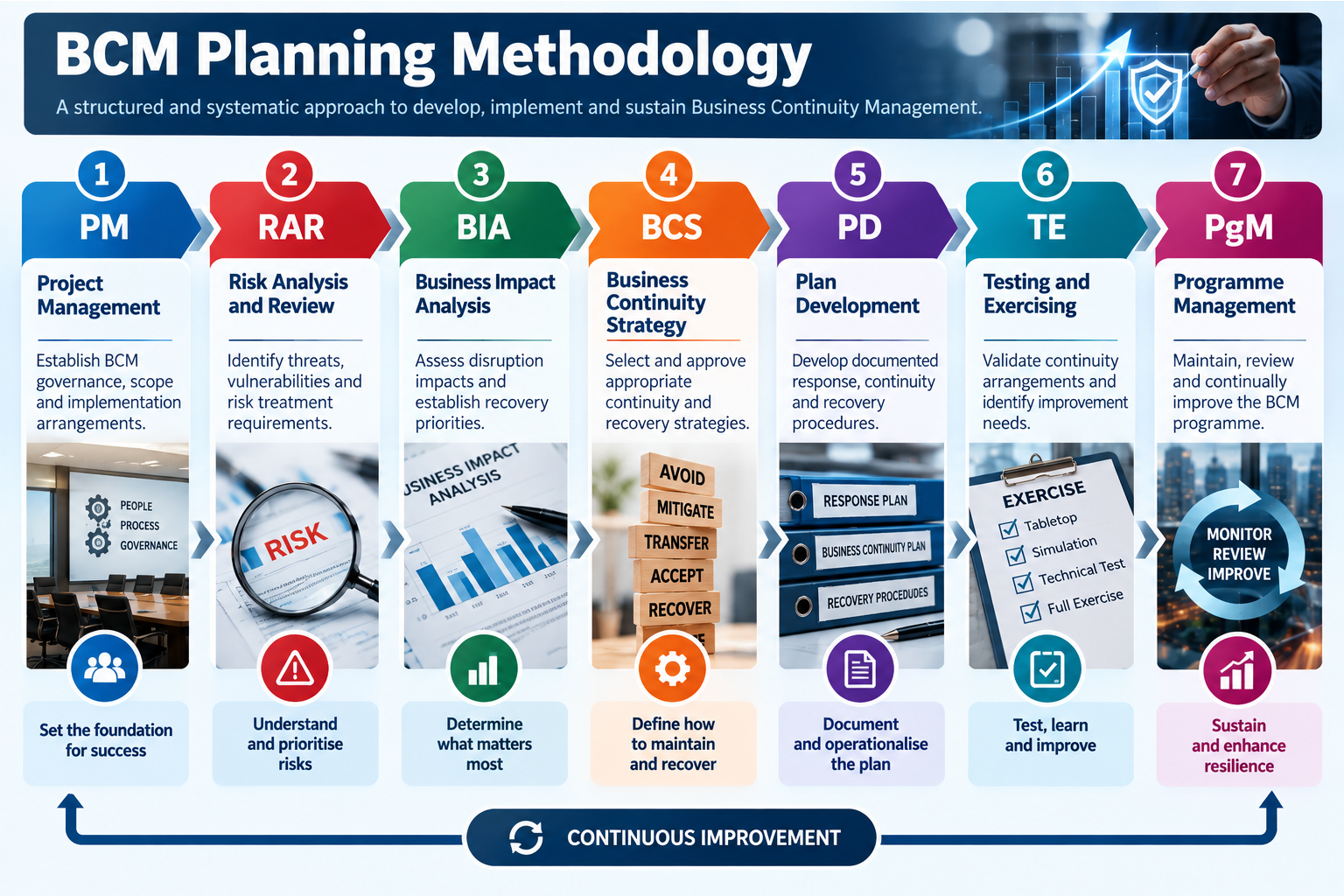 Business Continuity Management Planning Methodology for Jamiyah Healthcare
Introduction
Business Continuity Management (BCM) is a systematic management discipline that enables organisations to anticipate, prepare for, respond to, and recover from disruptive incidents while continuing to deliver their prioritised products and services at acceptable levels.
For Jamiyah Singapore (JS), BCM is particularly important because the organisation provides charitable, residential care, educational, welfare, and community support services to individuals and families, including vulnerable beneficiaries who may depend on timely and uninterrupted assistance.
Disruptions affecting these services may create consequences that extend beyond operational inconvenience or financial loss.
For example, interruptions to residential care may affect resident safety and essential daily support, while disruptions to nursing services, childcare, welfare assistance, or food distribution may adversely affect the health, safety, and well-being of beneficiaries.
Consequently, Jamiyah Singapore requires a structured BCM planning methodology that considers the continuity of essential services, protection of beneficiaries, organisational governance, regulatory obligations, and the availability of critical resources.
This chapter introduces the seven-phase Business Continuity Management Planning Methodology to guide Jamiyah Singapore in establishing, implementing, maintaining, and continually improving its Business Continuity Management System (BCMS).
The seven phases are:
- Project Management (PM).
- Risk Analysis and Review (RAR).
- Business Impact Analysis (BIA).
- Business Continuity Strategy (BCS).
- Plan Development (PD).
- Testing and Exercising (TE).
- Program Management (PgM).
The methodology provides a structured approach for translating BCM principles into practical organisational arrangements. It integrates governance, risk assessment, impact analysis, continuity strategies, recovery procedures, exercises, and programme maintenance.
The methodology is intended to align with ISO 22301:2019, including Amendment 1:2024, and is supported by ISO 22313:2020.
It also considers the governance principles established under Singapore's Charities Act 1994 and the Code of Governance for Charities and IPCs (2023), together with applicable sector-specific obligations administered by the Ministry of Social and Family Development (MSF), Ministry of Health (MOH), and Early Childhood Development Agency (ECDA).
The seven phases represent BCM Institute's structured implementation methodology. They should not be interpreted as seven phases prescribed verbatim by ISO 22301. Instead, they provide a practical means of implementing relevant requirements of the standard.
This chapter explains the purpose, activities, responsibilities, deliverables, and Jamiyah Singapore-specific considerations associated with each phase.
Overview of the Seven-Phase BCM Planning Methodology
Purpose of the Methodology
The seven-phase BCM planning methodology provides Jamiyah Singapore with a consistent approach for establishing and sustaining business continuity capabilities across its services and supporting functions.
The methodology aims to ensure that BCM activities are planned, coordinated, documented, approved, exercised, and maintained.
It also provides a common framework for CBF Owners, the BCM Coordinator, supporting departments, and senior management to participate in BCM implementation.
BCM Planning Methodology
Table 1.1: Overview of the Seven Phases
|
Phase |
Primary Purpose |
Expected Deliverables |
|
PM |
Establish governance, scope, responsibilities and implementation arrangements |
BCM project charter, scope, policy, governance structure and implementation plan |
|
RAR |
Identify threats, vulnerabilities, controls and risk exposure |
Threat register, risk assessment and treatment plan |
|
BIA |
Determine disruption impacts, critical activities and recovery requirements |
BIA reports, MTPDs, RTOs, minimum service levels and dependency assessments |
|
BCS |
Select practical continuity and recovery arrangements |
Mitigation strategies, recovery strategies and minimum resource requirements |
|
PD |
Develop actionable recovery procedures |
Business continuity plans, recovery procedures and communication arrangements |
|
TE |
Evaluate preparedness and recovery capability |
Exercise programme, exercise reports and corrective action plans |
|
PgM |
Maintain BCM effectiveness and support continual improvement |
Review records, audit reports, management reviews and updated BCM documentation |
Integration with Jamiyah Singapore's Services
The methodology should be applied to the critical activities identified within Jamiyah Singapore's approved BCMS scope.
For the purposes of this eBook, the following ten proposed Critical Business Functions provide the initial planning reference.
The Seven-Phase BCM Planning Methodology
 Phase 1: Project Management (PM)
Objective
Project Management establishes the organisational arrangements necessary to initiate and implement the BCM programme.
It provides the foundation for defining the scope, governance structure, responsibilities, implementation schedule, resources, and management reporting requirements.
For Jamiyah Singapore, this phase is particularly important because BCM implementation may involve multiple service units with different operating conditions and continuity requirements.
Establishing BCM Governance
Jamiyah Singapore should establish a governance structure that provides appropriate oversight and accountability for BCM implementation.
Table 1.3: Proposed BCM Governance Structure
|
Role |
Primary Responsibilities |
|
Board / Designated Governance Committee |
Provide oversight of significant BCM risks and organisational resilience |
|
BCM Sponsor |
Approve BCM policy, implementation priorities and resources |
|
BCM Steering Committee |
Oversee BCM implementation and resolve cross-functional issues |
|
BCM Coordinator |
Coordinate project activities, documentation, workshops and reporting |
|
CBF Owners |
Identify critical activities and develop continuity arrangements |
|
ICT Representative |
Support technology dependency analysis and IT recovery planning |
|
HR and Volunteer Management |
Support workforce continuity and personnel availability |
|
Facilities and Logistics Representative |
Support premises, utilities, transportation and essential supplies |
|
Finance and Procurement Representative |
Support emergency expenditure, procurement and supplier arrangements |
|
Communications Representative |
Support stakeholder communications and emergency notifications |
The actual governance structure should be approved by Jamiyah Singapore's management.
Defining the BCMS Scope
The BCMS scope should identify the services, locations, organisational units, activities, and supporting resources covered by the BCM programme.
An illustrative scope statement is:
The Business Continuity Management System of Jamiyah Singapore covers the governance, delivery, continuity, and recovery of its prioritised residential care, nursing support, educational, welfare, and community services, together with the personnel, facilities, information systems, suppliers, and supporting resources required to sustain these activities during disruptive incidents.
The final scope should reflect the organisation's actual operating entities, facilities, service arrangements and justified exclusions.
Establishing the BCM Policy
Jamiyah Singapore should develop a BCM policy endorsed by senior management.
The policy should establish the organisation's commitment to protecting beneficiaries, maintaining essential services, meeting applicable obligations, providing appropriate resources, and continually improving BCM capability.
For example, the policy may state that:
Jamiyah Singapore is committed to maintaining the safety and welfare of its beneficiaries and ensuring the continuity of prioritised charitable, residential, educational, healthcare-related, and community support services during disruptive incidents through an effective and continually improving Business Continuity Management System.
Developing the BCM Project Plan
The BCM Coordinator should prepare an implementation plan covering the seven phases.
The plan should identify activities, deliverables, responsible personnel, target dates, review requirements, and resource needs.
Jamiyah Singapore-Specific Requirement
Requirement PM-JS-01: Multi-Service BCM Governance
Jamiyah Singapore should appoint accountable representatives for each validated CBF and establish a central coordination mechanism to ensure that BCM requirements are consistently implemented across residential care, education, welfare, healthcare-related, and supporting services.
Expected evidence: Approved BCM governance structure, CBF ownership register, BCM project charter and implementation schedule.

Phase 2: Risk Analysis and Review (RAR)
Purpose of Risk Analysis and Review
Risk Analysis and Review identifies potential threats that could interrupt Jamiyah Singapore's operations and evaluates the effectiveness of existing controls.
The assessment should consider both the likelihood of disruptive incidents and their potential consequences for critical services.
For Jamiyah Singapore, risk assessment must place particular emphasis on beneficiary safety, essential care, welfare assistance, and the availability of critical resources.
Identifying Threats
Relevant threats may include:
|
Threat |
Potential Effect on Jamiyah Singapore |
|
Fire or building emergency |
Loss of access to residential, educational or service facilities |
|
Prolonged power outage |
Disruption to care-support equipment, ICT and essential facilities |
|
Cyberattack or ransomware |
Unavailability or compromise of beneficiary information and critical systems |
|
Infectious disease outbreak |
Workforce shortages and disruption to care or educational services |
|
Flooding and severe weather |
Restricted access to facilities and disruption to transportation |
|
Critical supplier failure |
Shortages of food, medical supplies or other essential resources |
|
Workforce shortage |
Inability to maintain required supervision and service capacity |
|
Telecommunications failure |
Loss of communication with staff, beneficiaries and families |
|
Transportation disruption |
Delays in food distribution, outreach or emergency relocation |
RAR Templates
The RAR phase should produce three principal documents.
|
Template |
Title |
Purpose |
|
RAR T1 |
List of Threats |
Identify relevant threats and disruption scenarios |
|
RAR T2 |
Treatment and Control |
Document existing controls and additional risk treatment measures |
|
RAR T3 |
Risk Impact and Likelihood Assessment |
Assess risk severity and determine treatment priorities |
Assessing Risk Impact
The impact assessment should consider:
- Life, health and safety.
- Beneficiary welfare.
- Legal and regulatory obligations.
- Service interruption.
- Financial consequences.
- Reputation and stakeholder confidence.
- Information security and confidentiality.
Risk ratings should be determined using an approved organisational methodology.
Jamiyah Singapore-Specific Requirement
Requirement RAR-JS-01: Beneficiary Safety Risk Assessment
Jamiyah Singapore should assess threats affecting residential care, nursing support, childcare and other services involving vulnerable beneficiaries, with explicit consideration of the consequences of delayed assistance, loss of supervision, utility interruption and workforce unavailability
Expected evidence: Completed RAR T1–T3 templates, approved risk ratings and documented risk treatment actions.

Phase 3: Business Impact Analysis (BIA)
Purpose of Business Impact Analysis
Business Impact Analysis identifies the consequences of disrupting Jamiyah Singapore's activities over time and establishes the requirements for continuity and recovery.
The BIA should determine which activities require prioritised recovery, how quickly they must resume, the minimum acceptable level of service, and the resources required.
For Jamiyah Singapore, the assessment should recognise that interruption to certain services may create immediate consequences for beneficiary safety and welfare.
Establishing Corporate MBCO
The Minimum Business Continuity Objective (MBCO) defines the minimum acceptable level of products or services to be delivered during disruption.
An illustrative corporate MBCO for Jamiyah Singapore is:
To maintain essential beneficiary safety and welfare, continue prioritised residential and nursing care, sustain critical childcare supervision, and provide urgent welfare and food assistance at approved minimum acceptable service levels during disruptive incidents.
The actual MBCO should be established through appropriate assessment and management approval.
1.5.3 BIA Documentation Requirements
Table 1.4: BIA Templates
|
Template |
Title |
Primary Purpose |
|
Part 0 |
Corporate MBCO and Products and Services |
Establish organisation-wide continuity expectations |
|
BIAQ T1 |
Identification of Business Functions |
Identify sub-functions and supporting processes |
|
BIAQ T2 |
Impact Areas of Business Functions |
Identify consequences of disruption |
|
BIAQ T3 |
Impact Over Time of Business Functions |
Assess disruption consequences over time and determine recovery requirements |
|
BIAQ T4 |
Supporting IT Systems and Applications |
Identify technology dependencies and recovery requirements |
|
BIAQ T5 |
Inter-dependencies |
Identify internal and external dependencies |
|
BIAQ T6 |
Vital Records |
Identify information required for continuity and recovery |
Determining Recovery Requirements
The BIA should establish the Maximum Tolerable Period of Disruption (MTPD), Recovery Time Objective (RTO), minimum acceptable service capacity, and relevant resource requirements.
For example, essential resident supervision may require continuous delivery, whereas selected routine administrative activities may tolerate a longer interruption.
Recovery requirements should be based on documented impacts rather than arbitrary time targets.
Assessing Dependencies
Jamiyah Singapore should identify the personnel, facilities, ICT systems, information, suppliers, transportation and other resources required to support each CBF.
For example, food assistance may depend on food suppliers, volunteers, storage facilities, transport providers and beneficiary distribution records.
Jamiyah Singapore-Specific Requirement
Requirement BIA-JS-01: Critical Service Recovery Requirements
Jamiyah Singapore should complete a BIA for each validated CBF, with explicit assessment of beneficiary safety, minimum service levels, disruption impacts over time, recovery priorities, and supporting dependencies.
Expected evidence: Approved corporate MBCO, Products and Services assessment, completed BIAQ T1–T6 templates and approved recovery requirements.

Phase 4: Business Continuity Strategy (BCS)
Objective
The Business Continuity Strategy phase identifies and selects practical arrangements for maintaining or recovering critical activities within approved recovery requirements.
Strategies should consider the nature of each CBF, the potential disruption scenarios, available resources, implementation costs, and the consequences of strategy failure.
Developing Mitigation Strategies
Mitigation strategies aim to reduce the likelihood or consequences of disruption.
Examples for Jamiyah Singapore include preventive maintenance, backup utilities, cybersecurity controls, alternative suppliers, workforce cross-training and emergency stock arrangements.
Developing Recovery Strategies
Recovery strategies establish how critical activities will continue or resume following disruption.
Table 1.5: Illustrative Recovery Strategies
|
CBF |
Illustrative Recovery Strategy |
|
CBF-1 Residential Care |
Alternative care location, emergency staffing and essential supplies |
|
CBF-2 Nursing Support |
Approved clinical downtime procedures and alternative care arrangements |
|
CBF-3 Early Childhood Care |
Child safeguarding, parent notification and approved alternative arrangements |
|
CBF-4 Student Care |
Alternative supervision and service arrangements |
|
CBF-5 Welfare Assistance |
Manual processing and alternative approved assistance arrangements |
|
CBF-6 Food Distribution |
Alternative suppliers, emergency stocks and substitute delivery arrangements |
|
CBF-7 Case Management |
Secure offline records and alternative referral coordination |
|
CBF-8 Communications |
Alternative communication channels and emergency contact procedures |
|
CBF-9 ICT |
Protected backups, alternative infrastructure and controlled restoration |
|
CBF-10 Finance and Procurement |
Emergency procurement and alternative payment authorisation procedures |
Determining Minimum Resources
Each recovery strategy should identify the minimum personnel, facilities, technology, information, equipment, supplies and external services required.
For example, a residential care recovery strategy should specify minimum staffing levels, safe accommodation capacity, essential utilities, care supplies and transportation arrangements.
BCS Templates
|
Template |
Title |
|
BCS T1 |
Mitigation Strategies |
|
BCS T2 |
Recovery Strategies and Justifications |
|
BCS T3 |
Minimum Resources Required During a Disaster |
Jamiyah Singapore-Specific Requirement
Requirement BCS-JS-01: Continuity of Essential Care and Welfare Services
Jamiyah Singapore should develop recovery strategies for its validated critical services that demonstrate how beneficiary safety and minimum acceptable service levels can be maintained when normal facilities, personnel, technology or suppliers are unavailable.
Expected evidence: Approved BCS T1–T3 templates, documented strategy justifications, resource requirements and management approvals.

Phase 5: Plan Development (PD)
Objective
Plan Development translates approved continuity strategies into documented procedures that can be activated during disruptive incidents.
The procedures should provide clear instructions for protecting people, assessing the incident, activating continuity arrangements, recovering critical activities and returning to normal operations.
Developing CBF-Specific Recovery Procedures
Jamiyah Singapore should develop recovery procedures appropriate to the operational requirements of each CBF.
The procedures should be sufficiently detailed to guide personnel who may need to implement them under stressful conditions.
Recommended Recovery Procedure Structure
|
Section |
Required Content |
|
Purpose and Scope |
Activities covered by the procedure |
|
Activation Criteria |
Conditions requiring continuity plan activation |
|
Roles and Responsibilities |
Recovery personnel and decision-making authority |
|
Immediate Response |
Safety actions and initial incident stabilisation |
|
Impact Assessment |
Evaluation of affected services and resources |
|
Recovery Priorities |
Activities requiring earliest continuation or recovery |
|
Recovery Actions |
Step-by-step implementation instructions |
|
Resource Mobilisation |
Personnel, facilities, equipment and supplies |
|
Communications |
Internal and external notification arrangements |
|
Escalation |
Reporting and crisis management coordination |
|
Return to Normal |
Criteria and procedures for restoring normal operations |
|
Records and Reporting |
Documentation of actions, decisions and lessons learned |
Illustrative Recovery Scenario
A prolonged power failure affects a Jamiyah Singapore residential care facility.
The recovery procedure should guide personnel to assess resident safety, activate available backup arrangements, maintain essential care, mobilise additional resources, communicate with relevant stakeholders and consider relocation if safe operations cannot be maintained.
The procedure should also identify who has authority to activate the plan and approve major recovery decisions.
Jamiyah Singapore-Specific Requirement
Requirement PD-JS-01: Actionable CBF Recovery Procedures
Jamiyah Singapore should develop documented recovery procedures for each validated CBF, with clear activation criteria, assigned responsibilities, minimum resource requirements, emergency communications and arrangements for returning to normal operations.
Expected evidence: Approved CBF-specific Business Continuity Plans, recovery procedures, emergency contact arrangements and controlled document records.
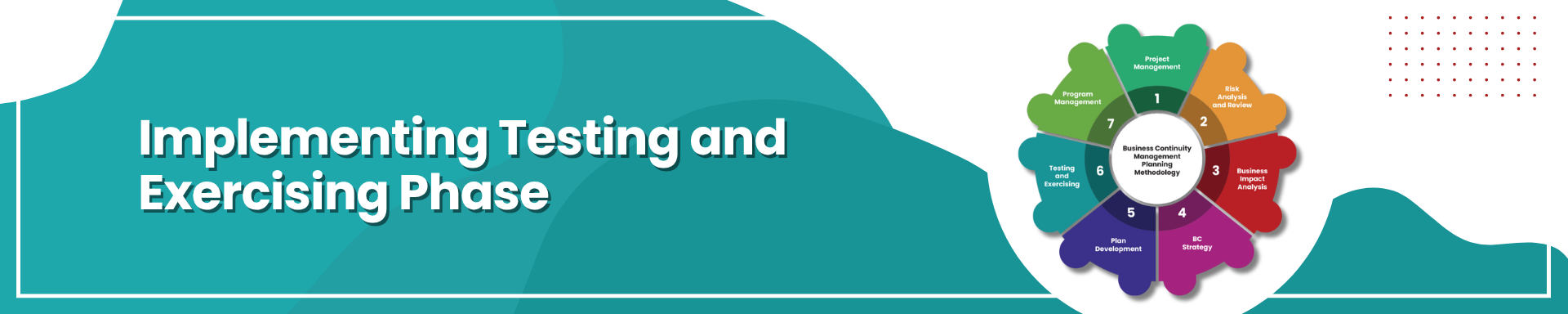
Phase 6: Testing and Exercising (TE)
Testing and Exercising evaluates whether Jamiyah Singapore's continuity arrangements can operate effectively under disruptive conditions.
The purpose is not merely to confirm that plans exist, but to demonstrate that personnel understand their responsibilities and that recovery strategies can achieve approved objectives.
Exercises also provide opportunities to identify gaps, improve coordination and strengthen organisational preparedness.
1.8.2 Types of Exercises
|
Exercise Type |
Description |
Jamiyah Singapore Example |
|
Walkthrough |
Structured review of recovery procedures |
Residential care team reviews emergency relocation steps |
|
Tabletop Exercise |
Scenario-based discussion of decisions and actions |
Management responds to a prolonged multi-site power outage |
|
Simulation |
Rehearsal of selected operational activities |
Emergency communications and staff mobilisation exercise |
|
Technical Recovery Test |
Validation of technology recovery capabilities |
Restoration of critical beneficiary records from backup |
|
Functional Exercise |
Practical execution of selected recovery procedures |
Alternative food distribution arrangements |
|
Integrated Exercise |
Coordinated exercise involving multiple functions |
Cyber incident affecting welfare, finance, communications and ICT |
Developing an Exercise Programme
Jamiyah Singapore should establish an exercise programme covering its critical functions, major disruption scenarios and supporting dependencies.
The programme should specify objectives, scope, participants, exercise methods, evaluation criteria, schedules and reporting requirements.
The frequency and complexity of exercises should reflect service criticality, regulatory obligations, organisational changes and previous exercise results.
Evaluating Exercise Results
Exercise evaluation should determine whether:
- Activation and escalation arrangements worked as intended.
- Recovery personnel understood their responsibilities.
- Essential resources were available.
- Communications were effective.
- Recovery objectives could be achieved.
- Dependencies and assumptions were valid.
- Gaps and corrective actions were appropriately documented.
Jamiyah Singapore-Specific Requirement
Requirement TE-JS-01: Validation of Beneficiary-Centred Recovery Capability
Jamiyah Singapore should exercise continuity arrangements for critical services involving vulnerable beneficiaries, including scenarios affecting resident safety, essential care, workforce availability, communications and alternative service delivery.
Expected evidence: Approved exercise programme, exercise scenarios, attendance records, evaluation reports, corrective action registers and evidence of follow-up validation.

Phase 7: Program Management (PgM)
Purpose of Program Management
Program Management ensures that BCM remains effective, current and integrated into Jamiyah Singapore's organisational governance and operations.
Unlike Project Management, which focuses on establishing the BCM programme, Program Management provides ongoing oversight after implementation.
It supports the maintenance, review, monitoring, audit and continual improvement of BCM arrangements.
Maintaining BCM Documentation
Jamiyah Singapore should establish arrangements for reviewing and updating BCM documentation.
Reviews should be undertaken at planned intervals and following material changes to services, facilities, personnel, technology, suppliers or applicable obligations.
BCM Awareness and Competency
Employees, volunteers and recovery personnel should understand the BCM arrangements relevant to their roles.
Awareness activities may include induction briefings, emergency response training, recovery team workshops and participation in exercises.
Personnel assigned specialised recovery responsibilities should receive appropriate training.
Monitoring BCM Performance
Jamiyah Singapore should establish measurable indicators for evaluating BCM effectiveness.
Table 1.6: Illustrative BCM Performance Indicators
|
Performance Indicator |
Illustrative Measurement |
|
CBF BIA completion |
Percentage of approved BIA assessments |
|
Recovery plan completion |
Percentage of critical functions with approved plans |
|
Exercise coverage |
Percentage of designated critical functions exercised |
|
Recovery objective achievement |
Percentage of exercises meeting approved recovery targets |
|
Corrective action closure |
Percentage of corrective actions completed by agreed deadlines |
|
BCM training participation |
Percentage of designated personnel completing relevant training |
|
Documentation currency |
Percentage of BCM documents reviewed within the required period |
|
Management reporting |
Completion of scheduled BCM performance reports |
Targets should be established by Jamiyah Singapore's management according to organisational priorities and available resources.
Internal Audit and Management Review
The BCMS should be subject to planned internal audits and management reviews consistent with ISO 22301.
Internal audits evaluate whether the BCMS conforms to applicable requirements and is effectively implemented.
Management reviews assess the continuing suitability, adequacy and effectiveness of the BCMS, including changes in organisational context, performance results, resource needs and improvement opportunities.
Continual Improvement
Findings from incidents, exercises, audits and management reviews should be used to improve BCM arrangements.
Corrective actions should identify accountable owners, completion dates and appropriate verification of effectiveness.
Jamiyah Singapore-Specific Requirement
Requirement PgM-JS-01: Sustaining BCM Across Community Services
Jamiyah Singapore should establish an ongoing BCM programme that includes periodic reviews of critical services, updates to continuity documentation, awareness activities, exercises, internal audits and management reporting.
Expected evidence: BCM maintenance schedule, training records, exercise reports, internal audit findings, management review records and corrective action registers.
Integrating the Seven Phases Across Jamiyah Singapore
Ensuring Consistency Across Phases
The seven phases should operate as an integrated management process. Information developed during one phase should inform subsequent activities.
For example, threats identified during RAR should be considered when developing continuity strategies and exercise scenarios.
Recovery requirements identified during BIA should influence the selection of BCS strategies.
Approved strategies should be reflected in recovery procedures, while exercise results should inform programme improvements.
Illustrative Integrated BCM Scenario
Consider a prolonged utility failure affecting a Jamiyah Singapore residential care facility.
Table 1.7: Application of the Seven Phases
|
Phase |
Application to the Scenario |
|
PM |
Assign responsibility for residential care BCM and establish implementation arrangements |
|
RAR |
Identify utility failure as a threat and assess existing controls |
|
BIA |
Determine impacts on resident safety, essential care and supporting resources |
|
BCS |
Select backup utility, emergency staffing and alternative accommodation strategies |
|
PD |
Document actions for maintaining care and relocating residents if required |
|
TE |
Conduct a tabletop or practical exercise to validate the arrangements |
|
PgM |
Review exercise findings, update plans and monitor corrective actions |
This integrated approach helps ensure that continuity planning is based on actual operational requirements and supported by practical arrangements.
Mapping the Methodology to ISO 22301
Alignment with the BCMS Requirements
The seven-phase methodology provides a practical structure for implementing relevant ISO 22301 requirements.
Table 1.8: Seven-Phase Methodology and ISO 22301 Alignment
|
BCM Phase |
Relevant ISO 22301 Clauses |
Key Requirements |
|
PM |
Clauses 4, 5, 6 and 7 |
Context, scope, leadership, objectives, resources and documented information |
|
RAR |
Clauses 6.1 and 8.2 |
BCMS risks and opportunities; assessment of disruption-related risks |
|
BIA |
Clause 8.2 |
Impact assessment, prioritised activities and recovery requirements |
|
BCS |
Clause 8.3 |
Business continuity strategies and solutions |
|
PD |
Clause 8.4 |
Business continuity plans and procedures |
|
TE |
Clauses 8.5 and 8.6 |
Exercise programme and evaluation of continuity documentation and capabilities |
|
PgM |
Clauses 7, 9 and 10 |
Support, monitoring, internal audit, management review and continual improvement |
The methodology should also consider the climate change relevance assessment introduced through ISO 22301 Amendment 1:2024.
Singapore Regulatory and Governance Alignment
Jamiyah Singapore should maintain a register of applicable legal, regulatory, licensing, contractual and governance requirements.
The Charities Act 1994 and the Code of Governance for Charities and IPCs (2023) provide important organisational governance references.
Applicable sector-specific obligations may arise from MSF, MOH and ECDA requirements, depending on the nature and licensing arrangements of individual services.
The BCM programme should identify how these obligations affect continuity priorities, emergency preparedness, recovery procedures and management accountability.
ISO 22301 is an international voluntary management system standard unless made binding through an applicable legal, contractual or other requirement. The seven-phase methodology supports alignment but does not, by itself, establish conformity or regulatory compliance.
Expected Deliverables of the BCM Planning Methodology
At the completion of the seven-phase methodology, Jamiyah Singapore should have developed an integrated set of BCM governance, planning, recovery and programme management documentation.
Table 1.9: BCM Documentation Deliverables
|
Phase |
Key Deliverables |
Responsible Contributors |
|
PM |
BCM policy, scope, governance structure, project charter and implementation plan |
BCM Sponsor, Steering Committee and Coordinator |
|
RAR |
RAR T1 List of Threats, RAR T2 Treatment and Control, RAR T3 Risk Impact and Likelihood Assessment |
CBF Owners and Risk Representatives |
|
BIA |
Corporate MBCO, Products and Services, BIAQ T1–T6 |
CBF Owners, BCM Coordinator and Supporting Functions |
|
BCS |
BCS T1 Mitigation Strategies, BCS T2 Recovery Strategies, BCS T3 Minimum Resources |
CBF Owners and Supporting Functions |
|
PD |
Business Continuity Recovery Procedures |
CBF Owners and Recovery Teams |
|
TE |
Exercise programme, exercise reports and corrective action records |
BCM Coordinator and Recovery Teams |
|
PgM |
Maintenance schedules, audit reports, management reviews and improvement records |
BCM Coordinator, Management and Internal Audit |
The documentation should be maintained under appropriate version control and approval arrangements.
Key Implementation Considerations for Jamiyah Singapore
The effectiveness of the BCM programme will depend on several important considerations.
Beneficiary-centred planning: Recovery priorities should reflect the potential consequences of disruption to vulnerable individuals and families.
Management commitment: Senior management should provide clear direction, accountability and sufficient resources.
Service owner participation: BCM planning should involve personnel who understand the actual operations and dependencies of each critical service.
Practical recovery strategies: Strategies must be feasible, adequately resourced and capable of meeting approved recovery requirements.
Regulatory awareness: The organisation should identify applicable governance, safeguarding, licensing and information protection obligations.
Exercise and validation: Recovery arrangements should be evaluated through suitable exercises and tests.
Continual improvement: BCM documentation and capabilities should evolve in response to organisational changes, incidents, exercises and emerging threats.
Chapter Summary
This chapter has introduced the seven-phase Business Continuity Management Planning Methodology for Jamiyah Singapore.
The methodology provides a structured approach for establishing BCM governance, identifying threats, assessing disruption impacts, developing continuity strategies, preparing recovery procedures, validating capabilities and maintaining an effective BCMS.
The seven phases are designed to work together as an integrated management process rather than as isolated planning activities.
For Jamiyah Singapore, the methodology should be applied with particular attention to the continuity of residential care, nursing support, childcare, educational services, welfare assistance, food distribution and other essential community services.
The chapter has also established specific proposed requirements for each phase, including governance, beneficiary safety assessment, recovery requirements, strategy development, recovery procedures, exercises and ongoing programme maintenance.
Key Takeaways
- Project Management establishes the foundation through governance, scope, responsibilities and implementation planning.
- Risk Analysis and Review identifies disruptive threats and evaluates risk treatment requirements.
- Business Impact Analysis establishes recovery priorities based on disruption consequences and service dependencies.
- Business Continuity Strategy determines practical solutions for maintaining and recovering critical services.
- Plan Development translates strategies into actionable procedures that recovery personnel can implement.
- Testing and Exercising validates preparedness and identifies capability gaps.
- Program Management sustains BCM effectiveness through reviews, audits, awareness and continual improvement.

Implementing Business Continuity Management is an important step in strengthening Jamiyah Singapore's ability to protect its beneficiaries, maintain essential community services and fulfil its charitable mission during disruptive incidents.
The seven-phase BCM planning methodology provides a structured and practical framework for achieving these objectives. It establishes the governance arrangements necessary to initiate the programme, the assessment processes required to understand risks and impacts, the strategies and procedures needed to sustain critical activities, and the evaluation and maintenance mechanisms necessary to ensure continuing effectiveness.
For Jamiyah Singapore, the methodology must recognise that different services have different recovery requirements. Residential care and nursing support may require immediate continuity arrangements, while welfare assistance, food distribution, educational services and supporting functions may have other time-sensitive requirements determined through formal assessment.
By applying the methodology consistently across its validated Critical Business Functions, Jamiyah Singapore can establish clear recovery priorities, identify resource dependencies, develop practical continuity strategies and strengthen coordination among service owners and supporting departments.
The methodology also provides a foundation for alignment with ISO 22301:2019, including Amendment 1:2024, and the implementation guidance of ISO 22313:2020. Applicable Singapore charity governance and sector-specific obligations should be incorporated into the programme according to the actual services and operating entities concerned.
The successful implementation of BCM requires more than completing assessments and producing recovery plans. It depends on management commitment, organisational participation, realistic recovery arrangements, regular exercises, and a culture of preparedness and continual improvement.
The subsequent chapters of Implementing Business Continuity Management for Jamiyah Singapore will examine each phase of the methodology in greater detail, providing the knowledge and guidance needed to develop and maintain effective business continuity capabilities.
These foundations will also support the practical templates and implementation activities presented in eBook 3, Starting Your BCM Implementation for Jamiyah Singapore.
Ultimately, the objective is to establish a sustainable and demonstrable BCM capability that enables Jamiyah Singapore to safeguard vulnerable beneficiaries, sustain critical services and continue serving the community when disruption occurs.
Implementation note: This chapter presents a proposed methodology tailored to Jamiyah Singapore. The CBF catalogue, roles, recovery arrangements and specific implementation requirements should be validated with the organisation. ISO 22301 alignment is an intended design objective and should not be represented as confirmed conformity or certification without appropriate assessment.


More Information About Business Continuity Management Courses
To learn more about the course and schedule, click the buttons below for BCM-300 Business Continuity Management Implementer [BCM-3] and BCM-5000 Business Continuity Management Expert Implementer [BCM-5]