


Chapter 9
Assessing Risks and Threats
Introduction
 Business Continuity Management (BCM) focuses on ensuring an organisation can continue delivering essential products and services when disruptive incidents occur.
An effective BCM programme must therefore begin with an understanding of the threats that could interrupt operations and the crisis scenarios that may develop when those threats are not adequately contained.
For Jamiyah Singapore (JS), this understanding is particularly important because its community services may support vulnerable individuals, residential care beneficiaries, children, students and families who depend on essential assistance and care.
Unlike organisations whose primary concerns may be financial losses or reduced commercial productivity, disruption to JS's services could directly affect resident safety, safeguarding, healthcare support, food assistance, emergency welfare, beneficiary communications and community confidence.
Threats affecting JS may originate from natural events, human activities, workforce shortages, supply chain failures, technology disruptions, cybersecurity incidents or failures involving external service providers.
Some threats may initially appear to be operational incidents but can escalate into serious crises when they affect vulnerable beneficiaries, create significant safety concerns, attract regulatory attention or undermine public confidence.
For example, a prolonged electricity outage at a residential care facility may initially be treated as a facilities incident. However, if the outage compromises essential environmental conditions, resident supervision, medical equipment or safe accommodation, the situation may require crisis management intervention.
Similarly, a ransomware attack affecting beneficiary information systems may begin as an ICT security incident but develop into a wider organisational crisis if sensitive information is compromised or critical services cannot continue.
This chapter examines the principal threats relevant to BCM and the categories of crisis scenarios JS should consider when developing its organisational resilience capabilities.
It also explains the relationship between threats, vulnerabilities, operational incidents, emergencies, crises and business continuity activation.
The objective is to establish a practical foundation for subsequent Risk Analysis and Review (RAR), Business Impact Analysis (BIA), Business Continuity Strategy (BCS), Plan Development (PD), and Testing and Exercising (TE).
Implementation note: The scenarios and organisational arrangements presented are illustrative and should be validated against JS's actual services, operating facilities, regulatory obligations, staffing arrangements and existing emergency procedures. They do not imply that any particular incident has occurred at JS.
Understanding Threats in Business Continuity Management
Definition of a Threat
Within BCM, a threat is a potential source of disruption that could adversely affect an organisation's ability to deliver its essential products, services and supporting activities.
A threat may affect one or more of the following:
- People and workforce availability.
- Premises and physical infrastructure.
- Technology and information systems.
- Essential records and information.
- Utilities and communications.
- Suppliers and third-party service providers.
- Transportation and logistics.
- Financial resources and payment arrangements.
- Stakeholder confidence and organisational reputation.
- Governance, regulatory compliance and decision-making.
A threat does not necessarily result in disruption. Its consequences depend on the organisation's vulnerabilities, exposure, preparedness and available controls.
Relationship between Threats, Vulnerabilities and Risks
It is important to distinguish these concepts.
|
Concept |
Description |
Example for JS |
|
Threat |
A potential source of disruption |
Prolonged electricity outage. |
|
Vulnerability |
A weakness or dependency that increases exposure |
Essential residential care equipment depends on a single power source. |
|
Risk |
The effect of uncertainty on objectives, assessed through the adopted risk methodology |
Essential resident care may be interrupted because of power unavailability. |
|
Incident |
An event that has occurred and requires management |
Electricity supply is interrupted at a residential facility. |
|
Emergency |
A situation requiring urgent action to protect people, property or essential services |
Resident safety is threatened by loss of critical environmental conditions. |
|
Crisis |
A serious situation involving significant uncertainty, potentially severe consequences and strategic management decisions |
Multiple essential residential services cannot be sustained and emergency relocation is required. |
The relationship can be illustrated as follows:
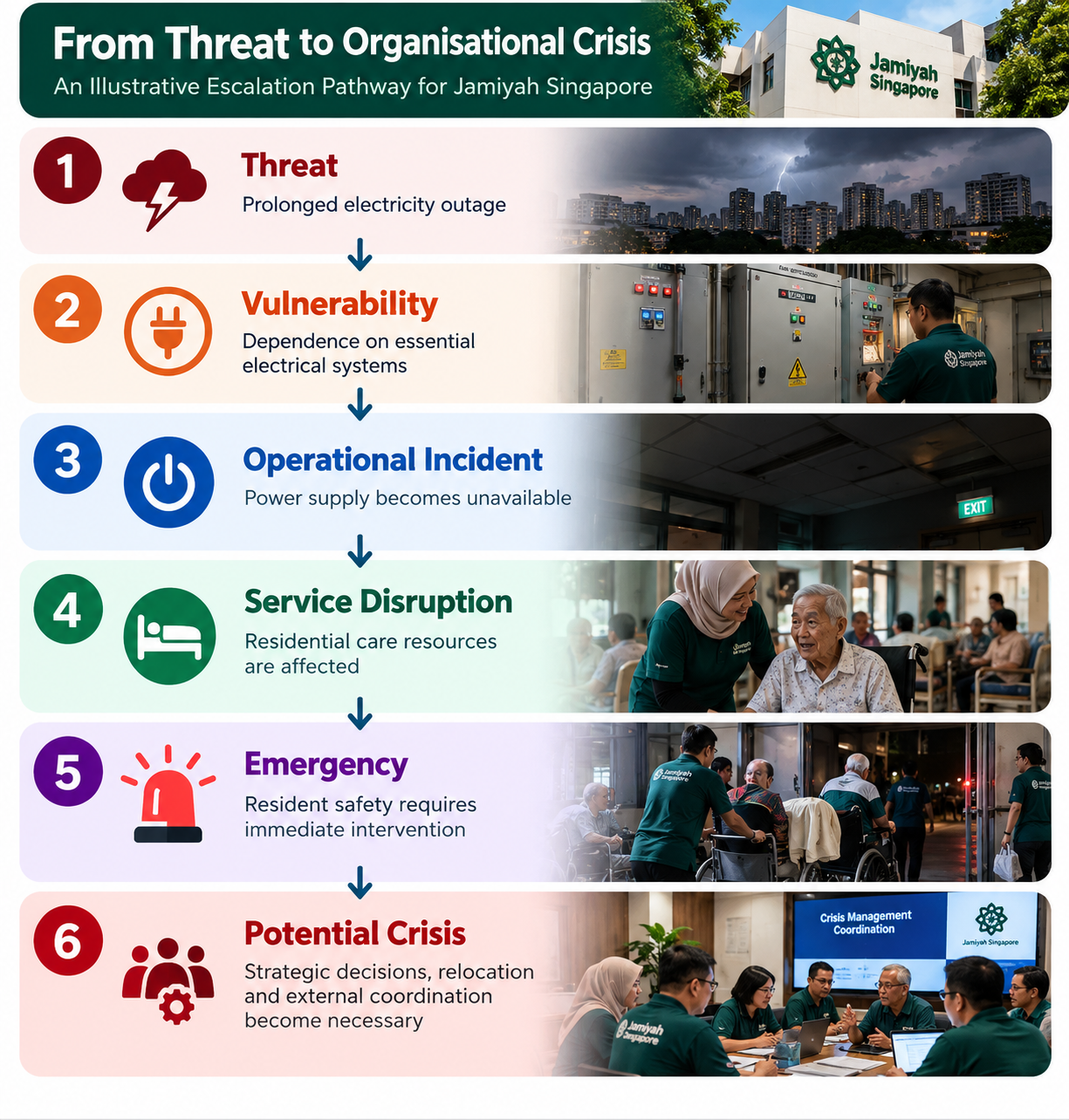
This is an illustrative escalation pathway, not an inevitable sequence.
A serious incident may trigger emergency response, crisis management and business continuity arrangements simultaneously.
Five Principal Categories of BCM Threats
For the purpose of JS's BCM methodology, threats can be organised into five categories:
- Denial of Access – Natural Disaster.
- Denial of Access – Man-made Disaster.
- Unavailability of People.
- Disruption to the Supply Chain.
- Equipment and IT-Related Disruption.
These categories provide a structured foundation for developing the Threat Register in RAR Part 1.
Do not treat them as mutually exclusive. For example, severe weather may simultaneously cause denial of access, power failure, transportation disruption and supplier unavailability.
Category 1: Denial of Access – Natural Disaster
Natural disasters and environmental events can prevent personnel, beneficiaries, suppliers or emergency services from accessing operational facilities.
For JS, denial of access may be especially serious when it affects residential care premises or facilities supporting children and vulnerable individuals.
Table 9.1: Natural Disaster Threats Relevant to JS
|
Threat |
Description |
Potential Consequences for JS |
|
Heavy Rainfall and Flash Flooding |
Intense rainfall causes localised flooding of roads, entrances or surrounding areas. |
Staff access restrictions, delayed supplies, disrupted beneficiary transport and possible relocation requirements. |
|
Severe Thunderstorm |
Strong winds, heavy rain and lightning affect buildings or surrounding infrastructure. |
Facility damage, interruptions to outdoor activities, power loss and access restrictions. |
|
Lightning Strike |
Electrical infrastructure or communications equipment is damaged. |
ICT failure, equipment damage and loss of communications. |
|
Extreme Heat |
Sustained high temperatures affect health, workforce conditions or facility suitability. |
Increased health concerns for vulnerable residents and staff, particularly where cooling systems are unavailable. |
|
Transboundary Haze |
Poor air quality affects health and outdoor operations. |
Restrictions on outdoor activities and increased support requirements for vulnerable beneficiaries. |
|
Infectious Disease Emergency |
Public health conditions lead to access restrictions or movement controls. |
Staffing limitations, reduced face-to-face service delivery, and increased infection-control requirements. |
|
Earthquake-Related Tremors |
Regional seismic events produce tremors affecting buildings or occupants. |
Temporary evacuation, inspections and access restrictions, although major local seismic exposure is comparatively limited. |
|
Regional Volcanic Ash Event |
Ash from a regional eruption affects air travel or regional logistics. |
Delayed imports, transport disruption and potential effects on regional supply chains. |
|
Coastal Inundation or Tsunami |
Exceptional coastal events affect exposed locations or transport infrastructure. |
Potential disruption to coastal facilities and logistics, depending on actual site exposure. |
|
Sinkhole or Ground Instability |
Localised ground failure affects a building or access route. |
Unsafe premises, restricted access and possible relocation. |
Example: Flash flooding affecting residential care
Consider a scenario where intense rainfall causes flooding near a JS residential care facility.
Personnel cannot reach the facility through normal transport routes, and essential deliveries are delayed.
Immediate continuity concerns include staffing availability, resident safety, food supplies, medication support, and communication with families.
If the facility remains safe, JS may continue essential care through existing personnel and alternative supply arrangements.
If the facility cannot remain safe, emergency relocation and crisis management arrangements may be required.
BCM planning consideration: JS should evaluate facility-specific flood exposure, alternative access routes, staffing continuity, and practical arrangements to maintain essential care during restricted access.
Category 2: Denial of Access – Man-made Disaster
Man-made disasters include incidents caused by human activity, technological accidents, malicious actions or infrastructure failures.
These events may occur within JS's facilities or in neighbouring premises and infrastructure.
Table 9.2: Man-made Disaster Threats Relevant to JS
|
Threat |
Description |
Potential Consequences for JS |
|
Building Fire |
Fire affects an operational facility or nearby premises. |
Evacuation, loss of accommodation, service suspension and possible resident relocation. |
|
Explosion |
An explosion causes structural damage or creates unsafe conditions. |
Injury, evacuation, facility closure and emergency response. |
|
Gas Leak |
Gas escapes from building systems or neighbouring infrastructure. |
Evacuation, access restrictions and interruption to essential operations. |
|
Chemical Spill |
Hazardous substances are released within or near a facility. |
Health concerns, restricted access and possible decontamination requirements. |
|
Structural Failure |
Building elements become unsafe or unusable. |
Close affected areas and relocate essential activities. |
|
Building Collapse |
Serious structural failure makes premises inaccessible. |
Loss of operating premises, injury and prolonged recovery. |
|
Bomb Threat |
A credible or suspected explosive threat triggers security intervention. |
Evacuation, access restrictions and emergency coordination. |
|
Terrorist Incident |
Deliberate violence affects facilities, transport networks or public areas. |
Threats to personnel and beneficiaries, security restrictions and major service disruption. |
|
Active Assailant |
An individual threatens or attacks people at a facility. |
Immediate life-safety response, lockdown or evacuation and potential trauma. |
|
Sabotage |
Deliberate damage affects premises, equipment or essential infrastructure. |
Loss of facilities or critical service capability. |
|
Civil Disturbance |
Public disorder restricts access or threatens safety. |
Staff access is restricted, and affected activities are suspended. |
|
Major Road Closure |
Road incidents, construction or emergency restrictions prevent normal access. |
Delayed staff deployment, deliveries and beneficiary transport. |
|
Public Transport Disruption |
Rail or bus services become unavailable. |
Workforce shortages and delayed programme delivery. |
|
Nearby Industrial Accident |
An incident at neighbouring facilities affects surrounding areas. |
Evacuation, access restrictions and environmental safety concerns. |
|
Utility Infrastructure Incident |
Damage to external infrastructure affects access or safe occupancy. |
Premises may close or essential services may be interrupted. |
Example: Fire at a Residential Care Facility
A fire at a residential care facility may require immediate evacuation and emergency response.
The priority is protecting and accounting for residents, personnel, and visitors.
Following evacuation, JS may need to determine whether the building remains safe for occupancy.
If residents cannot return, continuity arrangements must address alternative accommodation, competent care personnel, medication, personal belongings, essential records, food and family communication.
The incident may become a crisis if relocation involves significant safety risks, prolonged displacement, coordination with external agencies, or major organisational decisions.
BCM planning consideration: Fire emergency procedures, resident evacuation arrangements, temporary accommodation and continuity of essential care must operate as coordinated capabilities.
Category 3: Unavailability of People
People are among the most important resources supporting JS's essential services.
Some functions may depend on employees with specialised qualifications, professional competencies or familiarity with individual beneficiaries.
A personnel shortage may therefore affect service continuity even when facilities and technology remain operational.
Table 9.3: Workforce-Related Threats Relevant to JS
|
Threat |
Description |
Potential Consequences for JS |
|
Pandemic |
Widespread infectious disease affects workforce availability. |
Reduced staffing across multiple facilities and services. |
|
Infectious Disease Outbreak |
A localised outbreak affects residents, employees or beneficiaries. |
Staff isolation, additional care requirements and service restrictions. |
|
Mass Illness |
A substantial number of staff become ill at the same time. |
Inability to maintain essential staffing levels. |
|
Loss of Key Personnel |
Essential employees become unexpectedly unavailable. |
Loss of specialist knowledge, delayed decisions or interrupted services. |
|
Skills Shortage |
Insufficient personnel possess required competencies. |
Reduced ability to provide essential care, healthcare or specialised support. |
|
High Staff Turnover |
Repeated employee departures weaken operational capacity. |
Loss of experience, reduced continuity and increased workload. |
|
Mass Resignation |
Multiple employees leave within a short period. |
Significant disruption to staffing and operational management. |
|
Industrial Action |
Workforce disputes affect personnel availability or supporting services. |
Reduced service delivery or loss of external support. |
|
Workplace Accident |
Employees are injured during operational activities. |
Loss of personnel and possible suspension of affected activities. |
|
Workplace Violence |
Violence threatens employees or volunteers. |
Injury, psychological harm and reduced workforce availability. |
|
Staff Fatigue |
Prolonged operations or excessive workloads reduce personnel effectiveness. |
Errors, reduced supervision capability and increased safety concerns. |
|
Psychological Stress |
Employees experience significant mental or emotional strain. |
Absenteeism, reduced performance and workforce instability. |
|
Family Emergencies |
Personnel cannot work because of urgent family responsibilities. |
Reduced staffing, particularly during widespread emergencies. |
|
Travel Restrictions |
Movement controls prevent employees from reaching operating locations. |
Staffing shortages and delayed shift changes. |
|
Mandatory Quarantine or Isolation |
Public health requirements prevent affected personnel from attending work. |
Temporary loss of essential competencies and operational capacity. |
Example: Shortage of Residential Care Personnel
Suppose several qualified care personnel become unavailable because of an infectious disease outbreak.
The immediate concern is whether JS can maintain adequate supervision, essential daily living assistance, medication coordination and resident safeguarding.
Administrative activities may be deferred, but safety-critical care activities must continue.
If qualified replacements cannot be mobilised, management may need to consider alternative staffing arrangements, external support or changes to service delivery.
BCM planning consideration: JS should identify minimum staffing competencies, essential roles, succession arrangements and the limits of using alternative personnel.
Category 4: Disruption to the Supply Chain
JS may depend on external organisations for essential goods, facilities services, technology, transport and financial infrastructure.
Disruption to these dependencies can affect critical services even when JS's own employees and premises remain available.
Table 9.4: Supply Chain Threats Relevant to JS
|
Threat |
Description |
Potential Consequences for JS |
|
Critical Supplier Failure |
An essential supplier cannot fulfil contractual or operational commitments. |
Shortages affecting residential care, welfare assistance or essential operations. |
|
Food Supplier Disruption |
Food deliveries become unavailable or delayed. |
Inability to maintain planned meals or food assistance distributions. |
|
Medical Supply Disruption |
Essential healthcare or medication-related supplies become unavailable. |
Delayed healthcare support and increased beneficiary safety concerns. |
|
Outsourced Service Failure |
A contracted service provider cannot deliver essential services. |
Disruption to cleaning, security, maintenance, transport or other supporting functions. |
|
Cloud Service Provider Failure |
A third-party cloud platform becomes unavailable. |
Loss of access to hosted applications and information. |
|
Telecommunications Provider Failure |
External communications infrastructure is disrupted. |
Loss of telephone, internet or mobile connectivity. |
|
Electricity Supply Failure |
External power infrastructure becomes unavailable. |
Loss of essential utilities and technology capability. |
|
Water Supply Disruption |
Water service becomes unavailable or unsuitable for use. |
Interruption to hygiene, sanitation, food preparation and residential care. |
|
Fuel Supply Disruption |
Fuel becomes unavailable for transport or emergency equipment. |
Reduced logistics and backup equipment capability. |
|
Logistics Disruption |
Distribution or freight services experience major interruption. |
Delayed essential supplies and welfare distributions. |
|
Transportation Service Failure |
Contracted transport providers cannot operate. |
Delayed beneficiary movement, staff deployment or emergency relocation. |
|
Banking System Failure |
Banking services become unavailable. |
Payments are delayed, and access to financial services is limited. |
|
Payment System Failure |
Digital payment infrastructure is disrupted. |
Delayed welfare payments, procurement or other essential transactions. |
|
Vendor Insolvency |
A supplier ceases operations because of financial failure. |
Loss of essential goods or services and prolonged replacement arrangements. |
|
Third-Party Cyber Incident |
A supplier experiences a cyberattack affecting its service delivery. |
Disruption to outsourced systems, services or information exchange. |
|
Contract Termination |
An essential supplier relationship ends unexpectedly. |
Loss of service capability and urgent need for replacement arrangements. |
|
Single-Source Dependency |
An essential product or service is available from only one provider. |
Concentrated exposure if the provider becomes unavailable. |
|
Import or Regulatory Restrictions |
Restrictions affect the availability or movement of goods. |
Shortages of imported essential supplies. |
Example: Food Supply Disruption
A major food supplier becomes unable to fulfil deliveries to a JS residential care facility.
The disruption affects planned meals and potentially the availability of special dietary provisions.
JS must determine whether sufficient supplies remain available and whether alternative providers can meet essential nutritional and delivery requirements.
If multiple facilities are affected, procurement and service managers may need to coordinate organisation-wide resource allocation.
BCM planning consideration: Supplier continuity arrangements should reflect beneficiaries' minimum food, hydration, and dietary requirements, rather than relying solely on commercial delivery commitments.
Category 5: Equipment and IT-Related Disruption
Technology and equipment disruptions can affect JS's ability to access information, communicate, administer programmes and coordinate essential services.
Cybersecurity incidents may also compromise confidential beneficiary information and create regulatory, legal and reputational concerns.
Table 9.5: Equipment and IT-Related Threats Relevant to JS
|
Threat |
Description |
Potential Consequences for JS |
|
Cyberattack |
Malicious activity targets systems, networks or information. |
Disruption to essential digital services and possible compromise of information. |
|
Ransomware |
Malicious software encrypts or blocks access to information and systems. |
Loss of beneficiary records, operational applications and financial processing. |
|
Malware Infection |
Malicious software damages or disrupts technology. |
System instability, data compromise and service interruption. |
|
Distributed Denial-of-Service Attack |
Excessive malicious traffic overwhelms internet-facing services. |
Websites or digital service channels become unavailable. |
|
Insider Threat |
An authorised individual intentionally or negligently compromises systems or information. |
Data loss, service disruption or unauthorised disclosure. |
|
Data Breach |
Sensitive information is accessed or disclosed without authorisation. |
Confidentiality concerns, investigation requirements and loss of stakeholder confidence. |
|
Network Failure |
Internal networking equipment or connections become unavailable. |
Loss of access to applications and shared information. |
|
Server Failure |
Physical or virtual server infrastructure fails. |
Unavailability of hosted applications and records. |
|
Database Corruption |
Data becomes inaccurate, incomplete or inaccessible. |
Inability to rely on essential beneficiary or financial records. |
|
Cloud Service Outage |
Hosted platforms become unavailable. |
Loss of access to cloud-based applications and information. |
|
Power Failure |
Electrical supply to equipment is interrupted. |
ICT outage and possible failure of essential operational equipment. |
|
Hardware Failure |
Computers, storage devices or essential equipment malfunction. |
Reduced operational capability and loss of access to information. |
|
Application Failure |
Essential software stops functioning correctly. |
Delayed case processing, financial transactions or service administration. |
|
Software Update Failure |
A change or update causes system instability. |
Unexpected application outage and operational disruption. |
|
Internet Failure |
External internet connectivity becomes unavailable. |
Loss of cloud access and digital communications. |
|
Mobile Communications Failure |
Mobile voice or data services are interrupted. |
Delayed staff coordination and emergency notifications. |
|
Backup Failure |
Backups are unavailable, incomplete or unusable. |
Extended recovery and potential permanent information loss. |
|
Data Centre Outage |
Hosting infrastructure becomes unavailable. |
Simultaneous interruption of multiple systems. |
|
Authentication System Failure |
Users cannot complete identity verification. |
Inability to access critical applications. |
|
Identity Management Failure |
Access management systems malfunction or become compromised. |
Loss of authorised access or increased security exposure. |
|
AI System Failure |
An AI-enabled tool produces unavailable, unreliable or incorrect outputs where used. |
Incorrect information, disrupted workflows or inappropriate decisions. |
|
Telecommunications Equipment Failure |
Telephones, routers or related equipment fail. |
Reduced communications and emergency coordination capability. |
Example: Ransomware Affecting Beneficiary Information
A ransomware incident affects systems containing beneficiary information and operational records.
Staff may be unable to access essential case histories, emergency contact details, care records or financial information.
The incident may also raise concerns about the confidentiality and integrity of personal data.
The initial response would involve cybersecurity incident management, while BCM arrangements would focus on maintaining essential services through authorised alternative information and processing methods.
If significant information compromise, service interruption, or stakeholder harm occurs, crisis management may need to be activated.
BCM planning consideration: ICT Disaster Recovery, cybersecurity incident response, information security, privacy management and BCM must operate in a coordinated manner.
Understanding Crisis Scenarios
Definition of a Crisis Scenario
A crisis scenario is a structured description of a serious disruptive situation that may threaten an organisation's people, essential services, reputation, legal obligations or long-term viability.
It describes how an incident could develop, the consequences that may arise and the strategic decisions required to manage the situation.
A crisis scenario is more than a threat description.
For example:
- Threat: Building fire.
- Incident: Fire occurs at a residential care facility.
- Crisis scenario: The building becomes uninhabitable, residents require urgent relocation, essential care must continue, and management must coordinate with families, emergency services and relevant authorities.
This distinction matters because BCM and Crisis Management play complementary roles.
BCM focuses on sustaining and recovering essential activities.
Crisis Management focuses on strategic decision-making, leadership, stakeholder confidence, and managing potentially severe consequences.
Principal Types of Crisis Scenarios for Jamiyah Singapore
JS should consider crisis scenarios across several dimensions.
Table 9.6: Types of Crisis Scenarios for JS
|
Crisis Type |
Illustrative Crisis Scenario |
Potential Consequences |
Principal Management Concern |
|
Natural Disaster Crisis |
Severe flooding makes a residential care facility inaccessible. |
Resident displacement, staffing shortages and delayed supplies. |
Safe accommodation and continuity of essential care. |
|
Technological Crisis |
Ransomware disables beneficiary records and financial systems. |
Loss of critical information, delayed services and possible data compromise. |
Service continuity, cybersecurity and information protection. |
|
Humanitarian Crisis |
A serious event affects multiple vulnerable beneficiaries simultaneously. |
Increased demand for emergency care and welfare assistance. |
Beneficiary safety and coordinated humanitarian response. |
|
Healthcare Crisis |
An infectious disease outbreak affects a residential care facility. |
Resident illness, workforce shortages, and increased care needs. |
Infection management and essential healthcare continuity. |
|
Operational Crisis |
Multiple essential suppliers fail during a prolonged disruption. |
Shortages of food, hygiene products and essential supplies. |
Resource allocation and continuity of essential services. |
|
Financial Crisis |
Significant funding interruption or financial control failure affects operations. |
Difficulty sustaining essential spending and paying suppliers. |
Financial sustainability and governance accountability. |
|
Reputational Crisis |
Allegations of serious service failure generate widespread public concern. |
Loss of stakeholder confidence, donor concern and heightened scrutiny. |
Credible communication, accountability and corrective action. |
|
Governance Crisis |
A serious breakdown in leadership, oversight or decision-making occurs. |
Strategic decisions are delayed and organisational control weakens. |
Leadership continuity and governance restoration. |
|
Security Crisis |
A violent incident threatens residents, beneficiaries or staff. |
Injury, evacuation, trauma and service disruption. |
Life safety, security response and stakeholder assurance. |
|
Regulatory Crisis |
Serious non-compliance affecting a regulated service is identified. |
Investigation, restrictions, legal consequences and service interruption. |
Compliance, beneficiary protection and management accountability. |
|
Supply Chain Crisis |
Essential food or medical supplies become unavailable across several sites. |
Inability to maintain required care or welfare support. |
Alternative supply and prioritisation of essential needs. |
|
Multi-Dimensional Crisis |
A cyberattack coincides with a major workforce shortage and supplier disruption. |
Simultaneous failure of several CBFs. |
Enterprise-wide prioritisation and coordinated recovery. |
These are illustrative scenarios, not statements about JS's incident history.
Crisis Scenarios Affecting Critical Business Functions
Examine the consequences of a crisis in relation to JS's essential services.
Table 9.7: Illustrative Crisis Scenarios by Critical Business Function
|
CBF |
Critical Business Function |
Illustrative Crisis Scenario |
Required Continuity Outcome |
|
CBF-1 |
Residential Care and Resident Safety |
A major fire makes the residential facility unsafe. |
Maintain resident safety, supervision, safeguarding and essential care. |
|
CBF-2 |
Nursing and Essential Healthcare Support |
Healthcare personnel and essential medication supplies become unavailable. |
Maintain time-critical healthcare support and appropriate escalation. |
|
CBF-3 |
Early Childhood Care and Education |
A safety incident requires closure of an early childhood facility. |
Protect children and maintain safe supervision, accountability and handover. |
|
CBF-4 |
Student Care and Educational Support |
Severe weather prevents normal student care operations. |
Maintain student safety and communication with parents or guardians. |
|
CBF-5 |
Emergency Welfare and Financial Assistance |
Payment system disruption prevents the disbursement of urgent assistance. |
Continue prioritised welfare assistance through authorised arrangements. |
|
CBF-6 |
Food Assistance and Essential Distribution |
Supply chain disruption prevents scheduled food deliveries. |
Maintain emergency food assistance for priority beneficiaries. |
|
CBF-7 |
Critical Beneficiary Case Management and Referral |
Case management systems become unavailable during a major incident. |
Continue urgent case assessment, safeguarding and referral. |
|
CBF-8 |
Beneficiary, Family and Emergency Communications |
Telecommunications services fail during an emergency. |
Maintain critical stakeholder communication through alternative channels. |
|
CBF-9 |
Critical ICT Systems and Information Management |
Ransomware compromises essential applications and records. |
Restore or substitute access to critical information and services. |
|
CBF-10 |
Essential Finance, Procurement and Resource Support |
Financial systems and a critical supplier become unavailable at the same time. |
Maintain essential expenditure, procurement and resource mobilisation. |
Differentiating Operational Incidents, Emergencies and Crises
Not every incident requires activating the Crisis Management Team.
The appropriate response depends on the seriousness of the consequences, the degree of uncertainty, the decisions required and the organisation's approved escalation criteria.
Table 9.8: Incident, Emergency and Crisis Classification
|
Classification |
Characteristics |
Example for JS |
Typical Management Response |
|
Operational Incident |
Localised disruption manageable through normal procedures. |
A non-critical office printer temporarily fails. |
Departmental incident management. |
|
Significant Operational Incident |
Important service interruption requiring coordinated support. |
Short-term loss of a case management application. |
Functional escalation and possible BCM activation. |
|
Emergency |
Immediate threat to safety, health or essential operations. |
Fire requiring evacuation of residents. |
Emergency response and safety procedures. |
|
Organisational Crisis |
Severe or potentially severe consequences requiring strategic leadership. |
Prolonged residential care displacement affecting multiple beneficiaries. |
Activate the Crisis Management Team and coordinate a BCM response. |
|
Enterprise-Wide Crisis |
Multiple essential functions are affected, potentially threatening organisational viability or service continuity. |
A widespread cyberattack combined with the loss of essential suppliers. |
Senior leadership coordination, enterprise recovery and external stakeholder management. |
Translate the classifications into JS's approved escalation framework, including activation authority, notification thresholds, and responsibilities.
A life-safety emergency should never wait for a formal crisis classification before protective action begins.
Understanding Crisis Escalation
A disruptive incident may escalate when its consequences exceed the initial responding team's capacity.
Relevant escalation factors include:
- Immediate or increasing danger to beneficiaries or personnel.
- Inability to maintain minimum essential service levels.
- Unavailability of safe residential accommodation.
- Serious safeguarding or healthcare concerns.
- Significant disruption affecting multiple CBFs.
- Major information compromise or cybersecurity incidents.
- Regulatory notification or intervention requirements.
- Widespread stakeholder concern or adverse publicity.
- Prolonged disruption beyond approved recovery assumptions.
- Need for exceptional resource allocation or strategic decisions.
Illustrative Escalation Pathway
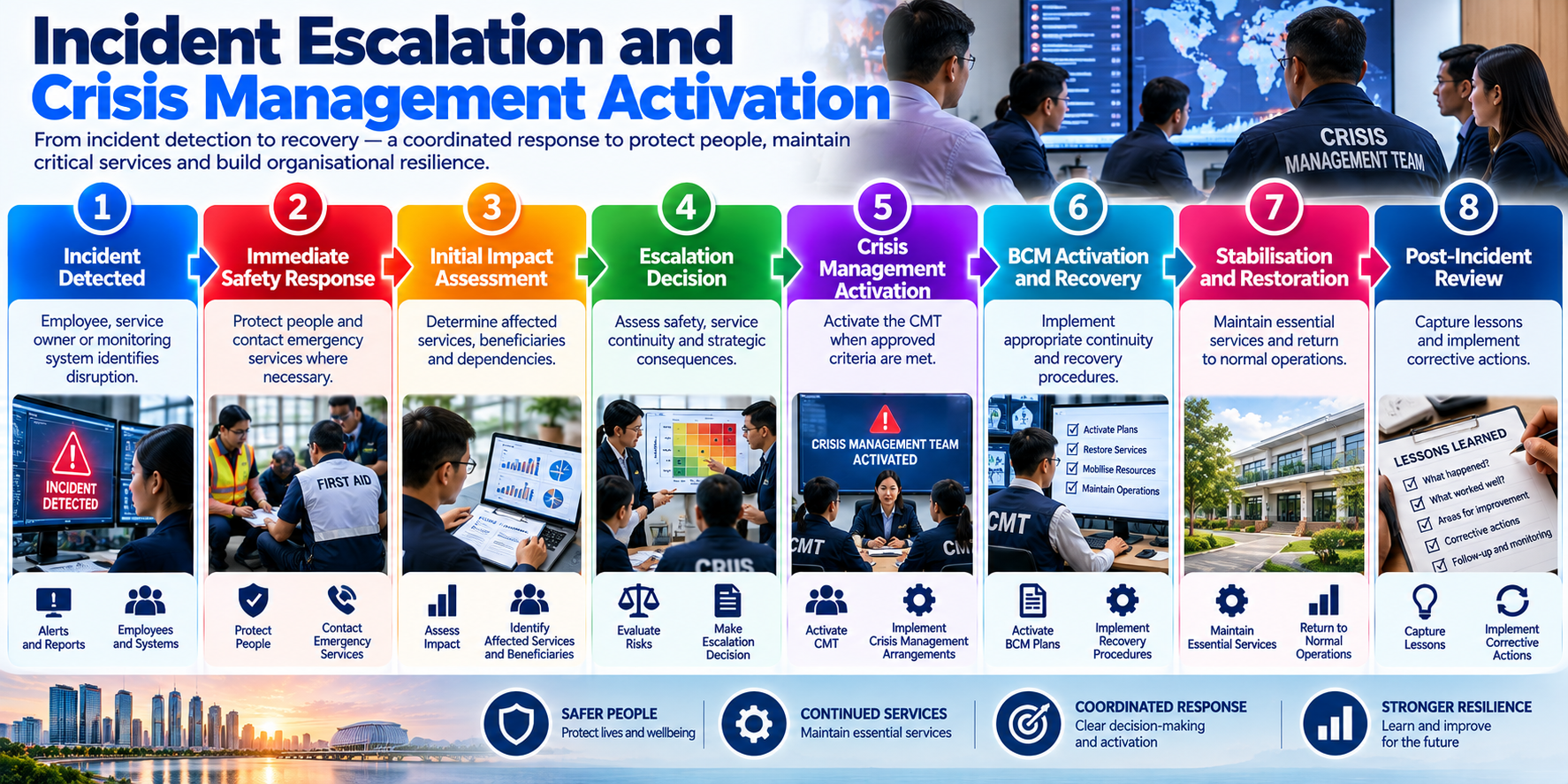
This is a conceptual management pathway. In practice, emergency response, crisis management and BCM recovery may be activated concurrently.
Developing a Crisis Scenario Portfolio
JS should develop a portfolio of credible scenarios for planning and exercising.
The portfolio should include scenarios that challenge individual CBFs and those that affect multiple functions simultaneously.
Table 9.9: Proposed Crisis Scenario Portfolio for JS
|
Scenario Code |
Crisis Scenario |
Primary CBFs Affected |
Scenario Focus |
|
CS-01 |
Major fire at residential care premises |
CBF-1, 2, 8, 10 |
Evacuation, resident relocation and continuity of care. |
|
CS-02 |
Infectious disease outbreak affecting residents and staff |
CBF-1, 2, 7, 8 |
Healthcare continuity, staffing and stakeholder communications. |
|
CS-03 |
Ransomware affecting beneficiary information systems |
CBF-7, 8, 9, 10 |
Cyber response, information recovery and manual workarounds. |
|
CS-04 |
Prolonged electricity and water disruption |
CBF-1, 2, 3, 9 |
Facility suitability and essential utility dependencies. |
|
CS-05 |
Critical food supplier failure |
CBF-1, 6, 10 |
Essential supplies and alternative sourcing. |
|
CS-06 |
Serious child safeguarding incident |
CBF-3, 4, 8 |
Child protection, emergency response and communications. |
|
CS-07 |
Significant personal data breach |
CBF-7, 8, 9 |
Information protection, notification and stakeholder confidence. |
|
CS-08 |
Prolonged loss of qualified care personnel |
CBF-1, 2, 10 |
Minimum staffing and continuity of essential care. |
|
CS-09 |
Banking and payment services disruption |
CBF-5, 10 |
Urgent financial assistance and emergency expenditure. |
|
CS-10 |
Major telecommunications outage |
CBF-7, 8, 9 |
Alternative communications and service coordination. |
|
CS-11 |
Widespread severe weather and transport disruption |
CBF-1, 3, 4, 6, 8 |
Staff access, essential deliveries and beneficiary safety. |
|
CS-12 |
Multi-site disruption involving cyberattack and supply shortages |
Multiple CBFs |
Enterprise prioritisation, crisis leadership and resource allocation. |
The portfolio should be validated through risk assessment, BIA findings, stakeholder requirements and management review.
Selecting Credible Crisis Scenarios
Not every imaginable crisis scenario needs to be developed into a detailed exercise.
JS should select scenarios based on their relevance to essential services, operational dependencies and potential consequences.
Table 9.10: Criteria for Selecting Crisis Scenarios
|
Selection Criterion |
Assessment Consideration |
|
Beneficiary Safety |
Could the scenario threaten life, health, safeguarding or essential care? |
|
Critical Service Impact |
Could the scenario interrupt one or more CBFs? |
|
Duration of Disruption |
Could the disruption extend beyond available operating arrangements? |
|
Resource Dependencies |
Does the scenario affect essential personnel, facilities, ICT or suppliers? |
|
Regulatory Consequences |
Could applicable reporting, licensing or compliance obligations be affected? |
|
Stakeholder Consequences |
Could beneficiaries, families, donors or partners experience significant disruption? |
|
Escalation Complexity |
Would senior management need to make urgent strategic decisions? |
|
Interdependencies |
Could the scenario trigger failures across multiple services? |
|
Recovery Complexity |
Would recovery require alternative facilities, specialised personnel or external support? |
|
Exercise Value |
Would testing the scenario reveal weaknesses in important continuity capabilities? |
The assessment should distinguish between a scenario's plausibility and the severity of its potential consequences.
Integrating Threats and Crisis Scenarios with BCM Planning
Threat identification and crisis scenario development should support the entire BCM planning methodology.
Table 9.11: Integration with BCM Implementation
|
BCM Phase |
Application of Threat and Crisis Scenario Analysis |
|
Programme Management |
Establish responsibilities, governance and assessment methodology. |
|
Risk Analysis and Review |
Identify threats, vulnerabilities, controls and risk exposure. |
|
Business Impact Analysis |
Determine consequences of disruption to CBFs and essential services. |
|
Business Continuity Strategy |
Select continuity solutions addressing credible disruption scenarios. |
|
Plan Development |
Document activation, response, continuity and recovery procedures. |
|
Testing and Exercising |
Validate arrangements using realistic threat and crisis scenarios. |
|
Programme Maintenance |
Review threats, incidents, exercise findings and changes in exposure. |
Relationship Between RAR and BIA
Risk Analysis and Review examines threats, vulnerabilities, controls and risk exposure.
Business Impact Analysis examines the consequences of activity disruption and determines the resources and recovery requirements needed to maintain essential services.
Both activities are necessary.
For example, RAR may identify ransomware as a significant technology threat.
BIA determines which services depend on affected systems, the consequences of their unavailability, their Recovery Time Objectives (RTOs) and the information needed to continue operations.
The Business Continuity Strategy then identifies appropriate alternatives, such as tested system recovery, authorised manual processing, or alternative service arrangements.
Governance and Responsibilities
Threat identification and crisis scenario development should involve relevant representatives from across JS.
Table 9.12: Roles and Responsibilities
|
Role |
Responsibilities |
|
Governing Board |
Provide oversight of significant organisational risks and resilience matters. |
|
Senior Management |
Approve BCM priorities, resources and strategic crisis arrangements. |
|
BCM Steering Committee |
Review significant threats and proposed crisis scenarios. |
|
BCM Coordinator |
Coordinate threat identification, scenario documentation and BCM integration. |
|
CBF Owners |
Identify service-specific threats, vulnerabilities and operational consequences. |
|
Crisis Management Team |
Assess strategic crisis scenarios and escalation requirements. |
|
Facilities and Security |
Identify physical security, building and environmental threats. |
|
Human Resources |
Identify workforce availability and competency threats. |
|
ICT and Cybersecurity |
Identify technology, information and cybersecurity threats. |
|
Finance and Procurement |
Identify financial and supplier-related threats. |
|
Communications |
Assess stakeholder communication and reputational crisis considerations. |
|
Governance and Compliance |
Assess applicable legal, regulatory and governance implications. |
Reviewing and Updating the Threat and Crisis Scenario Portfolio
Review threats and crisis scenarios regularly because organisational exposure changes over time.
Relevant review triggers include changes in services, facilities, technology, suppliers, staffing, regulatory obligations and the external environment.
Table 9.13: Recommended Review Triggers
|
Review Trigger |
Required Action |
|
Annual BCM Review |
Reassess the threat catalogue and crisis scenario portfolio. |
|
Significant Incident |
Determine whether new threats or escalation pathways have been identified. |
|
Cybersecurity Incident |
Review cyber scenarios, technology dependencies and recovery arrangements. |
|
New Service or Facility |
Identify new safety, operational and continuity threats. |
|
Major Supplier Change |
Review third-party and supply chain disruption scenarios. |
|
Regulatory Change |
Update scenarios involving compliance or reporting obligations. |
|
Organisational Restructuring |
Reassess governance and workforce dependencies. |
|
Exercise Findings |
Update scenario assumptions and continuity arrangements. |
|
Emerging Threat Intelligence |
Determine whether new threats should be included. |
|
Significant Environmental Change |
Reassess climate-related and facility-specific exposure. |
The BCM Coordinator should maintain appropriate version control and ensure the BCM governance structure reviews significant changes.
Key Deliverables
Completion of this chapter should provide JS with a structured foundation for subsequent threat and crisis assessments.
Table 9.14: Threat and Crisis Scenario Planning Deliverables
|
Deliverable |
Purpose |
Proposed Owner |
|
BCM Threat Category Framework |
Establish consistent categories for identifying threats. |
BCM Coordinator |
|
Preliminary Threat Catalogue |
Document specific threats relevant to JS. |
BCM Coordinator / CBF Owners |
|
Threat-to-CBF Mapping |
Identify which essential functions could be affected by each threat. |
CBF Owners |
|
Crisis Scenario Portfolio |
Establish credible scenarios for planning and exercising. |
BCM Coordinator / CMT |
|
Crisis Escalation Criteria |
Define conditions requiring management escalation. |
Crisis Management Team |
|
Scenario Dependency Mapping |
Identify resources and external dependencies affected by scenarios. |
CBF Owners / Supporting Functions |
|
RAR Input Register |
Provide threat information for formal risk assessment. |
Risk Management / BCM Coordinator |
|
BIA Scenario Inputs |
Support disruption analysis and determine recovery requirements. |
BCM Coordinator / CBF Owners |
|
Exercise Scenario Library |
Provide realistic scenarios for testing and exercising. |
BCM Coordinator |
|
Review and Maintenance Schedule |
Establish arrangements for updating threats and scenarios. |
BCM Coordinator |
Chapter Summary
This chapter has examined the principal types of threats relevant to Business Continuity Management and the crisis scenarios that may affect Jamiyah Singapore.
This chapter presents five categories of BCM threats: natural disasters causing denial of access, man-made disasters causing denial of access, unavailability of people, supply chain disruption, and equipment and IT-related disruption.
Each category is illustrated with realistic scenarios relevant to JS's residential care, healthcare support, early childhood services, student care, welfare assistance, food distribution, beneficiary case management, and supporting functions.
The chapter also explains the distinctions between threats, vulnerabilities, risks, incidents, emergencies, and crises.
The chapter proposes a structured crisis scenario portfolio to support management planning, escalation, recovery strategy development, and exercising.
Particular emphasis has been placed on recognising that an operational incident may escalate into an organisational crisis when it threatens beneficiary safety, essential service continuity, regulatory obligations or stakeholder confidence.
The chapter also shows how threat identification and crisis scenario analysis inform Risk Analysis and Review, Business Impact Analysis, Business Continuity Strategy, Plan Development, and Testing and Exercising.

Understanding the types of threats that could disrupt essential services is fundamental to effective Business Continuity Management at Jamiyah Singapore.
The organisation operates within an environment where disruptions may arise from natural events, physical incidents, workforce shortages, supply chain failures, technology outages, cybersecurity threats and other operational dependencies.
For JS, these threats must be considered in the context of its responsibilities towards beneficiaries who may rely on continuous residential care, essential healthcare support, child supervision, welfare assistance, food distribution and timely communication.
A comprehensive threat identification process enables JS to recognise potential sources of disruption before they develop into serious operational incidents.
However, identifying threats alone is insufficient.
The organisation must also understand how threats interact with vulnerabilities, dependencies and existing controls, and how an initially localised incident could escalate into a wider crisis.
Developing credible crisis scenarios helps management anticipate the strategic decisions, resource requirements, stakeholder communications and recovery arrangements that may be necessary during severe disruption.
It also provides a practical foundation for integrating BCM with emergency response, Crisis Management, ICT Disaster Recovery, cybersecurity and third-party risk management.
JS should therefore maintain a structured Threat Register and Crisis Scenario Portfolio that reflect its actual operating environment, Critical Business Functions, service dependencies and stakeholder obligations.
JS should review these documents periodically and update them after significant incidents, organisational changes, new regulatory requirements, and emerging threats.
The scenarios should also be incorporated into Testing and Exercising activities to demonstrate whether JS can sustain essential services under realistic conditions.
Ultimately, identifying threats and developing crisis scenarios is not simply about anticipating what could go wrong, but about ensuring Jamiyah Singapore can protect its beneficiaries, maintain essential services, and make timely decisions when disruption occurs.
By integrating threat identification, risk assessment, crisis management and continuity planning into a coordinated framework, JS can strengthen organisational resilience, improve emergency preparedness and sustain its commitment to serving the community.
Implementation note from author: This chapter is intended as a methodology and planning guide. The threats, crisis scenarios and proposed organisational responsibilities are illustrative and require validation by JS's management and service owners. Actual legal and regulatory obligations must be confirmed against the specific services operated and applicable Singapore requirements.


More Information About Business Continuity Management Courses
To learn more about the course and schedule, click the buttons below for BCM-300 Business Continuity Management Implementer [BCM-3] and BCM-5000 Business Continuity Management Expert Implementer [BCM-5].