


Sustaining Community Services: Implementing BCM at Jamiyah Home for the Aged — Ebook 3: Starting Your BCM Implementation

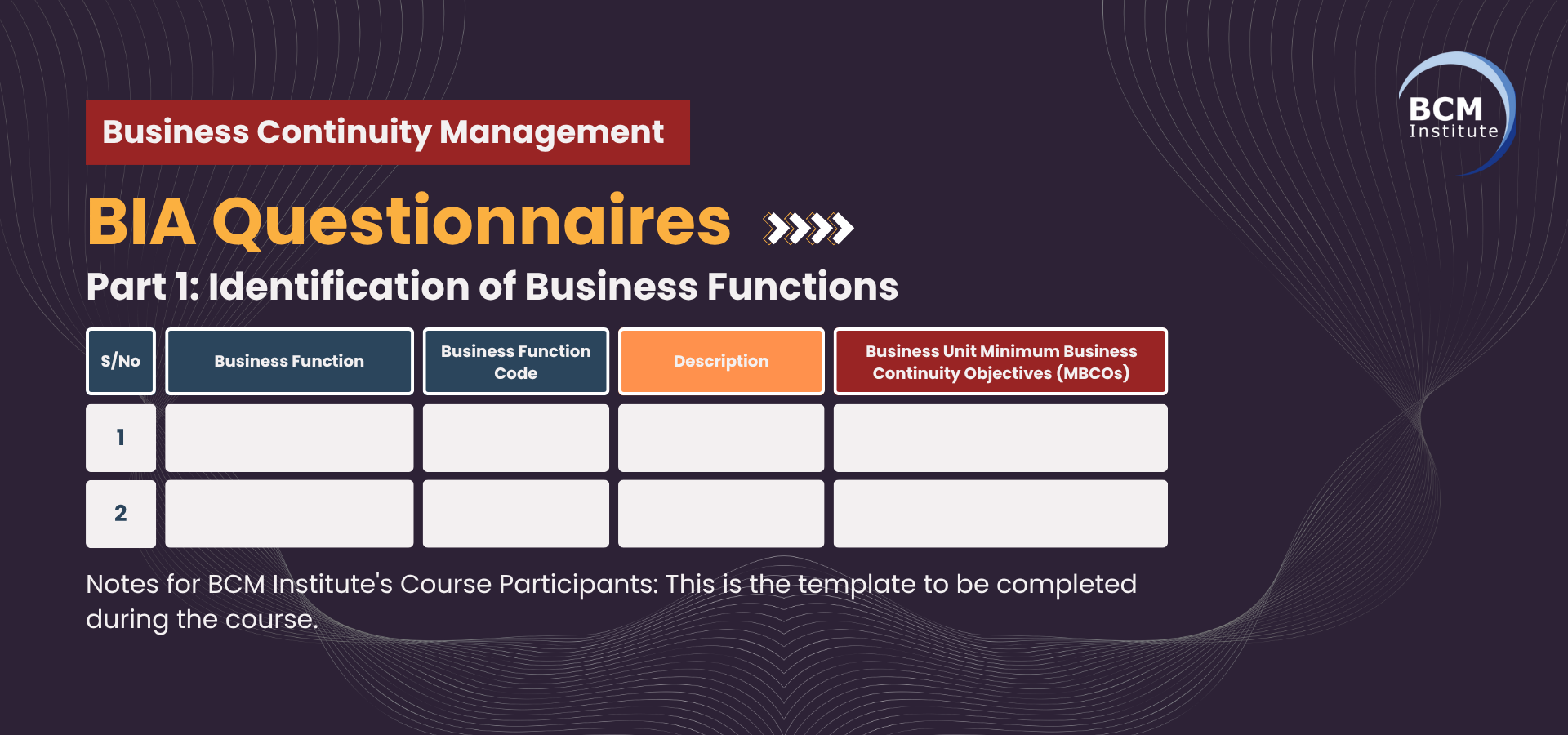
 BIA Part 1: Identification of Business Functions for CBF-1 Personal Care and 24-Hour Supervision at Jamiyah Home for the Aged
1. Introduction
This chapter breaks Critical Business Function CBF-1, Personal Care and 24-Hour Supervision, into 14 Sub-Critical Business Functions. It then sets the minimum level of each that Jamiyah Home for the Aged (JHA) must keep running during any disruption. Together, these two outputs form Part 1 of the Business Impact Analysis (BIA) for CBF-1.
Where this chapter fits
The previous chapter identified JHA's Critical Business Functions. These are the services whose interruption would quickly harm residents, breach licensing obligations, or damage public trust in the Home.
CBF-1 sits at the top of that list. JHA's residents are elderly, and many are frail. Some live with dementia, and most have no family able to take them in at short notice. Unlike an office function, personal care can't pause while systems are restored.
A missed repositioning, a missed dose, a missed meal or an unnoticed wandering episode can cause serious harm within hours.
The BIA is the step in ISO 22301 and ISO 22313 that turns the general statement "this function is critical" into specific, evidence-based requirements. It asks four questions:
- What does the function consist of?
- What happens, and how quickly, if it is disrupted?
- What is the least the organisation can accept during a disruption?
- What resources are needed to deliver that least acceptable level?
This chapter answers the first and third questions for CBF-1. Later parts of the BIA answer the second and fourth.
Why break a Critical Business Function into detailed functions
"Personal care and 24-hour supervision" is too broad to plan for as a single item. It covers activities as different as admitting a new resident, giving insulin, turning a bed-bound resident and searching for a resident who has left the building. Treating it as one block hides the differences that matter most in a disruption.
Breaking it down serves five purposes:
- Different activities fail in different ways. Loss of the electronic records system affects medication charts and handover notes but not mealtimes. A staff shortage affects almost everything. Planning must reflect these differences.
- Different activities tolerate different delays. A time-critical medicine cannot wait beyond its prescribed window. A routine care plan review can wait several weeks without harm.
- Dependencies become visible. Rostering enables supervision. Handover enables safe night care. Assessment informs every other activity. These links only appear when you break the function into its parts.
- Ownership becomes clear. Assign each Sub-CBF to a named owner, such as the nursing lead or a care supervisor, who is accountable for its continuity arrangements.
- Impact assessment becomes consistent. Later parts of the BIA rate impacts and set recovery timeframes for each Sub-CBF. That is only possible if each one is clearly defined.
The term "Sub-Critical Business Function" means a component of a Critical Business Function. It does not mean "less than critical". Every Sub-CBF in this chapter contributes directly to resident safety and wellbeing.
Why set Business Unit Minimum Business Continuity Objectives
ISO 22301 asks organisations to decide the minimum level of products and services they will accept during a disruption. This is the minimum business continuity objective (MBCO). A Business Unit MBCO (BU MBCO) applies the same idea to each Sub-CBF: the minimum capability that unit must keep running so that the overall Critical Business Function can still be delivered safely and lawfully.
A BU MBCO is neither normal service nor a recovery target. It is a deliberately reduced but safe level of service. It answers the question: "If we cannot do everything, what must we still do, for whom, and to what standard?"
Setting BU MBCOs in advance gives JHA four benefits:
- A shared, approved definition of "minimum acceptable". Without it, each shift leader decides under pressure, and decisions vary. With it, staff know what must be protected and what they can pause, and they have the Board's backing to do so.
- A safety floor for residents. Each BU MBCO states the elements of care that are never relaxed, whatever the disruption.
- Regulatory defensibility. As a licensed Social Residential Home, JHA must keep residents safe and manage incidents in line with the Social Residential Homes Act 2025, its General Regulations and the MSF Code of Practice. Infection control must also meet MOH expectations. Pre-agreed minimum standards show MSF and MOH reviewers that continuity decisions are planned and reasoned, not improvised.
- A basis for resourcing. A minimum standard expressed in measurable terms, such as rounds per night or days of supplies in reserve, can be converted directly into staff, stock and equipment requirements.
How this supports recovery strategies and Business Continuity Planning
The outputs of this chapter feed directly into the later stages of JHA's BCM programme:
- Recovery strategies are chosen to deliver each BU MBCO under realistic disruptions, such as a surge in staff absences, an outbreak, a power failure, or the loss of part of the building.
- Resource prioritisation follows from the BU MBCOs. Scarce staff and supplies go first to the elements that protect life and safety.
- Business Continuity Plans state each BU MBCO, the actions needed to reach it, and what may be paused.
- Governance is strengthened. Under the Code of Governance for Charities and IPCs (2023), the Board oversees JHA's key risks. Approving BU MBCOs is a concrete way for the Board to set the organisation's tolerance for service reduction.
Scope and Key Assumptions
This chapter covers CBF-1 only and the 14 Sub-CBFs listed in Section 3. The BU MBCOs apply to any disruption that reduces JHA's ability to deliver care, including:
- a surge in staff absence;
- an infectious disease outbreak;
- loss of power, water or part of the premises;
- failure of IT or records systems;
- disruption to suppliers of food, medicines, consumables or linen.
Where JHA-specific information was not available, the following planning assumptions were used:
- JHA provides care 24 hours a day in rotating shifts. The care team includes nursing staff and care staff, with medical input through a visiting doctor or partner clinic.
- Residents range from largely independent to fully dependent. A proportion are bed-bound, at high risk of falls or living with dementia.
- A pharmacy supplies medicines, and trained staff administer them under nursing oversight.
- Records are kept in both electronic and paper formats. Paper fallback templates either exist or will be created as part of this programme.
- "Priority residents" are those who are high-dependency, at high risk of falls or pressure injury, living with dementia or at risk of wandering, receiving end-of-life care, or on time-critical medicines.
- BU MBCOs apply from the start of a disruption until normal service is restored. Recovery timeframes are set in a later part of the BIA.
Figures marked (indicative) are planning assumptions, not regulatory requirements. The Superintendent, the nursing lead, care supervisors, and Jamiyah Singapore as managing agent must validate them and check them against applicable MSF and MOH requirements before the Board approves them. Thresholds are expressed per resident, per shift or as a percentage, so they remain valid whatever JHA's occupancy.

CBF-1 is delivered through 14 Sub-CBFs, each with a BU MBCO that states the minimum capability, who it covers, a measurable threshold, the safety floor and what may be deferred.
Table BIA Part 1: Identification of Business Functions for Sub-CBF-1 Personal Care and 24-Hour Supervision
| Sub-CBF Code | Sub-Critical Business Function | Description of Business Function | Business Unit Minimum Business Continuity Objective (BU MBCO) |
|---|---|---|---|
| CBF-1.1 | Admission and Care Needs Assessment | Activities: Screen referrals from hospitals and referring agencies; assess each new resident's physical, cognitive, functional, nutritional, continence, falls, and pressure-injury needs; reconcile medicines and allergies; record guardian or next-of-kin details; open the resident record. Role in CBF-1: Establishes the baseline knowledge of each resident on which all other care depends. An incomplete assessment leaves staff unaware of risks such as swallowing difficulty or wandering. | Planned admissions suspended. Urgent admissions accepted only where JHA can safely meet the resident's needs. A core safety assessment (falls, pressure injury, swallowing, allergies, medicines, cognition) completed within 24 hours (indicative) of arrival, on paper if needed. Full assessment deferred by up to 7 days (indicative). |
| CBF-1.2 | Individual Care Planning and Review | Activities: Turn assessments into individual care plans covering personal care, mobility, nutrition, continence, and behaviour; schedule reviews; conduct unscheduled reviews after a fall, hospital return, or change in condition; involve residents and guardians; brief care staff. Role in CBF-1: Converts assessed needs into specific, consistent instructions, so that every staff member, including relief and agency staff, delivers the same safe care. | A current one-page care summary (key risks, mobility aids, diet and fluid texture, continence, behaviour triggers, escalation contacts) available at the point of care for 100% of residents, including on paper. Care plans updated within 24 hours (indicative) of any significant change. Routine scheduled reviews deferred by up to 30 days (indicative). |
| CBF-1.3 | Care Workforce Rostering and Shift Deployment | Activities: Plan duty rosters; match skills mix across nursing and care staff; manage leave and absences; deploy staff by floor or wing; activate standby, overtime, agency, or redeployed Jamiyah staff; track competencies. Role in CBF-1: Every other Sub-CBF depends on having the right people on duty. Rostering is therefore the single largest enabler of CBF-1, and its failure cascades across all care activities. | Every shift staffed at or above a minimum safe staffing level approved by the Superintendent for each shift and floor (indicative, to be set). At least one staff member competent in medication administration and one trained in first aid and basic life support on site at all times. Escalate any shortfall to the Superintendent within 1 hour (indicative). Non-care duties reassigned. |
| CBF-1.4 | Activities of Daily Living Assistance | Activities: Helping residents with washing, bathing, oral care, grooming, dressing and toileting; changing bed linen; respecting privacy, dignity, gender-of-carer preferences and religious practice. Role in CBF-1: Maintains hygiene, comfort and dignity, and prevents infection and skin breakdown. Staff are also most likely to notice early changes in a resident's condition during daily personal care. | Provide essential daily hygiene (face, hands, perineal, and oral care) and clean clothing for 100% of residents, assisted according to dependency. Reduce full showers to at least every 2 days (indicative), unless soiled or clinically required. Non-essential grooming deferred. Maintain privacy and same-gender care preferences wherever staffing allows. |
| CBF-1.5 | Continence Care and Skin Integrity Management | Activities: Scheduled toileting; changing continence products; perineal care; repositioning bed-bound and chair-bound residents; inspecting pressure areas; managing pressure-relieving equipment; wound care with nursing input; maintaining stocks of continence products and barrier creams. Role in CBF-1: Prevents pressure injuries, skin damage, infection and distress. For immobile residents, pressure injuries can begin within hours of missed care. | Repositioning at least every 2 hours (indicative), or as the care plan specifies, for 100% of immobile or high pressure-injury-risk residents. Continence checks at least every 4 hours (indicative) and promptly when soiled. Daily pressure-area check for high-risk residents. At least 7 days (indicative) of continence products held on site. |
| CBF-1.6 | Mobility, Transfer and Fall Prevention | Activities: Assist residents to walk and transfer between bed, chair, and toilet using safe handling techniques and equipment such as hoists, transfer belts, and wheelchairs; maintain walking aids; assess fall risk; check the environment for hazards; review every fall. Role in CBF-1: Protects residents from falls and fractures, protects staff from handling injuries, and preserves residents' independence and mobility. | 100% of transfers for residents assessed as needing two-person or hoist assistance carried out with that assistance, without exception. Call bells or an alternative alert within reach of every resident. Name high-risk residents at each handover. Post-fall assessment within 1 hour (indicative). Group exercise and rehabilitation sessions may be suspended. |
| CBF-1.7 | Feeding and Hydration Assistance | Activities: Serve meals and drinks according to diet orders; provide texture-modified diets and thickened fluids; assist and supervise residents with swallowing difficulty or impairment; monitor food and fluid intake for at-risk residents; meet therapeutic and religious dietary requirements; coordinate with the kitchen or caterer. Role in CBF-1: Prevents malnutrition, dehydration, choking and aspiration, which are leading causes of avoidable deterioration in frail older people. | Three meals daily for 100% of residents, with drinks offered at least every 2 hours while awake (indicative). Full compliance with texture-modified, thickened-fluid, therapeutic and religious dietary orders. Supervised or assisted feeding for every resident at risk of choking. Intake recorded for monitored residents. At least 3 days (indicative) of emergency food and water held. Menu variety may be reduced. |
| CBF-1.8 | Medication Administration Support | Activities: Receive and store medicines from the pharmacy; give medicines at prescribed times; check the right resident, medicine, dose, route, and time; record each administration; manage high-alert medicines, refusals, errors, and reorders under nursing oversight. Role in CBF-1: Keeps chronic conditions such as diabetes, epilepsy, heart disease and Parkinson's disease under control. Medication errors and omissions are among the most serious care incidents. | Administer all time-critical medicines (for example insulin, anticonvulsants, anticoagulants and Parkinson's medicines) within the prescribed window to 100% of residents, and all other regular medicines during the scheduled round. Record every administration at the time, on paper charts if needed. At least 7 days (indicative) of supply on site. Routine medication reviews deferred by up to 14 days (indicative). |
| CBF-1.9 | Point-of-Care Infection Prevention and Control | Activities: Hand hygiene; correct use of personal protective equipment (PPE); cleaning shared care equipment between residents; handling soiled linen and clinical waste; isolating or cohorting residents with infectious symptoms; monitoring symptoms; reporting suspected outbreaks. Role in CBF-1: Protects residents who are highly vulnerable to infection. An uncontrolled outbreak can harm many residents at once and remove large parts of the workforce. | Hand hygiene and correct PPE at every care contact. At least 14 days (indicative) of PPE held at outbreak usage rates. Symptomatic residents isolated or cohorted within 2 hours (indicative) of identification. Report suspected outbreaks to the Superintendent immediately, and to MOH and other authorities as notification requirements specify. Shared equipment cleaned between residents. |
| CBF-1.10 | Day and Night Supervision and Safety Rounds | Activities: Maintain staff presence in resident areas; conduct scheduled day and night safety rounds; answer call bells; count residents at each shift change; monitor exits; check for environmental hazards; observe residents' wellbeing. Role in CBF-1: Delivers the "24-hour" element of CBF-1. Supervision detects falls, medical emergencies, wandering and fire at the earliest point. | Staff are present in every occupied resident area throughout the day. Overnight safety rounds covering every resident at least every 2 hours (indicative), and every 30 minutes (indicative) for residents on enhanced observation. Call bells answered within 5 minutes (indicative). Head count at every shift change, with any unaccounted resident escalated immediately. |
| CBF-1.11 | Dementia and Behavioural Care, including Wandering Prevention | Activities: Provide person-centred care for residents with dementia; recognise behavioural triggers; de-escalate; provide meaningful activity; manage exit-seeking; secure exits and monitor door alarms; run missing-resident procedures; liaise with medical and psychiatric services; minimise restraint in line with policy. Role in CBF-1: Protects residents with cognitive impairment, and those around them, from harm. A resident who leaves the Home unnoticed faces a high risk of serious injury. | Every resident at risk of wandering is listed on the shift sheet with a current photograph and description. Exits secured or monitored at all times, including during alarm or power failure. Start a missing-resident search within 10 minutes (indicative) of a resident being unaccounted for, and notify police as the procedure requires. De-escalate before any restraint, and record every restraint. Group activities may be reduced. |
| CBF-1.12 | Health Monitoring and Clinical Escalation | Activities: Take vital signs, weights, and blood glucose readings; observe changes in condition; apply escalation criteria; contact the nurse, visiting doctor, or emergency ambulance (995); arrange hospital transfers and appointments; inform guardians or next of kin. Role in CBF-1: Catches deterioration early and links personal care to medical care so residents receive treatment before conditions become critical. | An escalation pathway is available 24 hours a day. A nurse assesses any resident with acute deterioration within 30 minutes (indicative), and an ambulance (995) is called without delay when criteria are met. Prescribed monitoring, such as blood glucose, is maintained for 100% of residents who need it. Routine checks for stable residents reduced to weekly (indicative). Non-urgent appointments rescheduled. |
| CBF-1.13 | Incident Reporting and Safeguarding | Activities: Recording and reporting incidents such as falls, injuries, medication errors, missing residents, deaths and allegations of abuse or neglect; notifying the Superintendent, the managing agent and MSF as the licensing framework requires; protecting residents at risk; preserving evidence; investigating and learning. Role in CBF-1: Meets JHA's regulatory obligations, protects residents from abuse and neglect, and maintains transparency with regulators and guardians. | Report all serious incidents and safeguarding concerns immediately to the Superintendent or designated deputy, and notify MSF and other authorities within required timeframes, even during disruption. Take immediate protective steps for any resident at risk. Keep complete incident records, on paper if needed. Trend analysis and minor-incident reviews deferred by up to 30 days (indicative). |
| CBF-1.14 | Shift Handover and Care Documentation | Activities: Structured verbal and written handovers between shifts; daily care notes; repositioning, intake, continence and observation charts; maintaining accurate, retrievable resident records for audits and inspections. Role in CBF-1: Carries knowledge of each resident across the 24-hour cycle and between staff. It also provides the evidence of care that regulators, guardians and investigations rely on. | Conduct a structured handover at every shift change covering each resident's current risks, changes, incidents, and pending escalations, using a paper template if systems are down. Keep essential safety charts up to date at the time of care. Transfer paper records to the electronic system within 72 hours (indicative) of restoration. Narrative notes may be limited to exceptions. |
Figures marked (indicative) are planning assumptions to be validated before Board approval (see Section 2).
How These Outputs Support the BIA and Business Continuity Planning
The 14 Sub-CBFs and their BU MBCOs are the foundation for every later BCM decision on CBF-1. They define what JHA must protect, to what standard and with which resources. Recovery timeframes, strategies and plans are all built on them.
Supporting the rest of the Business Impact Analysis
Each Sub-CBF becomes a unit of analysis for the remaining parts of the BIA:
- Impact assessment. Each Sub-CBF is rated for the impact of disruption over time, across resident safety, regulatory compliance, reputation and finance.
- Dependency mapping. Identify the people, premises, equipment, information, suppliers, and partners each Sub-CBF relies on.
- Resource requirements. The minimum resources needed to meet each BU MBCO are quantified.
The Sub-CBFs fall into three groups that depend on one another:
- Enablers: rostering (CBF-1.3), care planning (CBF-1.2) and handover and documentation (CBF-1.14). If these fail, every other Sub-CBF degrades.
- Direct care: daily living, continence and skin, mobility, feeding and medication (CBF-1.4 to CBF-1.8).
- Protective layers: infection control, supervision, dementia care, clinical escalation and safeguarding (CBF-1.9 to CBF-1.13). These detect and contain harm when something goes wrong.
Admission and assessment (CBF-1.1) feeds the whole chain by establishing what each resident needs. These links will be mapped in detail in the dependency analysis.
Establishing minimum operating requirements
Each BU MBCO translates directly into minimum operating requirements:
- People: the minimum safe staffing level per shift, and the competencies that must always be on site, such as medication administration and first aid.
- Supplies: reserves of medicines (7 days), continence products (7 days), PPE (14 days at outbreak rates) and food and water (3 days). All figures are indicative.
- Information: paper fallback templates for care summaries, medication charts, handover sheets, incident reports and safety charts.
- Facilities and equipment: secured or monitored exits, working call bells or alternatives, hoists and pressure-relieving equipment, and isolation or cohorting space. All must remain usable during a power failure when safety-critical.
- External services: pharmacy supply, medical cover, ambulance access and catering.
The BU MBCOs also draw a clear line between care that is never relaxed and care that may be reduced or deferred. This gives shift leaders a pre-approved basis for decisions under pressure.
| Priority | What it covers | Examples from the BU MBCOs |
|---|---|---|
| Protect at all times | Elements whose loss could cause harm within hours | Time-critical medicines, safe transfers, repositioning of immobile residents, safe-swallowing support, secured exits, overnight rounds, clinical escalation, serious incident reporting |
| Maintain at a reduced level | Elements that can be scaled back for days without harm | Showering frequency, routine monitoring of stable residents, narrative care notes, menu variety |
| Defer | Elements that can wait until normal service resumes | Planned admissions, routine care plan and medication reviews, group activities and rehabilitation, trend analysis |
Informing recovery timeframes
The BU MBCO defines the required level of service. The Recovery Time Objective (RTO), set later in the BIA, defines how quickly that level must be reached after a disruption. The Maximum Tolerable Period of Disruption (MTPD) defines the point beyond which the impact becomes unacceptable.
For most safety-critical elements of CBF-1, the tolerable interruption is effectively zero. A resident cannot go without supervision or prescribed insulin while systems are restored. This has an important consequence. For CBF-1, JHA's strategies must focus mainly on continuity, keeping minimum care running throughout the disruption, rather than recovery, restoring it afterwards.
Shaping recovery strategies and resource prioritisation
Strategies will be selected to deliver each BU MBCO under realistic scenarios. Options to evaluate include:
- Workforce: cross-training care staff, a standby pool, redeployment from other Jamiyah Singapore services, and pre-arranged agency support.
- Premises: evacuation and relocation arrangements, including mutual aid with other residential homes.
- Information: paper fallback kits stored on each floor and kept current.
- Supplies: on-site reserves and alternative suppliers for medicines, food, PPE and continence products.
- Power: backup power for safety-critical equipment such as door alarms, call bells and hoists.
When resources are scarce, the priority table above tells management where they go first.
Building Business Continuity Plans and operational resilience
The Business Continuity Plan for CBF-1 will state, for each Sub-CBF, its BU MBCO, its owner, the actions needed to reach the minimum level, and what may be paused. Action cards for shift leaders will turn these into simple, step-by-step instructions staff under pressure can use at 3 a.m.
Exercises will then test whether each BU MBCO is achievable. For example, a night-shift exercise can test whether staff can still complete safety rounds, medication rounds, and handover with two staff members absent.
Over time, the BU MBCOs become JHA's statement of operational resilience for CBF-1: a clear, tested limit on how far service may fall, below which residents would be put at risk.

The Board should approve the BU MBCOs once they are validated, as a statement of JHA's accepted minimum service. They should be reviewed at least annually, and after any significant incident, change in operations or change in the regulatory framework under the Social Residential Homes Act 2025.
Recommended next steps:
- Hold a validation workshop with the Superintendent, nursing lead, care supervisors and the managing agent to confirm the Sub-CBFs and test each BU MBCO against real operations.
- Confirm or adjust every figure marked (indicative), checking each against applicable MSF and MOH requirements.
- Assign a named owner to each Sub-CBF.
- Present the validated BU MBCOs to the Board for approval.
- Proceed to the next part of the BIA: impact assessment and the setting of RTOs and MTPDs for each Sub-CBF.


