



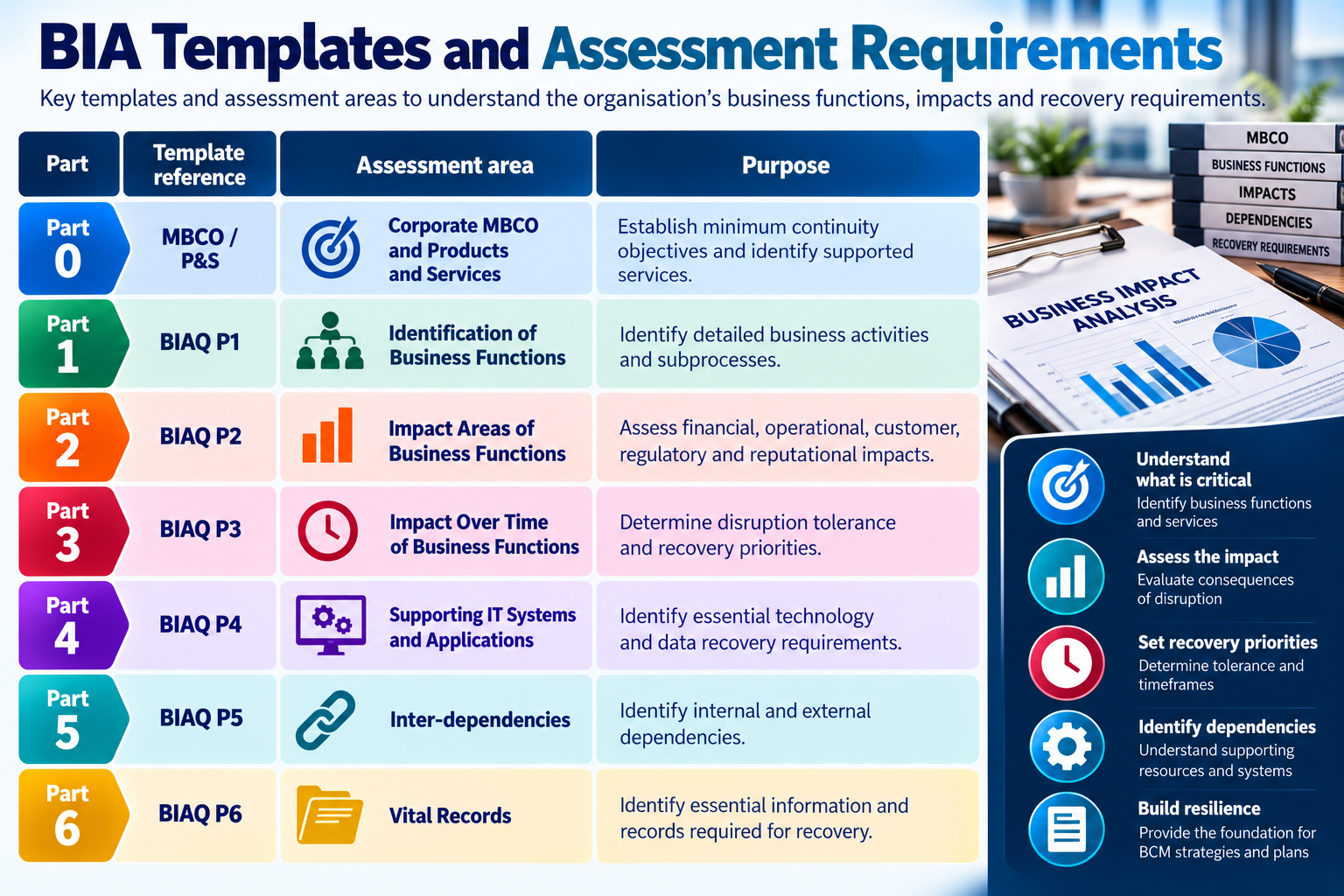
This chapter assesses what Jamiyah Home for the Aged (JHA) stands to lose, in money, compliance, safety and trust, when any of the fourteen activities that make up personal care and 24-hour supervision is disrupted. It is the second part of the Business Impact Analysis (BIA) for CBF-1, and it turns the function inventory from BIA Part 1 into evidence that the Board and management can use to decide what must be recovered first.
Introduction
Why evaluate business impacts
ISO 22301:2019 (clause 8.2.2) requires an organisation to understand the impacts that arise over time when its activities stop.
ISO 22313:2020 adds that the organisation should assess those impacts against criteria it agreed in advance, so it can compare one function fairly with another.
At JHA, the assessment subject is unusual.
The home's "customers" are elderly destitute residents, many frail, cognitively impaired or wholly dependent on staff for eating, toileting and moving.
Disruption to personal care is therefore measured first in harm to people, and only second in dollars.
A missed turning schedule can cause a pressure injury within hours; an unstaffed night shift can leave a resident who wanders or falls undiscovered.
Evaluating impact makes these consequences explicit.
It replaces the assumption that "everything in care is critical" with a reasoned view of which activities fail fastest, which fail most expensively, and which carry regulatory exposure under the Social Residential Homes Act 2025 and the MSF Code of Practice for Social Residential Homes.
Why impact areas are analysed separately
A single disruption rarely produces a single kind of harm. A staffing collapse on a night shift is a human resources problem, but it quickly becomes an operational, legal, regulatory and reputational one.
If all of these are folded into one score, the dominant consequence is hidden and the response is misdirected.
Analysing impact areas separately gives three benefits:
- Accuracy. Each Sub-CBF matches the consequence that would hurt JHA most, such as regulatory exposure for medication support or legal exposure for falls, rather than an averaged rating.
- Ownership. Each impact area points to a different owner and remedy. Workforce shortfalls belong to HR and the Superintendent; infection control lapses involve the nursing lead and MOH liaison; reputational harm involves Jamiyah Singapore's communications function.
- Comparability. Financial estimates can sit alongside non-financial consequences without one masking the other. A modest dollar loss can sit alongside a severe safeguarding consequence, and the Board can see both.
How impact assessment supports recovery
The results of this chapter feed directly into the next steps of the BIA and into the Business Continuity Plan.
The speed and severity with which each Sub-CBF erodes the Business Unit Minimum Business Continuity Objective (BU MBCO) determine its Recovery Time Objective (RTO) and its place in the recovery sequence.
The impact areas identified also shape the choice of continuity strategy.
A Sub-CBF whose main exposure is human resources calls for relief-staff agreements and cross-training; one whose exposure is information calls for paper downtime procedures and data back-up; one whose exposure is regulatory calls for pre-agreed notification routes with MSF and MOH. Impact assessment is therefore the bridge between knowing what JHA does and deciding how JHA will keep doing it.
Assessment Basis and BU MBCO
All figures in the table are indicative planning estimates in Singapore dollars, built on stated assumptions so that the Finance Committee can test and refine them. They are not accounting provisions.
Planning assumptions
Where JHA-specific data was not available, the assessment uses the following assumptions. Each should be replaced with actual figures during BIA validation.
| Assumption | Indicative value used |
|---|---|
| Resident population | 200 residents, of whom about 120 need substantial help with daily living and about 70 need assisted feeding |
| Care workforce | About 85 care staff on 12-hour day and night shifts; roughly 15 care staff on duty per shift |
| Agency or relief care aide | S$30–32 per hour |
| Overtime premium on own staff | S$11 per hour (0.5 × base rate of about S$22) |
| Locum or agency nurse | S$55 per hour |
| Nurse or care planner (internal cost) | S$45 per hour |
| Indicative funding and cost recovery per resident-day | S$110 |
| Standard disruption window | 72 hours, unless the formula states a longer window (14 or 30 days) because the function degrades slowly |
Costs of hospital treatment borne by public healthcare are excluded. Only costs that fall on JHA are counted: escorts, replacement staffing, consumables, external services, remediation, legal advice and lost funding.
BU MBCO for CBF-1
The BU MBCO is the minimum level of personal care and supervision JHA must sustain during a disruption to keep every resident safe and to remain within its licence conditions. For CBF-1 it is set out as eight elements, referenced in the table by code.
| Code | Minimum capability that must be sustained |
|---|---|
| MBCO-A | Safe staffing: every shift is staffed to the minimum safe ratio set by the Superintendent, with at least one trained senior on duty at all times |
| MBCO-B | Essential personal care: every dependent resident receives toileting or continence care, repositioning and basic hygiene at the intervals in their care plan |
| MBCO-C | Nutrition and hydration: three meals and scheduled fluids for every resident, with assisted feeding and texture-modified diets for those who need them |
| MBCO-D | Medication: time-critical medicines given within the prescribed window and all other medicines within the same day |
| MBCO-E | Supervision and safety: every resident accounted for at each round, night rounds at least two-hourly, and no resident with dementia unsupervised at exits |
| MBCO-F | Clinical escalation: signs of deterioration recognised and escalated to a nurse or doctor within 30 minutes, and emergency transfer arranged without delay |
| MBCO-G | Infection control: standard precautions maintained at every point of care, with isolation or cohorting of any suspected infectious case |
| MBCO-H | Records, reporting and admissions: handover and care records kept current, notifiable incidents reported to MSF and MOH within required timelines, and urgent MSF placements accepted after a safety screen (routine admissions may pause for up to 14 days) |
Impact Assessment by Sub-CBF
The largest single exposure is an infection outbreak (CBF-1.9, about S$37,200 over 14 days), followed by injurious falls (CBF-1.6) and failed clinical escalation (CBF-1.12). The fastest erosion of the BU MBCO comes from workforce shortfalls (CBF-1.3), because every other Sub-CBF depends on hands on the floor.
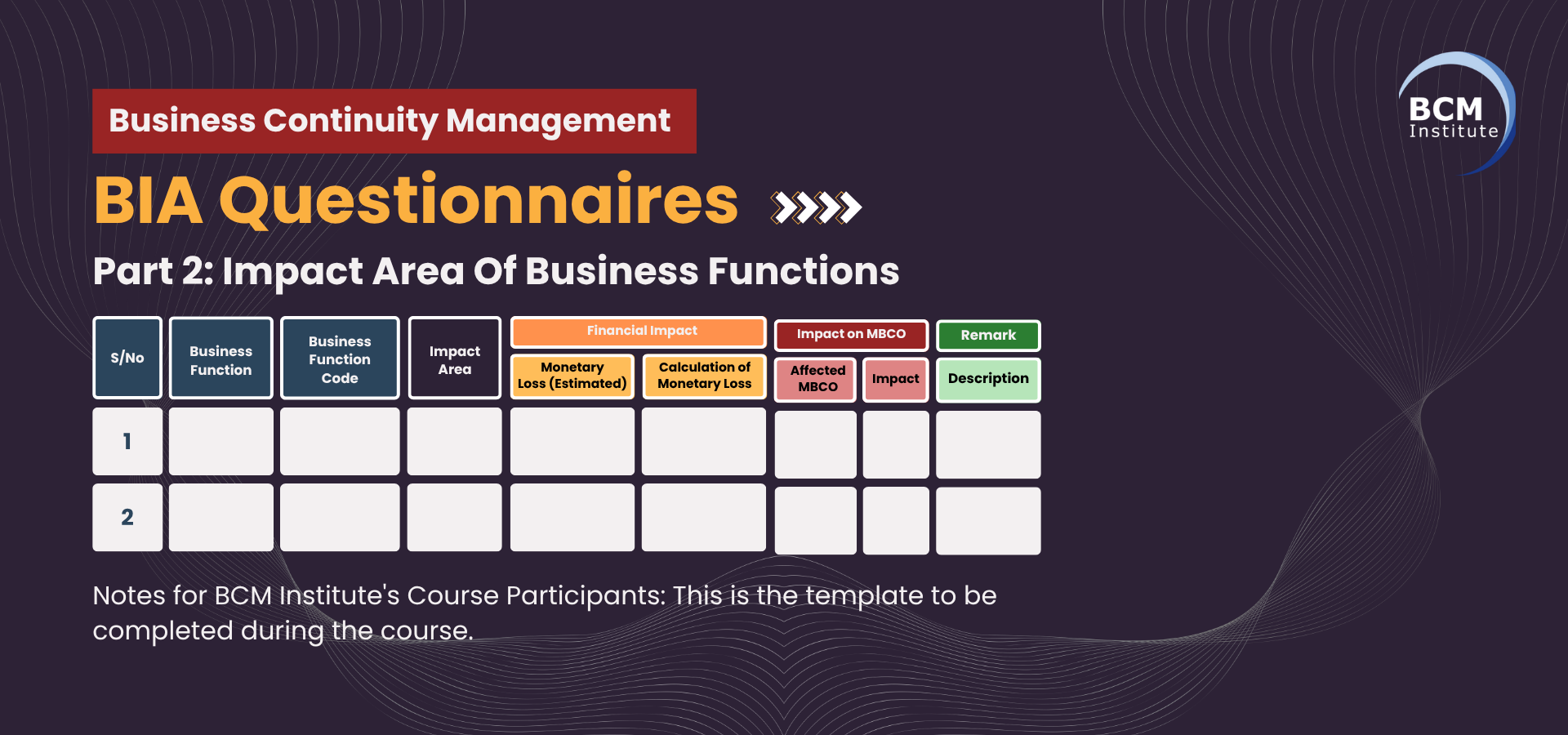
Table BIA Part 2: Impact Area Of Business Functions for CBF-1 Personal care and 24-hour supervision
| Sub-CBF Code | Sub-Critical Business Function | Impact Area | Financial Impact – Monetary Loss (Estimated) | Financial Impact – Calculation Formula | Impact on BU MBCO – Affected MBCO | Impact on BU MBCO – Business Impact | Remarks / Description |
|---|---|---|---|---|---|---|---|
| CBF-1.1 | Admission and Care Needs Assessment | Customer / Stakeholder | S$7,160 (14-day disruption) | (Deferred admissions × Funding per resident-day × Days deferred) + (Admissions × External assessment fee) = (4 × S$110 × 14) + (4 × S$250) | MBCO-H: urgent MSF placements accepted only after a pre-admission safety screen | Without trained assessors, JHA cannot safely accept destitute elders referred by MSF. Admitting without assessment risks placing a resident with unrecognised dementia, infection or nursing needs into an unsuitable ward. | The home can tolerate a short pause in routine admissions, so this is a slower-burning impact. The real cost falls on vulnerable people left without shelter and on MSF's confidence in JHA as a placement partner. An unsafe admission would also create downstream risk for CBF-1.9 and CBF-1.11. |
| CBF-1.2 | Individual Care Planning and Review | Regulatory | S$11,750 (30-day disruption) | (Overdue care plans × Hours to rebuild × Planner rate) + Regulatory remediation cost = (60 × 2.5 h × S$45) + S$5,000 | MBCO-B: personal care delivered to each resident's documented, current needs | Care continues but drifts from what residents actually need: diets, turning schedules and fall precautions no longer match changed conditions. Staff fall back on habit rather than an approved plan. | Out-of-date care plans are a common licensing inspection finding under the Code of Practice's resident management domain. Remediation includes a full review cycle and an action plan to MSF. The impact grows over weeks, not hours, but compounds harm in CBF-1.5, 1.6 and 1.7. |
| CBF-1.3 | Care Workforce Rostering and Shift Deployment | Human Resources | S$17,124 (72 hours) | (Shortfall staff per shift × Shifts × Hours × Agency rate) + (Own-staff overtime hours × Premium) = (6 × 6 × 12 h × S$32) + (300 h × S$11) | MBCO-A: every shift staffed to the minimum safe ratio with a trained senior on duty | A 40% shortfall on a 15-person shift leaves too few staff to toilet, feed, turn and watch 200 residents. MBCO-B, C, D and E all become unachievable within one shift. | This is the single point of failure for CBF-1. Triggers include an outbreak among staff, travel restrictions affecting foreign care workers, or mass resignation. Agency supply in Singapore tightens precisely when sector-wide events occur, so the cost may be higher and the supply uncertain. Fatigue from extended overtime raises error rates across all other Sub-CBFs. |
| CBF-1.4 | Activities of Daily Living Assistance | Operational | S$17,700 (72 hours) | (Dependent residents × ADL hours per day × Days × Relief rate) + Consumables surge = (120 × 1.5 h × 3 × S$30) + S$1,500 | MBCO-B: basic hygiene, dressing and toileting for every dependent resident | Residents who cannot wash, dress or reach the toilet unaided are left unattended for long periods. Dignity, comfort and skin health decline quickly. | The most labour-intensive Sub-CBF and the first to be cut when staff are short. Visible neglect of basic care is quickly noticed by visitors, volunteers and MSF officers. Recovery requires relief staff trained in safe handling of frail elders, not general labour. |
| CBF-1.5 | Continence Care and Skin Integrity Management | Reputation | S$17,300 (72 hours) | (New pressure injuries × Treatment cost per injury) + Continence supplies surge + Outsourced laundry = (3 × S$4,500) + S$2,000 + S$1,800 | MBCO-B: two-to-four-hourly continence care and repositioning for at-risk residents | Missed repositioning and delayed pad changes produce pressure injuries in bed-bound residents within hours. Each injury needs weeks of wound care and may need hospital treatment. | Pressure injuries are widely treated as a marker of care quality and potential neglect. A cluster would draw scrutiny from MSF, donors and the Muslim community that supports Jamiyah. Dependency on the pad supplier and laundry vendor should be checked in BIA Part 3. |
| CBF-1.6 | Mobility, Transfer and Fall Prevention | Financial | S$26,500 (72 hours) | (Additional injurious falls × Cost per injurious fall to JHA) + Incident investigation cost = (2 × S$12,000) + S$2,500 | MBCO-E: residents at high fall risk are supervised and transferred using safe techniques and working hoists | Without trained transfer staff or functioning hoists, residents either remain in bed or are moved unsafely. Falls and handling injuries to both residents and staff rise sharply. | The cost per fall covers hospital escorts, replacement staffing while staff accompany residents, post-discharge intensified care and equipment. A hip fracture in a frail resident carries serious risk of death. Falls are also the most likely source of a negligence claim, so legal exposure is a close second impact area. |
| CBF-1.7 | Feeding and Hydration Assistance | Operational | S$12,250 (72 hours) | (Assisted-feed residents × Meals per day × Hours per meal × Days × Relief rate) + (Hospital transfers × Escort cost) + Emergency supplies = (70 × 3 × 0.5 h × 3 × S$30) + (2 × S$800) + S$1,200 | MBCO-C: three meals and scheduled fluids, with assisted feeding and texture-modified diets | Residents who need hand-feeding or thickened fluids cannot eat or drink safely without trained help. Dehydration can develop within 24 to 48 hours; rushed feeding raises the risk of choking and aspiration pneumonia. | Feeding is time-bound around meal times, so even a partial staff shortfall creates a bottleneck. Halal compliance must be maintained in any substitute meal arrangement, which narrows the pool of alternative caterers. Dehydration and aspiration both lead to avoidable hospital admissions. |
| CBF-1.8 | Medication Administration Support | Regulatory | S$9,460 (72 hours) | (Locum nurse hours × Rate) + Emergency pharmacy repacking + Medication-error response cost = (72 h × S$55) + S$2,500 + S$3,000 | MBCO-D: time-critical medicines (for example insulin, anticonvulsants, Parkinson's medication) given within the prescribed window | Doses are missed, delayed or duplicated when trained staff are absent or medication records are unavailable. For time-critical medicines, a delay of a few hours can cause seizures, hypoglycaemia or loss of mobility. | Medication management is closely examined by MSF and MOH. Errors must be reported and investigated, and repeated errors can lead to licence conditions. Dependency on the supplying pharmacy for packed medicines is a key single point of failure. |
| CBF-1.9 | Point-of-Care Infection Prevention and Control | Regulatory | S$37,160 (14-day outbreak) | PPE + Terminal cleaning + Testing + (Days × 24 h × Cohort staff × Rate) = S$8,000 + S$6,000 + S$3,000 + (14 × 24 h × 2 × S$30) | MBCO-G: standard precautions at every point of care and isolation of suspected infectious cases | A lapse in hand hygiene, PPE use or isolation lets respiratory or gastrointestinal infection spread through shared wards. An outbreak also removes infected staff, collapsing MBCO-A. | The highest single financial exposure in CBF-1. Outbreaks trigger notification and direction from MOH, likely suspension of admissions and visiting, and close MSF oversight. Lost admission funding during any freeze is captured under CBF-1.1 and is additional to this figure. |
| CBF-1.10 | Day and Night Supervision and Safety Rounds | Customer / Stakeholder | S$13,456 (72 hours) | (Nights × Hours × Additional night staff × Rate) + Temporary call-bell hire + Cost of one serious unwitnessed incident = (3 × 12 h × 3 × S$32) + S$2,000 + S$8,000 | MBCO-E: every resident accounted for at each round and night rounds at least two-hourly | Thin night staffing or a failed nurse-call system means residents who fall, choke or deteriorate overnight may not be found for hours. | Residents, MSF and the public expect a 24-hour home to watch over residents continuously. An unwitnessed death or injury found at morning round is among the most damaging events a welfare home can face. Night shifts carry the thinnest margin and should be tested first in exercises. |
| CBF-1.11 | Dementia and Behavioural Care, including Wandering Prevention | Reputation | S$13,980 (72 hours) | (High-risk residents × Waking hours × Days × Sitter rate) + Missing-resident search cost + Communications and remediation = (6 × 12 h × 3 × S$30) + S$2,500 + S$5,000 | MBCO-E: no resident with dementia unsupervised at exits; behavioural incidents de-escalated safely | Residents with dementia may leave the premises unnoticed, harm themselves or others, or become distressed without consistent, familiar carers. Door-security failure removes the last physical safeguard. | A missing elderly resident involves the police and frequently attracts media and social media attention. Such cases damage public trust in Jamiyah's wider services. Agency staff unfamiliar with residents' triggers increase behavioural incidents, so continuity of known carers matters as much as numbers. |
| CBF-1.12 | Health Monitoring and Clinical Escalation | Legal | S$20,500 (72 hours) | (Avoidable hospital transfers × Cost per transfer to JHA) + (Days × Locum doctor or telemedicine cost) + Legal and inquiry support = (5 × S$1,200) + (3 × S$1,500) + S$10,000 | MBCO-F: deterioration recognised and escalated within 30 minutes; emergency transfers arranged without delay | Vital-sign checks lapse and early warning signs (fever, breathlessness, confusion) are missed. Conditions that could be treated in the home become emergencies, or are found too late. | A death following missed deterioration may lead to a coroner's inquiry and claims of negligence. Dependencies on the visiting doctor, telemedicine provider and ambulance services should be mapped. The legal cost estimate covers advice and preparation for an inquiry, not any damages awarded. |
| CBF-1.13 | Incident Reporting and Safeguarding | Regulatory | S$18,000 (7-day failure) | External review + Legal advice + (Staff × Retraining hours × Rate) = S$8,000 + S$6,000 + (80 × 2 h × S$25) | MBCO-H: notifiable incidents reported to MSF and MOH within required timelines; suspected abuse acted on immediately | Incidents go unrecorded or are reported late, and safeguarding concerns about abuse or neglect are not escalated. Patterns of harm remain invisible to management and regulators. | Late or missing notifications breach the incident management requirements of the Code of Practice and can be treated more seriously than the original incident. Failure to act on suspected abuse may also engage the Vulnerable Adults Act. This Sub-CBF must continue even when everything else is degraded; it is how the Board learns what is happening. |
| CBF-1.14 | Shift Handover and Care Documentation | Information | S$9,000 (72-hour system outage) | (Shifts × Staff × Extra paper-handover hours × Rate) + (Residents × Days × Back-entry hours × Rate) + Vendor emergency support = (6 × 15 × 1 h × S$25) + (200 × 3 × 0.25 h × S$25) + S$3,000 | MBCO-H: handover and care records kept current enough to support safe care on the next shift | Without reliable handover, incoming staff do not know who fell, who refused food, who has a fever or whose medication changed. Errors multiply across shifts. | The electronic care record and its vendor are critical technology dependencies. A tested paper downtime pack, with printed resident summaries refreshed daily, is the main mitigation. Incomplete records also weaken JHA's position in any later inquiry or claim. |
The fourteen estimates total about S$231,000. They use different disruption windows and overlap in a real event, so they should be read as a ranking of exposure, not added into one loss figure.

The assessment shows that CBF-1 cannot be treated as one block of "care". Its fourteen Sub-CBFs fail at different speeds, through different causes and with different consequences, and JHA's continuity arrangements must reflect those differences.
How Impact Assessment Supports the BIA
This chapter supplies the evidence that the rest of the BIA depends on. BIA Part 1 identified what JHA does; this part establishes what happens when it stops. Each row links a Sub-CBF to a named impact area, a cost, and a specific element of the BU MBCO, so later decisions can be traced back to a stated consequence rather than to opinion.
The assessment also exposes interdependencies. Workforce rostering (CBF-1.3) underpins nearly every other Sub-CBF, and infection control (CBF-1.9) can trigger a staffing collapse. These links will be carried into the dependency and resource analysis that follows.
How Financial Estimation Assists Management Decisions
Financial estimates give the Board and the Finance Committee a common scale for comparing exposure with the cost of protection.
For example, an outbreak costing about S$37,000 over 14 days can be weighed against the annual cost of a pre-stocked PPE reserve and a relief-staff agreement. A standing agency arrangement can be justified against a 72-hour workforce shortfall costing over S$17,000.
The figures also show where money is not the main issue. Incident reporting (CBF-1.13) carries a moderate cost but a severe regulatory and safeguarding consequence.
Seeing both side by side prevents management from under-investing in functions whose harm is not primarily financial. Because the estimates rest on stated formulas, they can be updated quickly as actual staffing costs, resident numbers and funding rates are confirmed.
How impact analysis shapes RTOs, priorities, strategies and plans
The rate at which each Sub-CBF erodes the BU MBCO sets its Recovery Time Objective. The analysis suggests three broad tiers, to be confirmed in the RTO chapter:
- Minutes to hours: rostering and deployment, supervision and safety rounds, medication support for time-critical medicines, clinical escalation, and dementia and wandering prevention. Failure here causes direct physical harm within a single shift.
- Within 24 hours: activities of daily living, continence and skin care, feeding and hydration, point-of-care infection control, incident reporting, and shift handover. Harm accumulates rapidly but can be held off briefly by prioritising the most dependent residents.
- Days to weeks: admission assessment and care plan review. These can pause safely for a defined period, provided urgent MSF placements and changed care needs are still handled.
The dominant impact area then points to the right continuity strategy. Human resources exposure calls for relief pools, cross-training of care staff across wards, and mutual aid with other Jamiyah services or partner homes. Regulatory exposure calls for pre-agreed notification routes and template reports for MSF and MOH. Information exposure calls for paper downtime packs and tested restoration of the electronic care record. Reputation exposure calls for a prepared communications protocol coordinated with Jamiyah Singapore.
These strategies become the content of the Business Continuity Plan for CBF-1: who acts, in what order, using which resources, to restore each MBCO element within its RTO.
How understanding impact areas strengthens resilience
Understanding impact areas gives JHA a more mature view of its own vulnerability. It shifts attention from single events, such as a fire or a flood, to the consequences any event can produce: too few staff, no records, a spreading infection, a missing resident. Plans built around consequences work across many scenarios.
It also strengthens governance. The Code of Governance for Charities and IPCs (2023) expects boards to understand and oversee key risks.
A documented impact assessment, reviewed annually and after any significant incident, gives the Board clear evidence of where residents are most exposed and whether investment in continuity is proportionate.
Above all, it keeps the focus where it belongs at JHA: ensuring every resident is fed, cared for, kept safe, and watched over, whatever disruption the home faces.

