
![[BCM] [JCU] [Full Banner] Business Continuity Management Implementation at JCU Singapore](https://no-cache.hubspot.com/cta/default/3893111/c28ce2ee-dfaa-4e23-b28a-6ae8ca285f06.png)

![x [BCM] [JCU] Legal Disclaimer Banner](https://no-cache.hubspot.com/cta/default/3893111/e57030e6-3c63-46cc-988b-1eabb945de75.png)
eBook 1: Chapter 1
Building Business Continuity Resilience for JCUS
Introduction
James Cook University Singapore operates in an environment where the continuity of education depends upon much more than the availability of classrooms.
Academic staff, students, learning technologies, student records, assessment processes, campus facilities, communications, third-party services and regulatory arrangements collectively support the University's ability to deliver education.
A serious disruption affecting any combination of these resources can quickly become an institutional continuity issue.
Examples include a cyberattack affecting student and academic systems, an extended campus closure, loss of telecommunications, failure of a critical cloud service, prolonged power disruption, infectious-disease events, loss of key personnel or an incident affecting the integrity of academic records.
Business Continuity Management (BCM) provides JCUS with a structured approach for preparing for such disruptions and maintaining its priority activities at acceptable levels.
ISO 22301:2019 is the current published international requirements standard for Business Continuity Management Systems (BCMS).
It provides a framework for establishing, implementing, operating, monitoring, reviewing, maintaining, and continually improving a BCMS so an organisation can prepare for, respond to, and recover from disruptions.
A new edition is under development as of September 2026, but ISO 22301:2019 remains the published edition. ISO
For JCUS, BCM should be treated as an institutional management capability rather than merely an emergency-response plan.
Its purpose is to protect the continued delivery of education and other priority activities while safeguarding students, employees, information, academic integrity, regulatory obligations and institutional confidence.
This opening chapter establishes the foundation for the remainder of Understanding Your Organisation for James Cook University. It introduces ten interconnected areas:
- Introducing BCM for JCUS
- Understanding JCUS's Operations
- Identifying BCM Goals for JCUS
- Establishing Business Continuity Objectives for JCUS
- Determining Business Continuity Assumptions for JCUS
- Developing the BCM Team Composition for JCUS
- Analysing the Operating Environment for JCUS
- Implementing the BCM Planning Methodology
- Assessing Risks and Threats for JCUS
- Identifying Critical Business Functions for JCUS
Together, these establish the organisational context needed before detailed BIA, continuity strategy, plan development, exercising and programme management can be undertaken.
Introducing BCM for James Cook University
BCM is the coordinated organisational capability that enables JCUS to prepare for disruptions, respond effectively when they occur, maintain priority activities and recover affected operations.
The emphasis is on continuity of outcomes, rather than simply recovery of individual assets.
For example, if the Sims Drive campus becomes temporarily inaccessible, the BCM objective is not necessarily to restore the building immediately.
The immediate continuity requirement may instead be to maintain an acceptable level of teaching, assessment, student support and communication through alternative arrangements.
Likewise, if LearnJCU or another critical academic platform becomes unavailable, the objective should extend beyond restoring the application. JCUS should determine how affected teaching and academic activities can continue while technical recovery is underway.
A practical JCUS BCM philosophy is therefore:
Protect people. Maintain priority education services. Protect academic information and integrity. Meet essential obligations. Recover systematically. Learn and improve.
This aligns with ISO 22301's emphasis on an organisation's ability to continue delivering products and services at an acceptable predefined capacity during disruption.
BCM Is More Than Emergency Management
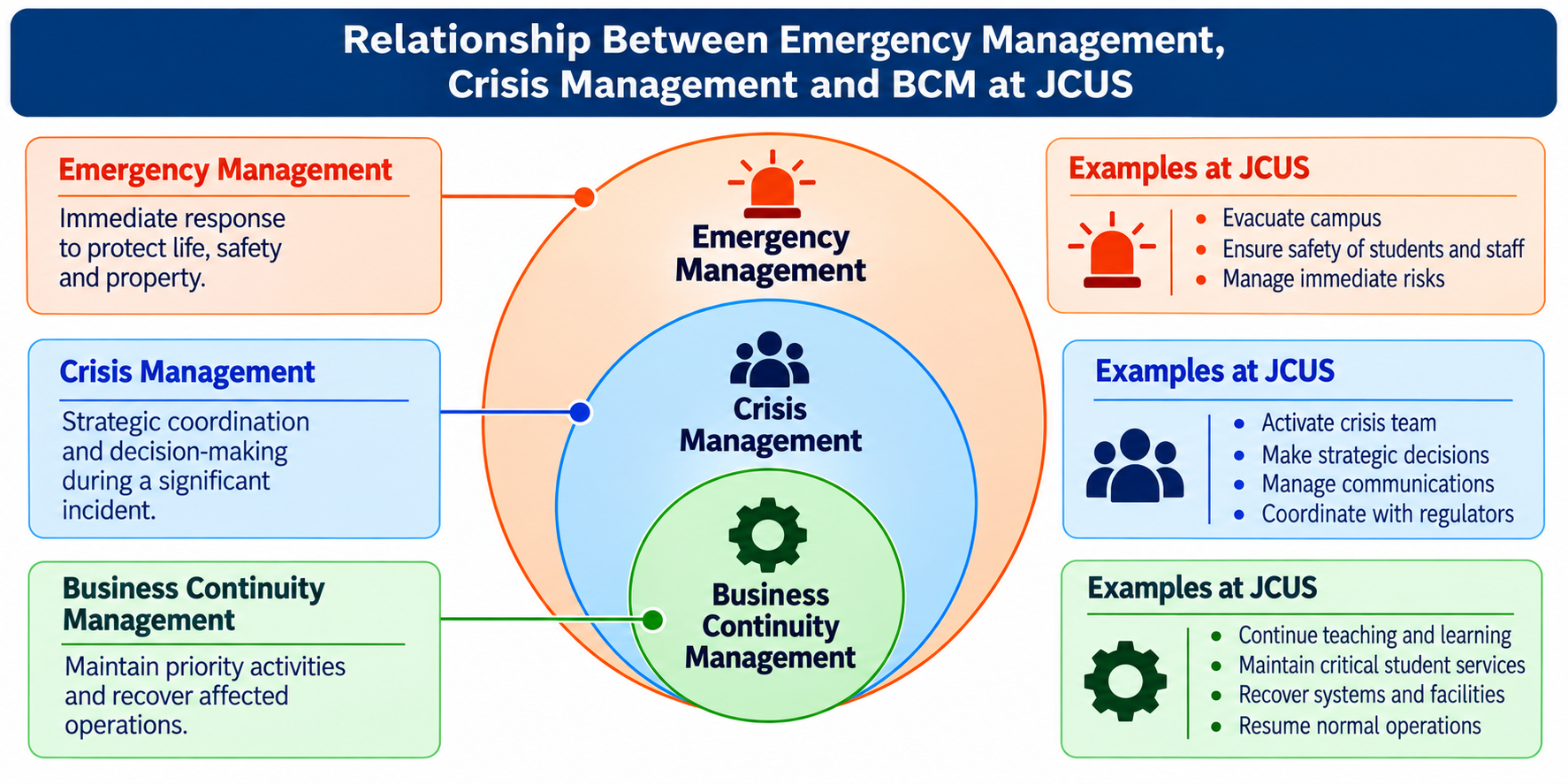
Emergency management and BCM are related but perform different functions.
An emergency response may focus on evacuating a building following a fire. BCM addresses the subsequent question:
How will JCUS continue its priority activities if the building remains unavailable for two weeks?
Similarly, cybersecurity teams may contain a ransomware incident. BCM asks:
How will teaching, assessment, student administration and other priority activities operate while systems are unavailable or being restored?
The JCUS BCMS should therefore integrate with, rather than replace:
-
emergency response;
-
crisis management;
-
ICT disaster recovery;
-
cybersecurity incident response;
-
facilities management;
-
health and safety;
-
academic management;
-
student support;
-
communications;
-
risk management; and
-
third-party management.

Understanding JCUS's Operations
Effective BCM starts with understanding the organisation.
ISO 22301 places organisational context at the beginning of the management-system process.
This includes understanding internal and external issues, interested parties, applicable requirements and the scope of the BCMS.
For JCUS, the operating model spans several interconnected domains.
|
Operational Domain |
Examples Relevant to JCUS |
BCM Consideration |
|
Academic delivery |
Lectures, tutorials, practical teaching |
How can teaching continue during campus or technology disruption? |
|
Assessment |
Assignments, examinations, marking and results |
Which assessment activities are time-critical? |
|
Student administration |
Admission, enrolment, progression and records |
How long can these activities be unavailable? |
|
Student services |
Advice, welfare and essential support |
Which services must remain accessible during disruption? |
|
Digital learning |
LearnJCU and associated academic technologies |
What alternatives exist if platforms become unavailable? |
|
ICT |
Networks, identity, applications, devices and connectivity |
Which technologies support priority activities? |
|
Campus |
Teaching spaces, laboratories, library and facilities |
What happens if the campus is inaccessible? |
|
Academic information |
Student records, results and teaching information |
How are availability and integrity protected? |
|
Research |
Research information, specialist facilities and activities |
Which research activities are time-sensitive or irreplaceable? |
|
Regulatory and quality assurance |
Private education and EduTrust obligations |
Which obligations have fixed deadlines or continuity implications? |
The important BCM principle is that these domains are interdependent.
Teaching, for example, may require academic staff, ICT connectivity, authentication, learning platforms, student enrolment information, learning resources, physical or virtual teaching facilities and communication channels.
JCUS should therefore understand services as end-to-end institutional activities rather than isolated departmental processes.
Singapore Regulatory and Quality-Assurance Context
JCUS operates within Singapore's private education regulatory and quality-assurance framework.
As of September 2026, JCUS states that the functions and powers under the Private Education Act 2009 and its subsidiary legislation transferred to the Skills and Workforce Development Agency (SWDA) from 1 July 2026 following the merger of SkillsFuture Singapore Agency and Workforce Singapore Agency.
JCUS also states that all courses at its Singapore campus are registered with SWDA and its operations are governed by EduTrust. James Cook University Singapore
SWDA administers EduTrust as the quality-assurance scheme for Private Education Institutions. JCUS states that it holds EduTrust Star, the highest level of the scheme, and obtained this award for the third time in 2023. James Cook University Singapore
EduTrust includes seven assessment criteria, beginning with Leadership and Strategic Planning, and is intended to support higher standards of educational services and student or graduate outcomes. SSG
The regulatory environment has direct implications for BCM. Continuity arrangements should therefore consider, where applicable:
• requirements under the Private Education Act and subsidiary legislation;
• SWDA requirements;
• EduTrust obligations;
• student protection arrangements;
• Fee Protection Scheme requirements;
• academic and student records;
• student contractual obligations;
• data protection requirements;
• safety obligations; and
• regulatory reporting and evidence.
For example, JCUS states that its students are covered under a Fee Protection Scheme and that it uses the Fee Protection Scheme Group Insurance arrangement. James Cook University Singapore
This means that BCM should not be designed solely around operational recovery.
It should also consider whether prolonged disruption could impair JCUS's ability to meet regulatory, quality-assurance and student-protection obligations.

Identifying BCM Goals for JCUS
BCM goals describe what JCUS ultimately seeks to achieve through its continuity programme.
They should align with institutional priorities rather than being limited to technical recovery.
Recommended BCM goals for JCUS include:
|
BCM Goal |
Application to JCUS |
|
Protect life, safety and welfare |
Safeguard students, employees, contractors and visitors during disruptive incidents. |
|
Maintain priority education activities |
Continue critical teaching, assessment and academic activities at acceptable levels. |
|
Protect students |
Minimise disruption to learning, progression, assessment and essential support. |
|
Maintain academic integrity |
Protect examinations, results, academic information and assessment processes. |
|
Protect information |
Maintain confidentiality, integrity and availability of critical information. |
|
Maintain regulatory obligations |
Support continued compliance with applicable Singapore requirements. |
|
Maintain stakeholder confidence |
Provide timely, accurate and consistent information during disruption. |
|
Protect institutional reputation |
Demonstrate controlled and responsible management of significant incidents. |
|
Enable structured recovery |
Restore affected operations according to agreed priorities. |
|
Continually improve resilience |
Learn from incidents, exercises, audits and organisational change. |
These goals provide direction for the more measurable business continuity objectives.

Establishing Business Continuity Objectives for JCUS
BCM goals express intent. Business continuity objectives translate that intent into measurable outcomes.
ISO 22301 emphasises establishing objectives that support the business continuity policy and allow the organisation to evaluate BCMS effectiveness. ISO
Illustrative JCUS objectives could include:
Objective 1 — Maintain Priority Teaching
Establish continuity arrangements that allow priority teaching activities to continue at an agreed minimum level following loss of normal teaching facilities or technologies.
Objective 2 — Protect Critical Assessment Activities
Establish alternative arrangements for examinations and assessments where disruption would otherwise create unacceptable academic consequences.
Objective 3 — Recover Critical ICT Services
Define recovery requirements for technologies supporting priority university activities and align ICT disaster recovery capabilities with BIA requirements.
Objective 4 — Maintain Student Communications
Provide reliable mechanisms for communicating disruption information and continuity arrangements to affected students.
Objective 5 — Maintain Critical Student Support
Ensure that essential welfare and student-support arrangements remain available during serious disruptions.
Objective 6 — Exercise Continuity Arrangements
Conduct planned exercises that validate business continuity procedures, responsibilities, communications, dependencies and decision-making.
Objective 7 — Continually Improve the BCMS
Capture corrective actions arising from incidents, exercises, audits and management reviews and track them through completion.
These objectives should subsequently be supported by indicators, accountable owners and review periods.

Determining Business Continuity Assumptions for JCUS
Develop continuity plans against explicit assumptions.
Without agreed assumptions, different departments may prepare for fundamentally different disruption conditions.
JCUS should consider assumptions such as:
|
Planning Assumption |
Example |
|
Campus loss |
Part or all of Sims Drive may be inaccessible for an extended period. |
|
Technology disruption |
One or more critical applications may be unavailable even where staff can work remotely. |
|
Cyber incident |
Systems may need to remain isolated until they are confirmed safe. |
|
Workforce disruption |
A significant proportion of employees may be unavailable or unable to reach campus. |
|
Communications disruption |
Normal email, telephony or collaboration tools may not always be available. |
|
Third-party disruption |
A critical supplier may fail when JCUS needs its services. |
|
Data integrity issue |
Information may be accessible but may not be initially trustworthy. |
|
Peak-period incident |
Disruption may occur during examinations, enrolment or another time-sensitive academic period. |
|
Prolonged disruption |
Recovery may take substantially longer than expected. |
|
Concurrent events |
JCUS may have to manage more than one disruption at the same time. |
A useful planning principle is:
Do not assume the resource that failed will be available to support the workaround.
For example, an ICT continuity plan should not rely exclusively on the same authentication infrastructure that failed and caused the original disruption.

Developing the BCM Team Composition for JCUS
BCM requires clearly defined governance and accountability.
Under ISO 22301, top management plays an important role in providing leadership, establishing policy, ensuring resources are available, and assigning responsibilities for implementing and maintaining the BCMS.
A practical JCUS BCM structure could comprise:
|
BCM Role |
Primary Responsibility |
|
Senior Management |
Strategic oversight, policy approval and resources |
|
BCMS Sponsor |
Executive sponsorship and escalation |
|
BCM Steering Committee |
Institutional BCM governance and prioritisation |
|
BCM Programme Lead |
Coordinate and maintain the BCMS |
|
Academic Representatives |
Teaching, assessment and academic continuity |
|
Student Administration Representatives |
Student records, enrolment and progression |
|
Student Support Representatives |
Student welfare and essential support |
|
ICT / Cybersecurity |
Technology resilience, cyber response and disaster recovery |
|
Facilities / Campus Operations |
Campus availability, utilities and alternative facilities |
|
Communications |
Student, staff and stakeholder communications |
|
Human Resources |
Workforce continuity and staff welfare |
|
Finance |
Critical financial processes and resources |
|
Regulatory / Quality Representatives |
Regulatory and EduTrust considerations |
|
Business Function Owners |
BIA, strategies and continuity procedures for individual functions |
The BCM team should not own every recovery activity.
A useful accountability principle is:
BCM coordinates the framework; business owners own continuity of their functions.

Analysing the Operating Environment for JCUS
The operating environment influences both the types of disruptions JCUS should consider and the continuity capabilities it requires.
The analysis should consider external and internal factors.
External Environment
Relevant factors may include:
- Singapore's regulatory framework;
- expectations of students and parents;
- dependence on telecommunications and utilities;
- cloud and technology providers;
- cyber threats;
- severe weather and environmental conditions;
- public-health events;
- transport disruption;
- critical suppliers;
- international dependencies; and
- changes affecting the higher-education sector.
Internal Environment
Relevant considerations include:
- academic calendar;
- student population;
- workforce;
- campus configuration;
- teaching delivery model;
- ICT architecture;
- learning platforms;
- academic governance;
- specialist facilities;
- information dependencies;
- organisational structure;
- third-party arrangements; and
- existing incident-management capabilities.
The assessment should also identify interested parties.
For JCUS, these may include students, employees, regulators, parents, partner organisations, suppliers, insurers and other stakeholders.
Each may have different continuity expectations.
 Implementing the BCM Planning Methodology
For this implementation guide, the BCM planning methodology consists of seven phases:
-
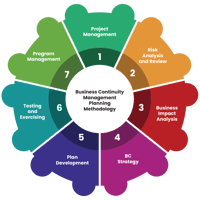 Project Management (PM)
 -
Risk Analysis and Review (RAR)
-
Business Impact Analysis (BIA)
-
Business Continuity Strategy (BCS)
-
Plan Development (PD)
-
Testing and Exercising (TE)
-
Programme Management (PgM)
ACF should implement BCM as a structured lifecycle, not a collection of standalone emergency plans.
A practical methodology contains seven major phases.
Phase 1 — Project Management
Establish governance, policy, roles, responsibilities, scope and programme management arrangements.
Phase 2 — Risk Assessment
Identify threats, vulnerabilities, existing controls and potential disruption scenarios.
Phase 3 — Business Impact Analysis
Determine critical activities, understand disruption consequences, and establish recovery priorities.
Phase 4 — Business Continuity Strategy
Identify practical solutions for meeting approved recovery requirements.
Phase 5 — Plan Development
Document activation, response, continuity and recovery procedures.
Phase 6 — Testing and Exercising
Validate whether the arrangements work under realistic disruptive conditions.
Phase 7 — Programme Management and Continual Improvement
Review incidents, exercises, organisational changes and performance to continually improve the BCMS.
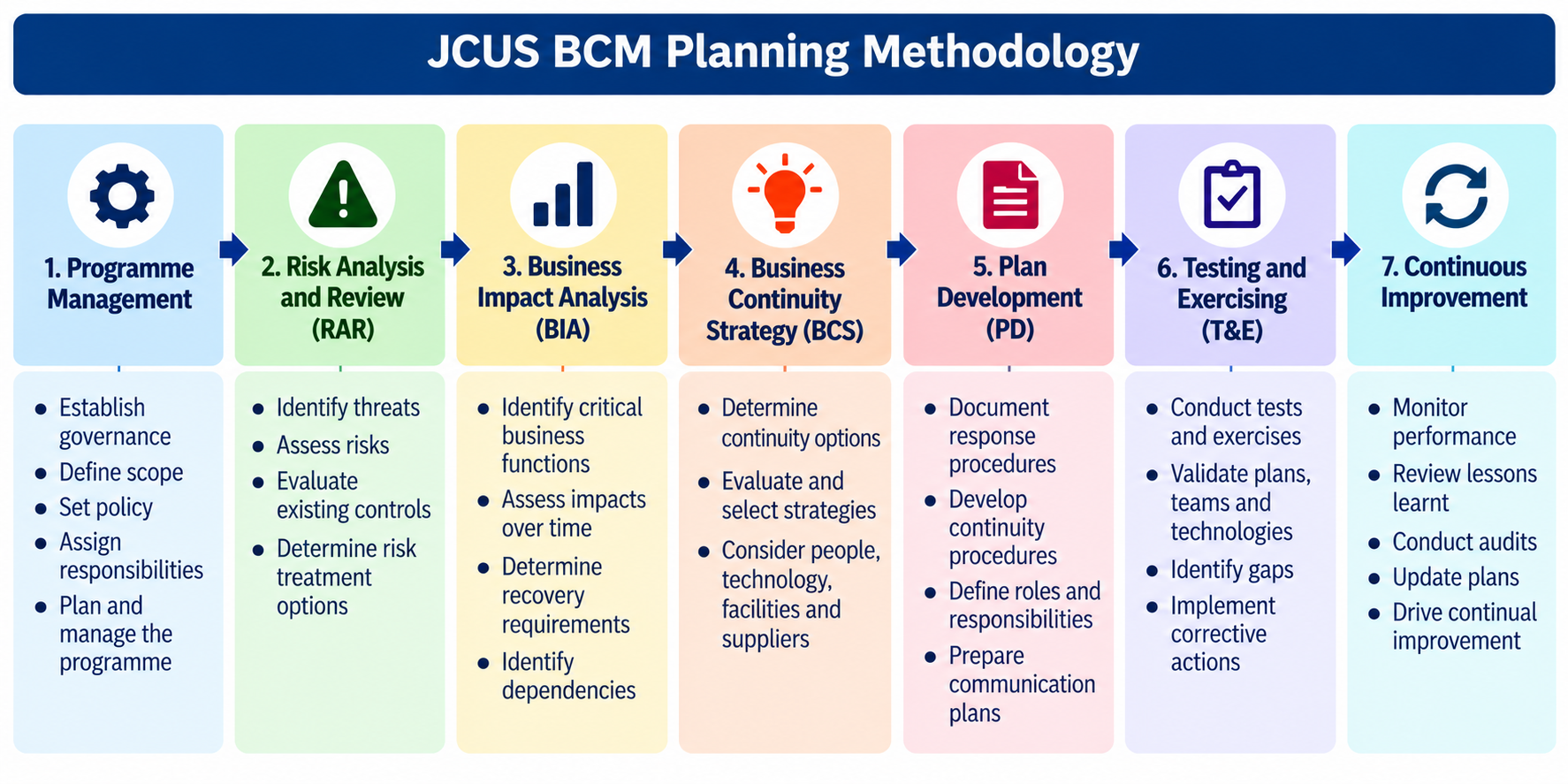
The methodology should operate as a continuous management cycle rather than a one-time project.
Example
Consider an extended failure of a critical learning platform.
The methodology would require JCUS to:
Risk Analysis and Review (RAR)—identify plausible causes such as a cyberattack, cloud outage, or authentication failure.
Business Impact Analysis (BIA) — determine which teaching and assessment activities are affected and when impacts become unacceptable.
BC Strategy (BCS) —identify alternative methods for distributing learning materials and receiving essential submissions.
Plan Development (PD) —document responsibilities, actions, escalation, and communication.
Exercise — simulate loss of the platform during a critical academic period.
Program Management (PgM) and Improvement — correct weaknesses discovered during the exercise.
BCM therefore becomes a lifecycle, not a collection of static documents.

Assessing Risks and Threats for JCUS
Risk assessment complements the BIA.
The risk assessment asks what could cause disruption.
The BIA asks what the consequences would be if disruption occurs and how quickly recovery is required.
Both are necessary.
Illustrative threats for JCUS include:
|
Threat Category |
Example Threats |
Potential JCUS Impact |
|
Cyber |
Ransomware, account compromise, DDoS |
Loss of academic and administrative systems |
|
ICT |
Application, network or authentication failure |
Loss of digital learning and administration |
|
Data |
Corruption or loss of records |
Academic and student-record integrity issues |
|
Facilities |
Fire, utility failure, building damage |
Campus or facility unavailability |
|
Utilities |
Extended electricity or telecommunications outage |
Teaching and ICT disruption |
|
People |
Pandemic, workforce shortage, loss of specialist staff |
Reduced ability to deliver critical activities |
|
Supplier |
Cloud or critical service-provider failure |
Loss of outsourced capabilities |
|
Security |
Threat affecting campus access |
Evacuation or denial of access |
|
Environmental |
Severe weather or environmental incident |
Campus and transportation disruption |
|
Academic |
Examination or assessment disruption |
Student progression and integrity consequences |
Risk treatment can reduce the probability or impact of some disruptions.
However, BCM should recognise that it cannot prevent every disruption.
The central continuity question therefore remains:
If the preventive controls fail, can JCUS still maintain its priority activities?

Identifying Critical Business Functions for JCUS
Critical Business Functions (CBFs) are activities whose disruption could create unacceptable consequences if they are not continued or recovered within the required timeframe.
Criticality should be based on impact over time, rather than organisational status or departmental preference.
For example, routine administrative activities may tolerate several days of disruption. In contrast, examination activities during a scheduled examination period may become critical within hours.
An initial enterprise-level JCUS CBF catalogue could include:
|
CBF |
Proposed Critical Business Function |
|
CBF-1 |
Teaching and Learning Delivery |
|
CBF-2 |
Examinations and Academic Assessment |
|
CBF-3 |
Student Enrolment, Registration and Academic Progression |
|
CBF-4 |
Student Records and Academic Results Management |
|
CBF-5 |
Critical Digital Learning and Academic Platforms |
|
CBF-6 |
Critical ICT Infrastructure, Identity and Connectivity |
|
CBF-7 |
Student Safety, Welfare and Critical Support |
|
CBF-8 |
Campus Safety, Security and Essential Facilities |
|
CBF-9 |
Admissions and Critical Student Onboarding |
|
CBF-10 |
Student Fee Administration and Protection |
|
CBF-11 |
Regulatory Compliance and Education Quality Assurance |
|
CBF-12 |
Critical University Communications and Crisis Information |
|
CBF-13 |
Library and Essential Academic Information Resources |
|
CBF-14 |
Critical Research and Specialist Laboratory Operations |
These classifications are proposed BCM working categories and should be validated through JCUS's formal BIA rather than interpreted as existing JCUS classifications.
Academic Calendar Criticality
A distinctive characteristic of university BCM is that criticality changes throughout the academic year.
During an intake period, admissions, enrolment, student systems and fee administration may become particularly time-sensitive.
During normal teaching weeks, teaching delivery, LearnJCU, ICT, student support and campus facilities may take priority.
During examinations, assessment, ICT, student records, facilities and communications may become exceptionally time-critical.
During results processing, academic records, assessment results and progression decisions become important.
JCUS should therefore incorporate peak-period criticality into its BIA rather than assigning one static recovery priority to each function.
Connecting the Ten BCM Components
The ten components discussed in this chapter should not be implemented independently.
They form an integrated sequence:
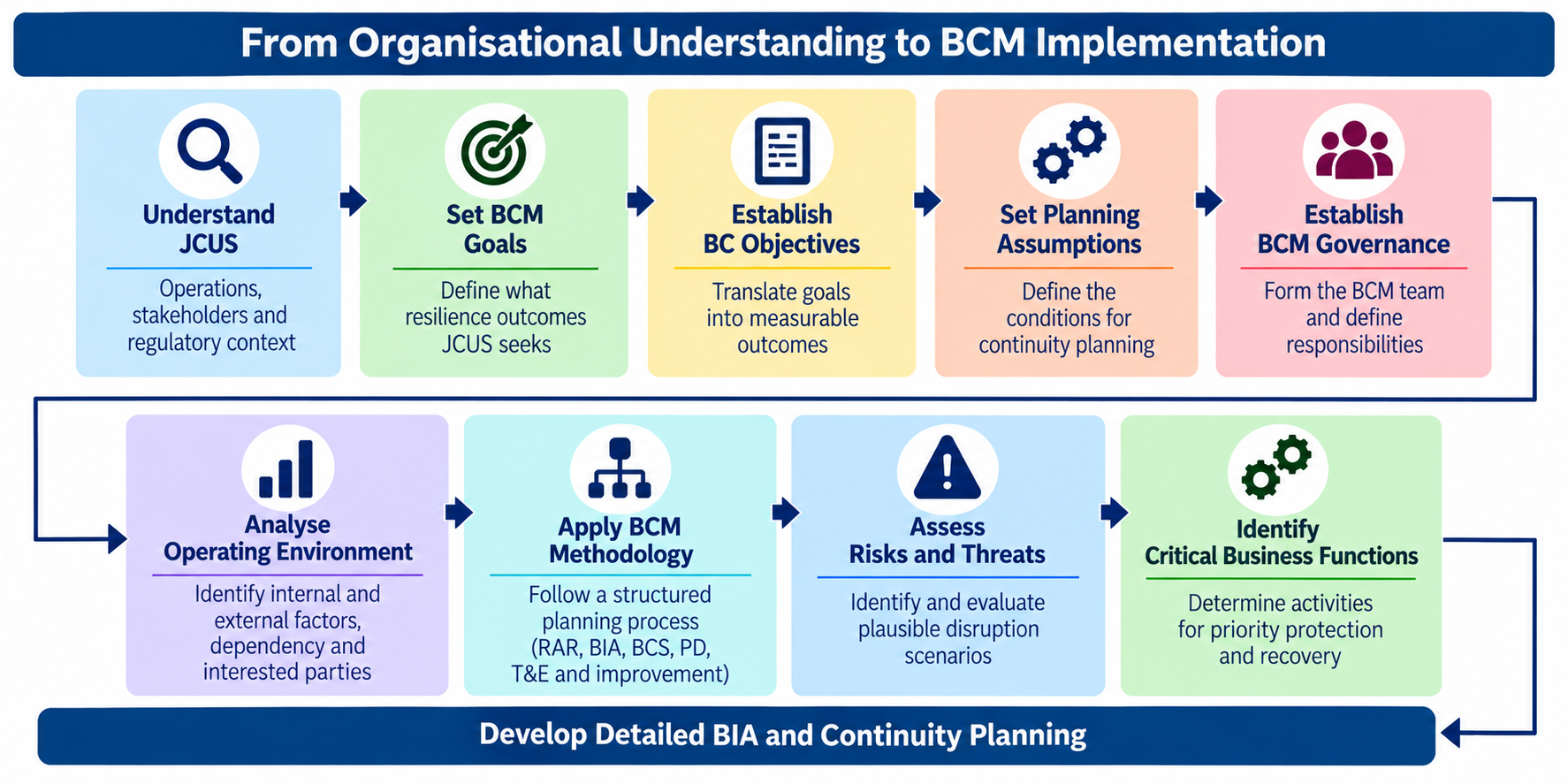
Understand JCUS and its regulatory context
This establishes what the organisation does, whom it serves and what obligations apply.
Define BCM goals and objectives
This establishes what resilience outcomes JCUS intends to achieve.
Establish assumptions and governance
This determines the conditions against which continuity will be planned and who is responsible.
Analyse the operating environment
This identifies internal and external dependencies and constraints.
Apply the BCM planning methodology
This provides the structured process for implementation.
Assess risks and threats
This identifies plausible causes of disruption.
Identify Critical Business Functions
This determines which activities require priority protection and recovery.
The subsequent BIA can then determine how quickly those functions need to be recovered and what resources they require.
What Effective BCM Should Look Like at JCUS
A mature JCUS BCMS should ultimately allow management to answer several practical questions confidently:
-
Which university activities must continue during a serious disruption?
-
How long can each priority activity tolerate interruption?
-
What is the minimum acceptable operating level?
-
Which people are essential?
-
Which systems and information are required?
-
Which facilities are required?
-
Which suppliers and external parties are critical?
-
What alternative arrangements are available?
-
Who has authority to activate continuity arrangements?
-
How will students and employees be informed?
-
How will ICT recovery priorities align with business priorities?
-
How will JCUS know that its plans actually work?
-
How will weaknesses be corrected?
Exercises and tests are particularly important because they provide evidence about whether continuity arrangements work as intended.
ISO guidance emphasises structured exercises to validate arrangements and build organisational capability. ISO
BCM maturity should therefore be measured not by the number of plans JCUS possesses but by its demonstrated ability to continue and recover priority activities under realistic disruption conditions.
Relationship to the Three-eBook Series
This three-eBook series takes ACF through a progressive BCM implementation journey.
![[BCM] [E1] [C1] eBook 1 to eBook 3 One Implementation Journey](https://no-cache.hubspot.com/cta/default/3893111/c8ff4234-63bc-493b-9945-c28a3c55b3f0.png)
This chapter also establishes the foundation for the complete series:
eBook 1 — Understanding Your Organisation for James Cook University
Establishes organisational context, BCM goals and objectives, assumptions, governance, operating environment, threats and Critical Business Functions.
eBook 2 — Implementing Business Continuity Management for James Cook University
Translates organisational understanding into detailed risk assessment, BIA, continuity strategies, recovery requirements, procedures, exercising and implementation activities.
eBook 3 — Starting Your BCM Implementation for James Cook University
Provides a practical implementation pathway for turning the methodology into an operational JCUS BCM programme, including ownership, implementation activities, templates, workshops and continuous improvement.
Together, the three eBooks move the reader from:
Understanding → Analysis → Strategy → Planning → Validation → Sustained BCM Capability
![Banner [Summary] [BCM] [E1] [C2] Understanding Your Organisation](https://no-cache.hubspot.com/cta/default/3893111/f008eb8e-2d77-4964-abfa-a4ef718b1284.png)
Business Continuity Management provides James Cook University Singapore with a structured way to prepare for disruption while protecting the continued delivery of priority education and institutional activities.
For JCUS, BCM must extend beyond recovering buildings or technology. Effective continuity depends upon understanding the relationships between students, academic staff, teaching and assessment, information, digital platforms, ICT infrastructure, campus facilities, student support, suppliers and regulatory obligations.
The Singapore context is also important.
JCUS operates under the Private Education Act framework, with SWDA exercising relevant regulatory functions since 1 July 2026, and operates within the EduTrust quality-assurance environment.
JCUS states that its Singapore courses are registered with SWDA and that EduTrust governs its operations.
ISO 22301 provides the management-system foundation for integrating these considerations into a coherent BCMS.
It requires more than producing continuity plans: the organisation must establish context, leadership, objectives, resources, operational arrangements, evaluation, and continual improvement.
The practical foundation established in this chapter can therefore be summarised as:
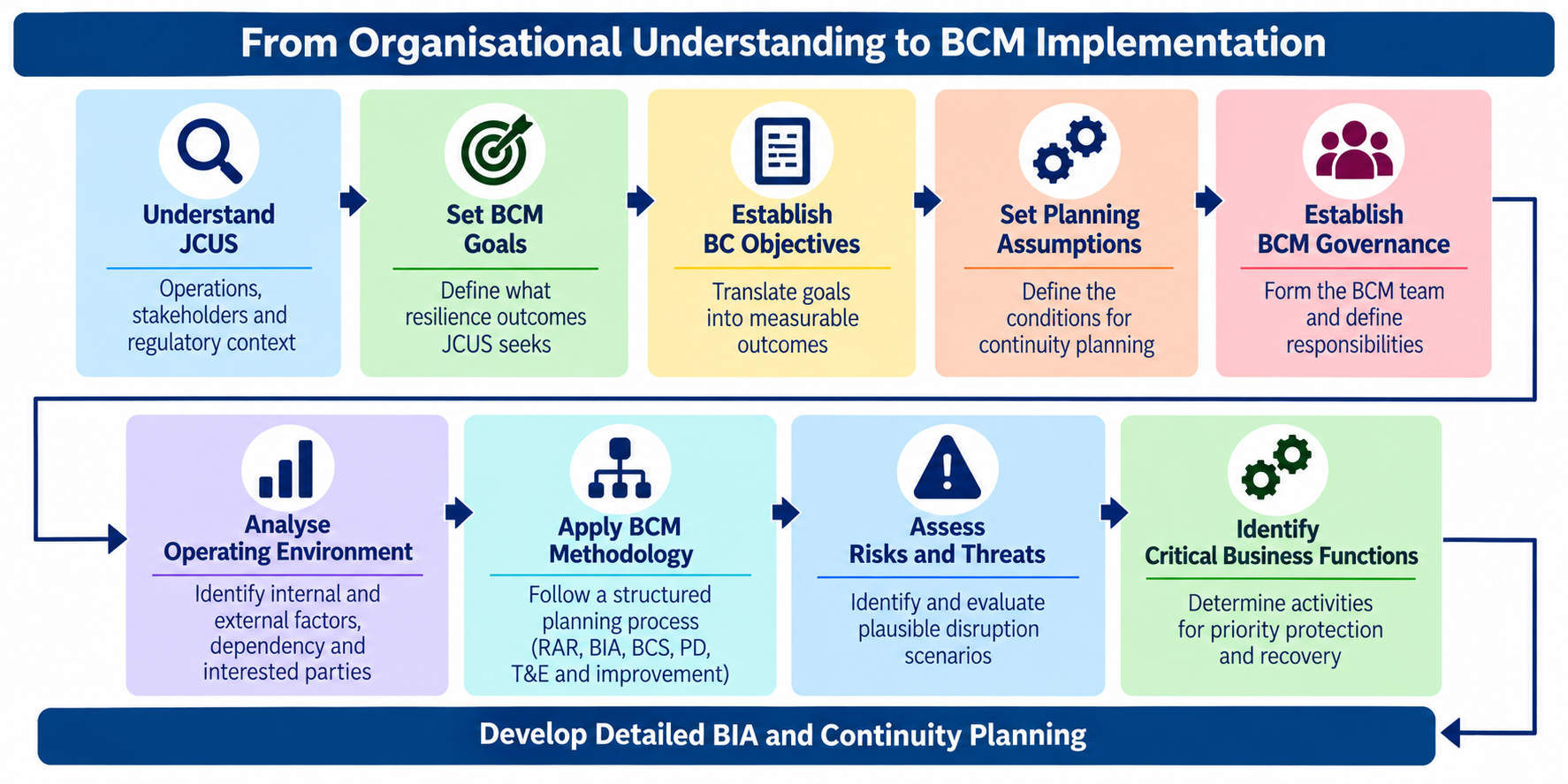
For JCUS, the desired outcome is an institutional capability that enables the University to protect people, maintain priority educational activities, safeguard students and academic integrity, meet essential obligations, communicate effectively, recover systematically and continually strengthen resilience.

Blogs marked [x] are under construction
![[BCM] [JCU] [3/4 Banner] Business Continuity Management Implementation at JCU Singapore](https://no-cache.hubspot.com/cta/default/3893111/d81098d9-9f30-4c17-a897-2fc202440adc.png)


More Information About Business Continuity Management Courses
To learn more about the course and schedule, click the buttons below for BCM-300 Business Continuity Management Implementer [BCM-3] and BCM-5000 Business Continuity Management Expert Implementer [BCM-5].


![Register [BL-B-3]*](https://no-cache.hubspot.com/cta/default/3893111/ac6cf073-4cdd-4541-91ed-889f731d5076.png)



![FAQ [BL-B-3]](https://no-cache.hubspot.com/cta/default/3893111/b3824ba1-7aa1-4eb6-bef8-94f57121c5ae.png)
![Email to Sales Team [BCM Institute]](https://no-cache.hubspot.com/cta/default/3893111/3c53daeb-2836-4843-b0e0-645baee2ab9e.png)


