



Chapter 4
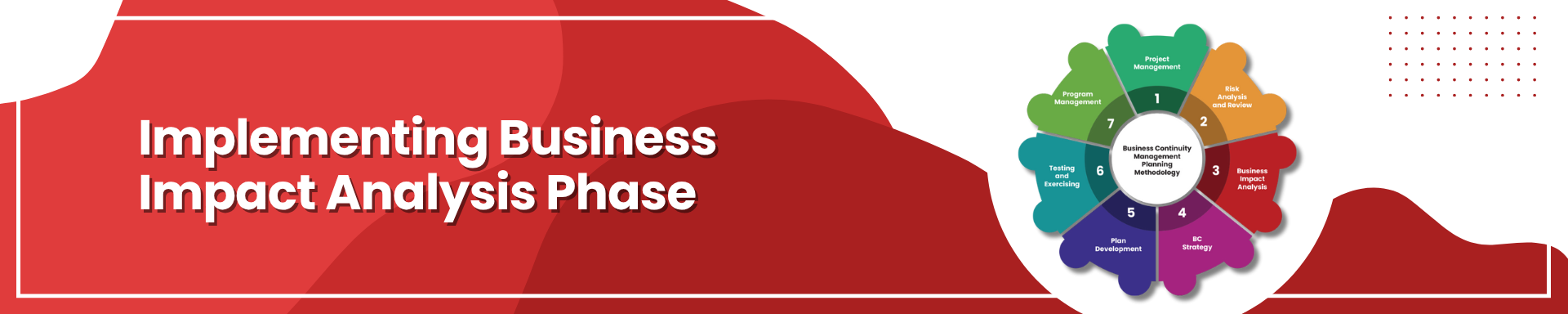
Business Impact Analysis Phase as Part of the BCM Planning Methodology for IsDB
![[BCM] [IsDB] [E2] [C4] Business Impact Analysis](https://no-cache.hubspot.com/cta/default/3893111/9f1cd1cd-4f5f-4f0f-b6f9-ebaa6bfbca56.png)
The Business Impact Analysis (BIA) phase is a critical component of Business Continuity Management (BCM) planning, particularly for an organisation such as the Islamic Development Bank (IsDB).
 BIA helps identify and assess the potential impacts of disruptions to critical business services (CBS) and essential functions of business (CBF) on which IsDB relies to fulfil its mission.
The goal of BIA is to assess the operational, financial, and reputational impacts of various disruptions, enabling the organisation to prioritise recovery strategies and allocate resources efficiently.
For IsDB, which serves a vital role in global development finance, understanding the impact of service disruptions across its multiple functions is essential.
This chapter will guide the reader through the BIA phase in the context of IsDB's operations, with a focus on specific CBS and CBF. It will provide a structured approach to conducting the analysis.
Business Impact Analysis for IsDB
Step 1: Identify Critical Business Functions (CBF)
The first step in the BIA process is to identify the CBF. These are the core areas critical to IsDB's day-to-day operations, and their disruption can severely affect the bank's ability to achieve its objectives.
Based on the organisational structure of IsDB, the following CBFs are identified:
|
CBF Code |
Critical Business Function (CBF) |
Description |
Why it is Critical to IsDB |
|
CBF-1 |
Financial Operations & Treasury Management |
This function involves managing IsDB's finances, investments, and funding operations. |
It ensures the liquidity and financial stability necessary for the bank’s projects and investments. |
|
CBF-2 |
Project Financing & Investment Management |
Involves funding and managing development projects across member countries. |
A key function of IsDB's mission is to finance development projects in member countries. |
|
CBF-3 |
Human Resources & Workforce Management |
Covers recruitment, training, and management of IsDB's personnel. |
A skilled workforce is essential for executing development projects and maintaining day-to-day operations. |
|
CBF-4 |
Information Technology & Data Management |
Manages IT systems, data, and digital infrastructure to support banking operations. |
IT is essential for ensuring operational efficiency, security, and communication. |
|
CBF-5 |
Risk Management & Compliance |
Oversees the management of risks and ensures compliance with internal policies and external regulations. |
Critical to maintaining the bank's reputation and adhering to international standards. |
|
CBF-6 |
Client Services & Customer Relationship Management |
Manages relationships with IsDB’s stakeholders, including member countries, partners, and clients. |
Essential for IsDB’s reputation and maintaining trust with stakeholders. |
|
CBF-7 |
Legal & Governance |
Ensures compliance with legal frameworks and regulations. |
Provides necessary legal protections for IsDB and its operations. |
|
CBF-8 |
Public Relations & Communications |
Manages public relations and communication strategies. |
Key to managing the bank’s image and maintaining stakeholder confidence. |
|
CBF-9 |
Facilities Management |
Responsible for maintaining physical assets, office spaces, and other infrastructures. |
Ensures operational continuity for the bank’s day-to-day operations. |
Step 2: Impact Assessment
Once the critical business functions have been identified, the next step is to assess the potential impacts of disruptions. These impacts can be classified into various categories:
- Operational Impact: Disruptions to a critical business function can hinder IsDB’s day-to-day operations, including delays in funding development projects or disruptions to client services.
- Financial Impact: A significant disruption can lead to economic losses, particularly in functions like treasury management, project financing, and investment management.
- Reputational Impact: Delays in funding or failure to meet commitments can damage IsDB’s reputation with member countries and stakeholders.
- Compliance & Legal Impact: A failure to comply with regulatory requirements could expose IsDB to legal liabilities, penalties, or loss of trust.
- Strategic Impact: Long-term disruptions could hinder the bank’s ability to fulfil its mission of supporting the development of member countries.
Step 3: Recovery Time Objectives (RTO) and Maximum Acceptable Outage (MAO)
The next step in the BIA is to determine the RTO and MAO for each critical business function.
The RTO specifies the maximum time allowed for recovery after a disruption, while the MAO represents the point at which the disruption becomes unacceptable to the organisation.
The RTO and MAO for each CBF will depend on the specific needs of IsDB and its stakeholders.
Example for IsDB
- CBF-1 (Financial Operations & Treasury Management): RTO of 4 hours, MAO of 12 hours. Financial operations are critical to ensure liquidity for ongoing projects.
- CBF-2 (Project Financing & Investment Management): RTO of 24 hours, MAO of 72 hours. Delays in project funding can ripple through development progress, but short-term delays are manageable.
Step 4: Prioritisation of Functions
Based on the BIA findings, the functions with the most significant impact and the shortest RTO/MAO should be prioritised for recovery.
This prioritisation helps IsDB focus resources on functions that, if disrupted, would have the most significant impact on its mission.
Example for IsDB
CBF-1 (Financial Operations & Treasury Management) and CBF-2 (Project Financing & Investment Management) are high-priority functions because they directly support the bank's operations and development goals.
![Banner [Summary] [BCM] [E2] [C4] Business Impact Analysis](https://no-cache.hubspot.com/cta/default/3893111/3d259877-5780-4502-9473-1129f6d08a8c.png)
The Business Impact Analysis phase is essential to developing a robust Business Continuity Management (BCM) plan for the Islamic Development Bank (IsDB).
By identifying and assessing the potential impacts of disruptions to critical business functions, IsDB can prioritise recovery efforts and allocate resources to minimise operational, financial, and reputational losses.
The BIA process is the foundation for developing effective recovery strategies and ensuring that IsDB can continue to fulfil its mission of promoting sustainable development in its member countries, even amid disruptions.
This chapter outlines the core elements of the BIA phase. It provides practical insights and guidelines for implementing BCM planning at IsDB, thereby ensuring resilience and continuity in the organisation’s critical functions.
![[BCM] [IsDB] [E2] [C1] Business Continuity Management Planning Methodology](https://no-cache.hubspot.com/cta/default/3893111/3c60ba88-5e0e-41d7-aba9-7b5f99301607.png)
![[BCM] [IsDB] [E2] [C2] Project Management](https://no-cache.hubspot.com/cta/default/3893111/1abb267f-fcc1-4ea9-8286-0b6557d40f52.png)
![[BCM] [IsDB] [E2] [C3] Risk Analysis and Review](https://no-cache.hubspot.com/cta/default/3893111/7a84aefa-3825-4276-83f6-e3d227929da9.png)
![[BCM] [IsDB] [E2] [C5] Business Continuity Strategy](https://no-cache.hubspot.com/cta/default/3893111/321f0cb1-f10d-42c4-ab52-c9263d75db65.png)
![[BCM] [IsDB] [E2] [C6] BCM Plan Development](https://no-cache.hubspot.com/cta/default/3893111/ea88aef4-db3d-4c32-af02-b6d1f26086f4.png)
![[BCM] [IsDB] [E2] [C7] Testing and Exercising](https://no-cache.hubspot.com/cta/default/3893111/ba1cbc74-bf97-4e21-955e-522e7558460d.png)
![[BCM] [IsDB] [E2] [C8] Program Management](https://no-cache.hubspot.com/cta/default/3893111/59b1632f-4a06-4644-8953-78de180453ea.png)
![[BCM] [IsDB] [E2] [C9] Summary](https://no-cache.hubspot.com/cta/default/3893111/8cdae626-e7b3-4ef6-b44f-cd3778be7647.png)
![[BCM] [IsDB] [E2] [C10] Back Cover for BCM](https://no-cache.hubspot.com/cta/default/3893111/c91c302e-56e0-454c-86ab-934394982e74.png)
More Information About Business Continuity Management Courses
To learn more about the course and schedule, click the buttons below for the BCM-300 Business Continuity Management Implementer [BCM-3] and the BCM-5000 Business Continuity Management Expert Implementer [BCM-5].


![Register [BL-B-3]*](https://no-cache.hubspot.com/cta/default/3893111/ac6cf073-4cdd-4541-91ed-889f731d5076.png)



![FAQ [BL-B-3]](https://no-cache.hubspot.com/cta/default/3893111/b3824ba1-7aa1-4eb6-bef8-94f57121c5ae.png)
![Email to Sales Team [BCM Institute]](https://no-cache.hubspot.com/cta/default/3893111/3c53daeb-2836-4843-b0e0-645baee2ab9e.png)


