



Chapter 8

Introduction
![[BCM] [IsDB] [E1] [C8] Implementing the BCM Planning Methodology](https://no-cache.hubspot.com/cta/default/3893111/df3b398d-89ff-4f4b-9197-2460649af19f.png)
The Islamic Development Bank (IsDB) operates as a multilateral development finance institution serving its member countries through Shariah-compliant financing, advisory services, and capacity development.
Its mandate encompasses sovereign financing, private-sector development, Islamic finance promotion, project implementation, treasury and investment management, and knowledge-driven development initiatives.
Given its international footprint, fiduciary responsibilities, and role in safeguarding development funds, IsDB must maintain uninterrupted delivery of critical services even during disruptive incidents.
Implementing a structured Business Continuity Management (BCM) planning methodology enables IsDB to protect its mission, maintain stakeholder confidence, comply with regulatory and governance expectations, and ensure resilience across headquarters and regional offices.
This chapter outlines how IsDB can apply a seven-phase BCM planning methodology aligned with ISO 22301 and ISO 22361 principles, tailored to the Bank’s operating environment, governance structure, and Shariah-compliant operations.
Overview of the BCM Planning Methodology
The BCM planning methodology for IsDB comprises seven integrated and cyclical phases:
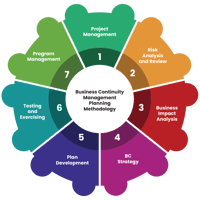 Project Management (PM)
- Risk Analysis and Review (RAR)
- Business Impact Analysis (BIA)
- Business Continuity Strategy (BCS)
- Plan Development (PD)
- Testing and Exercising (TE)
- Program Management (PgM)
Each phase supports informed decision-making and ensures that business continuity capabilities remain effective, up to date, and aligned with IsDB’s strategic objectives.
Phase 1: Project Management (PM)
Purpose
The Project Management phase establishes the foundation for the BCM initiative by defining scope, governance, roles, timelines, and deliverables.
Application at IsDB
At IsDB, the BCM project should be sponsored by senior management, such as the President’s Office or a designated executive committee, to ensure authority and cross-functional participation.
A central BCM Office or BCM Coordinator should be appointed to manage implementation across departments and regional hubs.
IsDB-Specific Requirement
IsDB shall establish a BCM Steering Committee comprising representatives from risk management, treasury, IT, human capital, operations, Shariah governance, and regional offices to ensure enterprise-wide ownership and alignment with the Bank’s development mandate.
Phase 2: Risk Analysis and Review (RAR)
Purpose
Risk Analysis and Review identifies threats that could disrupt IsDB’s operations and assesses existing controls and mitigation measures.
Application at IsDB
IsDB faces a diverse risk landscape, including geopolitical instability in member countries, cyber threats, technology failures, pandemics, supply chain disruptions, and reputational risks related to fiduciary and Shariah compliance.
Risk assessments should consider both internal and external threats, as well as interdependencies with third parties, including correspondent banks, payment systems, and service providers.
IsDB-Specific Requirement
IsDB shall conduct periodic risk assessments that explicitly include risks arising from operations across multiple jurisdictions, reliance on international financial infrastructure, and Shariah governance processes that may be affected by disruptions.
Phase 3: Business Impact Analysis (BIA)
Purpose
The BIA determines the potential impact of disruptions over time and identifies critical business functions, recovery priorities, and resource requirements.
Application at IsDB
For IsDB, critical business functions may include treasury and liquidity management, disbursement of development funds, loan servicing, Islamic finance structuring, IT and digital banking platforms, crisis communications, and governance decision-making.
The BIA should assess financial, operational, legal, regulatory, reputational, and development impacts.
IsDB-Specific Requirement
IsDB shall identify and prioritise business functions that directly affect the timely disbursement and safeguarding of development funds, including treasury settlement, payment processing, and member country support services, and define Recovery Time Objectives (RTOs) and Recovery Point Objectives (RPOs) accordingly.
Phase 4: Business Continuity Strategy (BCS)
Purpose
The Business Continuity Strategy phase defines how critical functions will be maintained or recovered within acceptable timeframes.
Application at IsDB
Strategies may include alternate processing arrangements, remote working capabilities, data replication across geographically separated data centres, succession planning for key roles, and mutual support arrangements between headquarters and regional offices.
Strategies must be cost-effective, feasible, and compliant with Shariah principles.
IsDB-Specific Requirement
IsDB shall develop continuity strategies that ensure uninterrupted treasury operations and secure access to financial systems, while maintaining Shariah compliance and segregation of duties during crisis conditions.
Phase 5: Plan Development (PD)
Purpose
Plan Development documents the procedures and actions required to respond to and recover from disruptions.
Application at IsDB
IsDB should develop a tiered set of plans, including an enterprise-level Business Continuity Plan, Crisis Management Plan, IT Disaster Recovery Plans, and departmental business continuity plans.
Plans must clearly define roles, escalation protocols, communication channels, and coordination with external stakeholders.
IsDB-Specific Requirement
IsDB shall ensure that all business continuity and crisis management plans include clear escalation paths to senior management and decision-making bodies, including provisions for convening executive and Shariah governance committees during disruptions.
Phase 6: Testing and Exercising (TE)
Purpose
Testing and Exercising validate the effectiveness of BCM strategies and plans and build organisational confidence and competence.
Application at IsDB
Exercises may include tabletop simulations, technical recovery tests, crisis communication drills, and cross-border coordination scenarios involving regional offices.
Scenarios should reflect realistic threats, such as cyber incidents, system outages, or geopolitical disruptions, that affect member countries.
IsDB-Specific Requirement
IsDB shall conduct regular BCM exercises that involve headquarters and selected regional offices, testing decision-making, cross-functional coordination, and communication with member countries and key financial partners.
Phase 7: Program Management (PgM)
Purpose
Program Management ensures that BCM remains a sustainable, continuously improving capability rather than a one-time project.
Application at IsDB
This phase includes performance monitoring, audits, management reviews, training, awareness programs, and alignment with enterprise risk management and governance frameworks.
Changes in organisational structure, technology, or operating environment should trigger reviews of BCM arrangements.
IsDB-Specific Requirement
IsDB shall integrate BCM into its enterprise governance and risk management framework, with regular reporting to senior management and the Board to ensure ongoing alignment with strategic objectives and regulatory expectations.
![Banner [Summary] [BCM] [E1] [C8] Implementing the BCM Planning Methodology](https://no-cache.hubspot.com/cta/default/3893111/e44be53e-a156-4a00-b518-a7714cf21ce3.png)
Implementing a structured Business Continuity Management planning methodology enables the Islamic Development Bank to protect its mission-critical operations, uphold fiduciary and Shariah responsibilities, and maintain confidence among member countries and stakeholders.
By applying the seven-phase BCM methodology—ranging from Project Management to Program Management—IsDB can systematically identify risks, prioritise critical functions, develop robust continuity strategies, and ensure effective response and recovery capabilities.
A well-governed, continuously maintained BCM program strengthens IsDB’s operational resilience, enabling the Bank to continue supporting sustainable development and economic growth across its member countries, even amid complex, evolving disruptions.
![[BCM] [IsDB] [E1] [C1] Overview of BCM Implementation for IsDB](https://no-cache.hubspot.com/cta/default/3893111/3c98e331-ea12-4d30-9c3f-e72480503673.png)
![[BCM] [IsDB] [E1] [C2] Understanding Your Organisation](https://no-cache.hubspot.com/cta/default/3893111/7b1eec91-64cb-49d0-9fa3-f4b0e084cee2.png)
![[BCM] [IsDB] [E1] [C3] Establishing Organisational Goals](https://no-cache.hubspot.com/cta/default/3893111/9de07780-e31c-42ca-9d01-18086c417e20.png)
![[BCM] [IsDB] [E1] [C4] Establishing Business Continuity Objectives](https://no-cache.hubspot.com/cta/default/3893111/7848f94a-8e45-46c6-b790-ae9f0d924616.png)
![[BCM] [IsDB] [E1] [C5] Determining BC Assumptions](https://no-cache.hubspot.com/cta/default/3893111/a41d4f8b-60a7-450f-b217-248f7514b388.png)
![[BCM] [IsDB] [E1] [C6] Composing BCM Team](https://no-cache.hubspot.com/cta/default/3893111/a220f8f5-614c-4838-815d-cf8f4c84dc9e.png)
![[BCM] [IsDB] [E1] [C7] Analysing Operating Environment](https://no-cache.hubspot.com/cta/default/3893111/606eaa38-ca7f-4ae6-9fc7-a0a90944af05.png)
![[BCM] [IsDB] [E1] [C9] Assessing Risks and Threats](https://no-cache.hubspot.com/cta/default/3893111/8f09319d-fd50-4f17-8bbc-d5fa3841ddd3.png)
![[BCM] [IsDB] [E1] [C10] Identifying Critical Business Functions](https://no-cache.hubspot.com/cta/default/3893111/e5120403-b31d-4ce8-95f1-6138d6b036da.png)
![[BCM] [IsDB] [E1] [C11] Summary of Understanding Your Organisation](https://no-cache.hubspot.com/cta/default/3893111/bb40e973-e404-455b-a7fe-95f5e7f2799f.png)
![[BCM] [IsDB] [E1] [C12] [Back Cover] eBook 1](https://no-cache.hubspot.com/cta/default/3893111/451ce0eb-caa1-42b0-b246-044f90b92c5a.png)
More Information About Business Continuity Management Courses
To learn more about the course and schedule, click the buttons below for BCM-300 Business Continuity Management Implementer [BCM-3] and BCM-5000 Business Continuity Management Expert Implementer [BCM-5].


![Register [BL-B-3]*](https://no-cache.hubspot.com/cta/default/3893111/ac6cf073-4cdd-4541-91ed-889f731d5076.png)



![FAQ [BL-B-3]](https://no-cache.hubspot.com/cta/default/3893111/b3824ba1-7aa1-4eb6-bef8-94f57121c5ae.png)
![Email to Sales Team [BCM Institute]](https://no-cache.hubspot.com/cta/default/3893111/3c53daeb-2836-4843-b0e0-645baee2ab9e.png)


