


Chapter 7

![[BCM] [IsDB] [E1] [C7] Analysing Operating Environment](https://no-cache.hubspot.com/cta/default/3893111/606eaa38-ca7f-4ae6-9fc7-a0a90944af05.png)
An effective Business Continuity Management (BCM) programme must be grounded in a clear understanding of the organisation’s operating environment.
For the Islamic Development Bank (IsDB), this environment is uniquely shaped by its multilateral development mandate, Shariah-compliant principles, diverse member countries, and complex stakeholder landscape.
Analysing the internal and external operating environment is a key requirement of ISO 22301, as it enables IsDB to identify context-specific risks, dependencies, constraints, and opportunities that may affect its ability to continue delivering critical services during disruptions.
This chapter examines IsDB’s operating environment from a BCM perspective, providing a structured analysis to support resilience planning and informed decision-making.
Overview of IsDB’s Operating Context
IsDB is a multilateral development finance institution that serves its member countries by promoting sustainable socioeconomic development in accordance with Islamic finance principles.
Its operations span multiple regions, jurisdictions, and development sectors, supported by headquarters, regional hubs, country offices, and affiliated institutions.
From a business continuity standpoint, IsDB operates in an environment characterised by:
- Cross-border financial and development operations
- Diverse regulatory and legal frameworks
- High expectations for governance, transparency, and accountability
- Dependence on digital platforms, data, and secure communications
- Exposure to geopolitical, economic, environmental, and operational risks
Understanding this context is essential for tailoring BCM strategies that are realistic, proportionate, and aligned with IsDB’s mandate.
External Operating Environment
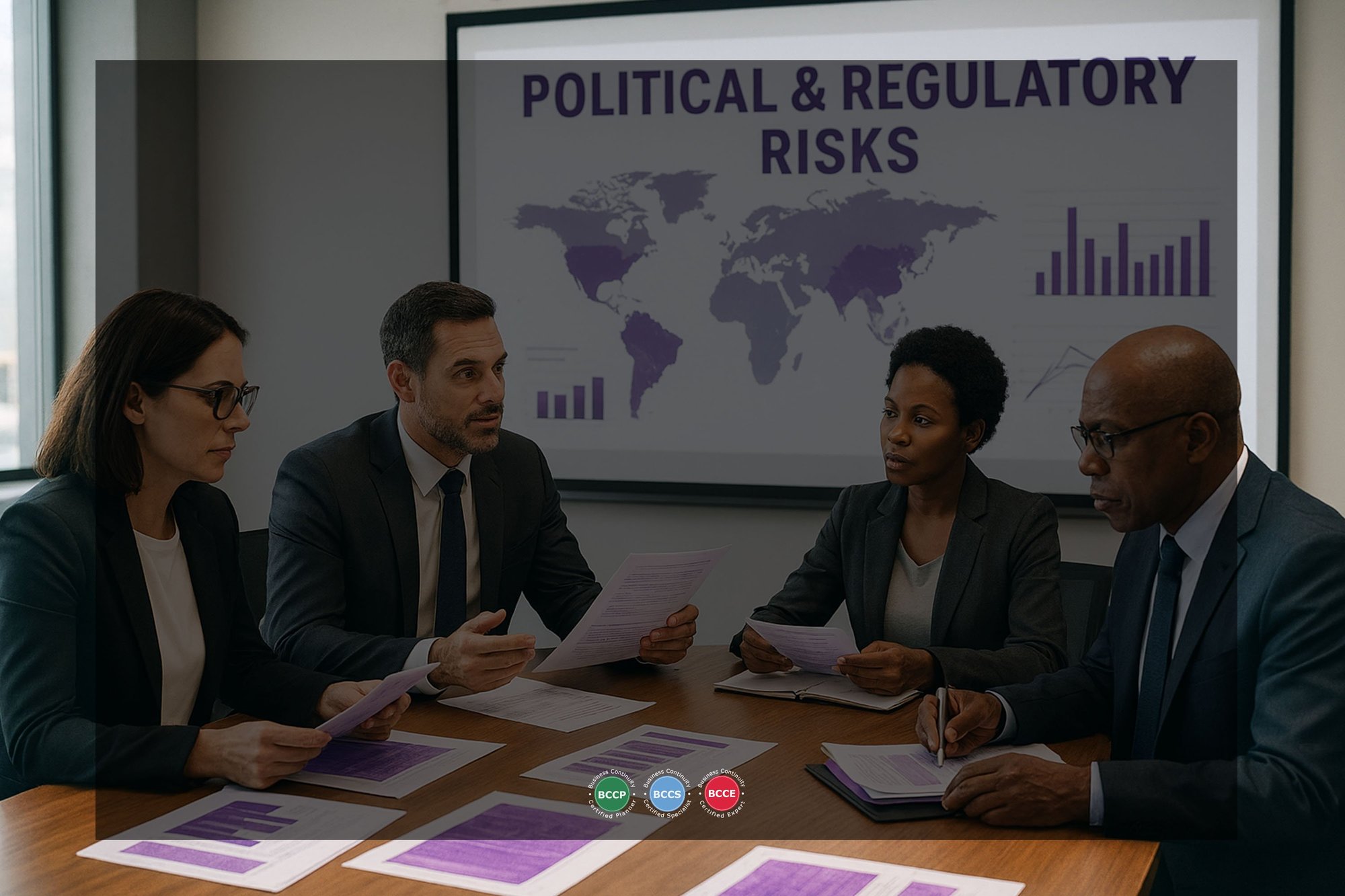
Political and Geopolitical Factors
IsDB operates across member countries with varying degrees of political stability, governance maturity, and security conditions.
Political transitions, regional conflicts, sanctions, or diplomatic tensions can disrupt project execution, financial transactions, staff mobility, and supply chains.
From a BCM perspective, these factors influence:
- Access to facilities and country offices
- Continuity of funded projects and partnerships
- Safety and availability of staff in high-risk locations
- Reliability of local infrastructure and service providers
BCM planning must therefore consider geopolitical risk scenarios and ensure that appropriate contingency arrangements are in place.
Economic and Financial Environment
Global and regional economic conditions directly affect IsDB’s funding activities, investment portfolios, and development programmes.
Economic downturns, currency volatility, inflation, and financial market disruptions can challenge liquidity management and operational stability.
Key BCM implications include:
- Continuity of treasury and financial operations
- Dependence on global banking and payment systems
- Resilience of counterparties and correspondent banks
- Ability to sustain operations during financial stress events
Regulatory and Legal Environment
IsDB operates under a complex regulatory environment that includes:
- International financial regulations
- Host country laws and regulations
- Development finance governance requirements
- Shariah governance and compliance obligations
Regulatory changes, compliance breaches, or legal disputes can disrupt operations and damage institutional credibility.
BCM must therefore align with regulatory expectations and ensure that continuity arrangements do not compromise legal or Shariah requirements during crises.
Technological Environment
Technology is a critical enabler of IsDB’s operations, supporting financial systems, project management, communications, and collaboration across geographies.
At the same time, reliance on technology increases exposure to:
- Cyber threats and data breaches
- System outages and infrastructure failures
- Third-party technology and cloud service disruptions
The technological environment necessitates close integration between BCM, IT disaster recovery, cybersecurity, and data protection strategies.
Environmental and Climate Factors
As a development institution, IsDB is increasingly exposed to climate-related risks that affect both its operations and the projects it finances.
Natural disasters, extreme weather events, and pandemics can disrupt facilities, staff availability, and critical suppliers.**
BCM must consider:
- Physical risks to offices and data centres
- Business travel and staff deployment constraints
- Continuity of operations during widespread regional or global events
Internal Operating Environment
Organisational Structure and Governance
IsDB’s governance structure includes the Board of Governors, Board of Executive Directors, management committees, and supporting functions.
Transparent governance is essential for effective crisis decision-making and escalation.
From a BCM perspective, this includes:
- Defined roles and responsibilities during disruptions
- Clear authority for crisis response and recovery decisions
- Alignment between BCM governance and overall corporate governance
Culture and Values
IsDB’s culture is shaped by its development mission, ethical principles, and commitment to member countries.
*A strong culture of responsibility and service supports resilience, but must be reinforced with BCM awareness and preparedness.
Key considerations include:
- Staff understanding of BCM roles and expectations
- Willingness to adapt and collaborate during disruptions
- Leadership commitment to resilience and preparedness
People and Workforce Considerations
IsDB’s workforce is geographically dispersed and culturally diverse. Workforce availability can be affected by health crises, travel restrictions, security incidents, or local disruptions.
BCM implications include:
- Succession planning and key person risk
- Remote working capabilities
- Staff safety, welfare, and communication during crises
Operational Dependencies
Internally, IsDB relies on interconnected processes across finance, operations, project management, procurement, HR, IT, and communications. Disruption in one area can quickly cascade across the organisation.
Understanding these interdependencies is critical for:
- Identifying critical business functions
- Prioritising recovery objectives
- Designing effective continuity strategies
Stakeholder Expectations and Interfaces
IsDB’s operating environment is strongly influenced by its stakeholders, including:
- Member countries and beneficiaries
- Donors, partners, and co-financiers
- Regulators and oversight bodies
- Employees and service providers
Stakeholders expect IsDB to remain operational, responsive, and trustworthy during crises.
BCM must therefore address not only operational continuity but also communication, reputation management, and stakeholder confidence.
Implications for BCM at IsDB
The analysis of IsDB’s operating environment highlights several critical implications for BCM:
- BCM strategies must be globally coordinated yet locally adaptable
- Crisis scenarios should reflect geopolitical, financial, technological, and environmental risks
- Strong governance and decision-making frameworks are essential
- Integration with risk management, IT disaster recovery, security, and crisis management is critical
- Stakeholder communication and trust are central to resilience
This contextual understanding provides the foundation for subsequent BCM activities, including risk assessment, business impact analysis, strategy development, and plan implementation.
![Banner [Summary] [BCM] [E1] [C7] Analysing Operating Environment](https://no-cache.hubspot.com/cta/default/3893111/c5ddfb8e-a79f-4110-ad04-437a4c85cfd2.png)
Analysing the operating environment is a vital step in building a resilient Business Continuity Management programme at the Islamic Development Bank.
IsDB’s complex internal and external contexts present unique challenges but also opportunities to strengthen organisational resilience through informed planning and proactive governance.
By systematically understanding the political, economic, regulatory, technological, environmental, and organisational factors that shape its operations, IsDB can design BCM arrangements that are robust, compliant, and aligned with its development mandate.
This analysis ensures that business continuity is not treated as a standalone exercise but as an integral component of how IsDB sustains its mission in an uncertain, rapidly changing world.
![[BCM] [IsDB] [E1] [C1] Overview of BCM Implementation for IsDB](https://no-cache.hubspot.com/cta/default/3893111/3c98e331-ea12-4d30-9c3f-e72480503673.png)
![[BCM] [IsDB] [E1] [C2] Understanding Your Organisation](https://no-cache.hubspot.com/cta/default/3893111/7b1eec91-64cb-49d0-9fa3-f4b0e084cee2.png)
![[BCM] [IsDB] [E1] [C3] Establishing Organisational Goals](https://no-cache.hubspot.com/cta/default/3893111/9de07780-e31c-42ca-9d01-18086c417e20.png)
![[BCM] [IsDB] [E1] [C4] Establishing Business Continuity Objectives](https://no-cache.hubspot.com/cta/default/3893111/7848f94a-8e45-46c6-b790-ae9f0d924616.png)
![[BCM] [IsDB] [E1] [C5] Determining BC Assumptions](https://no-cache.hubspot.com/cta/default/3893111/a41d4f8b-60a7-450f-b217-248f7514b388.png)
![[BCM] [IsDB] [E1] [C6] Composing BCM Team](https://no-cache.hubspot.com/cta/default/3893111/a220f8f5-614c-4838-815d-cf8f4c84dc9e.png)
![[BCM] [IsDB] [E1] [C8] Implementing the BCM Planning Methodology](https://no-cache.hubspot.com/cta/default/3893111/df3b398d-89ff-4f4b-9197-2460649af19f.png)
![[BCM] [IsDB] [E1] [C9] Assessing Risks and Threats](https://no-cache.hubspot.com/cta/default/3893111/8f09319d-fd50-4f17-8bbc-d5fa3841ddd3.png)
![[BCM] [IsDB] [E1] [C10] Identifying Critical Business Functions](https://no-cache.hubspot.com/cta/default/3893111/e5120403-b31d-4ce8-95f1-6138d6b036da.png)
![[BCM] [IsDB] [E1] [C11] Summary of Understanding Your Organisation](https://no-cache.hubspot.com/cta/default/3893111/bb40e973-e404-455b-a7fe-95f5e7f2799f.png)
![[BCM] [IsDB] [E1] [C12] [Back Cover] eBook 1](https://no-cache.hubspot.com/cta/default/3893111/451ce0eb-caa1-42b0-b246-044f90b92c5a.png)
More Information About Business Continuity Management Courses
To learn more about the course and schedule, click the buttons below for BCM-300 Business Continuity Management Implementer [BCM-3] and BCM-5000 Business Continuity Management Expert Implementer [BCM-5].


![Register [BL-B-3]*](https://no-cache.hubspot.com/cta/default/3893111/ac6cf073-4cdd-4541-91ed-889f731d5076.png)



![FAQ [BL-B-3]](https://no-cache.hubspot.com/cta/default/3893111/b3824ba1-7aa1-4eb6-bef8-94f57121c5ae.png)
![Email to Sales Team [BCM Institute]](https://no-cache.hubspot.com/cta/default/3893111/3c53daeb-2836-4843-b0e0-645baee2ab9e.png)


