---
title: [BCM] [GRA] [E2] [C9] Summary
description: [BCM] [GRA] [E2] [C9] Summary
image: https://blog.bcm-institute.org/hubfs/Gambling%20Regulatory%20Authority%20Graphic%20Folder/GRA%20E2%20Morepost/%5BBCM%5D%20%5BGRA%5D%20%5BE2%5D%20%5BC9%5D%20Summary.jpg
---
.
[](http://www.bcm-institute.org/)
- [Home](https://www.bcm-institute.org/)
- [About Us](https://www.bcm-institute.org/about-us-3/)
- [A President’s Perspective](https://www.bcm-institute.org/about-us/a-presidents-perspective/)
- [Our History](https://www.bcm-institute.org/about-us/our-history/)
- [Our Advisory Council](https://www.bcm-institute.org/about-us/our-advisory-council/)
- [Customers’ Testimonials](https://www.bcm-institute.org/about-us/customers-testimonials/)
- [Credential Verification](https://www.bcm-institute.org/about-us/credential-verification/)
- [Courses](https://blog.bcm-institute.org/blog/course-fees-for-blended-learning-courses-master-catalog)
- [ISO 22301 Business Continuity Management System Audit](https://blog.bcm-institute.org/audit/business-continuity-management-audit-courses)
- [ISO 22301 Business Continuity Management](https://blog.bcm-institute.org/bcm/business-continuity-management-courses)
- [Crisis Communication](https://blog.bcm-institute.org/crisis-communication/crisis-communication-courses)
- [Crisis Management](https://blog.bcm-institute.org/en/crisis-management/courses)
- [IT Disaster Recovery](https://blog.bcm-institute.org/it-disaster-recovery/courses)
- [Operational Resilience](https://blog.bcm-institute.org/operational-resilience/courses)
- [Operational Resilience Audit](https://blog.bcm-institute.org/operational-resilience-audit/courses)
- [Certification](https://blog.bcm-institute.org/certification/types-of-certifications-offered)
- [ISO 22301 BCMS Audit Certification](https://blog.bcm-institute.org/certification/business-continuity-management-audit-certification)
- [ISO22301 Business Continuity Management Certification](https://blog.bcm-institute.org/bcm/business-continuity-management-certification)
- [Crisis Communication Certification](https://blog.bcm-institute.org/crisis-communication/crisis-communication-certification)
- [Crisis Management Certification](https://blog.bcm-institute.org/en/crisis-management/crisis-management-certification)
- [IT Disaster Recovery Planning Certification](https://blog.bcm-institute.org/it-disaster-recovery/it-disaster-recovery-certification)
- [Operational Resilience Certification](https://blog.bcm-institute.org/operational-resilience/operational-resilience-certification)
- [Operational Resilience Audit Certification](https://blog.bcm-institute.org/operational-resilience-audit)
- [Seminars](https://blog.bcm-institute.org/meet-the-expert/mte-webinar-mainpage)
- [Store](https://www.bcm-institute.org/store-2/)
- [Contact Us](http://www.bcm-institute.org/about-us/contact-us/)
-
-
##### Implementing Business Continuity Management for the Gambling Regulatory Authority (GRA): A Practical Guide to Organisational Resilience, Service Continuity, and Regulatory Excellence
# \[BCM\] \[GRA\] \[E2\] \[C9\] Summary
[![\[Full Banner\] Gambling Regulatory Authority](https://no-cache.hubspot.com/cta/default/3893111/19ae41b0-2229-43d0-a2d6-347c7025bf77.png)](https://cta-redirect.hubspot.com/cta/redirect/3893111/19ae41b0-2229-43d0-a2d6-347c7025bf77)
The Ministry of Manpower (MOM) plays a pivotal role in safeguarding Singapore’s workforce ecosystem, overseeing employment standards, workplace safety and health, foreign manpower policies, and income security.
Given its national mandate and high public service dependency, MOM must remain operationally resilient in the face of disruptions ranging from pandemics and cyber incidents to infrastructure failures and geopolitical uncertainties.
[![eBook Cover \[BCM\] \[MOM\] \[E2\] \[2D\]](https://no-cache.hubspot.com/cta/default/3893111/4e070216-7c24-45f2-9f71-309ac832cf83.png)](https://cta-redirect.hubspot.com/cta/redirect/3893111/4e070216-7c24-45f2-9f71-309ac832cf83)This final chapter of eBook 2, “Implementing Business Continuity Management”, serves as a comprehensive summary of the Business Continuity Management (BCM) planning methodology applied to MOM.
Building upon the foundational concepts introduced in earlier volumes of the Resilient Support series, this eBook focuses on the practical implementation of BCM in alignment with ISO 22301 requirements and public-sector governance expectations in Singapore.
The chapter consolidates the seven-phase BCM planning methodology adopted for MOM, demonstrating how structured planning, inter-agency coordination, and continuous improvement collectively strengthen organisational resilience.
It also highlights how BCM is embedded in MOM’s operational culture to ensure the continuity of critical services for workers, employers, and national stakeholders during crises.
### [](https://cta-redirect.hubspot.com/cta/redirect/3893111/ed46e362-3b5a-4a67-95cd-d0df7fae8af4)
[Moh Heng Goh](https://blog.bcm-institute.org/ebook/author/moh-heng-goh) Jun 22, 2026
###### Business Continuity Management Certified Planner-Specialist-Expert
###### [![\[Full Banner\] Gambling Regulatory Authority](https://no-cache.hubspot.com/cta/default/3893111/19ae41b0-2229-43d0-a2d6-347c7025bf77.png)](https://cta-redirect.hubspot.com/cta/redirect/3893111/19ae41b0-2229-43d0-a2d6-347c7025bf77)
### eBook 2: Chapter 9
### [](https://cta-redirect.hubspot.com/cta/redirect/3893111/ed46e362-3b5a-4a67-95cd-d0df7fae8af4)
### **Final Chapter: Bringing It All Together – A Roadmap to Business Continuity Excellence for the Gambling Regulatory Authority (GRA)**
#### Introduction
The purpose of this eBook has been to provide a practical and structured guide for implementing a Business Continuity Management System (BCMS) within GRA in accordance with the principles and requirements of ISO 22301.[![\[BCM\] \[GRA\] \[E2\] \[C9\] Summary](https://no-cache.hubspot.com/cta/default/3893111/93c5feac-87dc-48fd-bc58-32a8347bf16a.png)](https://cta-redirect.hubspot.com/cta/redirect/3893111/93c5feac-87dc-48fd-bc58-32a8347bf16a)
As Singapore's gambling regulator, GRA performs critical regulatory, licensing, enforcement, compliance monitoring, intelligence, and stakeholder engagement functions that support the integrity and stability of the nation's gambling ecosystem.
Any significant disruption to these activities could affect regulatory oversight, public confidence, and the effective administration of gambling controls.
To address these challenges, GRA must establish a robust and sustainable BCM programme that enables the organisation to anticipate disruptions, prepare for incidents, respond effectively, recover critical operations, and continuously improve its resilience capabilities.
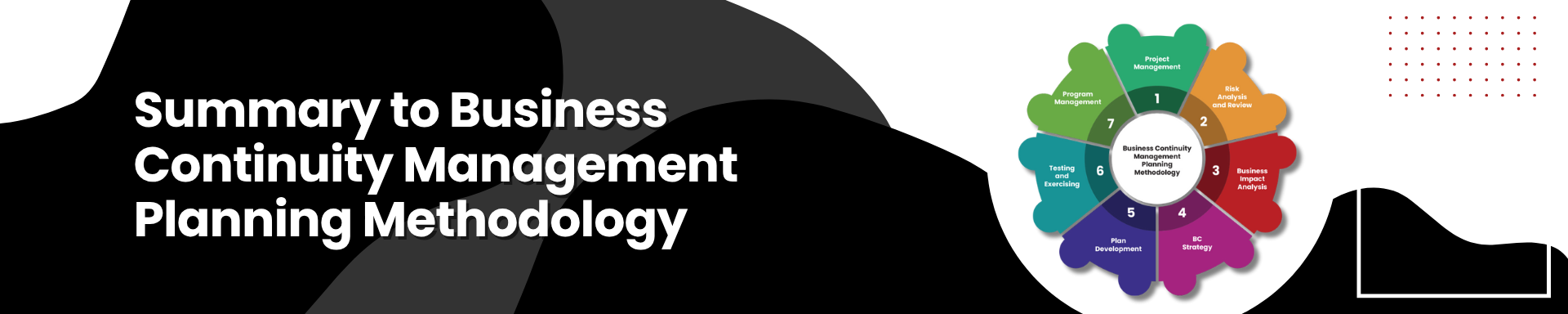
This eBook has presented a comprehensive **seven-phase Business Continuity Management Planning Methodology** that serves as a roadmap for developing and maintaining business continuity capabilities across the organisation.
#### **The Seven-Phase BCM Planning Methodology**
The BCM Planning Methodology provides a structured framework that guides GRA from the initiation of the BCM programme through to long-term governance and continual improvement.
The seven phases are:
1. Project Management (PM)
2. Risk Analysis and Review (RAR)
3. Business Impact Analysis (BIA)
4. Business Continuity Strategy (BCS)
5. Plan Development (PD)
6. Testing and Exercising (TE)
7. Programme Management (PgM)
Together, these phases create an integrated Business Continuity Management System that supports organisational resilience and compliance with ISO 22301.
#### **Phase 1: Project Management (PM)**
The Project Management phase establishes the foundation for the BCM programme.
Key activities include:
- Securing executive sponsorship.
- Establishing BCM governance.
- Defining project scope and objectives.
- Assigning roles and responsibilities.
- Developing implementation plans.
- Allocating resources.
For GRA, this phase ensures that all regulatory and support functions are included within the scope of the BCM programme and that management commitment is obtained from the outset.
##### **Key Outcome**
A formally approved BCM project structure that provides direction and governance for the implementation journey.
#### **Phase 2: Risk Analysis and Review (RAR)**
The Risk Analysis and Review phase identifies threats that may disrupt GRA's operations and evaluates their potential impact.
Key activities include:
- Identifying threats and vulnerabilities.
- Assessing likelihood and impact.
- Evaluating existing controls.
- Determining risk treatment options.
- Maintaining a risk register.
Examples of risks relevant to GRA include:
- Cybersecurity incidents.
- Data breaches.
- Technology failures.
- Loss of key personnel.
- Third-party service disruptions.
- Regulatory crises.
- Physical facility disruptions.
##### **Key Outcome**
A comprehensive understanding of risks that may affect GRA's critical business functions and recovery capabilities.
#### **Phase 3: Business Impact Analysis (BIA)**
The Business Impact Analysis phase identifies critical business functions and determines the consequences of disruptions.
Key activities include:
- Identifying critical services.
- Assessing operational impacts.
- Establishing recovery priorities.
- Determining Recovery Time Objectives (RTOs).
- Determining Recovery Point Objectives (RPOs).
- Identifying dependencies and resource requirements.
Examples of critical functions within GRA include:
- Licensing and permit administration.
- Regulatory compliance monitoring.
- Enforcement and investigation activities.
- Regulatory intelligence and surveillance.
- Stakeholder communications.
##### **Key Outcome**
Clearly defined recovery priorities and recovery objectives for critical business functions.
#### **Phase 4: Business Continuity Strategy (BCS)**
The Business Continuity Strategy phase identifies practical solutions to ensure continuity and recovery of critical operations.
The strategies are grouped into three categories:
##### **Mitigation Strategies**
Actions designed to reduce the likelihood and impact of disruptions.
Examples:
- Cybersecurity controls.
- Redundant infrastructure.
- Vendor resilience measures.
##### **Prevention Strategies**
Actions designed to avoid disruptions from occurring.
Examples:
- Staff training.
- Succession planning.
- Preventive maintenance.
##### **Recovery Strategies**
Actions designed to restore operations after an incident.
Examples:
- Alternate work locations.
- Disaster recovery systems.
- Remote working arrangements.
##### **Key Outcome**
Approved continuity strategies that support the continuity and recovery of GRA's critical business functions.
#### **Phase 5: Plan Development (PD)**
The Plan Development phase converts continuity strategies into documented procedures.
The phase consists of:
##### **Determining the Organisation of the BC Plan**
- Designing plan templates.
- Establishing recovery teams.
- Defining recovery responsibilities.
##### **Conducting BC Plan Writing Workshops**
- Guiding plan writers.
- Documenting recovery procedures.
- Identifying resource requirements.
##### **Finalising BC Plans**
- Reviewing plan completeness.
- Validating recovery procedures.
- Obtaining management approval.
##### **Key Outcome**
Comprehensive Business Continuity Plans that provide clear guidance during disruptions.
#### **Phase 6: Testing and Exercising (TE)**
The Testing and Exercising phase validates the effectiveness of continuity plans and recovery capabilities.
Testing progresses from basic exercises to advanced exercises.
#### **Initial Tests**
##### **Component Tests**
Testing individual recovery components such as backups and communication systems.
##### **Call Notification Tests**
Testing emergency contact and escalation procedures.
##### **Walkthrough Exercises**
Reviewing plans and discussing recovery actions.
#### **Advanced Tests**
##### **Integrated Tests**
Testing coordination between multiple business units.
##### **Simulation Tests**
Practising realistic disruption scenarios.
##### **Live Tests**
Conducting full recovery exercises involving personnel, systems, and facilities.
#### **Key Outcome**
Confidence that recovery plans, teams, systems, and facilities can function effectively during actual disruptions.
#### **Phase 7: Programme Management (PgM)**
The Programme Management phase ensures the long-term sustainability of the BCM programme.
Key activities include:
- Governance and oversight.
- Policy management.
- Plan maintenance.
- Training and awareness.
- Exercise management.
- Audit and compliance reviews.
- Performance monitoring.
- Management reviews.
- Continual improvement.
For GRA, Programme Management ensures that the BCM programme remains aligned with evolving regulatory requirements, emerging technologies, cyber threats, and changes within the gambling industry.
##### **Key Outcome**
A mature and continually improving BCMS embedded within the organisation.
##### **Key Success Factors for GRA's BCM Programme**
The successful implementation of BCM within GRA depends upon several critical success factors.
##### **Leadership Commitment**
Senior management must actively support and champion BCM initiatives.
##### **Organisation-Wide Participation**
Business continuity is everyone's responsibility and requires participation from all business units.
##### **Integration with Business Processes**
BCM should be integrated into governance, risk management, operational planning, and regulatory activities.
##### **Continuous Improvement**
Plans, strategies, and recovery capabilities must be reviewed and improved regularly.
##### **Regular Testing**
Recovery capabilities must be validated through exercises and real-world learning.
##### **Alignment with ISO 22301**
The BCM programme should continuously align with recognised international standards and best practices.
#### **The Future of Organisational Resilience at GRA**
The threat landscape continues to evolve.
Emerging challenges include:
- Advanced cyber threats.
- Artificial intelligence-enabled attacks.
- Cloud technology dependencies.
- Increasing third-party risks.
- Evolving gambling technologies.
- Complex stakeholder expectations.
As these risks evolve, GRA's BCM programme must continue to mature and adapt. Organisational resilience is no longer simply about recovering from disruptions; it is about building the capability to anticipate, withstand, respond to, and adapt to changing conditions.
A resilient organisation is one that continues to deliver its mission even under adverse circumstances.
#### [![Banner \[Summary\] \[BCM\] \[E2\] \[C9\] Summary](https://no-cache.hubspot.com/cta/default/3893111/c5ee8e58-7a25-42f1-8cdf-0905d23b68db.png)](https://cta-redirect.hubspot.com/cta/redirect/3893111/c5ee8e58-7a25-42f1-8cdf-0905d23b68db)
This eBook has presented a practical and comprehensive roadmap for implementing Business Continuity Management within the Gambling Regulatory Authority (GRA). Through the seven phases of the BCM Planning Methodology—Project Management, Risk Analysis and Review, Business Impact Analysis, Business Continuity Strategy, Plan Development, Testing and Exercising, and Programme Management—GRA can establish a robust and sustainable Business Continuity Management System that aligns with ISO 22301 requirements and international best practices.
The journey towards organisational resilience is continuous. Business continuity is not a one-time project, but an ongoing management discipline that requires commitment, governance, training, testing, review, and continual improvement.
By embracing this methodology and embedding resilience into its culture, processes, and decision-making, GRA will be better positioned to safeguard critical regulatory services, maintain stakeholder confidence, and fulfil its mandate of ensuring a safe, trusted, and well-regulated gambling environment in Singapore. Ultimately, a mature BCM programme will strengthen GRA's ability to withstand disruptions, adapt to emerging challenges, and continue delivering regulatory excellence under all circumstances.
[![\[Thin Banner\] Gambling Regulatory Authority](https://no-cache.hubspot.com/cta/default/3893111/4f23072f-0544-42d8-b1c9-4b74082dae90.png)](https://cta-redirect.hubspot.com/cta/redirect/3893111/4f23072f-0544-42d8-b1c9-4b74082dae90)
| **eBook 2: Implementing Business Continuity Management for GRA** | | | | |
| --- | --- | --- | --- | --- |
| **C1** | **C2** | **C3** | **C4** | **C5** |
| [![\[BCM\] \[GRA\] \[E2\] \[C1\] Business Continuity Management Planning Methodology](https://no-cache.hubspot.com/cta/default/3893111/01d882c6-04f6-408f-97ab-2f4cde8d1f6b.png)](https://cta-redirect.hubspot.com/cta/redirect/3893111/01d882c6-04f6-408f-97ab-2f4cde8d1f6b) | [![\[BCM\] \[GRA\] \[E2\] \[C2\] Project Management](https://no-cache.hubspot.com/cta/default/3893111/f582601e-58a4-4d69-b0e0-cb3c5ea8643b.png)](https://cta-redirect.hubspot.com/cta/redirect/3893111/f582601e-58a4-4d69-b0e0-cb3c5ea8643b) | [![\[BCM\] \[GRA\] \[E2\] \[C3\] Risk Analysis and Review](https://no-cache.hubspot.com/cta/default/3893111/55ec9acb-df16-4fc7-b0be-6cc3656c406c.png)](https://cta-redirect.hubspot.com/cta/redirect/3893111/55ec9acb-df16-4fc7-b0be-6cc3656c406c) | [![\[BCM\] \[GRA\] \[E2\] \[C4\] Business Impact Analysis](https://no-cache.hubspot.com/cta/default/3893111/fb15dbb1-c559-4f54-88bb-6cc2274c6553.png)](https://cta-redirect.hubspot.com/cta/redirect/3893111/fb15dbb1-c559-4f54-88bb-6cc2274c6553) | [![\[BCM\] \[GRA\] \[E2\] \[C5\] Business Continuity Strategy](https://no-cache.hubspot.com/cta/default/3893111/b9f0877f-b8b5-4cb4-97ce-ab032e34cd3f.png)](https://cta-redirect.hubspot.com/cta/redirect/3893111/b9f0877f-b8b5-4cb4-97ce-ab032e34cd3f) |
| **C7** | **C8** | **C9** | **C10** | **C11** |
| [![\[BCM\] \[GRA\] \[E2\] \[C6\] BCM Plan Development](https://no-cache.hubspot.com/cta/default/3893111/3a85f1b6-b018-483f-bd97-760464351273.png)](https://cta-redirect.hubspot.com/cta/redirect/3893111/3a85f1b6-b018-483f-bd97-760464351273) | [![\[BCM\] \[GRA\] \[E2\] \[C7\] Testing and Exercising](https://no-cache.hubspot.com/cta/default/3893111/68abc237-9fe7-440c-b9d6-5d107996f67d.png)](https://cta-redirect.hubspot.com/cta/redirect/3893111/68abc237-9fe7-440c-b9d6-5d107996f67d) | [![\[BCM\] \[GRA\] \[E2\] \[C8\] Program Management](https://no-cache.hubspot.com/cta/default/3893111/4845d6bf-6033-44e4-b851-09bdb3d92c88.png)](https://cta-redirect.hubspot.com/cta/redirect/3893111/4845d6bf-6033-44e4-b851-09bdb3d92c88) | [![\[BCM\] \[GRA\] \[E2\] \[C9\] Summary](https://no-cache.hubspot.com/cta/default/3893111/93c5feac-87dc-48fd-bc58-32a8347bf16a.png)](https://cta-redirect.hubspot.com/cta/redirect/3893111/93c5feac-87dc-48fd-bc58-32a8347bf16a) | [![\[BCM\] \[GRA\] \[E2\] \[C10\] Back Cover of eBook 2](https://no-cache.hubspot.com/cta/default/3893111/d39a2276-e4a6-4b9b-b0b5-10384cd96e93.png)](https://cta-redirect.hubspot.com/cta/redirect/3893111/d39a2276-e4a6-4b9b-b0b5-10384cd96e93) |
| | | | | |
---
#### More Information About Business Continuity Management Courses
To learn more about the course and schedule, click the buttons below for the BCM-300 Business Continuity Management Implementer \[BCM-3\] and the BCM-5000 Business Continuity Management Expert Implementer \[BCM-5\].
| [](https://cta-redirect.hubspot.com/cta/redirect/3893111/f3922b80-e96a-46d6-8993-dc150a5de2d5) | [](https://cta-redirect.hubspot.com/cta/redirect/3893111/9ff8a3dc-e39a-465b-929f-72e232cdd5fb) | [![Register \[BL-B-3\]*](https://no-cache.hubspot.com/cta/default/3893111/ac6cf073-4cdd-4541-91ed-889f731d5076.png)](https://cta-redirect.hubspot.com/cta/redirect/3893111/ac6cf073-4cdd-4541-91ed-889f731d5076) |
| --- | --- | --- |
| [](https://cta-redirect.hubspot.com/cta/redirect/3893111/21525c10-4003-4934-95fc-fe218174bc5b) | [](https://cta-redirect.hubspot.com/cta/redirect/3893111/46460171-c91a-4936-9bb2-8dc5928a0e02) | [](https://cta-redirect.hubspot.com/cta/redirect/3893111/1cb17ac7-50b2-4f88-bc4b-c7444e4b57b5) |
| [![FAQ \[BL-B-3\]](https://no-cache.hubspot.com/cta/default/3893111/b3824ba1-7aa1-4eb6-bef8-94f57121c5ae.png)](https://cta-redirect.hubspot.com/cta/redirect/3893111/b3824ba1-7aa1-4eb6-bef8-94f57121c5ae) | Please feel free to send us a note if you have any questions. [![Email to Sales Team \[BCM Institute\]](https://no-cache.hubspot.com/cta/default/3893111/3c53daeb-2836-4843-b0e0-645baee2ab9e.png)](https://cta-redirect.hubspot.com/cta/redirect/3893111/3c53daeb-2836-4843-b0e0-645baee2ab9e) | [](https://cta-redirect.hubspot.com/cta/redirect/3893111/9c199ae8-c470-4bb7-9612-73c7a084e94c) |
| [](https://cta-redirect.hubspot.com/cta/redirect/3893111/8999211a-2c51-4be7-bf49-c393f6c67974) | [](https://cta-redirect.hubspot.com/cta/redirect/3893111/5c1aa95d-f6dd-4067-a95c-5cc0c32d7ed8) | [](https://cta-redirect.hubspot.com/cta/redirect/3893111/086ab3b9-4d66-4a95-b2f7-1148e9803a9c) |
### Your Comments Here :
### More Posts
[](https://cta-redirect.hubspot.com/cta/redirect/3893111/839787f4-a4fd-456f-accf-54c947026558)

All rights reserved. Copyright 2026
```json
{
"@context" : "https://schema.org",
"@type" : "BlogPosting",
"author" : {
"@type" : "Person",
"name" : "Moh Heng Goh",
"url" : "https://blog.bcm-institute.org/ebook/author/moh-heng-goh"
},
"dateModified" : "2026-06-22T08:28:21.732Z",
"datePublished" : "2026-06-22T07:35:44.000Z",
"headline" : "[BCM] [GRA] [E2] [C9] Summary",
"mainEntityOfPage" : {
"@id" : "https://blog.bcm-institute.org/ebook/bcm-gra-e2-c9-summary",
"@type" : "WebPage"
},
"publisher" : {
"@type" : "Organization",
"logo" : {
"@type" : "ImageObject",
"url" : "https://blog.bcm-institute.org/hubfs/BCMI%20Logo.png"
},
"name" : "BCMI Pte Ltd"
}
}
```