

![[Full Banner] Gambling Regulatory Authority](https://no-cache.hubspot.com/cta/default/3893111/19ae41b0-2229-43d0-a2d6-347c7025bf77.png)
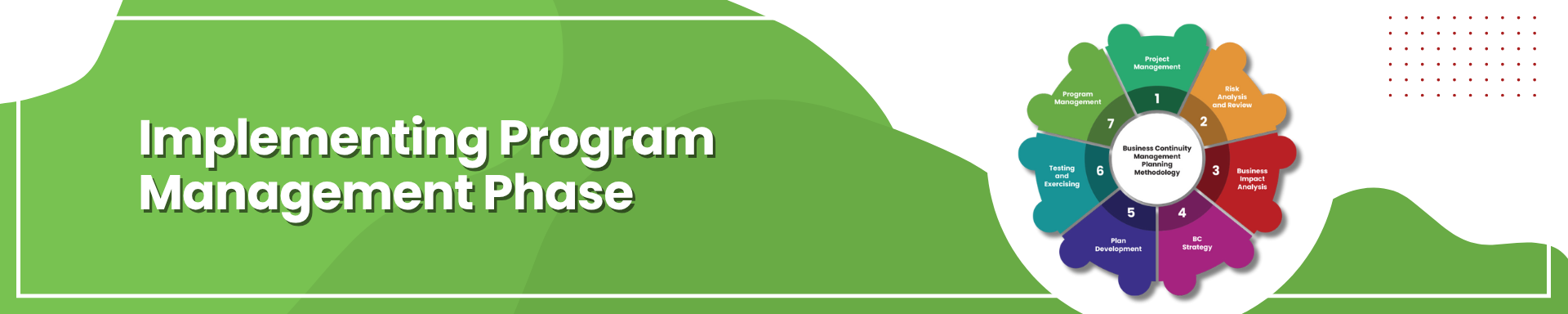
eBook 2: Chapter 8
Program Management Phase for BCM Planning Methodology for Gambling Regulatory Authority (GRA)
Introduction
The successful completion of the Project Management, Risk Analysis and Review, Business Impact Analysis, Business Continuity Strategy, Plan Development, and Testing and Exercising phases does not mark the end of the Business Continuity Management (BCM) journey.![[BCM] [GRA] [E2] [C7] Testing and Exercising](https://no-cache.hubspot.com/cta/default/3893111/68abc237-9fe7-440c-b9d6-5d107996f67d.png)
Business continuity is an ongoing management discipline that requires continuous oversight, maintenance, improvement, and governance.
The purpose of the Programme Management (PgM) Phase is to ensure that GRA's BCM programme remains effective, relevant, and aligned with organisational objectives, regulatory responsibilities, emerging risks, and ISO 22301 requirements.
Programme Management transforms BCM from a one-time project into a sustainable management system that continually enhances organisational resilience.
For GRA, effective programme management is essential because changes in technology, regulatory requirements, gambling industry trends, stakeholder expectations, and threat landscapes can significantly affect preparedness for business continuity. Therefore, BCM must be actively governed and continuously improved.
Purpose of Program Management
Programme Management ensures that:
 BCM remains aligned with organisational objectives.
- Business continuity plans remain accurate and up to date.
- Recovery capabilities are maintained.
- Personnel remain trained and prepared.
- Risks are continuously monitored.
- Lessons learned are incorporated into the BCM programme.
- Compliance with ISO 22301 is maintained.
- Organisational resilience continues to improve.
The Programme Management phase serves as the governance and continual improvement component of the BCMS.
BCM Governance Structure
Strong governance is fundamental to sustaining an effective BCM programme.
BCM Governance Objectives
The governance structure should:
- Establish accountability.
- Provide management oversight.
- Allocate resources.
- Monitor programme effectiveness.
- Drive continual improvement.
GRA BCM Governance Structure
A typical governance structure for GRA may include:
|
Governance Level |
Responsibilities |
|
Executive Management |
Strategic direction, policy approval, resource allocation |
|
BCM Steering Committee |
Oversight of BCM programme implementation and performance |
|
BCM Manager |
Day-to-day management of the BCM programme |
|
Business Unit Heads |
Ownership of business continuity plans and recovery capabilities |
|
BCM Coordinators |
Plan maintenance, training, and exercise coordination |
|
Recovery Teams |
Operational response and recovery activities |
This governance structure ensures BCM responsibilities are clearly assigned throughout the organisation.
BCM Policy Management
The BCM Policy provides the foundation for the BCMS and communicates management's commitment to business continuity.
Policy Requirements
The BCM Policy should:
- Define BCM objectives.
- Establish scope and applicability.
- Assign responsibilities.
- Specify compliance requirements.
- Support continual improvement.
GRA-Specific Requirement
The BCM Policy should explicitly support GRA's responsibility to:
- Maintain regulatory oversight of gambling activities.
- Ensure continuity of licensing and permit administration.
- Sustain enforcement and investigation capabilities.
- Protect regulatory information and records.
- Maintain communications with government agencies, gambling operators, and stakeholders during disruptions.
The policy should be reviewed at least annually or whenever significant organisational changes occur.
Plan Maintenance and Review
Business continuity plans must remain accurate and relevant.
Review Triggers
Plans should be reviewed when:
- Organisational structures change.
- New technologies are introduced.
- Critical business functions change.
- Recovery strategies are modified.
- Regulatory requirements are updated.
- Significant incidents occur.
GRA-Specific Requirement
All BC Plans supporting:
- Licensing Operations.
- Regulatory Compliance Monitoring.
- Enforcement and Investigation Activities.
- Regulatory Intelligence Functions.
- Stakeholder Communications.
- Information Technology Services.
should undergo formal review at least annually.
Training and Awareness Programme
Employees must understand their roles during a disruption.
Objectives
Training and awareness programmes should:
- Increase BCM knowledge.
- Improve preparedness.
- Familiarise personnel with plans.
- Reinforce recovery responsibilities.
Types of Training
|
Training Type |
Target Audience |
|
BCM Awareness Training |
All employees |
|
Recovery Team Training |
Recovery team members |
|
Crisis Management Training |
Senior management |
|
Exercise Participation Training |
Business unit personnel |
|
Specialist Recovery Training |
IT and technical recovery teams |
GRA Example
New employees joining the Licensing Division should receive BCM awareness training covering:
- Recovery procedures.
- Alternate work arrangements.
- Escalation procedures.
- Communication protocols.
This ensures continuity of knowledge is maintained despite staff turnover.
Testing and Exercising Management
Testing and exercising should be managed as an ongoing programme rather than an isolated activity.
Annual Exercise Programme
GRA should establish an annual exercise calendar covering:
- Component tests.
- Call notification tests.
- Walkthrough exercises.
- Integrated tests.
- Simulation exercises.
- Live recovery exercises.
GRA-Specific Requirement
At least one annual exercise should involve a scenario affecting critical regulatory services, such as:
- Licensing system outages.
- Cybersecurity incidents.
- Data breaches.
- Enforcement operation disruptions.
- Regulatory communications failures.
Exercise outcomes should be reported to senior management.
Incident and Exercise Lessons Learned
Continuous improvement depends on learning from both real incidents and exercises.
Post-Incident Reviews
Following significant incidents, GRA should conduct:
- Root cause analysis.
- Recovery performance assessment.
- Gap identification.
- Corrective action planning.
Post-Exercise Reviews
Exercise reviews should evaluate:
- Plan effectiveness.
- Recovery team performance.
- Communication effectiveness.
- Achievement of recovery objectives.
GRA Example
Following a simulation involving a cyberattack on regulatory systems, lessons learned may include:
- Delays in escalation procedures.
- Incomplete contact information.
- Technology recovery gaps.
- Additional training needs.
These findings should be incorporated into future programme improvements.
Performance Monitoring and Measurement
Programme performance should be measured using defined Key Performance Indicators (KPIs).
Sample BCM KPIs
|
KPI |
Target |
|
Annual Plan Review Completion |
100% |
|
BCM Training Completion Rate |
95% or higher |
|
Exercise Completion Rate |
100% |
|
Corrective Action Closure Rate |
90% or higher |
|
Recovery Objective Achievement |
100% during exercises |
Performance metrics provide management with visibility into programme effectiveness.
Audit and Compliance Management
Regular reviews provide assurance that the BCM programme remains effective.
Internal Audits
Internal BCM audits should evaluate:
- Compliance with BCM policies.
- Plan quality.
- Exercise effectiveness.
- Training records.
- Governance effectiveness.
ISO 22301 Compliance Reviews
Periodic reviews should assess compliance with:
- ISO 22301 requirements.
- Government directives.
- Internal policies and procedures.
GRA-Specific Requirement
Audit reviews should include critical regulatory functions and supporting technology platforms to ensure recovery capabilities remain effective.
Risk Monitoring and Environmental Scanning
The BCM programme should continuously monitor emerging risks.
Areas to Monitor
- Cybersecurity threats.
- Technology changes.
- Regulatory developments.
- Third-party dependencies.
- Workforce risks.
- Physical security threats.
GRA Example
Emerging risks that may require BCM review include:
- New online gambling technologies.
- Artificial intelligence-enabled threats.
- Changes in gambling legislation.
- Increased reliance on cloud services.
- Sophisticated cybercrime targeting regulators.
Monitoring these developments helps keep the BCM programme relevant.
Management Review
ISO 22301 requires top management to periodically review the BCMS.
Review Topics
Management reviews should consider:
- Audit results.
- Exercise outcomes.
- Incident reports.
- KPI performance.
- Resource requirements.
- Improvement opportunities.
GRA-Specific Requirement
The BCM Steering Committee should present an annual BCM performance report to senior management summarising:
- Programme status.
- Major risks.
- Exercise results.
- Corrective actions.
- Improvement initiatives.
This enables informed decision-making and continued executive support.
Continual Improvement
Continual improvement is a core principle of ISO 22301.
GRA should use the Plan-Do-Check-Act (PDCA) approach to:
- Identify improvement opportunities.
- Implement enhancements.
- Measure effectiveness.
- Update BCM arrangements.
Improvement initiatives should be prioritised based on risk, business impact, and organisational objectives.
Programme Management Deliverables
Key deliverables from the Programme Management phase include:
|
Deliverable |
Purpose |
|
BCM Policy |
Strategic direction and governance |
|
BCM Governance Framework |
Accountability and oversight |
|
Annual BCM Programme Plan |
Programme activities and objectives |
|
Training and Awareness Records |
Evidence of competency development |
|
Exercise Reports |
Validation of recovery capabilities |
|
Audit Reports |
Compliance and effectiveness assessment |
|
Corrective Action Register |
Tracking improvement activities |
|
Management Review Reports |
Executive oversight and decision-making |
These deliverables support the ongoing effectiveness of the BCMS.
![Banner [Summary] [BCM] [E2] [C8] Program Management](https://no-cache.hubspot.com/cta/default/3893111/9ab836f6-9d8f-4673-9d57-5729a3c8d644.png)
The Programme Management Phase is the final and most enduring phase of the Business Continuity Management Planning Methodology.
It ensures that GRA's BCM programme remains active, effective, and aligned with organisational priorities long after plans have been developed and tested.
Through robust governance, policy management, plan maintenance, training, exercising, auditing, performance monitoring, and continual improvement, GRA can sustain a mature and resilient BCMS.
For the Gambling Regulatory Authority, Programme Management is particularly important given its responsibility for maintaining regulatory oversight, licensing administration, enforcement activities, and stakeholder confidence in Singapore's gambling sector.
By embedding BCM into everyday management practices and continuously adapting to emerging threats and organisational changes, GRA can strengthen its operational resilience and maintain its ability to fulfil its critical regulatory mandate under all circumstances.
Effective Programme Management, therefore, ensures that BCM becomes an integral part of organisational culture and supports long-term compliance with ISO 22301 and regulatory excellence.
![[Thin Banner] Gambling Regulatory Authority](https://no-cache.hubspot.com/cta/default/3893111/4f23072f-0544-42d8-b1c9-4b74082dae90.png)
![[BCM] [GRA] [E2] [C1] Business Continuity Management Planning Methodology](https://no-cache.hubspot.com/cta/default/3893111/01d882c6-04f6-408f-97ab-2f4cde8d1f6b.png)
![[BCM] [GRA] [E2] [C2] Project Management](https://no-cache.hubspot.com/cta/default/3893111/f582601e-58a4-4d69-b0e0-cb3c5ea8643b.png)
![[BCM] [GRA] [E2] [C3] Risk Analysis and Review](https://no-cache.hubspot.com/cta/default/3893111/55ec9acb-df16-4fc7-b0be-6cc3656c406c.png)
![[BCM] [GRA] [E2] [C4] Business Impact Analysis](https://no-cache.hubspot.com/cta/default/3893111/fb15dbb1-c559-4f54-88bb-6cc2274c6553.png)
![[BCM] [GRA] [E2] [C5] Business Continuity Strategy](https://no-cache.hubspot.com/cta/default/3893111/b9f0877f-b8b5-4cb4-97ce-ab032e34cd3f.png)
![[BCM] [GRA] [E2] [C6] BCM Plan Development](https://no-cache.hubspot.com/cta/default/3893111/3a85f1b6-b018-483f-bd97-760464351273.png)
![[BCM] [GRA] [E2] [C8] Program Management](https://no-cache.hubspot.com/cta/default/3893111/4845d6bf-6033-44e4-b851-09bdb3d92c88.png)
![[BCM] [GRA] [E2] [C9] Summary](https://no-cache.hubspot.com/cta/default/3893111/93c5feac-87dc-48fd-bc58-32a8347bf16a.png)
![[BCM] [GRA] [E2] [C10] Back Cover of eBook 2](https://no-cache.hubspot.com/cta/default/3893111/d39a2276-e4a6-4b9b-b0b5-10384cd96e93.png)
More Information About Business Continuity Management Courses
To learn more about the course and schedule, click the buttons below for the BCM-300 Business Continuity Management Implementer [BCM-3] and the BCM-5000 Business Continuity Management Expert Implementer [BCM-5].


![Register [BL-B-3]*](https://no-cache.hubspot.com/cta/default/3893111/ac6cf073-4cdd-4541-91ed-889f731d5076.png)



![FAQ [BL-B-3]](https://no-cache.hubspot.com/cta/default/3893111/b3824ba1-7aa1-4eb6-bef8-94f57121c5ae.png)
![Email to Sales Team [BCM Institute]](https://no-cache.hubspot.com/cta/default/3893111/3c53daeb-2836-4843-b0e0-645baee2ab9e.png)


