

![[Full Banner] Gambling Regulatory Authority](https://no-cache.hubspot.com/cta/default/3893111/19ae41b0-2229-43d0-a2d6-347c7025bf77.png)
eBook 2: Chapter 6
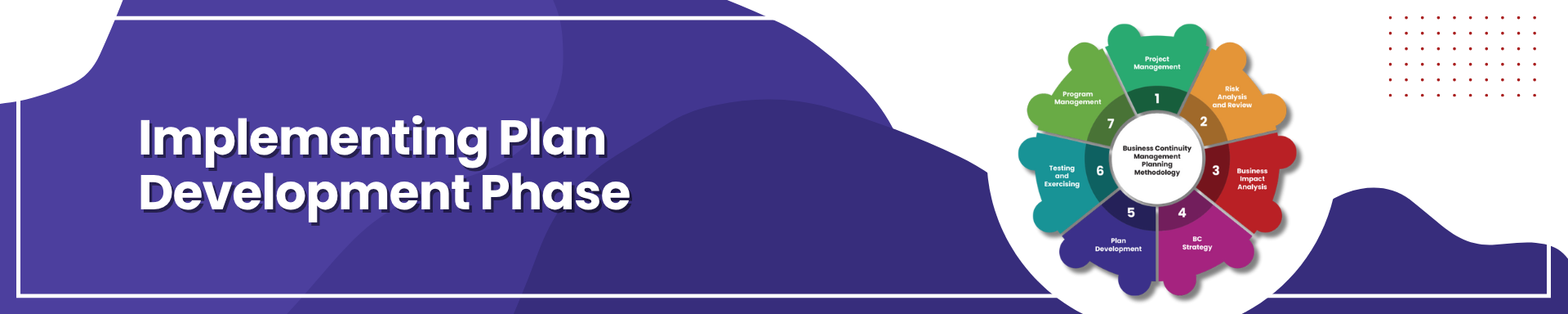
BC Plan Development Phase as part of the BCM Planning Methodology for the Gambling Regulatory Authority (GRA)
Introduction
Following the completion of the Business Continuity Strategy (BCS) phase, the next stage in the Business Continuity Management (BCM) Planning Methodology is the Business![[BCM] [GRA] [E2] [C6] BCM Plan Development](https://no-cache.hubspot.com/cta/default/3893111/3a85f1b6-b018-483f-bd97-760464351273.png) Continuity Plan (BC Plan) Development Phase.
Continuity Plan (BC Plan) Development Phase.
This phase transforms the recovery strategies identified during earlier phases into documented procedures that can be executed during a disruption.
The objective of plan development is to ensure that all critical business functions within GRA have clear, practical, and actionable recovery procedures that enable personnel to respond effectively during incidents.
A well-developed BC Plan provides a structured framework for managing disruptions, protecting regulatory responsibilities, and restoring normal operations within agreed recovery timeframes.
This chapter explains the key activities involved in developing Business Continuity Plans for GRA and outlines how business units can create, validate, and maintain effective recovery plans.
What Does Plan Development Entail?
The Business Continuity Plan Development process consists of three major stages:
- Determination of the Organisation of the BC Plan Document.
- Conducting a BC Plan Writing Workshop.
- Finalisation of the BC Plan Production.
Each stage ensures that the resulting plans are comprehensive, practical, and aligned with GRA's business continuity objectives.
Determination of the Organisation of the BC Plan Document
The first stage involves establishing the overall structure and framework of the Business Continuity Plan documentation.
The objective is to ensure consistency across all business units and provide a standardised approach to recovery planning.
Designing and Developing the BC Plan Template
A standard BC Plan template should be developed to guide all business units in documenting their continuity arrangements.
Typical Sections of the BC Plan Template
|
Section |
Description |
|
Plan Administration |
Ownership, approval, review, and distribution details |
|
Purpose and Scope |
Objectives and applicability of the plan |
|
Critical Business Functions |
Key activities covered by the plan |
|
Recovery Organisation |
Recovery team structure and responsibilities |
|
Activation Procedures |
Conditions and authority to invoke the plan |
|
Incident Response Procedures |
Immediate response actions |
|
Recovery Procedures |
Step-by-step recovery actions |
|
Resource Requirements |
People, facilities, technology, information, and suppliers |
|
Communication Procedures |
Internal and external communication arrangements |
|
Contact Information |
Emergency contact lists |
|
Appendices |
Supporting forms, checklists, and references |
A standard template ensures consistency across all GRA departments.
GRA Example
The Licensing Division, Enforcement Division, Corporate Services Division, and Information Technology Division should all use the same BC Plan structure while documenting function-specific recovery procedures.
Determining the Recovery Organisation
The Recovery Organisation identifies the personnel responsible for managing and executing recovery activities during a disruption.
Typical Recovery Structure
|
Recovery Role |
Responsibility |
|
Recovery Manager |
Overall recovery coordination |
|
Deputy Recovery Manager |
Backup recovery leader |
|
Team Leaders |
Manage recovery activities within functional areas |
|
Recovery Team Members |
Execute recovery procedures |
|
Communications Coordinator |
Manage stakeholder communications |
|
IT Recovery Coordinator |
Restore critical technology services |
GRA Example
For a disruption affecting regulatory operations:
|
Team |
Responsibility |
|
Licensing Recovery Team |
Restore licensing activities |
|
Enforcement Recovery Team |
Continue critical investigations |
|
Regulatory Monitoring Team |
Resume compliance monitoring activities |
|
IT Recovery Team |
Restore regulatory systems and databases |
|
Corporate Support Team |
Provide administrative and logistical support |
The recovery organisation should clearly define reporting relationships and escalation paths.
Conducting a BC Plan Writing Workshop to Guide Plan Writers
Once the template and recovery organisation have been established, the next step is to conduct BC Plan Writing Workshops.
The purpose of these workshops is to guide plan writers through the process of documenting recovery procedures.
Objectives of the Workshop
The workshop should:
- Explain BCM objectives and requirements.
- Review findings from the Risk Analysis and Review (RAR).
- Review Business Impact Analysis (BIA) results.
- Review approved Business Continuity Strategies.
- Explain the plan writing standards.
- Clarify recovery roles and responsibilities.
- Facilitate completion of BC Plan templates.
Participants
Typical participants include:
- BCM Manager.
- BCM Coordinator.
- Business Unit BCM Coordinators.
- Department Managers.
- Recovery Team Leaders.
- Subject Matter Experts.
GRA Example
Participants may include representatives from:
-
- Licensing and Permits Division.
- Regulatory Compliance Division.
- Enforcement and Investigation Division.
- Regulatory Intelligence Unit.
- Corporate Services Division.
- Information Technology Division.
- Communications and Stakeholder Engagement Team.
Completion of the Plan Template by Individual BU BCM Coordinators
Each Business Unit (BU) BCM Coordinator is responsible for documenting the recovery procedures for their respective areas.
Key Activities
- Identify critical activities.
- Document recovery priorities.
- Define recovery procedures.
- Identify required resources.
- Document alternate work arrangements.
- Establish communication requirements.
- Complete emergency contact lists.
GRA Example
The Licensing Division BCM Coordinator may document procedures such as:
- Manual processing of urgent licence applications.
- Accessing alternate licensing databases.
- Working remotely during office disruptions.
- Communicating with gambling operators during service interruptions.
Similarly, the Enforcement Division may document:
- Alternate investigation procedures.
- Access to critical case records.
- Emergency evidence management processes.
- Coordination with law enforcement agencies.
Finalisation of the BC Plan Production
The final stage ensures that all plans are complete, accurate, and ready for implementation.
Validation of BC Plans
Each plan should undergo a formal validation process to confirm:
- Accuracy.
- Completeness.
- Practicality.
- Alignment with recovery objectives.
- Compliance with organisational requirements.
Validation Responsibilities
BU BCM Coordinators
The BCM Coordinators validate:
- Recovery procedures.
- Resource requirements.
- Contact information.
- Recovery team assignments.
Heads of Business Units
Business Unit Heads validate:
- Operational feasibility.
- Recovery priorities.
- Resource commitments.
- Management approval.
BCM Programme Team
The BCM Programme Team reviews:
- Consistency across plans.
- Compliance with BCM standards.
- Alignment with ISO 22301 requirements.
GRA Example: Validation Process
For the Regulatory Compliance Division:
|
Validation Activity |
Responsible Party |
|
Verify compliance monitoring procedures |
BCM Coordinator |
|
Confirm staffing requirements |
Division Manager |
|
Validate technology recovery arrangements |
IT Department |
|
Review communication procedures |
Communications Team |
|
Approve final plan |
Head of Division |
Only after all reviews have been completed should the BC Plan be formally approved and issued.
Deliverables from the Plan Development Phase
The key outputs from this phase include:
|
Deliverable |
Purpose |
|
BC Plan Template |
Standardised documentation framework |
|
Recovery Organisation Structure |
Defines recovery roles and responsibilities |
|
Departmental BC Plans |
Recovery procedures for each business unit |
|
Emergency Contact Lists |
Supports rapid communications |
|
Recovery Checklists |
Guides recovery actions |
|
Plan Approval Records |
Evidence of management endorsement |
These deliverables become the operational documents used during disruptions.
Success Factors for Effective BC Plan Development
To maximise the effectiveness of BC Plans, GRA should ensure:
- Strong management support.
- Active participation by business units.
- Accurate and current information.
- Clear recovery procedures.
- Defined recovery responsibilities.
- Regular updates and reviews.
- Integration with testing and exercising activities.
A BC Plan is only effective if it is practical, accessible, and understood by the personnel responsible for executing it.
![Banner [Summary] [BCM] [E2] [C6] BCM Plan Development](https://no-cache.hubspot.com/cta/default/3893111/a8cffab8-99ea-4a3b-8755-e4196a5d5b95.png)
The Business Continuity Plan Development Phase is the process by which GRA's continuity strategies are translated into practical, executable recovery procedures.
By establishing a standardised BC Plan structure, defining a recovery organisation, conducting plan-writing workshops, and validating completed plans, GRA can ensure that each critical business function has clear guidance for responding to disruptions.
Well-developed BC Plans enable GRA to continue essential regulatory activities, protect critical information assets, maintain stakeholder confidence, and fulfil its statutory obligations during adverse events.
As required by ISO 22301, these plans should be regularly reviewed, updated, and tested to ensure they remain effective and aligned with the evolving operational and regulatory environment.
The completion of this phase provides the foundation for the next stage of the BCM Planning Methodology—Testing and Exercising—where the effectiveness of the plans will be validated through structured exercises and simulations.
![[Thin Banner] Gambling Regulatory Authority](https://no-cache.hubspot.com/cta/default/3893111/4f23072f-0544-42d8-b1c9-4b74082dae90.png)
![[BCM] [GRA] [E2] [C1] Business Continuity Management Planning Methodology](https://no-cache.hubspot.com/cta/default/3893111/01d882c6-04f6-408f-97ab-2f4cde8d1f6b.png)
![[BCM] [GRA] [E2] [C2] Project Management](https://no-cache.hubspot.com/cta/default/3893111/f582601e-58a4-4d69-b0e0-cb3c5ea8643b.png)
![[BCM] [GRA] [E2] [C3] Risk Analysis and Review](https://no-cache.hubspot.com/cta/default/3893111/55ec9acb-df16-4fc7-b0be-6cc3656c406c.png)
![[BCM] [GRA] [E2] [C4] Business Impact Analysis](https://no-cache.hubspot.com/cta/default/3893111/fb15dbb1-c559-4f54-88bb-6cc2274c6553.png)
![[BCM] [GRA] [E2] [C5] Business Continuity Strategy](https://no-cache.hubspot.com/cta/default/3893111/b9f0877f-b8b5-4cb4-97ce-ab032e34cd3f.png)
![[BCM] [GRA] [E2] [C7] Testing and Exercising](https://no-cache.hubspot.com/cta/default/3893111/68abc237-9fe7-440c-b9d6-5d107996f67d.png)
![[BCM] [GRA] [E2] [C8] Program Management](https://no-cache.hubspot.com/cta/default/3893111/4845d6bf-6033-44e4-b851-09bdb3d92c88.png)
![[BCM] [GRA] [E2] [C9] Summary](https://no-cache.hubspot.com/cta/default/3893111/93c5feac-87dc-48fd-bc58-32a8347bf16a.png)
![[BCM] [GRA] [E2] [C10] Back Cover of eBook 2](https://no-cache.hubspot.com/cta/default/3893111/d39a2276-e4a6-4b9b-b0b5-10384cd96e93.png)
More Information About Business Continuity Management Courses
To learn more about the course and schedule, click the buttons below for the BCM-300 Business Continuity Management Implementer [BCM-3] and the BCM-5000 Business Continuity Management Expert Implementer [BCM-5].


![Register [BL-B-3]*](https://no-cache.hubspot.com/cta/default/3893111/ac6cf073-4cdd-4541-91ed-889f731d5076.png)



![FAQ [BL-B-3]](https://no-cache.hubspot.com/cta/default/3893111/b3824ba1-7aa1-4eb6-bef8-94f57121c5ae.png)
![Email to Sales Team [BCM Institute]](https://no-cache.hubspot.com/cta/default/3893111/3c53daeb-2836-4843-b0e0-645baee2ab9e.png)


