

 Chapter 3: The Business Continuity Management Planning Methodology
/Business%20Continuity%20Management%20Planning%20Methodology%201.jpg?width=312&height=312&name=Business%20Continuity%20Management%20Planning%20Methodology%201.jpg) Chapter 3 dives into the core of BCM: the Business Continuity Management (BCM) Planning Methodology.
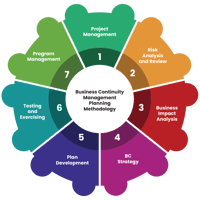
Chapter 3 dives into the core of BCM: the Business Continuity Management (BCM) Planning Methodology.It outlines the seven interconnected phases that guide the development, implementation, and maintenance of a BCM program.
The Risk Analysis and Review (RAR) phase lays the foundation and provides a deeper understanding of potential threats.
Following the RAR phase, the Business Impact Analysis (BIA) plays a central role in identifying critical business functions (CBFs) and acceptable downtime limits, and the BCM Strategy (BCS) development phases provide a deeper understanding of the organisation's overall BCM approach.
With a clear strategy, BCM Plan Development (PD) translates it into actionable BCM Pans, ensuring personnel are trained and resources are secured for recovery efforts. Testing and exercising the plan are crucial to identify weaknesses, and the BC Plan manages this process to ensure the program remains effective.
Finally, the BCM program requires ongoing maintenance and review, with BCM Plans overseeing updates to reflect changes and ensure the organisation's resilience is continuously safeguarded.
 By understanding and effectively navigating each phase of the BCM planning methodology, BCM Plans become instrumental in building a program that fosters organisational preparedness.
The Risk Analysis and Review (RAR) phase lays the foundation and provides a deeper understanding of potential threats.
Following the RAR phase, the Business Impact Analysis (BIA) plays a central role in identifying critical business functions (CBFs) and acceptable downtime limits, and the BCM Strategy (BCS) development phases provide a deeper understanding of the organisation's overall BCM approach.
With a clear strategy, BCM Plan Development (PD) translates it into actionable BCM Pans, ensuring personnel are trained and resources are secured for recovery efforts. Testing and exercising the plan are crucial to identify weaknesses, and the BC Plan manages this process to ensure the program remains effective.
Finally, the BCM program requires ongoing maintenance and review, with BCM Plans overseeing updates to reflect changes and ensure the organisation's resilience is continuously safeguarded.
By understanding and effectively navigating each phase of the BCM planning methodology, BCM Plans become instrumental in building a program that fosters organisational preparedness.BCM is not a one-time event but a continuous cycle designed to ensure an organisation can weather any storm. This chapter explores the BCM planning methodology, a series of interconnected phases that guide developing, implementing, and maintaining a comprehensive business continuity program.
We will delve into each crucial phase, highlighting the role of BCM Professionals within the BCM planning methodology.
We will delve into each crucial phase, highlighting the role of BCM Professionals within the BCM planning methodology.
Phases of the BCM Planning Methodology
The BCM planning methodology can be broadly categorised into seven key phases. The first phase is project management, which is optional if the organisation has already embarked on its BCM journey.
Project Management (PM)
The PM phase is the planning, organising, and managing tasks and resources to accomplish a defined objective of implementing the BCM project, usually with constraints on time and cost.
Risk Analysis and Review (RAR)
This RAR phase builds and identifies potential threats and vulnerabilities that could disrupt CBFs. BCM professionals work with risk management teams to assess the likelihood and severity of these threats, prioritising them based on their potential impact on CBFs.
Business Impact Analysis (BIA)
The BIA, the foundation of BCM, identifies CBFs and assesses their tolerance for disruption. BCM Professionals play a central role in facilitating the BIA.
They work with stakeholders across different departments to identify CBFs, determine their Recovery Time Objectives (RTOs) and Recovery Point Objectives (RPOs), and understand the financial impact of disruptions.
BC Strategy (BCS) Development
Based on the RAR and BIA, BCM Professionals collaborate with leadership to develop a BCM strategy. This strategy outlines the organisation's overall approach to continuity, including the types of disruptions to be addressed, acceptable downtime limits, and preferred recovery methods.
BC Plan Development (PD)
This phase translates the BCM strategy into a practical action plan. BC Plans draft detailed procedures for responding to disruptions, outlining roles, responsibilities, communication protocols, and activation triggers for recovery activities.
This PD phase brings the BC Plan to life. BCM Professionals spearhead the implementation process, ensuring personnel are trained on their roles and responsibilities, establishing communication channels, and acquiring necessary technology or resources.
BC Testing and Exercising (TE)
Testing the BCM plan is vital to identify gaps and ensure its effectiveness. BCM Professionals organise and facilitate different tests, ranging from tabletop exercises simulating disruptions to full-scale simulations involving entire departments.
Program Management (Maintenance and Review)
The BCM program is not static. BCM Professionals oversee the BCM Plan's ongoing maintenance and review. This involves updating the plan to reflect changes in the organisation, its environment, or emerging threats. Regular reviews ensure the BCM program remains relevant and practical.
Roles and Responsibilities within the BCM Planning Methodology
 BCM Plans play a crucial role throughout the BCM planning methodology.
 Here is a breakdown of their critical responsibilities within each phase:
Summing Up ...
By assuming these responsibilities within each phase of the BCM planning methodology, BCM Professionals play a critical role in building and maintaining a robust program that safeguards the organisation's resilience.
This chapter has provided a comprehensive overview of the BCM planning methodology and the essential role BCM Professionals play within it. The subsequent chapters will delve deeper into each phase, providing specific guidance and best practices for BCM Professionals to navigate the BCM program effectively.
This chapter has provided a comprehensive overview of the BCM planning methodology and the essential role BCM Professionals play within it. The subsequent chapters will delve deeper into each phase, providing specific guidance and best practices for BCM Professionals to navigate the BCM program effectively.





More Information About Business Continuity Management Courses
To learn more about the course and schedule, click the buttons below for the BCM-300 Business Continuity Management Implementer [BCM-3] and the BCM-5000 Business Continuity Management Expert Implementer [BCM-5].


![Register [BL-B-3]*](https://no-cache.hubspot.com/cta/default/3893111/ac6cf073-4cdd-4541-91ed-889f731d5076.png)



![FAQ [BL-B-3]](https://no-cache.hubspot.com/cta/default/3893111/b3824ba1-7aa1-4eb6-bef8-94f57121c5ae.png)
![Email to Sales Team [BCM Institute]](https://no-cache.hubspot.com/cta/default/3893111/3c53daeb-2836-4843-b0e0-645baee2ab9e.png)


