

![[BCM] [Damanat] [Full Banner] Implementing BCM for The Saudi Mortgage Guarantees Services Company](https://no-cache.hubspot.com/cta/default/3893111/221734db-8c33-48bd-8147-fc740eecaf83.png)


eBook 2: Chapter 4: Part 1
![[BCM] [Damanat] [Full Banner] Guide to Implementing Business Impact Analysis](https://no-cache.hubspot.com/cta/default/3893111/8c9c1922-5a52-4f2f-9d38-6465514a7caf.png)
Implementing the Business Impact Analysis Phase in the Saudi Mortgage Guarantees Services Company BCM Planning Methodology
Introduction
![[BCM] [Damanat] [E2] [C4] [P1] Position of BIA in the BCM Planning Methodology](https://no-cache.hubspot.com/cta/default/3893111/0ca2ca7d-0103-44fe-9d63-4bc2ed724444.png)
This chapter is the 1st instalment of the BIA planning process and will cover:
-
Part 1: Position of BIA in BCM Planning Methodology
-
Part 2: BIA Governance Structure
-
Part 3: Defining the BIA Scope
Part 1: Position of the Business Impact Analysis within the BCM Planning Methodology
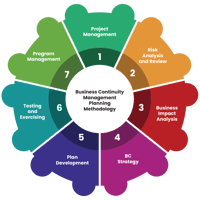 The Business Continuity Management Planning Methodology comprises a sequence of interrelated phases that collectively enable an organisation to establish, implement, maintain and continually improve its Business Continuity Management capability.
The Business Impact Analysis occupies the central analytical position within this methodology because it translates organisational knowledge into measurable recovery requirements that guide all subsequent continuity planning activities.
The relationship between the principal phases can be summarised as follows.
|
BCM Phase |
Primary Purpose |
Principal Output |
|---|---|---|
|
Project Management |
Establish governance, scope, resources and implementation approach |
Approved BCM project |
|
Risk Assessment |
Identify threats, vulnerabilities and existing controls |
Enterprise risk profile |
|
Business Impact Analysis |
Assess the consequences of disruption and determine recovery requirements |
Approved recovery requirements |
|
Business Continuity Strategy |
Select practical recovery solutions |
Recovery strategies |
|
Plan Development |
Document operational recovery procedures |
Business Continuity Plans |
|
Testing and Exercising |
Validate strategies and plans |
Improvement actions |
|
Programme Management |
Maintain and improve the BCM programme |
Continual improvement |
Each phase depends upon information generated during earlier activities.
Project Management establishes governance and defines the scope of the BCM initiative. Risk Assessment provides an understanding of the threats and vulnerabilities facing Damanat, but it does not determine recovery priorities.
The BIA builds upon this information by evaluating how disruption affects each Critical Business Function over time and by identifying the operational capability required to resume those functions before impacts become unacceptable.
Business Continuity Strategy then uses the approved BIA outputs to determine how the identified recovery requirements will be achieved.
These strategies are translated into detailed Business Continuity Plans that specify the operational procedures required during an actual disruption.
Testing and exercising validate whether those strategies and plans can achieve the approved recovery objectives. Programme Management subsequently maintains all BIA information, ensuring that recovery requirements remain aligned with organisational changes.
Inputs Required Before Conducting the BIA
Before commencing the BIA, Damanat should confirm that the following information has been assembled and validated:
|
Required Input |
Purpose within the BIA |
|---|---|
|
Approved BCM Scope |
Defines organisational coverage |
|
Organisation Structure |
Identifies accountable business units |
|
Critical Business Function Catalogue |
Establishes assessment scope |
|
Business Process Documentation |
Supports process decomposition |
|
Risk Assessment Results |
Provides disruption context |
|
Service Commitments |
Identifies delivery expectations |
|
Statutory and Regulatory Obligations |
Determines mandatory outcomes |
|
Stakeholder Requirements |
Establishes service expectations |
|
Historical Incident Information |
Supports realistic assumptions |
|
Existing Recovery Arrangements |
Identifies current capabilities |
|
ICT Architecture |
Determines technology dependencies |
|
Supplier Information |
Identifies external dependencies |
Expected Outputs of the BIA
Upon completion, the BIA should produce a comprehensive set of management-approved outputs that support all subsequent BCM activities.
These include:
- Validated Critical Business Function catalogue.
- Validated Sub-CBF inventory.
- Impact assessments across multiple impact categories.
- Impact-over-time analysis.
- Indicative Maximum Tolerable Periods of Disruption (MTPDs).
- Indicative Recovery Time Objectives (RTOs).
- Recovery Point Objectives (where applicable).
- Minimum Business Continuity Objectives (MBCOs).
- Recovery priorities.
- Internal and external dependency registers.
- Minimum resource requirements.
- Vital records inventory.
- Supporting systems inventory.
- Management-approved recovery requirements.
Collectively, these outputs provide the evidence base required to design recovery strategies that are proportionate to the actual consequences of disruption rather than assumptions or historical practices.
Part 2: Establishing the BIA Governance Structure
![[BCM] [Damanat] [E2] [C4] [P2] Establishing the BIA Governance Structure](https://no-cache.hubspot.com/cta/default/3893111/41158d1a-4d94-4fff-b5be-4e5866e18add.png) An effective Business Impact Analysis requires strong governance to ensure that recovery priorities reflect organisational objectives, statutory responsibilities and operational realities.
An effective Business Impact Analysis requires strong governance to ensure that recovery priorities reflect organisational objectives, statutory responsibilities and operational realities.
Governance also promotes consistency, transparency and management accountability throughout the assessment process.
Senior Management
Senior Management provides executive sponsorship and retains overall accountability for the BIA. Their responsibilities include:
- Approving the BIA methodology.
- Endorsing impact assessment criteria.
- Defining organisational disruption tolerance.
- Resolving disagreements between CBF owners.
- Approving enterprise recovery priorities.
- Authorising significant resource investments.
- Accepting justified recovery gaps.
- Providing final management approval of BIA outputs.
BCM Steering Committee
The BCM Steering Committee provides strategic oversight and cross-functional coordination.
Its responsibilities include:
- Monitoring BIA progress.
- Reviewing assessment consistency.
- Challenging assumptions.
- Resolving cross-functional dependency issues.
- Reviewing enterprise-wide recovery priorities.
- Endorsing completed BIA findings.
- Monitoring corrective actions arising from the BIA.
BCM Manager or BCM Coordinator
The BCM Manager is responsible for planning and coordinating the entire BIA exercise.
Typical responsibilities include:
- Developing the BIA methodology and templates.
- Planning interviews and workshops.
- Facilitating assessments.
- Maintaining consistency across business units.
- Challenging incomplete responses.
- Consolidating assessment results.
- Preparing management reports.
- Maintaining the central BIA repository.
Critical Business Function Owners
Each CBF Owner is responsible for validating the operational content of the assessment.
Responsibilities include:
- Confirming the purpose of the CBF.
- Validating Sub-CBF decomposition.
- Assessing business impacts.
- Proposing recovery requirements.
- Identifying dependencies.
- Determining minimum service levels.
- Confirming operational assumptions.
- Approving completed BIA submissions.
Sub-CBF or Process Owners
Operational managers provide the detailed information necessary for accurate analysis.
Typical responsibilities include:
- Documenting business activities.
- Confirming process dependencies.
- Identifying essential systems and records.
- Assessing manual workaround capability.
- Estimating backlog accumulation.
- Validating operational recovery assumptions.
Specialist Support Functions
Several corporate functions should participate in validating specialist assumptions.
|
Function |
Primary Contribution |
|---|---|
|
ICT |
Technology dependencies and recovery capability |
|
Cybersecurity |
Security controls and cyber resilience |
|
Human Resources |
Staffing, succession and mobilisation |
|
Facilities |
Recovery of workplaces and infrastructure |
|
Finance |
Financial impacts and recovery funding |
|
Procurement |
Supplier continuity arrangements |
|
Legal |
Statutory obligations and legal impacts |
|
Compliance |
Regulatory obligations |
|
Records Management |
Vital records and information governance |
|
Communications |
Stakeholder communications |
|
Security |
Physical security arrangements |
|
Third-Party Risk Management |
Supplier dependency validation |
These specialist functions ensure that business assumptions are technically feasible, legally compliant and operationally achievable before they are approved.
Part 3: Defining the Scope of the Business Impact Analysis
![[BCM] [Damanat] [E2] [C4] [P3] Defining the BIA Scope](https://no-cache.hubspot.com/cta/default/3893111/357a1d12-62f0-467a-9b5b-881b817063c6.png) The scope of the Business Impact Analysis should encompass all activities necessary for Damanat to fulfil its statutory responsibilities and deliver essential mortgage guarantee services. Defining an appropriate scope is fundamental because incomplete coverage may result in critical recovery requirements being overlooked.
The scope of the Business Impact Analysis should encompass all activities necessary for Damanat to fulfil its statutory responsibilities and deliver essential mortgage guarantee services. Defining an appropriate scope is fundamental because incomplete coverage may result in critical recovery requirements being overlooked.
The BIA should include:
- All approved Critical Business Functions.
- Supporting Sub-CBFs and operational processes.
- Mortgage guarantee products and services.
- Business units and functional departments.
- Offices and operational locations.
- Personnel and specialist competencies.
- Premises and recovery facilities.
- ICT systems and applications.
- Information assets and vital records.
- Internal support services.
- Third-party suppliers.
- Financial institutions.
- Government agencies.
- Communications channels.
- Statutory and regulatory obligations.
When determining whether a process falls within the BIA scope, Damanat should consider whether disruption would:
- Affect statutory responsibilities.
- Prevent delivery of mortgage guarantee services.
- Delay regulatory or contractual commitments.
- Affect financial institutions or borrowers.
- Interrupt executive decision-making.
- Create significant legal, financial or reputational consequences.
- Prevent other Critical Business Functions from operating.
- Support ICT, information management or corporate governance.
Not every function requires the same recovery priority. The purpose of the BIA is to identify those differences objectively so that recovery resources are directed first toward the activities that have the greatest organisational, regulatory and stakeholder consequences if disrupted.
![Banner [Summary] [BCM] [E2] [C4] Business Impact Analysis](https://no-cache.hubspot.com/cta/default/3893111/3d259877-5780-4502-9473-1129f6d08a8c.png)
The next instalment will cover:
-
Part 4: Critical Business Function Catalogue.
-
Part 5: Sub-CBF Decomposition.
-
Part 6: Identifying Products, Services and Regulatory Outcomes.

![[BCM] [Damanat] [3/4 Banner] Implementing BCM for The Saudi Mortgage Guarantees Services Company](https://no-cache.hubspot.com/cta/default/3893111/eb2678e7-9b23-4a73-827d-897c4b20315c.png)
![[BCM] [Damanat] [E2] [C4] [P0] Introduction](https://no-cache.hubspot.com/cta/default/3893111/cf1089fb-ba15-4935-bafe-d469db8b731b.png)
![[BCM] [Damanat] [E2] [C4] [P4] Confirming the Critical Business Functions](https://no-cache.hubspot.com/cta/default/3893111/1729e39a-c267-4d7a-8282-0a30b44a296c.png)
![[BCM] [Damanat] [E2] [C4] [P5] Decomposing CBFs into Sub-CBFs](https://no-cache.hubspot.com/cta/default/3893111/9a19fac4-668e-41e2-b188-f08991e6097a.png)
![[BCM] [Damanat] [E2] [C4] [P6] Identifying Product, Services and Outcomes](https://no-cache.hubspot.com/cta/default/3893111/d6db6926-824a-4256-9c3b-f781422ce57e.png)
![[BCM] [Damanat] [E2] [C4] [P7] Identifying Impact Areas](https://no-cache.hubspot.com/cta/default/3893111/23e335dc-644f-4a06-bdde-067b828f8b55.png)
More Information About Business Continuity Management Courses
To learn more about the course and schedule, click the buttons below for the BCM-300 Business Continuity Management Implementer [BCM-3] and the BCM-5000 Business Continuity Management Expert Implementer [BCM-5].


![Register [BL-B-3]*](https://no-cache.hubspot.com/cta/default/3893111/ac6cf073-4cdd-4541-91ed-889f731d5076.png)



![FAQ [BL-B-3]](https://no-cache.hubspot.com/cta/default/3893111/b3824ba1-7aa1-4eb6-bef8-94f57121c5ae.png)
![Email to Sales Team [BCM Institute]](https://no-cache.hubspot.com/cta/default/3893111/3c53daeb-2836-4843-b0e0-645baee2ab9e.png)


