


![x [OR] [BML] Legal Disclaimer Banner](https://no-cache.hubspot.com/cta/default/3893111/7d48f2b3-8004-4429-9f4b-7ee7be465092.png)
eBook 3: Chapter 1

Introduction
![[BCM] [BML] [E3] [C1] Starting Your BCM Implementation](https://no-cache.hubspot.com/cta/default/3893111/c982a7ae-1f09-46b6-9113-d2e6b69d3bb3.png)
Business Continuity Management (BCM) is a critical capability for financial institutions operating in an increasingly complex risk landscape.
For the Bank of Maldives (BML), as the nation’s primary banking institution with extensive retail, corporate, digital, and national payment responsibilities, effective BCM implementation is essential to ensuring service continuity, financial stability, regulatory compliance, and public confidence during disruptive events.
This eBook, “Starting Your BCM Implementation,” is the third instalment in the Bank of Maldives eBook series and marks the transition from conceptual understanding to the structured execution of BCM practices.
Business Continuity Management (BCM) is a critical capability for financial institutions operating in an increasingly complex risk landscape.
The content is designed to support Bank of Maldives stakeholders in translating organisational knowledge, risk awareness, and governance intent into actionable continuity strategies and plans.
![x eBook Cover [BCM] [MINDS] [E1] [2D]](https://no-cache.hubspot.com/cta/default/3893111/4fb0dc0d-0c63-4998-999d-425fae691337.png) It assumes readers have reviewed the two preceding eBooks—eBook 1: Understanding Your Organisation and eBook 2: Implementing BCM Planning Methodology—which offer foundational knowledge and a strategic overview of BCM processes and planning.
It assumes readers have reviewed the two preceding eBooks—eBook 1: Understanding Your Organisation and eBook 2: Implementing BCM Planning Methodology—which offer foundational knowledge and a strategic overview of BCM processes and planning.
In contrast, eBook 3 focuses on the execution phase of the BCM planning journey, where concepts are translated into actionable tasks and documentation.
It provides detailed templates and step-by-step instructions aligned with the four core phases of the BCM planning methodology:
Purpose of this eBook
![x eBook Cover [BCM] [MINDS] [E3] [2D]](https://no-cache.hubspot.com/cta/default/3893111/6fb74713-0a79-4ff7-a203-1d77308ebda5.png) A practical guide and a repository of outputs generated during the BCM planning exercise.
A practical guide and a repository of outputs generated during the BCM planning exercise.
It enables the organisation to systematically document the results of its risk analysis and review (RAR), business impact analysis (BIA), business continuity strategies (BCS), and business continuity plan development (PD) in a single consolidated reference.
Specifically, this guide provides:
- Templates and structured tools to capture information at each stage of the BCM methodology.
- A framework for aligning BCM processes with critical business functions (CBFs).
- A compilation of BCM submissions by various units of the organisation, demonstrating how resilience planning has been applied across the organisation.
The content also reflects the BCM Institute’s training-led implementation approach, providing participants with practical, competency-driven guidance to successfully implement or update their BCM projects.
Overview of Implementation Phases and Templates
The Four Phases of BCM Planning
The content of this eBook 3 "Starting Your BCM Implementation," drills down into the specific requirements for each phase of the BCM planning methodology.
The four phases of the BCM planning methodology are
- Risk analysis and review (RAR)
- Business impact analysis (BIA)
- Business continuity strategy (BCS)
- BC plan development (PD)
 Risk Analysis and Review (RAR)
In the Risk Analysis and Review (RAR) phase, the content includes the completion of these three templates:
- List of Threats [RAR T1]
- Treatment and Control [RAR T2]
- Risk Impact and Likelihood Assessment [RAR T3]
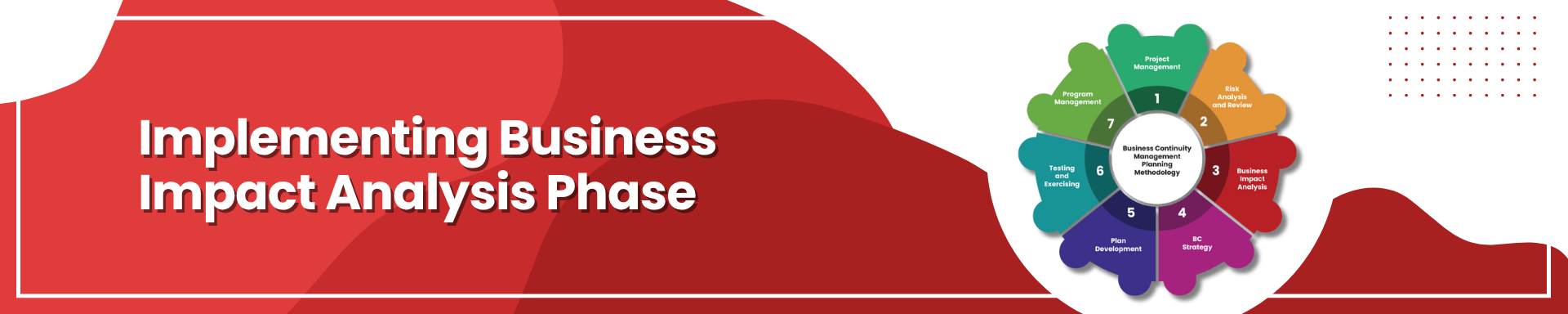 Business Impact Analysis (BIA)
During the business impact analysis (BIA) phase, six-part templates are completed for each critical business function.
- Part 0: Corporate MBCO & Product and Services [MBCO] [P&S]
- Part 1: Identification of Business Functions [BIAQ T1]
- Part 2: Impact Areas of Business Functions [BIAQ T1]
- Part 3: Impact Over Time of Business Functions [BIAQ T2]
- Part 4: Supporting IT Systems and Applications [BIAQ T2]
- Part 5: Inter-dependencies [BIAQ T3]
- Part 6: Vital Records [BIAQ T3]
Each section is completed for all of the critical business functions, providing granular insight into operational dependencies and recovery priorities.
Business Continuity Strategy (BCS)
In the Business Continuity Strategy (BCS) phase, each critical business unit will have the following requirements presented:
- Mitigation Strategies [BCS T1]
- Recovery Strategies and Justifications [BCS T2]
- Minimum Resources Required during a Disaster [BCS T3]
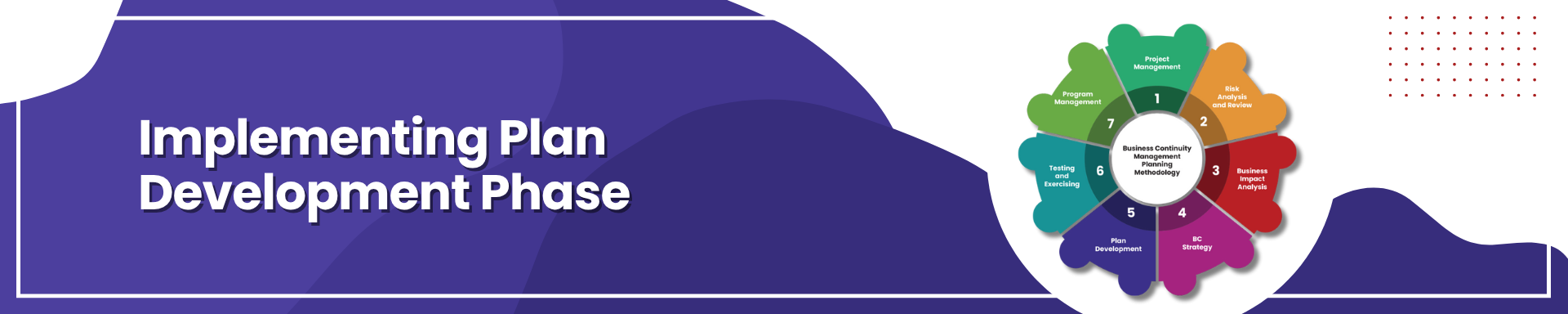
Plan Development (PD)
Once strategies are finalised, the BCM team proceeds to develop and document the actual Business Continuity Plans [PD] for each business function. This includes the:
- Procedures and workflows tailored to each Sub-CBF
- Communication protocols
- Roles and responsibilities during disruption events
BML's Critical Business Functions (CBFs)
As part of the Business Impact Analysis phase, the organisation has identified the following Critical Business Functions (CBFs):
|
CBF Code |
Critical Business Function (CBF) |
Description of the Function |
|
CBF-1 |
Retail & Corporate Banking Services |
Provision of deposit accounts, savings, loans, credit facilities, and customer account servicing for individuals and corporates. |
|
CBF-2 |
Payment & Settlement Services |
Processing of domestic and international payments, fund transfers, ATM transactions, card payments, and clearing activities. |
|
CBF-3 |
ATM & Digital Banking Operations |
Operation of ATMs, internet banking, mobile banking, and digital payment platforms. |
|
CBF-4 |
Treasury & Liquidity Management |
Management of liquidity, cash flow, interbank transactions, and foreign exchange activities. |
|
CBF-5 |
Core Banking System Operations |
Operation and availability of core banking systems supporting account management, transactions, and reporting. |
|
CBF-6 |
Customer Support & Call Centre Services |
Handling customer enquiries, complaints, fraud reporting, and service requests. |
|
CBF-7 |
Credit Risk & Loan Management |
Monitoring credit exposure, loan approvals, repayments, restructuring, and recovery processes. |
|
CBF-8 |
Compliance, AML & Regulatory Reporting |
Monitoring regulatory compliance, AML/CFT controls, sanctions screening, and statutory reporting. |
|
CBF-9 |
IT Infrastructure & Cybersecurity Operations |
Management of data centres, networks, cybersecurity monitoring, and system resilience. |
|
CBF-10 |
Branch Operations & Cash Handling |
Operation of physical branches, teller services, and cash logistics across islands. |
This approach ensures continuity planning is operationally grounded, data-informed, and recovery-focused.
A Strategic Step Forward
This eBook is part of BCM Institute’s value-adding and complementary services, designed to help organisations implement a complete BCM project or upgrade their existing continuity programme.
It supports learning during BCM Institute’s certification or competency-based training courses and provides participants with a ready-to-use, organisation-specific reference.
For the organisation, this means its leadership, staff, and volunteers will not only gain theoretical knowledge but also produce tangible continuity artefacts that safeguard the Centre’s services and reputation.
By completing the exercises and templates in this eBook, the organisation will move from BCM awareness to practical resilience planning, ensuring that the Centre can withstand disruptions and continue delivering essential support to the organisation's continuity of critical services.
Next Steps
As you begin working through the templates and planning phases outlined in this eBook, refer to the earlier eBooks for context and methodological support.
Engage with BCM Institute’s facilitators and leverage their training workshops to ensure your submissions are thorough, aligned, and ready for implementation.
This guide will not only help you start your BCM implementation but also empower you to build a culture of resilience for years to come.

![[BCM] [BML] [E3] [BIA] MBCO Corporate MBCO](https://no-cache.hubspot.com/cta/default/3893111/cc4f2a0b-d0ec-4cd8-89e3-464ee81071a4.png)
![[BCM] [BML] [E3] [BIA] [PS] Key Product and Services](https://no-cache.hubspot.com/cta/default/3893111/cad2fd52-1da3-4962-ae2e-c7494b4a9c17.png)
![[BCM] [BML] [E3] [RAR] [T1] List of Threats](https://no-cache.hubspot.com/cta/default/3893111/2a34509c-ede3-41d0-8e42-06963d4efef1.png)
![[BCM] [BML] [E3] [RAR] [T2] Treatment and Control](https://no-cache.hubspot.com/cta/default/3893111/f4b790bc-1f50-468f-8a81-1241021505bc.png)
![[BCM] [BML] [E3] [RAR] [T3] Risk Impact and Likelihood Assessment](https://no-cache.hubspot.com/cta/default/3893111/76013e61-8496-4f30-9167-68af8634b33a.png)
![[BCM] [BML] [E3] [BCS] [T1] Mitigation Strategies and Justification](https://no-cache.hubspot.com/cta/default/3893111/770009a7-6358-4ae2-a12e-95dd6a8717d8.png)
![[BCM] [BML] [E1] [C10] Identifying Critical Business Functions](https://no-cache.hubspot.com/cta/default/3893111/a26696f2-9b69-4bd6-88c7-bdf182ed66d8.png)
![[BCM] [BML] [E3] [BIA] [DP] [CBF] [1] Retail & Corporate Banking Services](https://no-cache.hubspot.com/cta/default/3893111/495c9325-ac90-441d-a330-b1e8269dfad7.png)
Note that the icon marked with [x] is under construction
More Information About Business Continuity Management Courses

 To learn more about the course and schedule, click the buttons below for the BCM-300 Business Continuity Management Implementer [B-3] course and the BCM-5000 Business Continuity Management Expert Implementer [B-5].
![Register [BL-B-3]*](https://no-cache.hubspot.com/cta/default/3893111/ac6cf073-4cdd-4541-91ed-889f731d5076.png)





![FAQ [BL-B-3]](https://no-cache.hubspot.com/cta/default/3893111/b3824ba1-7aa1-4eb6-bef8-94f57121c5ae.png)
![Email to Sales Team [BCM Institute]](https://no-cache.hubspot.com/cta/default/3893111/3c53daeb-2836-4843-b0e0-645baee2ab9e.png)


