


![x [OR] [BML] Legal Disclaimer Banner](https://no-cache.hubspot.com/cta/default/3893111/7d48f2b3-8004-4429-9f4b-7ee7be465092.png)
![Banner [BCM] [E3] [BIA] [P1] Identification of Business Functions](https://no-cache.hubspot.com/cta/default/3893111/206ddd7e-615a-42c8-aa2a-3416a1ad06b3.png)
CBF-1 Retail & Corporate Banking Services
![[BCM] [BML] [E3] [BIA] [T1] [CBF] [1] Retail & Corporate Banking Services](https://no-cache.hubspot.com/cta/default/3893111/c8342fbc-6ef7-4e13-9b90-2b5cf7587197.png) Retail and Corporate Banking Services form the core customer-facing functions of Bank of Maldives and are fundamental to the bank’s role as the primary financial services provider in the Maldives.
Retail and Corporate Banking Services form the core customer-facing functions of Bank of Maldives and are fundamental to the bank’s role as the primary financial services provider in the Maldives.
These services enable individuals, businesses, and institutions to access essential banking products such as deposits, payments, lending, trade finance, and digital banking channels.
In accordance with ISO 22301: Business Continuity Management Systems (BCMS), the identification and prioritisation of Critical Business Functions (CBFs) is a foundational step in ensuring organisational resilience.
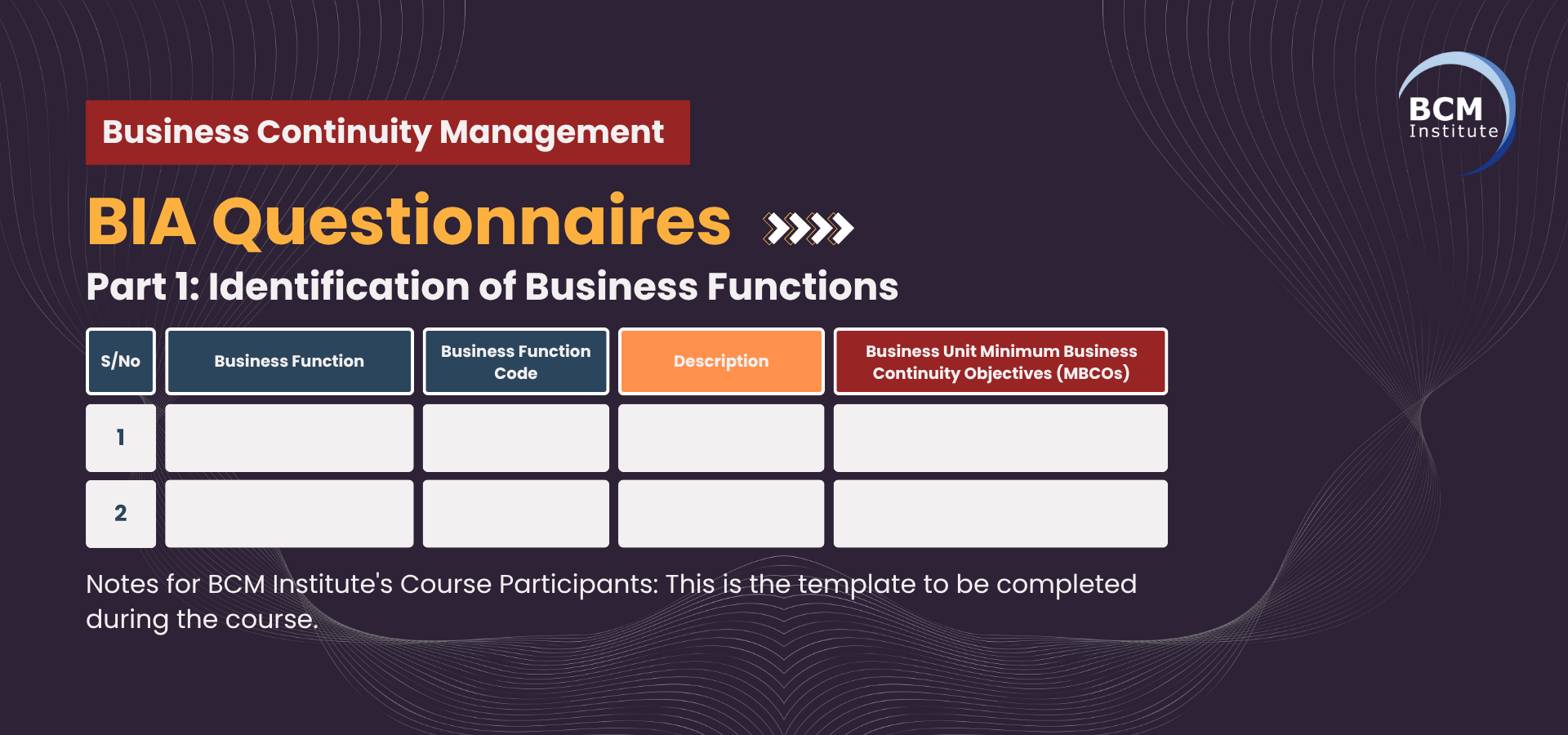
This chapter focuses on CBF-1 Retail & Corporate Banking Services, breaking it down into logical Sub-CBFs and defining the Business Unit Minimum Business Continuity Objective (BU MBCO) for each.
The BU MBCO represents the minimum acceptable level of service that must be maintained or restored following a disruption, before unacceptable impacts occur.
Unlike the Corporate MBCO, which reflects enterprise-wide priorities, BU MBCOs are defined at the functional level and are used to guide recovery strategies, resource allocation, and continuity planning in line with ISO 22301 requirements.
![Banner [Table] [BCM] [E3] [BIA] [P1] Identification of Critical Business Functions](https://no-cache.hubspot.com/cta/default/3893111/4fe499c9-0c19-46b4-8b6f-75450dba07d8.png)
Table P1: Critical Business Functions for CBF-1
|
Sub-CBF Code |
Sub-CBF |
Description of CBF |
Business Unit Minimum Business Continuity Objective (MBCO) |
|
1.1 |
Customer Onboarding & Account Opening |
Processes for onboarding retail and corporate customers, including KYC, AML checks, account creation, documentation verification, and regulatory compliance. |
Ability to onboard priority customers (e.g. essential services, corporates, government-linked entities) within 2–3 business days, with simplified or manual procedures during disruption. |
|
1.2 |
Deposit & Withdrawal Services |
Management of customer deposits and withdrawals via branches, ATMs, agents, and electronic channels. |
Maintain access to customer funds with limited daily withdrawal and deposit capabilities restored within the same business day. |
|
1.3 |
Payment Processing & Fund Transfers |
Processing of domestic and international payments, including interbank transfers, remittances, standing instructions, and internal account transfers. |
Support critical and high-value payment transactions (salary payments, utilities, government payments) within the same day or the next business day. |
|
1.4 |
Lending & Credit Management |
Credit origination, loan servicing, repayments, restructuring, and monitoring of retail and corporate loan portfolios. |
Ensure loan servicing, repayment posting, and credit risk monitoring are maintained within 1–2 business days, with new lending deferred if required. |
|
1.5 |
Card Services & Merchant Solutions |
Issuance and management of debit/credit cards, POS acquiring services, merchant settlements, and card dispute handling. |
Enable basic card transaction processing and merchant settlements within the same business day, with manual exception handling if systems are unavailable. |
|
1.6 |
Digital & Online Banking |
Internet banking, mobile banking, self-service channels, and digital customer interactions. |
Restore essential digital banking functions (balance enquiry, transfers, bill payments) within 4–8 hours of disruption. |
|
1.7 |
Trade & Corporate Financial Solutions |
Trade finance, guarantees, letters of credit, cash management, and structured solutions for corporate clients. |
Support critical trade and corporate obligations within 1 business day, prioritising time-sensitive and regulatory-bound transactions. |
|
1.8 |
Account Maintenance & Reporting |
Account updates, customer instructions, statements, regulatory reporting, and customer correspondence. |
Maintain minimum account maintenance and regulatory reporting capabilities within 2 business days, using alternative processes if required. |
![Banner [BCM] [E3] [BIA] [Summing Up] [P1] Identification of Critical Business Functions](https://no-cache.hubspot.com/cta/default/3893111/22330ab3-0a0f-4efd-9da7-43032e1e6573.png)
The identification of CBF-1 Retail & Corporate Banking Services and its associated Sub-CBFs provides Bank of Maldives with a clear functional view of its most critical customer-facing operations.
By defining Business Unit Minimum Business Continuity Objectives (BU MBCOs) for each Sub-CBF, the bank establishes a practical baseline for acceptable service levels during disruptive incidents.
This structured approach aligns with ISO 22301 requirements by:
- Clearly identifying critical business functions and dependencies
- Establishing measurable continuity objectives at the business unit level
- Supporting informed recovery strategy design and prioritisation
- Enabling consistent alignment between operational recovery and customer, regulatory, and financial impact tolerance
The outcomes of this chapter serve as a direct input into subsequent Business Impact Analysis (BIA), resource dependency mapping, and business continuity and disaster recovery strategy development, ensuring that Retail and Corporate Banking Services remain resilient, trusted, and sustainable under adverse conditions.
![Banner [BCM] [E3] [BIA] [P2] Impact Area of Business Functions](https://no-cache.hubspot.com/cta/default/3893111/182e67c2-aa89-4b0b-b3e9-144293680ea4.png)
CBF-1 Retail & Corporate Banking Services
Retail and Corporate Banking Services form the core revenue-generating and customer-facing capability of Bank of Maldives (BML).
These services underpin the Bank’s role as the primary financial intermediary for individuals, SMEs, corporates, and public-sector entities across the Maldives.
Any disruption to these functions would have immediate financial, operational, reputational, and regulatory consequences, potentially affecting national financial stability.
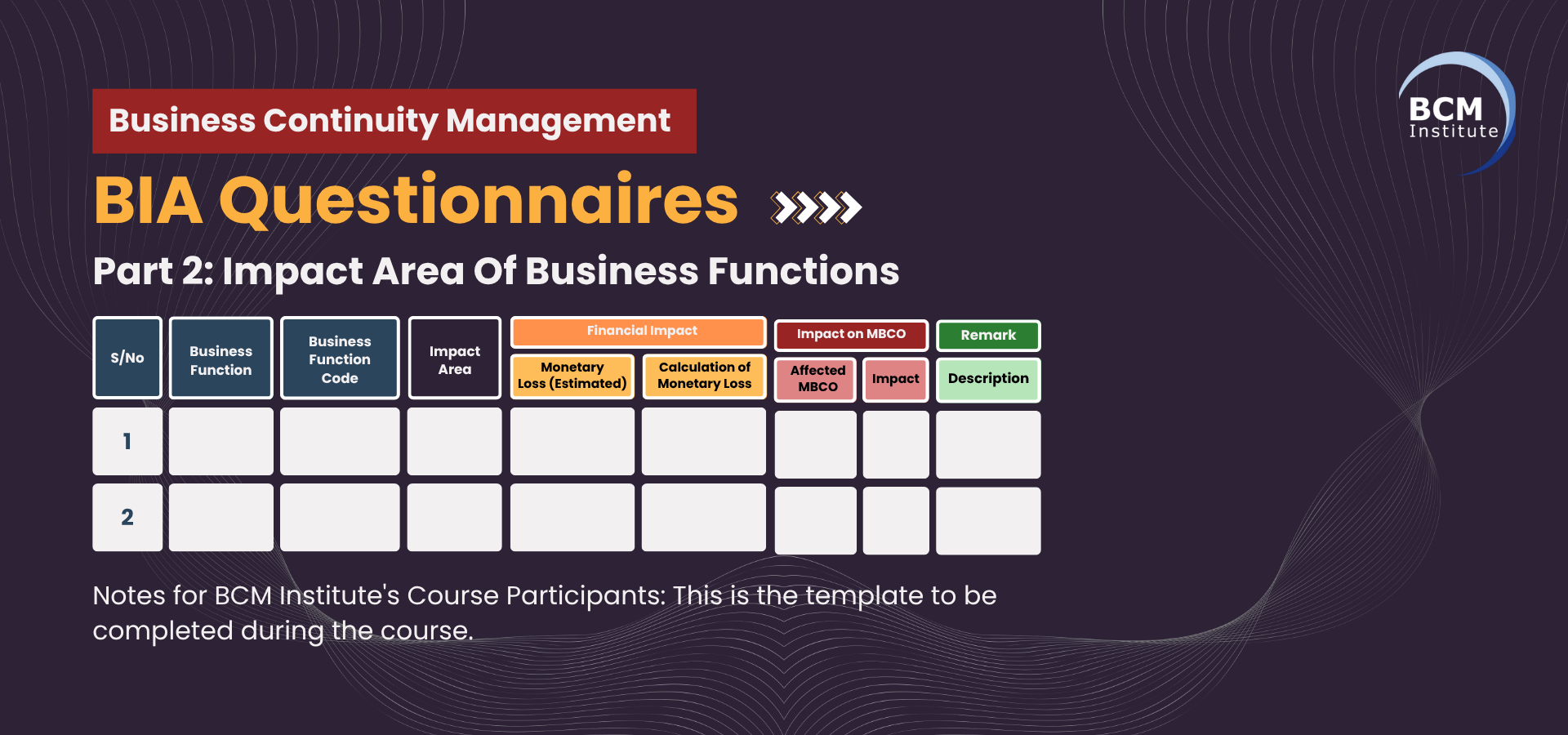
This chapter identifies and analyses the Impact Areas associated with the detailed Sub-Critical Business Functions (Sub-CBFs) under CBF-1 Retail & Corporate Banking Services, in accordance with ISO 22301 Business Impact Analysis (BIA) requirements.
The analysis supports the determination of Corporate Minimum Business Continuity Objectives (MBCO) by clearly articulating the severity, scale, and nature of impacts should these functions be disrupted.
![Banner [Table] [BCM] [E3] [BIA] [P2] Impact Areas of Business Functions [BIAQ]](https://no-cache.hubspot.com/cta/default/3893111/91582408-03ad-40e1-90e8-43ce62079aa6.png)
Table P2: Impact Area Assessment for CBF-1
|
Sub-CBF Code |
Sub-CBF |
Impact Area |
Financial Impact – Monetary Loss (Estimated) |
Financial Impact – Calculation of Monetary Loss (Formula) |
Impact on MBCO – Affect MBCO |
Impact on MBCO – Impact |
Remarks – Description |
|
1.1 |
Customer Onboarding & Account Opening |
Financial, Regulatory, Reputational, Customer |
Medium |
(Average new accounts/day × Average onboarding revenue) + Compliance penalty costs |
Yes |
Extended disruption slows revenue growth and risks non-compliance with KYC/AML timelines |
Impacts customer acquisition, regulatory standing, and public trust |
|
1.2 |
Deposit & Withdrawal Services |
Financial, Customer, Reputational, Operational |
High |
(Daily deposit & withdrawal volume × Avg. transaction value) + Customer compensation costs |
Yes |
Immediate effect on customer confidence and liquidity management |
Core banking activity is essential for daily public access to funds |
|
1.3 |
Payment Processing & Fund Transfers |
Financial, Regulatory, Reputational, Customer |
Very High |
(Failed transaction value × Penalty/interest costs) + SLA breach penalties |
Yes |
Failure to meet MBCO disrupts economic activity and settlement obligations |
Time-critical service with national and interbank dependencies |
|
1.4 |
Lending & Credit Management |
Financial, Strategic, Regulatory |
High |
(Delayed loan disbursement × Interest margin loss) |
Yes |
Revenue loss and deterioration of credit risk oversight |
Impacts loan approvals, repayments, and regulatory credit monitoring |
|
1.5 |
Card Services & Merchant Solutions |
Financial, Reputational, Customer |
High |
(Daily card transaction value × Interchange & merchant fee loss) |
Yes |
Direct and visible impact on commerce and merchant confidence |
High public visibility; outages rapidly damage brand perception |
|
1.6 |
Digital & Online Banking |
Customer, Reputational, Operational |
Medium–High |
(Failed digital transactions × Avg. service fee) + Customer remediation costs |
Yes |
Loss of accessibility, especially for remote island communities |
Increases dependency on branches and call centres during outages |
|
1.7 |
Trade & Corporate Financial Solutions |
Financial, Regulatory, Strategic |
High |
(Delayed trade finance value × Penalty/interest costs) |
Yes |
Breach of client and international trade obligations |
Time-sensitive services with contractual and cross-border impact |
|
1.8 |
Account Maintenance & Reporting |
Regulatory, Operational, Reputational |
Medium |
(Reporting delays × Regulatory fines or sanctions) |
Yes |
Weakens compliance posture and audit readiness |
Essential for customer transparency and statutory reporting |
![Banner [BCM] [E3] [BIA] [Summing Up] [P2] Impact Areas of Business Functions [BIAQ]](https://no-cache.hubspot.com/cta/default/3893111/76188041-e1c9-43d9-8efa-e550f46ad04d.png)
The analysis of CBF-1 Retail & Corporate Banking Services demonstrates that all associated Sub-CBFs have a direct and material impact on Bank of Maldives’ Corporate MBCO.
Several functions—particularly payments, deposits, lending, and digital banking—exhibit high to very high financial and reputational impact, confirming their time-critical nature under ISO 22301.
This Impact Area assessment provides a structured and auditable foundation for:
- Establishing Recovery Time Objectives (RTOs) and Recovery Point Objectives (RPOs)
- Prioritising continuity and resilience strategies
- Aligning operational resilience with regulatory and national financial stability expectations
By clearly linking business impacts to MBCO considerations, Bank of Maldives strengthens its ability to withstand, respond to, and recover from disruptions while continuing to meet customer, regulatory, and stakeholder expectations.

Note that the icon marked with [x] is under construction
Ensuring Service Continuity and Compliance: ISO 22301 BCMS at Bank of Maldives |
||||||
| eBook 3: Starting Your BCM Implementation |
||||||
![[BCM] [BML] [E3] [BIA] MBCO Corporate MBCO](https://no-cache.hubspot.com/cta/default/3893111/cc4f2a0b-d0ec-4cd8-89e3-464ee81071a4.png) |
![[BCM] [BML] [E3] [BIA] [PS] Key Product and Services](https://no-cache.hubspot.com/cta/default/3893111/cad2fd52-1da3-4962-ae2e-c7494b4a9c17.png) |
![[BCM] [BML] [E3] [RAR] [T1] List of Threats](https://no-cache.hubspot.com/cta/default/3893111/2a34509c-ede3-41d0-8e42-06963d4efef1.png) |
![[BCM] [BML] [E3] [RAR] [T2] Treatment and Control](https://no-cache.hubspot.com/cta/default/3893111/f4b790bc-1f50-468f-8a81-1241021505bc.png) |
![[BCM] [BML] [E3] [RAR] [T3] Risk Impact and Likelihood Assessment](https://no-cache.hubspot.com/cta/default/3893111/76013e61-8496-4f30-9167-68af8634b33a.png) |
![[BCM] [BML] [E3] [BCS] [T1] Mitigation Strategies and Justification](https://no-cache.hubspot.com/cta/default/3893111/770009a7-6358-4ae2-a12e-95dd6a8717d8.png) |
![[BCM] [BML] [E1] [C10] Identifying Critical Business Functions](https://no-cache.hubspot.com/cta/default/3893111/a26696f2-9b69-4bd6-88c7-bdf182ed66d8.png) |
| CBF-1 Retail & Corporate Banking Services |
||||||
| DP | BIAQ T1 | BIAQ T2 | BIAQ T3 | BCS T2 | BCS T3 | PD |
![[BCM] [BML] [E3] [BIA] [DP] [CBF] [1] Retail & Corporate Banking Services](https://no-cache.hubspot.com/cta/default/3893111/495c9325-ac90-441d-a330-b1e8269dfad7.png) |
|
![[BCM] [BML] [E3] [BIA] [T2] [CBF] [1] Retail & Corporate Banking Services](https://no-cache.hubspot.com/cta/default/3893111/69e049ec-a2c3-41f7-b47f-a131a677206d.png) |
![[BCM] [BML] [E3] [BIA] [T3] [CBF] [1] Retail & Corporate Banking Services](https://no-cache.hubspot.com/cta/default/3893111/9d002ca5-84f8-4270-86dc-ab03e81a22b7.png) |
![[BCM] [BML] [E3] [BCS] [T2] [CBF] [1] Retail & Corporate Banking Services](https://no-cache.hubspot.com/cta/default/3893111/fa20e9fc-74b8-4554-9920-3e25eda43d19.png) |
![[BCM] [BML] [E3] [BCS] [T3] [CBF] [1] Retail & Corporate Banking Services](https://no-cache.hubspot.com/cta/default/3893111/11fa5643-4b71-49fa-a855-379d2f0dc323.png) |
![[BCM] [BML] [E3] [PD] [CBF] [1] Retail & Corporate Banking Services](https://no-cache.hubspot.com/cta/default/3893111/648dfc7c-b7da-4818-a1ac-0c480f847e6a.png) |
More Information About Business Continuity Management Courses
To learn more about the course and schedule, click the buttons below for the BCM-300 Business Continuity Management Implementer [BCM-3] and the BCM-5000 Business Continuity Management Expert Implementer [BCM-5].


![Register [BL-B-3]*](https://no-cache.hubspot.com/cta/default/3893111/ac6cf073-4cdd-4541-91ed-889f731d5076.png)



![FAQ [BL-B-3]](https://no-cache.hubspot.com/cta/default/3893111/b3824ba1-7aa1-4eb6-bef8-94f57121c5ae.png)
![Email to Sales Team [BCM Institute]](https://no-cache.hubspot.com/cta/default/3893111/3c53daeb-2836-4843-b0e0-645baee2ab9e.png)


