---
title: [BCM] [BIA] [ISO22301] [P3] Impact Over Time of Business Functions
description: [BCM] [BIA] [P2] [ISO22301] [P3] Impact Over Time of Business Functions
image: https://blog.bcm-institute.org/hubfs/BIA%20Morepost/Assignment%20%5BB%5D%20BIA%20Morepost%20Sample%20Answers/IC_BCM%20BIA%20Guidance%20Notes_Part%204_Impact%20Over%20Time%20of%20Business%20Functions.png
---
.
[](http://www.bcm-institute.org/)
- [Home](https://www.bcm-institute.org/)
- [About Us](https://www.bcm-institute.org/about-us-3/)
- [A President’s Perspective](https://www.bcm-institute.org/about-us/a-presidents-perspective/)
- [Our History](https://www.bcm-institute.org/about-us/our-history/)
- [Our Advisory Council](https://www.bcm-institute.org/about-us/our-advisory-council/)
- [Customers’ Testimonials](https://www.bcm-institute.org/about-us/customers-testimonials/)
- [Credential Verification](https://www.bcm-institute.org/about-us/credential-verification/)
- [Courses](https://blog.bcm-institute.org/blog/course-fees-for-blended-learning-courses-master-catalog)
- [ISO 22301 Business Continuity Management System Audit](https://blog.bcm-institute.org/audit/business-continuity-management-audit-courses)
- [ISO 22301 Business Continuity Management](https://blog.bcm-institute.org/bcm/business-continuity-management-courses)
- [Crisis Communication](https://blog.bcm-institute.org/crisis-communication/crisis-communication-courses)
- [Crisis Management](https://blog.bcm-institute.org/en/crisis-management/courses)
- [IT Disaster Recovery](https://blog.bcm-institute.org/it-disaster-recovery/courses)
- [Operational Resilience](https://blog.bcm-institute.org/operational-resilience/courses)
- [Operational Resilience Audit](https://blog.bcm-institute.org/operational-resilience-audit/courses)
- [Certification](https://blog.bcm-institute.org/certification/types-of-certifications-offered)
- [ISO 22301 BCMS Audit Certification](https://blog.bcm-institute.org/certification/business-continuity-management-audit-certification)
- [ISO22301 Business Continuity Management Certification](https://blog.bcm-institute.org/bcm/business-continuity-management-certification)
- [Crisis Communication Certification](https://blog.bcm-institute.org/crisis-communication/crisis-communication-certification)
- [Crisis Management Certification](https://blog.bcm-institute.org/en/crisis-management/crisis-management-certification)
- [IT Disaster Recovery Planning Certification](https://blog.bcm-institute.org/it-disaster-recovery/it-disaster-recovery-certification)
- [Operational Resilience Certification](https://blog.bcm-institute.org/operational-resilience/operational-resilience-certification)
- [Operational Resilience Audit Certification](https://blog.bcm-institute.org/operational-resilience-audit)
- [Seminars](https://blog.bcm-institute.org/meet-the-expert/mte-webinar-mainpage)
- [Store](https://www.bcm-institute.org/store-2/)
- [Contact Us](http://www.bcm-institute.org/about-us/contact-us/)
-
-
##### Ebook Series

# \[BCM\] \[BIA\] \[ISO22301\] \[P3\] Impact Over Time of Business Functions
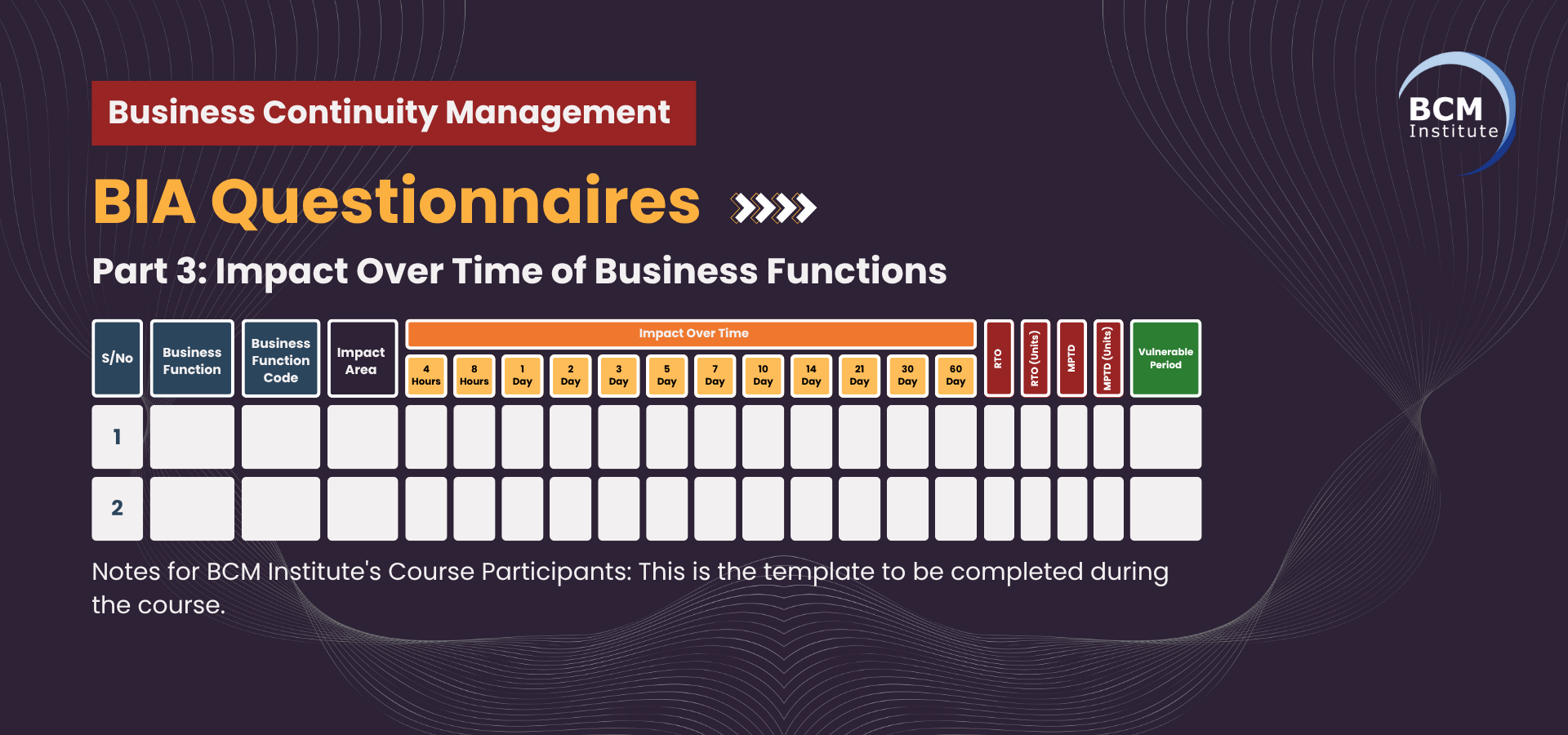
The “Impact Over Time of Business Functions” template is a structured tool for assessing the escalation of impact as a business function's unavailability persists.
Aligned with ISO 22301:2019, Clause 8.2.2, this analysis enables organisations to determine Recovery Time Objectives (RTOs) and Maximum Tolerable Periods of Disruption (MTPDs) for all critical functions.
By capturing both the severity and timing of potential impacts, the template provides a clear, evidence-based foundation for prioritising recovery strategies, allocating resources, and demonstrating compliance with business continuity management system (BCMS) requirements.
This chapter guides practitioners in completing the template, interpreting results, and linking them directly to continuity planning and operational resilience, ensuring that business decisions are informed by a robust, time-sensitive impact assessment.
[![Banner \[BCM\] \[E3\] \[BIA\] \[Summing Up\] \[P3\] Impact Over Time of Business Functions \[BIAQ\]](https://no-cache.hubspot.com/cta/default/3893111/987f8ca5-0ba4-4281-be57-5221186733d0.png)](https://cta-redirect.hubspot.com/cta/redirect/3893111/987f8ca5-0ba4-4281-be57-5221186733d0)
[Dr Goh Moh Heng](https://blog.bcm-institute.org/ebook/author/dr-goh-moh-heng) Jan 18, 2026
###### Business Continuity Management Certified Planner-Specialist-Expert
[](https://cta-redirect.hubspot.com/cta/redirect/3893111/a1b4b4e2-f0aa-44df-a197-431397a7927c)
[](https://cta-redirect.hubspot.com/cta/redirect/3893111/326c85d5-f1af-4a99-9f0e-0072cfcad36a)
### [![Banner \[BCM\] \[E3\] \[BIA\] \[P3\] Impact Over Time of Business Functions](https://no-cache.hubspot.com/cta/default/3893111/bc131ed6-ca92-4253-8940-2f98dad34599.png)](https://cta-redirect.hubspot.com/cta/redirect/3893111/bc131ed6-ca92-4253-8940-2f98dad34599)
### “Impact Over Time of Business Functions”(Aligned with ISO 22301 BCMS)
#### Introduction
In any organisation, understanding how disruptions to business functions affect operational, financial, regulatory, and reputational outcomes is critical for effective continuity planning.
The “Impact Over Time of Business Functions” template is a structured tool for assessing the escalation of impact as a business function's unavailability persists over time.
Aligned with ISO 22301:2019, Clause 8.2.2, this analysis enables organisations to determine Recovery Time Objectives (RTOs) and Maximum Tolerable Periods of Disruption (MTPDs) for all critical functions.
By capturing both the severity and timing of potential impacts, the template provides a clear, evidence-based foundation for prioritising recovery strategies, allocating resources, and demonstrating compliance with business continuity management system (BCMS) requirements.
This chapter guides practitioners in completing the template, interpreting results, and linking them directly to continuity planning and operational resilience, ensuring that business decisions are informed by a robust, time-sensitive impact assessment.
#### **Objectives of the Template (with ISO 22301 Alignment)**
The objective of the **Impact Over Time of Business Functions** template is to support the **Business Impact Analysis (BIA)** required under **ISO 22301:2019, Clause 8.2.2**, by systematically evaluating **how the consequences of disruption to business functions escalate over time**.
From an ISO 22301 perspective, this template enables the organisation to:
##### **Identify and analyse disruption impacts over time**
- In line with **Clause 8.2.2 a)**, which requires the organisation to assess the impacts of disruption on its activities.
- The time-based analysis ensures impacts are not assessed statically but reflect real operational deterioration as downtime increases.
##### **Determine prioritised activities and continuity requirements**
- Supports **Clause 8.2.2 b)** by identifying which business functions must be prioritised for recovery based on escalating impact.
##### Establish Recovery Time Objectives (RTOs)
- Fulfils **Clause 8.2.2 c)**, which requires the organisation to determine the time within which activities must be resumed to avoid unacceptable consequences.
##### **Define Maximum Tolerable Period of Disruption (MTPD)**
- Aligns with **Clause 8.2.2 d)** by identifying the maximum period after which the organisation’s viability, obligations, or objectives would be compromised.
##### **Support continuity strategy selection and justification**
- Provides evidence-based input into **Clause 8.3 (Business Continuity Strategies and Solutions)** by linking recovery requirements directly to time-based impact severity.
---
### **Template Structure & Content (Mapped to ISO 22301)**
#### **1. Business Function / Activity Identification**
- Identifies the business function being analysed, consistent with the scope defined under **Clause 4.3** and activities identified in the BIA.
- Ensures traceability between:
- Business objectives (Clause 4.1)
- Critical activities (Clause 8.2.2)
###### **ISO 22301 linkage**
Ensures all activities within scope are analysed for their impact on disruption.
---
#### **2. Highest Impact Category**
- Identifies the most severe impact area (e.g. regulatory, customer, financial, reputational, safety).
- Reflects ISO 22301’s requirement to consider **both tangible and intangible impacts**.
###### **ISO 22301 linkage**
Clause 8.2.2 requires assessment of impacts that may affect:
- Legal and regulatory compliance
- Customer commitments
- Organisational objectives and reputation
---
#### **3. Impact Over Time Assessment**
- Evaluates impact severity across defined time intervals (e.g. 2 hours, 1 day, 3 days, 1 week).
- Uses a consistent **impact rating scale** to demonstrate escalation.
###### **ISO 22301 linkage**
- Enables evidence-based determination of:
- Acceptable downtime
- Prioritisation of recovery sequencing
- Supports auditors’ expectations for **time-dependent justification**, not arbitrary RTOs.
---
#### **4. Recovery Time Objective (RTO)**
- Identifies the time by which the function **must be resumed** to prevent unacceptable consequences.
- Typically determined at the point where impact becomes **significant or severe**.
###### **ISO 22301 linkage**
Clause 8.2.2 c)
> “The organization shall determine the time within which activities shall be resumed.”
RTOs derived here become **mandatory inputs** to:
- Business continuity strategies (Clause 8.3)
- Business continuity plans (Clause 8.4)
---
#### **5. Maximum Tolerable Period of Disruption (MTPD)**
- Defines the **absolute maximum downtime** the organisation can tolerate for the function.
- Beyond this point, impacts threaten organisational survival, compliance, or strategic objectives.
###### **ISO 22301 linkage**
Clause 8.2.2 d)
> “The organization shall determine the maximum tolerable period of disruption.”
This ensures:
- RTOs are always **shorter than MTPD**
- Continuity strategies are designed within survivability limits
---
#### **6. Vulnerable Periods**
- Identifies periods when disruption impact is significantly higher (e.g. payroll cycles, regulatory reporting dates, peak trading periods).
- Enhances the realism of the BIA by recognising operational context.
###### **ISO 22301 linkage**
Supports Clause 8.2.2 by ensuring the impact analysis reflects **real operating conditions**, not theoretical averages.
---
#### **Value of This Template for an ISO 22301 BCMS**
When completed correctly, this template enables the organisation to:
✅ Demonstrate **conformance with ISO 22301 Clause 8.2.2** during audits
✅ Justify RTOs and MTPDs with **documented, time-based impact analysis**
✅ Provide defensible input to continuity strategies and recovery solutions
✅ Align operational resilience objectives with BCMS requirements
✅ Improve senior management understanding of **risk tolerance over time**
---
#### **Good Practice (ISO 22301 Auditor Expectations)**
- Impact ratings should reflect **worst-credible disruption scenarios**, not optimistic assumptions.
- Time intervals must be **meaningful to the business**, not generic placeholders.
- Vulnerable periods should be clearly defined and operationally relevant.
- The analysis should clearly show **why an activity is prioritised**, not just that it is.
### [![Banner \[BCM\] \[E3\] \[BIA\] \[Summing Up\] \[P3\] Impact Over Time of Business Functions \[BIAQ\]](https://no-cache.hubspot.com/cta/default/3893111/987f8ca5-0ba4-4281-be57-5221186733d0.png)](https://cta-redirect.hubspot.com/cta/redirect/3893111/987f8ca5-0ba4-4281-be57-5221186733d0)
The completion of the **Impact Over Time of Business Functions** template provides a **time-based perspective of operational vulnerabilities**, enabling organisations to understand not just what is critical, but **when criticality becomes most severe**.
By mapping escalating impacts across defined time intervals, organisations can establish realistic, justifiable RTOs and MTPDs that align with ISO 22301 requirements.
The insights gained from this template support strategic continuity planning, risk-informed decision-making, and regulatory compliance, while also fostering a culture of preparedness across the organisation.
Ultimately, this analysis ensures that business continuity strategies are **targeted, evidence-based, and capable of sustaining operations during disruptions, thereby** enhancing overall organisational resilience.
[](https://cta-redirect.hubspot.com/cta/redirect/3893111/e58ac134-028b-48aa-8c19-c78eb59b6fc2)
#### More Information About Business Continuity Management Courses
To learn more about the course and schedule, click the buttons below for the BCM-300 Business Continuity Management Implementer \[BCM-3\] and the BCM-5000 Business Continuity Management Expert Implementer \[BCM-5\].
| [](https://cta-redirect.hubspot.com/cta/redirect/3893111/f3922b80-e96a-46d6-8993-dc150a5de2d5) | [](https://cta-redirect.hubspot.com/cta/redirect/3893111/9ff8a3dc-e39a-465b-929f-72e232cdd5fb) | [![Register \[BL-B-3\]\*](https://no-cache.hubspot.com/cta/default/3893111/ac6cf073-4cdd-4541-91ed-889f731d5076.png)](https://cta-redirect.hubspot.com/cta/redirect/3893111/ac6cf073-4cdd-4541-91ed-889f731d5076) |
| --- | --- | --- |
| [](https://cta-redirect.hubspot.com/cta/redirect/3893111/21525c10-4003-4934-95fc-fe218174bc5b) | [](https://cta-redirect.hubspot.com/cta/redirect/3893111/46460171-c91a-4936-9bb2-8dc5928a0e02) | [](https://cta-redirect.hubspot.com/cta/redirect/3893111/1cb17ac7-50b2-4f88-bc4b-c7444e4b57b5) |
| [![FAQ \[BL-B-3\]](https://no-cache.hubspot.com/cta/default/3893111/b3824ba1-7aa1-4eb6-bef8-94f57121c5ae.png)](https://cta-redirect.hubspot.com/cta/redirect/3893111/b3824ba1-7aa1-4eb6-bef8-94f57121c5ae) | Please feel free to send us a note if you have any questions. [![Email to Sales Team \[BCM Institute\]](https://no-cache.hubspot.com/cta/default/3893111/3c53daeb-2836-4843-b0e0-645baee2ab9e.png)](https://cta-redirect.hubspot.com/cta/redirect/3893111/3c53daeb-2836-4843-b0e0-645baee2ab9e) | [](https://cta-redirect.hubspot.com/cta/redirect/3893111/9c199ae8-c470-4bb7-9612-73c7a084e94c) |
| [](https://cta-redirect.hubspot.com/cta/redirect/3893111/8999211a-2c51-4be7-bf49-c393f6c67974) | [](https://cta-redirect.hubspot.com/cta/redirect/3893111/5c1aa95d-f6dd-4067-a95c-5cc0c32d7ed8) | [](https://cta-redirect.hubspot.com/cta/redirect/3893111/086ab3b9-4d66-4a95-b2f7-1148e9803a9c) |
#### **Your Comments Here:**
### More Posts
[](https://cta-redirect.hubspot.com/cta/redirect/3893111/839787f4-a4fd-456f-accf-54c947026558)

All rights reserved. Copyright 2026
```json
{
"@context" : "https://schema.org",
"@type" : "BlogPosting",
"author" : {
"@type" : "Person",
"name" : "Dr Goh Moh Heng",
"url" : "https://blog.bcm-institute.org/ebook/author/dr-goh-moh-heng"
},
"dateModified" : "2026-01-18T12:33:33.406Z",
"datePublished" : "2026-01-18T12:26:36.000Z",
"headline" : "[BCM] [BIA] [ISO22301] [P3] Impact Over Time of Business Functions",
"mainEntityOfPage" : {
"@id" : "https://blog.bcm-institute.org/ebook/bcm-bia-p2-iso22301-p3-impact-over-time-of-business-functions",
"@type" : "WebPage"
},
"publisher" : {
"@type" : "Organization",
"logo" : {
"@type" : "ImageObject",
"url" : "https://blog.bcm-institute.org/hubfs/BCMI%20Logo.png"
},
"name" : "BCMI Pte Ltd"
}
}
```