

![[BCM] [ALPS] [Full Banner] Implementing Business Continuity Management for ALPS Healthcare](https://no-cache.hubspot.com/cta/default/3893111/a577c05a-ab89-4043-9a89-1dea0d883afc.png)
![[BCM] [ALPS] Legal Disclaimer Banner](https://no-cache.hubspot.com/cta/default/3893111/eb6856d2-cbb2-4a76-b237-7bd842e84226.png)
![[BCM] [E3] [BIA] [P1] [P2] [P3] [P4] {P5] [P6] Template](https://no-cache.hubspot.com/cta/default/3893111/d0508ed9-8fef-4cbe-a91b-337f2f8a2463.png)
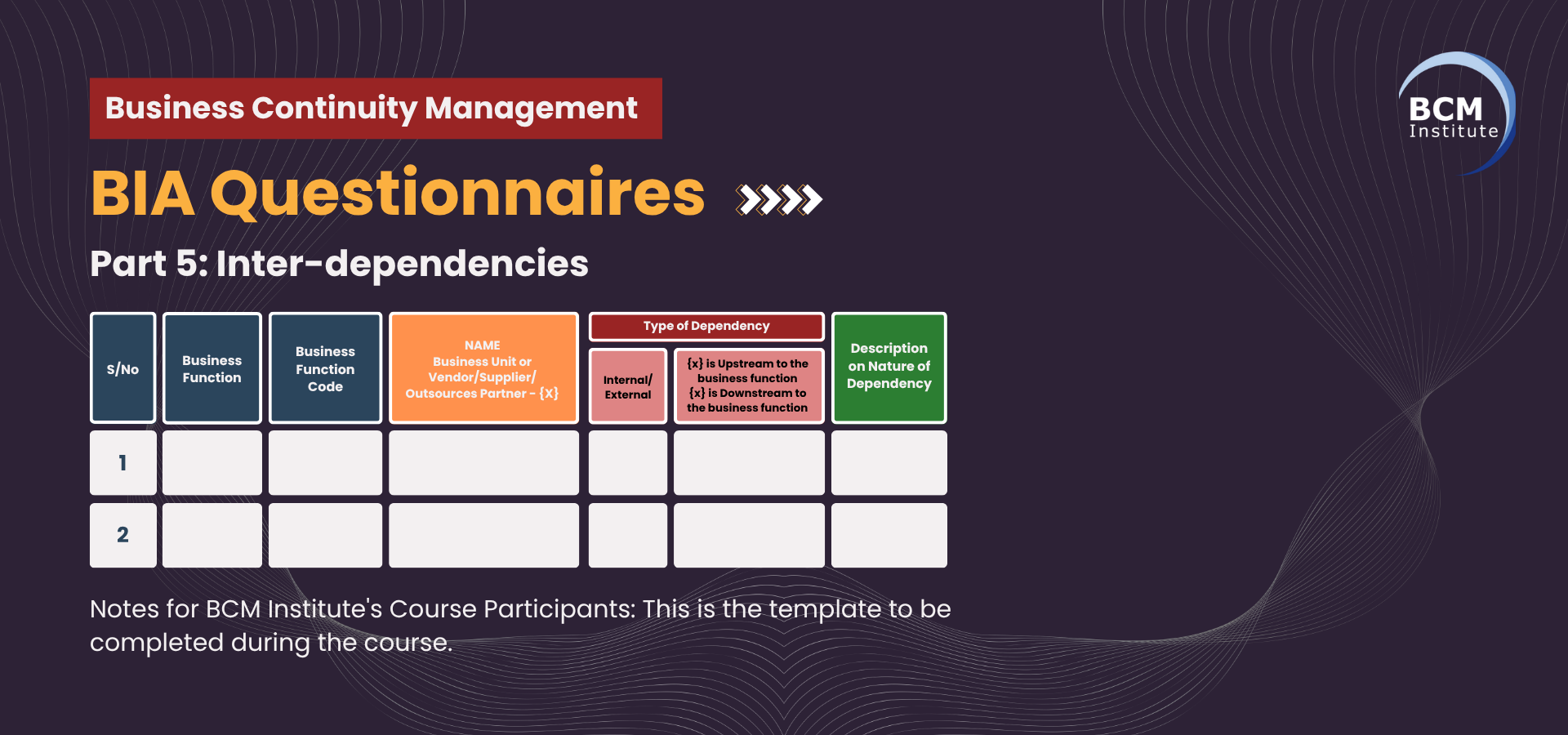
![Banner [BCM] [E3] [BIA] [P5] Inter-dependencies](https://no-cache.hubspot.com/cta/default/3893111/c7d00b8b-77c0-43ee-a2cf-76ea43b26fe8.png)
CBF-1 Strategic Procurement and Sourcing
![[BCM] [ALPS] [E3] [BIA] [T5] [CBF] [1] Strategic Procurement and Sourcing](https://no-cache.hubspot.com/cta/default/3893111/e1572772-84ee-4091-b436-62fb43179d00.png)
Business functions do not operate in isolation. Every Sub-Critical Business Function (Sub-CBF) within Strategic Procurement and Sourcing relies upon a network of internal departments, external suppliers, service providers, and supporting organisations.
During a Business Impact Analysis (BIA), dependency mapping identifies these relationships so that organisations understand where disruptions may originate and how failures in one area can cascade across the procurement lifecycle.
For ALPS Healthcare, procurement activities support the uninterrupted supply of medical products and services to Singapore's public healthcare institutions, making dependency management an essential element of Business Continuity Management (BCM).
Dependency mapping should consider both internal and external relationships. Internal dependencies include business units such as Finance, Legal, ICT, Clinical Operations, Governance, and Executive Management that provide approvals, technical expertise, systems, or operational support.
External dependencies include suppliers, manufacturers, logistics providers, cloud service providers, procurement platform vendors, regulatory authorities, and healthcare institutions.
Because disruptions often originate outside the organisation, understanding third-party dependencies is as important as understanding internal business relationships.
Dependency analysis should also distinguish dependency direction. Upstream dependencies provide the resources, approvals, information, or services a business activity needs before it can begin. Downstream dependencies rely on the outputs produced by a Sub-CBF to perform subsequent activities.
Mutual dependencies exist where two parties continuously exchange information, services, or decisions throughout the business process. Understanding these relationships enables ALPS Healthcare to strengthen Business Continuity Planning,
Third-Party Risk Management, supplier resilience, and Operational Resilience by protecting, monitoring, and incorporating critical dependencies into recovery strategies.
![Banner [Table] [BCM] [E3] [BIA] [P5] Inter-dependencies [BIAQ]](https://no-cache.hubspot.com/cta/default/3893111/ed6152ff-4926-4fae-bd6b-ba572bcc781b.png)
Table P5: Inter‑dependencies for CBF-1
|
Sub-CBF Code |
Sub-Critical Business Function |
Business Unit / Vendor / Supplier / Outsourcing Partner |
Internal Dependency |
External Dependency |
Dependency Direction |
Description of the Nature of Dependency |
|
CBF-1.1 |
Procurement Strategy Development |
Executive Management |
Yes |
No |
Upstream |
Executive Management provides strategic direction, funding priorities, and procurement objectives. Without executive guidance, long-term procurement strategies cannot be approved or aligned with organisational goals. |
|
CBF-1.2 |
Category Management |
Finance Department |
Yes |
No |
Mutual |
Finance provides expenditure data while category management provides procurement forecasts and cost optimisation recommendations. Both functions rely on timely financial information. |
|
CBF-1.3 |
Demand Consolidation and Forecast Review |
Public Healthcare Institutions |
No |
Yes |
Upstream |
Healthcare institutions submit demand forecasts and procurement requirements. Delayed or inaccurate demand information directly affects procurement planning and inventory availability. |
|
CBF-1.4 |
Market Research and Supplier Intelligence |
Medical Product Suppliers and Market Intelligence Providers |
No |
Yes |
Upstream |
External suppliers and market intelligence sources provide pricing trends, product availability, and supply chain information. Loss of market visibility reduces sourcing effectiveness. |
|
CBF-1.5 |
Procurement Planning and Sourcing Schedule |
Procurement Operations Department |
Yes |
No |
Mutual |
Procurement Operations coordinates sourcing schedules while planning activities determine procurement priorities and timelines. Both functions continuously exchange planning information. |
|
CBF-1.6 |
Procurement Risk Assessment |
Enterprise Risk Management (ERM) Department |
Yes |
No |
Mutual |
ERM provides enterprise risk frameworks while procurement contributes supplier and sourcing risks. Risk assessments support procurement continuity planning. |
|
CBF-1.7 |
Specification Development |
Clinical Users and Technical Specialists |
Yes |
No |
Upstream |
Clinical experts define technical and functional requirements for medical products. Procurement depends on approved specifications before tender preparation can begin. |
|
CBF-1.8 |
Tender Preparation and Documentation |
Legal Department |
Yes |
No |
Upstream |
Legal reviews procurement documentation, contractual clauses, and compliance requirements before tender publication. Delays affect procurement timelines. |
|
CBF-1.9 |
Tender Management |
Electronic Procurement Platform Provider |
No |
Yes |
Mutual |
The eProcurement platform enables supplier submissions while procurement administrators manage tender activities. System unavailability interrupts procurement operations. |
|
CBF-1.10 |
Supplier Evaluation and Selection |
Evaluation Committee |
Yes |
No |
Mutual |
Procurement coordinates evaluations while technical committee members assess supplier proposals. Both parties rely on timely collaboration to complete evaluations. |
|
CBF-1.11 |
Due Diligence and Compliance Assessment |
Regulatory Authorities and Compliance Information Providers |
No |
Yes |
Upstream |
External regulatory information supports supplier compliance verification. Missing or delayed compliance information increases procurement risk. |
|
CBF-1.12 |
Contract Negotiation |
Legal Department |
Yes |
No |
Mutual |
Legal provides contractual advice while procurement negotiates commercial terms. Successful contract completion depends upon coordinated negotiations. |
|
CBF-1.13 |
Contract Award and Approval |
Executive Procurement Approval Committee |
Yes |
No |
Upstream |
Procurement awards require governance approvals before supplier contracts become effective. Approval delays postpone contract implementation. |
|
CBF-1.14 |
Supplier Onboarding |
Supplier Organisations |
No |
Yes |
Mutual |
Suppliers provide corporate documentation while ALPS completes system registration and onboarding activities. Both parties must complete onboarding before transactions begin. |
|
CBF-1.15 |
Procurement Governance and Compliance Monitoring |
Internal Audit |
Yes |
No |
Mutual |
Internal Audit reviews procurement governance while procurement implements corrective actions. Audit findings strengthen procurement controls and compliance. |
|
CBF-1.16 |
Strategic Supplier Relationship Management |
Strategic Suppliers |
No |
Yes |
Mutual |
Procurement and strategic suppliers maintain ongoing collaboration, performance reviews, innovation discussions, and continuity planning. Disruptions weaken long-term supplier resilience. |
|
CBF-1.17 |
Supplier Performance Management |
Contract Managers |
Yes |
No |
Mutual |
Contract managers provide operational performance data while procurement monitors supplier KPIs and initiates corrective actions where necessary. |
|
CBF-1.18 |
Procurement Data Analytics and Reporting |
ICT Business Intelligence Team |
Yes |
No |
Upstream |
ICT maintains reporting platforms and data warehouses that enable procurement analytics. Reporting quality depends upon reliable technology services. |
|
CBF-1.19 |
Procurement Continuity and Contingency Planning |
Alternative Suppliers and Logistics Providers |
No |
Yes |
Mutual |
Continuity planning depends upon pre-qualified alternative suppliers and logistics partners capable of supporting emergency procurement during supply disruptions. |
|
CBF-1.20 |
Continuous Improvement and Procurement Optimisation |
Quality and Process Improvement Team |
Yes |
No |
Mutual |
Improvement teams analyse procurement performance while procurement implements process enhancements. Continuous collaboration supports operational excellence and resilience. |
![Banner [BCM] [E3] [BIA] [Summing Up] [P5] Inter-dependencies [BIAQ]](https://no-cache.hubspot.com/cta/default/3893111/117996e6-4a68-4449-880f-d8a48ff3071d.png)
Dependency mapping is a critical component of the Business Impact Analysis because it identifies the internal and external relationships that enable Strategic Procurement and Sourcing to operate effectively.
By documenting the dependencies associated with each Sub-Critical Business Function, ALPS Healthcare gains a comprehensive understanding of where procurement activities rely on business units, technology, governance structures, suppliers, healthcare institutions, logistics providers, and external service providers.
This visibility enables potential points of failure to be identified before they become operational disruptions.
Understanding dependency relationships significantly improves recovery planning by highlighting which supporting functions and external organisations must be restored or engaged before procurement activities can resume.
Internal dependencies such as Executive Management, Finance, Legal, ICT, Clinical Services, Enterprise Risk Management, and Internal Audit ensure that governance, approvals, technical expertise, and technology services remain available during recovery.
Recovery planning should include external dependencies—including suppliers, electronic procurement platform providers, logistics partners, and healthcare institutions—because disruptions affecting these organisations may directly impact ALPS Healthcare's ability to sustain procurement operations.
Third-party dependencies matter in Business Continuity Plans because procurement resilience closely depends on supplier resilience.
Identifying critical suppliers, outsourced service providers, cloud platforms, and logistics partners enables the incorporation of continuity requirements into contracts, service level agreements, supplier assessments, and contingency sourcing strategies.
This strengthens supplier resilience while supporting broader Operational Resilience and Enterprise Risk Management objectives.
Ultimately, dependency analysis gives management valuable information to prioritise recovery activities during major disruptions.
By understanding the direction and nature of dependencies—upstream, downstream, or mutual—ALPS Healthcare can sequence recovery activities more effectively, coordinate with critical stakeholders, minimise cascading failures, and restore procurement capabilities in a controlled, efficient manner.
This integrated understanding of business relationships strengthens organisational resilience and supports the continued delivery of essential procurement services that underpin Singapore's public healthcare system.

![[BCM] [ALPS] [3/4 Banner] Implementing Business Continuity Management for ALPS Healthcare](https://no-cache.hubspot.com/cta/default/3893111/5bb3d163-ccf4-4942-8e51-90cb0e0de84f.png)
![[BCM] [ALPS] [E3] [BIA] MBCO Corporate MBCO](https://no-cache.hubspot.com/cta/default/3893111/3e0b35d2-08b6-4caf-b7db-144625ec8145.png)
![[BCM] [ALPS] [E3] [BIA] [PS] Key Product and Services](https://no-cache.hubspot.com/cta/default/3893111/ab611654-bce2-450c-affc-3970de6c8909.png)
![[BCM] [ALPS] [E3] [RAR] [T1] List of Threats](https://no-cache.hubspot.com/cta/default/3893111/806c27e6-1db5-42a2-ac84-e0df3624bc49.png)
![[BCM] [ALPS] [E3] [RAR] [T2] Treatment and Control](https://no-cache.hubspot.com/cta/default/3893111/bf6da142-014d-4c47-83cf-f31e0c55b75e.png)
![[BCM] [ALPS] [E3] [RAR] [T3] Risk Impact and Likelihood Assessment](https://no-cache.hubspot.com/cta/default/3893111/4c14572c-2ed4-46aa-82c8-5ead8fd31ced.png)
![[BCM] [ALPS] [E3] [BCS] [T1] Mitigation Strategies and Justification](https://no-cache.hubspot.com/cta/default/3893111/25548d11-adb7-4e6e-9a5a-054db2ea377d.png)
![[BCM] [ALPS] [E1] [C10] Identifying Critical Business Functions](https://no-cache.hubspot.com/cta/default/3893111/94f8b16c-55da-4543-a948-448f2241296e.png)
![[BCM] [ALPS] [E3] [BIA] [DP] [CBF] [1] Strategic Procurement and Sourcing](https://no-cache.hubspot.com/cta/default/3893111/b1b7c047-3a39-41d7-b2af-2b00d6f13590.png)
![[BCM] [ALPS] [E3] [BIA] [T1] [CBF] [1] Strategic Procurement and Sourcing](https://no-cache.hubspot.com/cta/default/3893111/ffed8b6e-4d2f-4066-a3ab-24aa0a28728b.png)
![[BCM] [ALPS] [E3] [BIA] [T2] [CBF] [1] Strategic Procurement and Sourcing](https://no-cache.hubspot.com/cta/default/3893111/70981a61-b605-4686-a3e5-de0275050496.png)
![[BCM] [ALPS] [E3] [BIA] [T3] [CBF] [1] Strategic Procurement and Sourcing](https://no-cache.hubspot.com/cta/default/3893111/bf3e01a8-f0da-43cc-abc1-d24397682927.png)
![[BCM] [ALPS] [E3] [BIA] [T4] [CBF] [1] Strategic Procurement and Sourcing](https://no-cache.hubspot.com/cta/default/3893111/98714bc9-8556-479e-894b-b67ccfc0f5b9.png)
![[BCM] [ALPS] [E3] [BIA] [T6] [CBF] [1] Strategic Procurement and Sourcing](https://no-cache.hubspot.com/cta/default/3893111/4bcf60b1-2551-40ea-a780-6283033126cb.png)
![[BCM] [ALPS] [E3] [BCS] [T2] [CBF] [1] Strategic Procurement and Sourcing](https://no-cache.hubspot.com/cta/default/3893111/1b2b0da8-76c7-4f9a-b2a6-4d4ae8648810.png)
![[BCM] [ALPS] [E3] [BCS] [T3] [CBF] [1] Strategic Procurement and Sourcing](https://no-cache.hubspot.com/cta/default/3893111/154f46c8-d8e4-4ace-89f4-5a6ff2c5abc9.png)
![[BCM] [ALPS] [E3] [PD] [CBF] [1] Strategic Procurement and Sourcing](https://no-cache.hubspot.com/cta/default/3893111/b4e8c236-74a3-4226-9cae-52d2b6bf8868.png)
More Information About Business Continuity Management Courses
To learn more about the course and schedule, click the buttons below for the BCM-300 Business Continuity Management Implementer [BCM-3] and the BCM-5000 Business Continuity Management Expert Implementer [BCM-5].


![Register [BL-B-3]*](https://no-cache.hubspot.com/cta/default/3893111/ac6cf073-4cdd-4541-91ed-889f731d5076.png)



![FAQ [BL-B-3]](https://no-cache.hubspot.com/cta/default/3893111/b3824ba1-7aa1-4eb6-bef8-94f57121c5ae.png)
![Email to Sales Team [BCM Institute]](https://no-cache.hubspot.com/cta/default/3893111/3c53daeb-2836-4843-b0e0-645baee2ab9e.png)


