

![[BCM] [ALPS] [Full Banner] Implementing Business Continuity Management for ALPS Healthcare](https://no-cache.hubspot.com/cta/default/3893111/a577c05a-ab89-4043-9a89-1dea0d883afc.png)
![[BCM] [ALPS] Legal Disclaimer Banner](https://no-cache.hubspot.com/cta/default/3893111/eb6856d2-cbb2-4a76-b237-7bd842e84226.png)
![Banner [BCM] [E3] [BIA] [P4] Supporting IT Systems and Applications](https://no-cache.hubspot.com/cta/default/3893111/e60ed308-5615-4727-b6c2-5fb4eed933d7.png)
CBF-2 Pharmaceutical Procurement and Supply Management
![[BCM] [ALPS] [E3] [BIA] [T4] [CBF] [2] Pharmaceutical Procurement and Supply Management](https://no-cache.hubspot.com/cta/default/3893111/34c325a5-f352-4a73-abe3-e665d504d71f.png)
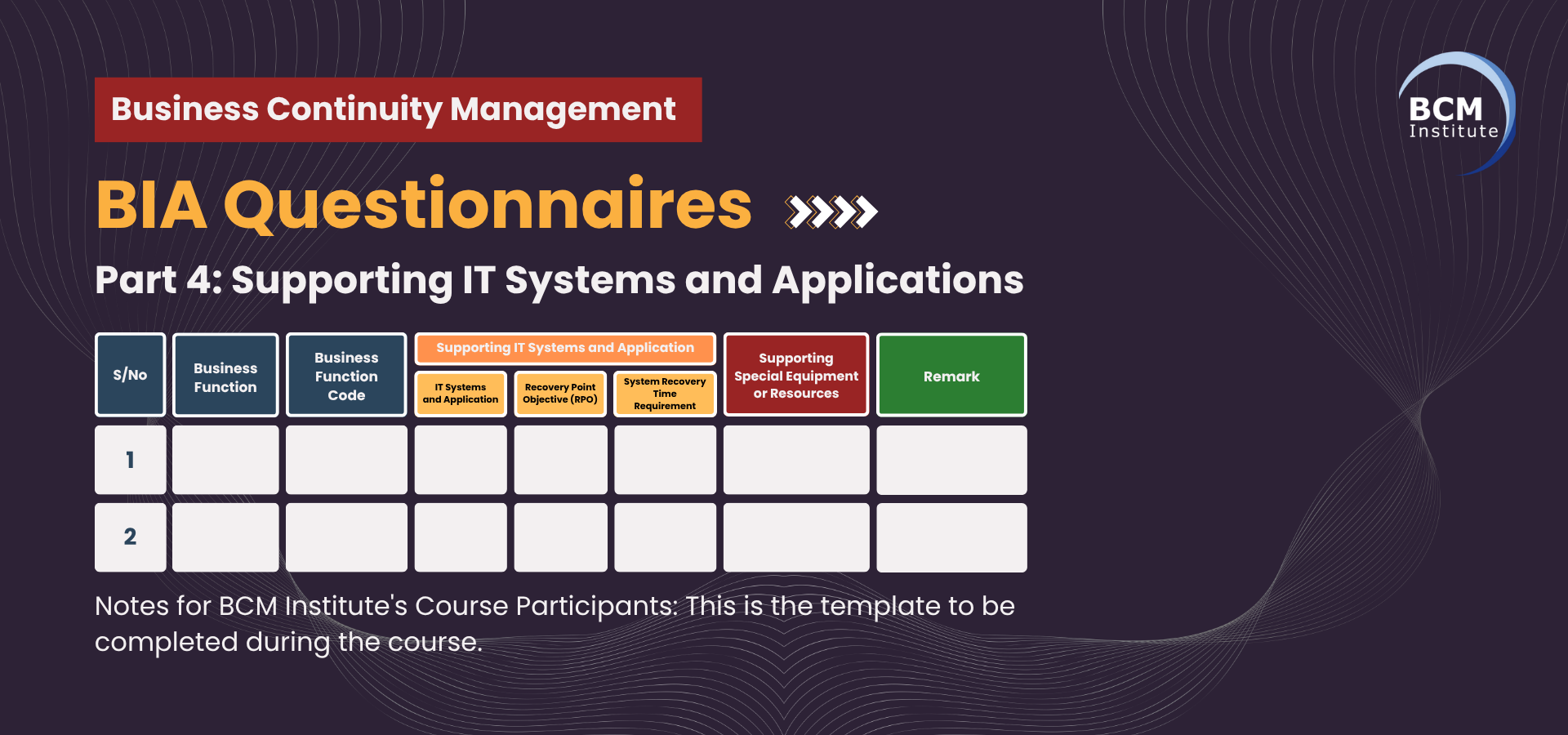
Information technology is a fundamental enabler of modern pharmaceutical procurement and supply management. Within ALPS Healthcare, every stage of the procurement lifecycle—from demand forecasting and supplier qualification to inventory replenishment and product recall coordination—relies on integrated information systems, secure data exchanges, and automated workflows.
During a Business Impact Analysis (BIA), identifying these technology dependencies is essential to understanding how disruptions to IT systems may affect the organisation's ability to maintain the continuous supply of medicines to Singapore's public healthcare institutions.
Business processes rarely operate in isolation from technology. Enterprise Resource Planning (ERP) systems, procurement platforms, warehouse management systems, inventory databases, supplier portals, regulatory information repositories, business intelligence tools, and collaboration platforms collectively support the execution of critical procurement activities.
Consequently, Business Continuity Planning (BCP) must be closely aligned with Information Technology Disaster Recovery (ITDR) to ensure that critical business services can be restored within acceptable timeframes following a disruption.
Two important recovery parameters are established during this assessment. The Recovery Point Objective (RPO) defines the maximum acceptable amount of data loss measured in time, while the System Recovery Time Objective (System RTO) specifies the target time for restoring supporting IT systems after an outage.
Together, these objectives ensure that technology recovery aligns with business recovery priorities. In addition, specialised equipment, secure connectivity, cloud services, backup infrastructure, and operational technology should be identified because they frequently represent critical dependencies that influence recovery capability and operational resilience.
![Banner [Table] [BCM] [E3] [BIA] [P4] Supporting IT Systems and Applications [BIAQ]](https://no-cache.hubspot.com/cta/default/3893111/b0e47631-f680-46d1-b7a9-040fce25e117.png)
Table P4: Supporting IT Systems and Applications for CBF-2
|
Sub-CBF Code |
Sub-Critical Business Function |
Supporting IT Systems and Applications |
Recovery Point Objective (RPO) |
System Recovery Time Objective (System RTO) |
Supporting Special Equipment / Resources |
Remarks |
|
CBF-2.1 |
Pharmaceutical Demand Forecasting |
ERP Procurement Module, Demand Forecasting & Analytics Platform, Business Intelligence Dashboard, Data Warehouse |
1 Hour |
4 Hours |
Analytics servers, secure network connectivity, cloud analytics platform |
Forecasting data should be synchronised frequently to support emergency procurement decisions. |
|
CBF-2.2 |
Pharmaceutical Requirements Planning |
ERP Materials Management, Supply Planning System, Workflow Management System |
1 Hour |
4 Hours |
High-availability application servers, secure user authentication |
Supports consolidated procurement planning across healthcare institutions. |
|
CBF-2.3 |
Approved Drug Catalogue Management |
Product Information Management System, Document Management System (DMS), Master Data Management Platform |
4 Hours |
8 Hours |
Secure document repository, database servers |
Master pharmaceutical records must remain accurate and recoverable. |
|
CBF-2.4 |
Supplier Qualification and Evaluation |
Supplier Relationship Management (SRM), Vendor Database, Compliance Management System |
4 Hours |
8 Hours |
Secure supplier portal, identity and access management (IAM) |
Supplier qualification records support procurement continuity and auditability. |
|
CBF-2.5 |
Pharmaceutical Tender and Sourcing Management |
e-Tendering System, ERP Procurement Module, Electronic Document Management System |
1 Hour |
4 Hours |
Digital signature infrastructure, secure procurement portal |
Tender documentation and evaluation workflows require rapid restoration. |
|
CBF-2.6 |
Contract and Pricing Management |
Contract Lifecycle Management (CLM), ERP Financial Module |
4 Hours |
8 Hours |
Encrypted contract repository, secure backup storage |
Active contracts should remain accessible during continuity operations. |
|
CBF-2.7 |
Purchase Order Processing |
ERP Procurement System, Electronic Purchasing Platform, Workflow Engine |
15 Minutes |
2 Hours |
High-availability ERP servers, secure network connectivity |
One of the highest-priority systems supporting medicine procurement. |
|
CBF-2.8 |
Regulatory and Product Compliance Verification |
Regulatory Compliance System, Product Registration Database, Quality Management System (QMS) |
15 Minutes |
2 Hours |
Secure compliance database, digital certificates |
Compliance verification must be available before procurement approval proceeds. |
|
CBF-2.9 |
Pharmaceutical Supply Scheduling |
Logistics Management System, Transportation Management System (TMS), Supplier Portal |
1 Hour |
4 Hours |
Mobile communications, logistics dashboards |
Real-time visibility of supplier deliveries supports uninterrupted distribution. |
|
CBF-2.10 |
Pharmaceutical Receipt and Inspection Coordination |
Warehouse Management System (WMS), Barcode Management System, Inventory Control System |
15 Minutes |
2 Hours |
Barcode scanners, handheld terminals, warehouse Wi-Fi |
Warehouse operations depend on accurate real-time inventory updates. |
|
CBF-2.11 |
Cold Chain and Controlled Storage Coordination |
Cold Chain Monitoring System, Building Management System (BMS), Environmental Monitoring Platform |
Real-Time |
1 Hour |
IoT temperature sensors, data loggers, backup power, cold storage equipment |
Continuous monitoring is essential to preserve pharmaceutical integrity. |
|
CBF-2.12 |
Pharmaceutical Inventory Replenishment |
Inventory Management System, ERP Inventory Module, Automated Replenishment Engine |
15 Minutes |
2 Hours |
High-availability databases, warehouse connectivity |
Supports automatic replenishment of essential medicines before stock depletion. |
|
CBF-2.13 |
Drug Shortage Monitoring and Mitigation |
Supply Risk Monitoring Platform, Business Intelligence System, Supplier Portal |
1 Hour |
4 Hours |
External supplier connectivity, secure internet access |
Timely risk intelligence enables proactive sourcing alternatives. |
|
CBF-2.14 |
Supplier Performance Management |
Supplier Relationship Management (SRM), Performance Dashboard, Vendor Database |
4 Hours |
8 Hours |
Performance analytics servers, collaboration platform |
Supplier performance history supports continuity planning and supplier resilience. |
|
CBF-2.15 |
Pharmaceutical Recall Coordination |
Recall Management System, Inventory Management System, Communication Platform |
Real-Time |
1 Hour |
Mobile notification platform, barcode scanners, secure communications |
Immediate system availability is required to support patient safety and regulatory compliance. |
|
CBF-2.16 |
Procurement Risk Monitoring |
Enterprise Risk Management (ERM) System, Business Intelligence Platform, Risk Dashboard |
1 Hour |
4 Hours |
Secure remote access, monitoring dashboards |
Supports continuous monitoring of procurement and supply chain risks. |
|
CBF-2.17 |
Pharmaceutical Procurement Information Management |
Enterprise Content Management (ECM), Database Management System, Records Management System |
4 Hours |
8 Hours |
Secure archival storage, backup media, cloud backup services |
Procurement documentation supports governance, audits, and emergency procurement decisions. |
|
CBF-2.18 |
Pharmaceutical Procurement Reporting and Governance |
Reporting & Analytics Platform, Executive Dashboard, Document Management System |
End of Business Day |
24 Hours |
Business intelligence servers, reporting workstations |
Reporting systems may be restored after higher-priority operational procurement systems. |
![Banner [BCM] [E3] [BIA] [Summing Up] [P4] Supporting IT Systems and Applications [BIAQ]](https://no-cache.hubspot.com/cta/default/3893111/9bde2d75-0c8e-4d9e-a8ca-e8d1655a082c.png)
The successful delivery of Pharmaceutical Procurement and Supply Management depends on a closely integrated technology ecosystem comprising enterprise procurement systems, warehouse and inventory management platforms, supplier management solutions, regulatory compliance applications, business intelligence tools, and secure communication services.
Identifying these supporting IT systems during the Business Impact Analysis provides ALPS Healthcare with a comprehensive understanding of the technology dependencies underpinning each Sub-Critical Business Function and highlights where technology failures could interrupt the supply of essential medicines.
Defining Recovery Point Objectives (RPOs) and System Recovery Time Objectives (System RTOs) establishes measurable recovery requirements for Information Technology Disaster Recovery (ITDR).
High-priority operational systems, such as purchase order processing, inventory management, cold-chain monitoring, and pharmaceutical recall management, require minimal data loss and rapid restoration to maintain patient safety, regulatory compliance, and uninterrupted healthcare operations.
Less time-sensitive administrative and reporting systems may be restored later without significantly affecting frontline procurement activities.
The inclusion of specialised equipment and supporting resources—including high-availability infrastructure, IoT temperature sensors, barcode scanning devices, secure network connectivity, disaster recovery facilities, digital signature infrastructure, and cloud-based backup services—ensures that Business Continuity Plans address not only software applications but also the physical and technical capabilities required for recovery.
By understanding these technology dependencies and aligning business recovery requirements with IT recovery capabilities, ALPS Healthcare strengthens its operational resilience and improves its ability to sustain critical pharmaceutical procurement services during disruptive events.

![[BCM] [ALPS] [3/4 Banner] Implementing Business Continuity Management for ALPS Healthcare](https://no-cache.hubspot.com/cta/default/3893111/5bb3d163-ccf4-4942-8e51-90cb0e0de84f.png)
![[BCM] [ALPS] [E3] [BIA] MBCO Corporate MBCO](https://no-cache.hubspot.com/cta/default/3893111/3e0b35d2-08b6-4caf-b7db-144625ec8145.png)
![[BCM] [ALPS] [E3] [BIA] [PS] Key Product and Services](https://no-cache.hubspot.com/cta/default/3893111/ab611654-bce2-450c-affc-3970de6c8909.png)
![[BCM] [ALPS] [E3] [RAR] [T1] List of Threats](https://no-cache.hubspot.com/cta/default/3893111/806c27e6-1db5-42a2-ac84-e0df3624bc49.png)
![[BCM] [ALPS] [E3] [RAR] [T2] Treatment and Control](https://no-cache.hubspot.com/cta/default/3893111/bf6da142-014d-4c47-83cf-f31e0c55b75e.png)
![[BCM] [ALPS] [E3] [RAR] [T3] Risk Impact and Likelihood Assessment](https://no-cache.hubspot.com/cta/default/3893111/4c14572c-2ed4-46aa-82c8-5ead8fd31ced.png)
![[BCM] [ALPS] [E3] [BCS] [T1] Mitigation Strategies and Justification](https://no-cache.hubspot.com/cta/default/3893111/25548d11-adb7-4e6e-9a5a-054db2ea377d.png)
![[BCM] [ALPS] [E1] [C10] Identifying Critical Business Functions](https://no-cache.hubspot.com/cta/default/3893111/94f8b16c-55da-4543-a948-448f2241296e.png)
![[BCM] [ALPS] [E3] [BIA] [DP] [CBF] [2] Pharmaceutical Procurement and Supply Management](https://no-cache.hubspot.com/cta/default/3893111/14fb1541-5073-4293-a4b3-76e57b0b5956.png)
![[BCM] [ALPS] [E3] [BIA] [T1] [CBF] [2] Pharmaceutical Procurement and Supply Management](https://no-cache.hubspot.com/cta/default/3893111/a44633ed-d5cd-446e-be5f-075dbb65247c.png)
![[BCM] [ALPS] [E3] [BIA] [T2] [CBF] [2] Pharmaceutical Procurement and Supply Management](https://no-cache.hubspot.com/cta/default/3893111/10661937-edb5-459e-b9fd-07209caac51f.png)
![[BCM] [ALPS] [E3] [BIA] [T3] [CBF] [2] Pharmaceutical Procurement and Supply Management](https://no-cache.hubspot.com/cta/default/3893111/5171d0b5-976b-445f-9e43-a4e588e823f0.png)
![[BCM] [ALPS] [E3] [BIA] [T5] [CBF] [2] Pharmaceutical Procurement and Supply Management](https://no-cache.hubspot.com/cta/default/3893111/0bcf5a3a-4abf-4f74-b32d-fe90a6f667cc.png)
![[BCM] [ALPS] [E3] [BIA] [T6] [CBF] [2] Pharmaceutical Procurement and Supply Management](https://no-cache.hubspot.com/cta/default/3893111/b0445693-282e-4078-bb82-d359cdc7f389.png)
![[BCM] [ALPS] [E3] [BCS] [T2] [CBF] [2] Pharmaceutical Procurement and Supply Management](https://no-cache.hubspot.com/cta/default/3893111/e0edaf2d-dbbe-4690-a580-2e64966100e7.png)
![[BCM] [ALPS] [E3] [BCS] [T3] [CBF] [2] Pharmaceutical Procurement and Supply Management](https://no-cache.hubspot.com/cta/default/3893111/39abeb9e-931e-4f0e-a6b4-4d24f339ed63.png)
![[BCM] [ALPS] [E3] [PD] [CBF] [2] Pharmaceutical Procurement and Supply Management](https://no-cache.hubspot.com/cta/default/3893111/963ac068-f245-4af5-9eed-ba5ecbbff753.png)
More Information About Business Continuity Management Courses
To learn more about the course and schedule, click the buttons below for the BCM-300 Business Continuity Management Implementer [BCM-3] and the BCM-5000 Business Continuity Management Expert Implementer [BCM-5].


![Register [BL-B-3]*](https://no-cache.hubspot.com/cta/default/3893111/ac6cf073-4cdd-4541-91ed-889f731d5076.png)



![FAQ [BL-B-3]](https://no-cache.hubspot.com/cta/default/3893111/b3824ba1-7aa1-4eb6-bef8-94f57121c5ae.png)
![Email to Sales Team [BCM Institute]](https://no-cache.hubspot.com/cta/default/3893111/3c53daeb-2836-4843-b0e0-645baee2ab9e.png)


