
![[BCM] [ALPS] [Full Banner] Implementing Business Continuity Management for ALPS Healthcare](https://no-cache.hubspot.com/cta/default/3893111/a577c05a-ab89-4043-9a89-1dea0d883afc.png)
![[BCM] [ALPS] Legal Disclaimer Banner](https://no-cache.hubspot.com/cta/default/3893111/eb6856d2-cbb2-4a76-b237-7bd842e84226.png)
![Banner [BCM] [E3] [BCS] [T3] Minimum Resources Required during a Disaster](https://no-cache.hubspot.com/cta/default/3893111/8969ce47-38c2-4b89-88da-727979f12c39.png)
CBF-2 Pharmaceutical Procurement and Supply Management
![[BCM] [ALPS] [E3] [BCS] [T3] [CBF] [2] Pharmaceutical Procurement and Supply Management](https://no-cache.hubspot.com/cta/default/3893111/39abeb9e-931e-4f0e-a6b4-4d24f339ed63.png)
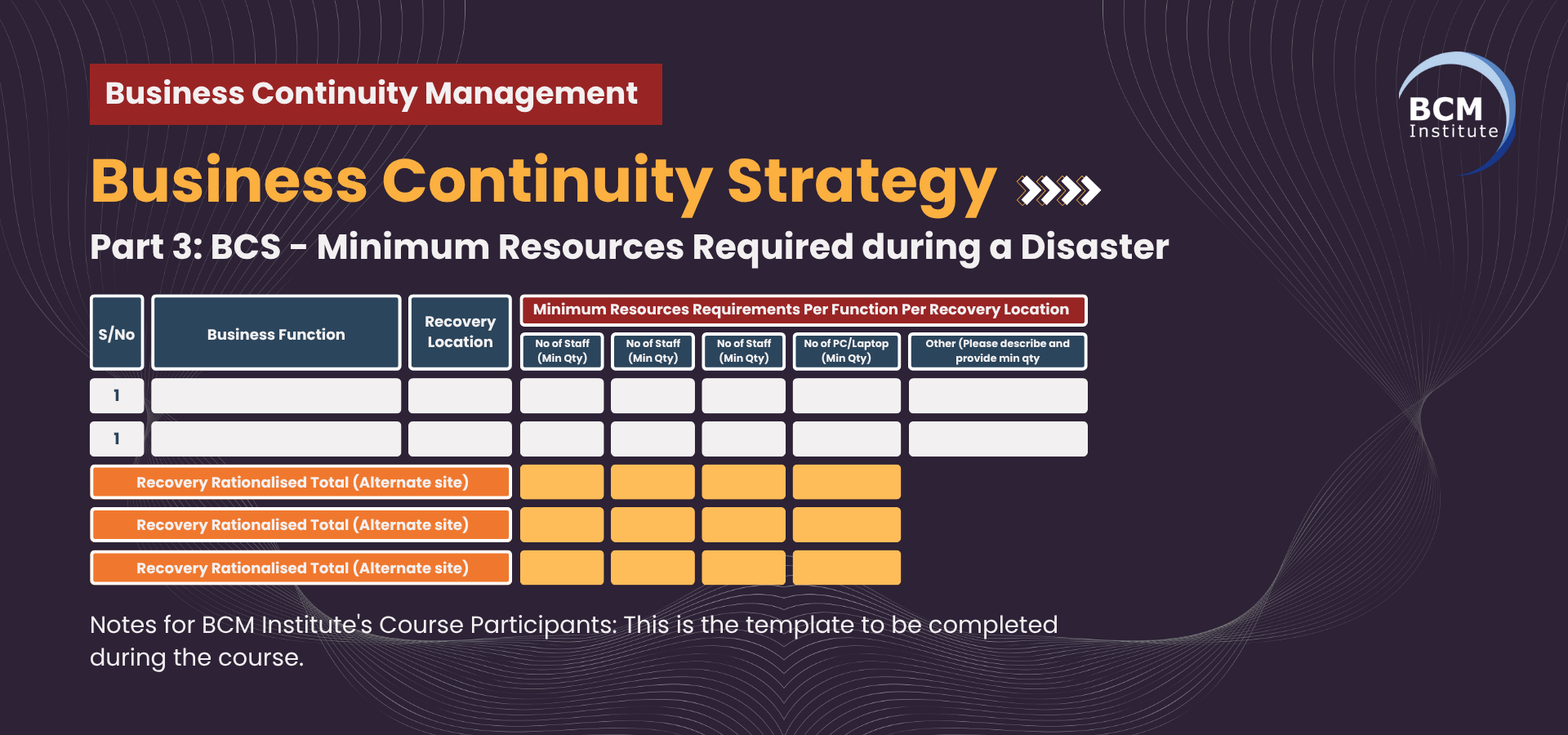
An effective Business Continuity Plan (BCP) identifies not only how business functions will recover, but also the minimum resources required to sustain essential operations until normal capability is restored.
For Pharmaceutical Procurement and Supply Management, resource planning focuses on maintaining the Minimum Business Continuity Objective (MBCO) rather than restoring full operational capacity immediately.
This approach enables ALPS Healthcare to continue supplying essential medicines to Singapore's public healthcare institutions while optimising the use of limited personnel, facilities, and technology during a disruption.
The determination of minimum recovery resources is directly informed by the Business Impact Analysis (BIA) and the selected Recovery Strategies.
The BIA identifies the criticality of each Sub-Critical Business Function, establishes Recovery Time Objectives (RTOs), and defines the minimum acceptable service levels.
Recovery strategies specify how these service levels will be achieved. Resource planning then translates these findings into practical requirements by identifying the minimum people, workspaces, ICT equipment, communication facilities, specialist tools, and supporting resources necessary to sustain operations.
During a major disruption, resources are frequently constrained. Staff may be unavailable, facilities inaccessible, and technology partially degraded.
Consequently, organisations should identify only those resources essential to maintaining critical procurement activities.
Cross-trained personnel, shared workspaces, remote working capabilities, secure communications, and cloud-based technologies allow ALPS Healthcare to optimise limited resources while continuing to fulfil its procurement responsibilities in accordance with ISO 22301, ISO 22313, and Singapore public sector business continuity good practices.
![Banner [Table] [BCM] [E3] [BCS] [T3] Minimum Resources Required during a Disaster](https://no-cache.hubspot.com/cta/default/3893111/7456e7dd-9e1f-4c07-a6f9-a39e58f74746.png)
Table S3: Minimum Resources Required During a Disaster for CBF-2
|
Sub-CBF Code |
Sub-Critical Business Function |
Recovery Location |
Minimum Resource Requirements per Function per Recovery Location |
Staff (Min.) |
Seats (Min.) |
Telephones (Min.) |
PCs/Laptops (Min.) |
Other Resources (Description and Minimum Quantity) |
|
CBF-2.1 |
Pharmaceutical Demand Forecasting |
Cloud-based Virtual Workplace |
Cross-trained demand planners with secure access to forecasting and analytics platforms |
2 |
2 |
2 |
2 |
VPN tokens (2), BI software licences (2), secure internet connection (1) |
|
CBF-2.2 |
Pharmaceutical Requirements Planning |
Alternate Office |
Procurement planners with ERP access and collaboration tools |
2 |
2 |
2 |
2 |
ERP access (2), multifunction printer (1), secure Wi-Fi (1) |
|
CBF-2.3 |
Approved Drug Catalogue Management |
Remote Working |
Pharmacist or procurement specialist with access to catalogue management system |
1 |
1 |
1 |
1 |
EDMS access (1), VPN token (1), digital signature device (1) |
|
CBF-2.4 |
Supplier Qualification and Evaluation |
Alternate Office |
Procurement specialist performing supplier assessments and approvals |
2 |
2 |
2 |
2 |
Supplier portal access (2), video conferencing licence (1) |
|
CBF-2.5 |
Pharmaceutical Tender and Sourcing Management |
Secondary Operations Centre |
Tender evaluation team with secure procurement platform access |
3 |
3 |
2 |
3 |
e-Tender system access (3), document scanner (1), secure printer (1) |
|
CBF-2.6 |
Contract and Pricing Management |
Remote Working |
Contract administrator with secure document access |
2 |
2 |
2 |
2 |
Contract management software (2), digital signature devices (2) |
|
CBF-2.7 |
Purchase Order Processing |
Disaster Recovery Site |
Procurement officers processing emergency purchase orders via ERP |
3 |
3 |
2 |
3 |
ERP access (3), authentication tokens (3), UPS (1) |
|
CBF-2.8 |
Regulatory and Product Compliance Verification |
Disaster Recovery Site |
Regulatory affairs specialists validating pharmaceutical compliance |
2 |
2 |
2 |
2 |
Regulatory database access (2), secure certificates (2) |
|
CBF-2.9 |
Pharmaceutical Supply Scheduling |
Alternate Office |
Logistics coordinators liaising with suppliers and transport providers |
2 |
2 |
2 |
2 |
Logistics management system (2), mobile phones (2) |
|
CBF-2.10 |
Pharmaceutical Receipt and Inspection Coordination |
Primary Warehouse |
Warehouse inspectors operating manual and electronic receiving processes |
3 |
3 |
2 |
2 |
Barcode scanners (2), handheld terminals (2), multifunction printer (1) |
|
CBF-2.11 |
Cold Chain and Controlled Storage Coordination |
Primary Cold Storage Facility |
Cold-chain operators and engineering support maintaining temperature-controlled storage |
3 |
2 |
2 |
2 |
Temperature monitoring devices (2), backup generator (1), UPS (2), portable refrigeration unit (1) |
|
CBF-2.12 |
Pharmaceutical Inventory Replenishment |
Disaster Recovery Site |
Inventory controllers maintaining emergency stock allocation |
2 |
2 |
2 |
2 |
Inventory management system access (2), barcode scanners (2) |
|
CBF-2.13 |
Drug Shortage Monitoring and Mitigation |
Alternate Office |
Procurement risk specialists coordinating alternative sourcing |
2 |
2 |
2 |
2 |
Supplier communication platform (1), risk dashboard (1), VPN tokens (2) |
|
CBF-2.14 |
Supplier Performance Management |
Remote Working |
Supplier relationship managers monitoring supplier performance remotely |
2 |
2 |
2 |
2 |
SRM system access (2), video conferencing facilities (1) |
|
CBF-2.15 |
Pharmaceutical Recall Coordination |
Primary Operations Centre |
Recall coordinator supported by procurement and quality assurance personnel |
4 |
4 |
3 |
4 |
Recall management system (1), emergency notification platform (1), barcode scanners (2), secure mobile devices (4) |
|
CBF-2.16 |
Procurement Risk Monitoring |
Remote Working |
Enterprise risk analyst monitoring procurement and supply chain risks |
2 |
2 |
2 |
2 |
ERM system access (2), external intelligence feeds (1), VPN tokens (2) |
|
CBF-2.17 |
Pharmaceutical Procurement Information Management |
Cloud-based Virtual Workplace |
Records administrator managing procurement records and document retrieval |
2 |
2 |
1 |
2 |
ECM access (2), cloud backup repository (1), secure storage (1) |
|
CBF-2.18 |
Pharmaceutical Procurement Reporting and Governance |
Alternate Office |
Procurement manager producing executive operational reports |
1 |
1 |
1 |
1 |
Business intelligence dashboard (1), video conferencing facility (1), secure printer (1) |
![Banner [BCM] [E3] [BCS] [Summing Up] [T3] Minimum Resources Required during a Disaster](https://no-cache.hubspot.com/cta/default/3893111/6cebfa28-ed8a-49d6-8978-797c3a577f9e.png)
Identifying the minimum recovery resources required for each Sub-Critical Business Function provides ALPS Healthcare with a practical foundation for sustaining Pharmaceutical Procurement and Supply Management during disruptive events.
Rather than replicating normal operating conditions, this assessment focuses on the minimum combination of people, facilities, technology, communications, and specialist resources necessary to achieve each function's Minimum Business Continuity Objective (MBCO).
This ensures that essential procurement activities can continue while finite resources are directed to the highest-priority operations.
Resource optimisation is particularly important during disaster recovery, when personnel availability, workplace capacity, and technology infrastructure may be constrained. The use of cross-trained personnel, shared workspaces, cloud-based virtual workplaces, alternate recovery sites, secure remote access, and prioritised allocation of ICT resources enables ALPS Healthcare to maintain critical pharmaceutical procurement capabilities without unnecessary duplication of resources. This approach improves operational flexibility while remaining aligned with the organisation's Recovery Strategies and Recovery Time Objectives (RTOs).
The relationship between MBCOs, Recovery Strategies, Recovery Locations, and minimum resource requirements ensures that recovery arrangements are proportionate to business criticality and operational risk.
Business functions with short recovery timeframes—such as purchase order processing, cold-chain management, inventory replenishment, regulatory compliance verification, and pharmaceutical recall coordination—require dedicated personnel, resilient ICT infrastructure, and specialised operational equipment.
Less time-critical functions can be supported through remote working and shared resources, allowing recovery efforts to remain efficient and sustainable.
Documenting these minimum resource requirements strengthens Business Continuity Planning by providing clear guidance on the personnel, facilities, equipment, communications, and technology needed to sustain operations during a disruption.
It also assists ALPS Healthcare in validating resource availability, planning alternate workplace arrangements, coordinating recovery logistics, and supporting regular continuity exercises. Collectively, these measures enhance organisational resilience, improve recovery readiness, and support compliance with Singapore Government business continuity guidance, ISO 22301, and ISO 22313 while ensuring the continued procurement and supply of essential pharmaceuticals to Singapore's public healthcare system.

![[BCM] [ALPS] [3/4 Banner] Implementing Business Continuity Management for ALPS Healthcare](https://no-cache.hubspot.com/cta/default/3893111/5bb3d163-ccf4-4942-8e51-90cb0e0de84f.png)
![[BCM] [ALPS] [E3] [BIA] MBCO Corporate MBCO](https://no-cache.hubspot.com/cta/default/3893111/3e0b35d2-08b6-4caf-b7db-144625ec8145.png)
![[BCM] [ALPS] [E3] [BIA] [PS] Key Product and Services](https://no-cache.hubspot.com/cta/default/3893111/ab611654-bce2-450c-affc-3970de6c8909.png)
![[BCM] [ALPS] [E3] [RAR] [T1] List of Threats](https://no-cache.hubspot.com/cta/default/3893111/806c27e6-1db5-42a2-ac84-e0df3624bc49.png)
![[BCM] [ALPS] [E3] [RAR] [T2] Treatment and Control](https://no-cache.hubspot.com/cta/default/3893111/bf6da142-014d-4c47-83cf-f31e0c55b75e.png)
![[BCM] [ALPS] [E3] [RAR] [T3] Risk Impact and Likelihood Assessment](https://no-cache.hubspot.com/cta/default/3893111/4c14572c-2ed4-46aa-82c8-5ead8fd31ced.png)
![[BCM] [ALPS] [E3] [BCS] [T1] Mitigation Strategies and Justification](https://no-cache.hubspot.com/cta/default/3893111/25548d11-adb7-4e6e-9a5a-054db2ea377d.png)
![[BCM] [ALPS] [E1] [C10] Identifying Critical Business Functions](https://no-cache.hubspot.com/cta/default/3893111/94f8b16c-55da-4543-a948-448f2241296e.png)
![[BCM] [ALPS] [E3] [BIA] [DP] [CBF] [2] Pharmaceutical Procurement and Supply Management](https://no-cache.hubspot.com/cta/default/3893111/14fb1541-5073-4293-a4b3-76e57b0b5956.png)
![[BCM] [ALPS] [E3] [BIA] [T1] [CBF] [2] Pharmaceutical Procurement and Supply Management](https://no-cache.hubspot.com/cta/default/3893111/a44633ed-d5cd-446e-be5f-075dbb65247c.png)
![[BCM] [ALPS] [E3] [BIA] [T2] [CBF] [2] Pharmaceutical Procurement and Supply Management](https://no-cache.hubspot.com/cta/default/3893111/10661937-edb5-459e-b9fd-07209caac51f.png)
![[BCM] [ALPS] [E3] [BIA] [T3] [CBF] [2] Pharmaceutical Procurement and Supply Management](https://no-cache.hubspot.com/cta/default/3893111/5171d0b5-976b-445f-9e43-a4e588e823f0.png)
![[BCM] [ALPS] [E3] [BIA] [T4] [CBF] [2] Pharmaceutical Procurement and Supply Management](https://no-cache.hubspot.com/cta/default/3893111/34c325a5-f352-4a73-abe3-e665d504d71f.png)
![[BCM] [ALPS] [E3] [BIA] [T5] [CBF] [2] Pharmaceutical Procurement and Supply Management](https://no-cache.hubspot.com/cta/default/3893111/0bcf5a3a-4abf-4f74-b32d-fe90a6f667cc.png)
![[BCM] [ALPS] [E3] [BIA] [T6] [CBF] [2] Pharmaceutical Procurement and Supply Management](https://no-cache.hubspot.com/cta/default/3893111/b0445693-282e-4078-bb82-d359cdc7f389.png)
![[BCM] [ALPS] [E3] [BCS] [T2] [CBF] [2] Pharmaceutical Procurement and Supply Management](https://no-cache.hubspot.com/cta/default/3893111/e0edaf2d-dbbe-4690-a580-2e64966100e7.png)
![[BCM] [ALPS] [E3] [PD] [CBF] [2] Pharmaceutical Procurement and Supply Management](https://no-cache.hubspot.com/cta/default/3893111/963ac068-f245-4af5-9eed-ba5ecbbff753.png)
More Information About Business Continuity Management Courses
To learn more about the course and schedule, click the buttons below for the BCM-300 Business Continuity Management Implementer [BCM-3] and the BCM-5000 Business Continuity Management Expert Implementer [BCM-5].


![Register [BL-B-3]*](https://no-cache.hubspot.com/cta/default/3893111/ac6cf073-4cdd-4541-91ed-889f731d5076.png)



![FAQ [BL-B-3]](https://no-cache.hubspot.com/cta/default/3893111/b3824ba1-7aa1-4eb6-bef8-94f57121c5ae.png)
![Email to Sales Team [BCM Institute]](https://no-cache.hubspot.com/cta/default/3893111/3c53daeb-2836-4843-b0e0-645baee2ab9e.png)


