

![[BCM] [ALPS] [Full Banner] Implementing Business Continuity Management for ALPS Healthcare](https://no-cache.hubspot.com/cta/default/3893111/a577c05a-ab89-4043-9a89-1dea0d883afc.png)
eBook 2: Chapter 9
Final Chapter: Bringing It All Together – A Roadmap to Business Continuity Excellence for ALPS Healthcare
Introduction
This chapter concludes eBook 2, Implementing Business Continuity Management for ALPS Healthcare, which forms part of the series Implementing Business Continuity Management for ALPS Healthcare: An Enterprise Implementation Guide.
Throughout this eBook, a practical and structured Business Continuity Management (BCM) Planning Methodology has been presented to support ALPS Healthcare (ALPS) in![[BCM] [ALPS] [E2] [C9] Summary](https://no-cache.hubspot.com/cta/default/3893111/c702d1dd-d76e-4015-8be8-58641496151a.png) establishing, implementing, maintaining, and continually improving a Business Continuity Management System (BCMS) aligned with the principles and requirements of ISO 22301.
establishing, implementing, maintaining, and continually improving a Business Continuity Management System (BCMS) aligned with the principles and requirements of ISO 22301.
As Singapore's national healthcare supply chain agency, ALPS plays a vital role in ensuring the continuous availability of pharmaceuticals, medical devices, medical consumables, laboratory supplies, vaccines, and other healthcare products for the country's public healthcare institutions.
Its responsibilities extend beyond procurement and warehousing to encompass inventory management, cold-chain logistics, supplier management, healthcare distribution, information systems, and coordination with healthcare clusters, government agencies, and strategic partners.
The complexity and interconnected nature of these operations mean that disruptions can rapidly affect healthcare delivery across Singapore.
Consequently, ALPS requires a systematic methodology that enables the organisation to identify risks, understand business impacts, develop appropriate recovery strategies, prepare practical Business Continuity Plans, validate those plans through testing, and sustain a resilient BCM programme over the long term.
This final chapter summarises the seven phases of the Business Continuity Management Planning Methodology and demonstrates how they collectively strengthen ALPS Healthcare's organisational resilience and support the continuity of Singapore's healthcare supply chain.
Purpose of eBook 2
The purpose of this eBook has been to provide ALPS Healthcare with a practical implementation guide for developing a Business Continuity Management System that:
- Aligns with ISO 22301.
- Supports the continuity of critical healthcare supply chain services.
- Provides a structured implementation methodology.
- Enables consistent recovery planning across all business units.
- Strengthens organisational resilience.
- Supports continual improvement of Business Continuity Management capabilities.
Rather than focusing solely on compliance, the methodology has emphasised practical implementation, operational readiness, and long-term sustainability.
Overview of the Seven-Phase BCM Planning Methodology
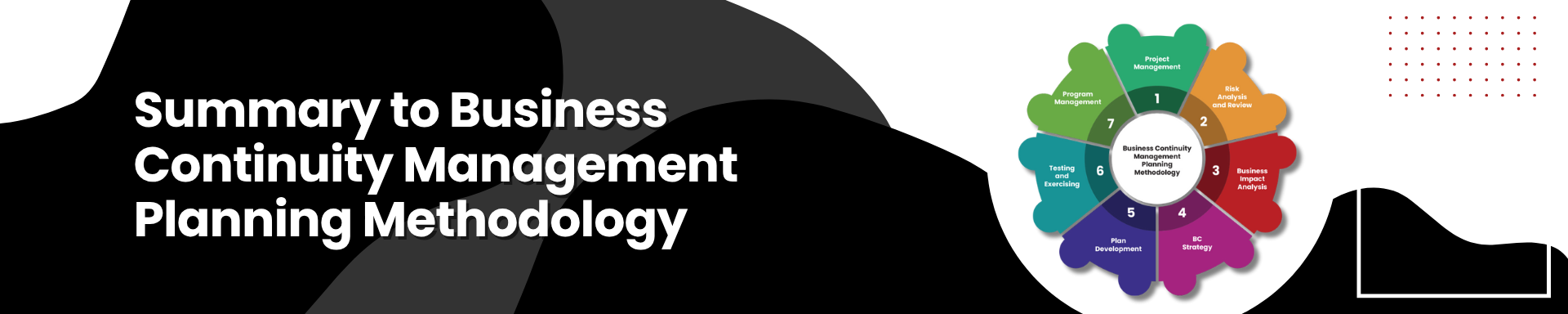
The methodology presented throughout this eBook consists of seven integrated phases.
|
Phase |
Purpose |
Primary Outcome |
|
Project Management (PM) |
Establish governance, scope, and implementation framework |
BCM governance and implementation roadmap |
|
Risk Analysis and Review (RAR) |
Identify, assess, and treat organisational risks |
Enterprise risk profile and mitigation measures |
|
Business Impact Analysis (BIA) |
Determine critical business functions and recovery priorities |
Recovery objectives and dependency analysis |
|
Business Continuity Strategy (BCS) |
Develop prevention, mitigation, and recovery strategies |
Enterprise recovery strategies |
|
Plan Development (PD) |
Develop Business Continuity Plans and supporting procedures |
Approved Business Continuity Plans |
|
Testing and Exercising (TE) |
Validate the effectiveness of plans and recovery capabilities |
Exercise reports and improvement actions |
|
Program Management (PgM) |
Sustain and continually improve the BCMS |
Mature and continually improving BCM programme |
Each phase builds upon the outputs of the previous phase, creating a continuous improvement cycle that strengthens organisational resilience.
Summary of Each Phase
Phase 1 – Project Management (PM)
The implementation journey begins with effective project management.
This phase establishes:
- Executive sponsorship.
- BCM governance.
- Project scope.
- Implementation roadmap.
- Resource allocation.
- Stakeholder engagement.
- Project monitoring.
For ALPS Healthcare, this phase ensures that all departments—including procurement, warehousing, logistics, ICT, quality assurance, finance, supplier management, and corporate services—participate in the implementation programme under a common governance structure.
Phase 2 – Risk Analysis and Review (RAR)
The Risk Analysis and Review Phase enables ALPS to understand the threats that could disrupt its operations.
Activities include:
- Risk identification.
- Risk assessment.
- Risk mitigation.
- Continuous review.
Examples of significant risks include:
- Pharmaceutical shortages.
- Supplier failures.
- Cyberattacks.
- Cold-chain failures.
- Warehouse fires.
- Transportation disruptions.
- Pandemic events.
- Information system failures.
The outputs from this phase provide the risk information required to support Business Impact Analysis and the development of Business Continuity Strategy.
Phase 3 – Business Impact Analysis (BIA)
The Business Impact Analysis determines which business functions are critical and establishes recovery priorities.
For ALPS Healthcare, twenty Critical Business Functions were identified, covering:
- Strategic Procurement.
- Pharmaceutical Procurement.
- Medical Supplies Procurement.
- Supplier Management.
- Warehouse Operations.
- Cold-Chain Logistics.
- Healthcare Distribution.
- Information Systems.
- Business Continuity.
- Corporate Management.
The BIA establishes:
- Maximum Acceptable Outage (MAO).
- Minimum Business Continuity Objectives (MBCO).
- Recovery Time Objectives (RTO).
- Recovery Point Objectives (RPO).
- Resource dependencies.
- Recovery priorities.
These outputs form the foundation for the development of continuity strategy.
Phase 4 – Business Continuity Strategy (BCS)
The Business Continuity Strategy Phase identifies the practical measures required to maintain or restore critical operations.
Strategies are grouped into:
- Prevention strategies.
- Mitigation strategies.
- Recovery strategies.
Examples include:
- Multi-supplier sourcing.
- Strategic inventory.
- Alternate warehouses.
- Cold-chain redundancy.
- ICT disaster recovery.
- Emergency procurement.
- Healthcare distribution prioritisation.
These strategies ensure that ALPS can continue supporting Singapore's healthcare system even during major disruptions.
Phase 5 – Plan Development (PD)
This phase converts approved strategies into operational Business Continuity Plans.
The chapter described three major stages:
- Designing Business Continuity Plan templates.
- Conducting Business Continuity Plan writing workshops.
- Validating and approving completed plans.
The resulting documentation provides personnel with clear recovery procedures for responding to incidents affecting procurement, logistics, warehousing, ICT, supplier management, and other critical operations.
Phase 6 – Testing and Exercising (TE)
Testing validates the effectiveness of Business Continuity Plans.
The exercise programme progresses from:
Initial Tests
- Component Tests.
- Call Notification Tests.
- Walkthrough Exercises.
Advanced Tests
- Integrated Tests.
- Simulation Exercises.
- Live Tests.
Exercises provide assurance that recovery procedures, communication processes, personnel, and supporting resources function effectively under realistic operating conditions.
Phase 7 – Program Management (PgM)
The final phase ensures that the Business Continuity Management System remains effective after implementation.
Activities include:
- BCM governance.
- Documentation maintenance.
- Training and awareness.
- Internal audits.
- Management reviews.
- Performance monitoring.
- Continual improvement.
This phase transforms BCM from a project into a permanent organisational capability.
Integration of the Seven Phases
Although presented sequentially, the seven phases operate as a continuous management cycle.
Project Management
↓
Risk Analysis & Review
↓
Business Impact Analysis
↓
Business Continuity Strategy
↓
Plan Development
↓
Testing & Exercising
↓
Program Management
↓
Continuous Improvement
↺
The outputs from each phase continually inform improvements in earlier phases as ALPS Healthcare's operations, technologies, suppliers, and external environment evolve.
Benefits to ALPS Healthcare
Implementing the seven-phase methodology provides significant organisational benefits.
These include:
Operational Benefits
- Reduced disruption to healthcare supply chain operations.
- Faster recovery from incidents.
- Improved operational resilience.
- Greater supply chain visibility.
- Better coordination across departments.
Healthcare Benefits
- Continuous availability of essential medicines.
- Improved support for public healthcare institutions.
- Reduced risk of treatment delays.
- Enhanced patient safety.
- Greater resilience during national emergencies.
Organisational Benefits
- Improved governance.
- Better decision-making.
- Increased staff preparedness.
- Stronger supplier resilience.
- Enhanced stakeholder confidence.
Strategic Benefits
- Alignment with ISO 22301.
- Improved regulatory compliance.
- Enhanced organisational reputation.
- Increased executive confidence.
- Long-term resilience.
Critical Success Factors
Successful implementation depends upon:
- Visible executive leadership.
- Organisation-wide participation.
- Strong governance.
- Realistic recovery objectives.
- Effective supplier engagement.
- Reliable information technology.
- Comprehensive Business Continuity Plans.
- Regular testing and exercising.
- Ongoing training.
- Continual improvement.
Looking Beyond Implementation
Business Continuity Management should never be regarded as a completed project.
Instead, ALPS Healthcare should continuously:
- Monitor emerging risks.
- Review Business Impact Analysis.
- Update Business Continuity Plans.
- Assess supplier resilience.
- Conduct regular exercises.
- Improve recovery capabilities.
- Invest in technology resilience.
- Strengthen healthcare partnerships.
- Review regulatory developments.
- Enhance organisational resilience.
The ability to adapt to changing risks is essential for maintaining a resilient healthcare supply chain.
Final Thoughts
Business Continuity Management is fundamentally about protecting ALPS Healthcare's ability to fulfil its mission of supporting Singapore's public healthcare system.
While the technical components of BCM—such as risk assessments, business impact analyses, recovery strategies, and continuity plans—are essential, the true measure of success lies in the organisation's capability to continue delivering critical healthcare supplies when they are needed most.
By adopting the seven-phase methodology presented in this eBook, ALPS Healthcare establishes a structured, repeatable, and internationally recognised framework for managing disruption.
More importantly, it creates a culture of preparedness in which resilience becomes an integral part of governance, operational planning, supplier management, technology investment, and decision-making.
![Banner [Summary] [BCM] [E2] [C9] Summary](https://no-cache.hubspot.com/cta/default/3893111/c5ee8e58-7a25-42f1-8cdf-0905d23b68db.png)
This eBook has presented a comprehensive Business Continuity Management Planning Methodology tailored specifically to the operational environment of ALPS Healthcare.
Through the seven integrated phases of Project Management (PM), Risk Analysis and Review (RAR), Business Impact Analysis (BIA), Business Continuity Strategy (BCS), Plan Development (PD), Testing and Exercising (TE), and Program Management (PgM), ALPS is provided with a practical roadmap for implementing, maintaining, and continually improving an ISO 22301-aligned Business Continuity Management System.
Collectively, these phases establish the governance, processes, resources, and organisational capabilities required to safeguard ALPS' critical business functions and support the uninterrupted procurement, storage, and distribution of essential healthcare products across Singapore.
By integrating Business Continuity Management into strategic planning, operational management, supplier engagement, information technology, and organisational culture, ALPS strengthens not only its own resilience but also the resilience of the broader public healthcare ecosystem.
This chapter concludes eBook 2 – Implementing Business Continuity Management for ALPS Healthcare.
Together with the companion volumes in the Implementing Business Continuity Management for ALPS Healthcare: An Enterprise Implementation Guide series, it provides a comprehensive reference for designing, implementing, operating, and continuously enhancing a mature Business Continuity Management programme.
By consistently applying the methodology described throughout this eBook, ALPS Healthcare will be well-positioned to anticipate disruptions, minimise operational impacts, recover efficiently, and continue to fulfil its vital role in ensuring the availability of healthcare supplies that underpin Singapore's healthcare system.
![[BCM] [ALPS] [3/4 Banner] Implementing Business Continuity Management for ALPS Healthcare](https://no-cache.hubspot.com/cta/default/3893111/5bb3d163-ccf4-4942-8e51-90cb0e0de84f.png)
![[BCM] [ALPS] [E2] [C1] Business Continuity Management Planning Methodology](https://no-cache.hubspot.com/cta/default/3893111/34a98265-b1ac-4365-8fb1-b89701c81850.png)
![[BCM] [ALPS] [E2] [C2] Project Management](https://no-cache.hubspot.com/cta/default/3893111/2a25b902-93e0-4adc-9793-121a2849bfab.png)
![[BCM] [ALPS] [E2] [C3] Risk Analysis and Review](https://no-cache.hubspot.com/cta/default/3893111/74b8cdd9-6407-4d41-bfa9-1c382a227c82.png)
![[BCM] [ALPS] [E2] [C4] Business Impact Analysis](https://no-cache.hubspot.com/cta/default/3893111/eedd40d9-b511-4e16-96de-58834c1e7d92.png)
![[BCM] [ALPS] [E2] [C5] Business Continuity Strategy](https://no-cache.hubspot.com/cta/default/3893111/404ab765-7f69-49dd-ac4a-b9079f065d1c.png)
![[BCM] [ALPS] [E2] [C6] BCM Plan Development](https://no-cache.hubspot.com/cta/default/3893111/4df32844-f3fe-4e88-b9e0-c33cd4f354f5.png)
![[BCM] [ALPS] [E2] [C7] Testing and Exercising](https://no-cache.hubspot.com/cta/default/3893111/be2eeb3c-4b1a-4d42-bebd-0a30e1047952.png)
![[BCM] [ALPS] [E2] [C8] Program Management](https://no-cache.hubspot.com/cta/default/3893111/52497940-4ed8-4ee5-b5e9-0a1b21e83f29.png)
![[BCM] [ALPS] [E2] [C10] Back Cover of eBook 2](https://no-cache.hubspot.com/cta/default/3893111/7f72c39b-5844-4487-92a5-c9d0f38f0bad.png)
ore Information About Business Continuity Management Courses
To learn more about the course and schedule, click the buttons below for BCM-300 Business Continuity Management Implementer [BCM-3] and BCM-5000 Business Continuity Management Expert Implementer [BCM-5]


![Register [BL-B-3]*](https://no-cache.hubspot.com/cta/default/3893111/ac6cf073-4cdd-4541-91ed-889f731d5076.png)



![FAQ [BL-B-3]](https://no-cache.hubspot.com/cta/default/3893111/b3824ba1-7aa1-4eb6-bef8-94f57121c5ae.png)
![Email to Sales Team [BCM Institute]](https://no-cache.hubspot.com/cta/default/3893111/3c53daeb-2836-4843-b0e0-645baee2ab9e.png)


