

![[BCM] [ALPS] [Full Banner] Implementing Business Continuity Management for ALPS Healthcare](https://no-cache.hubspot.com/cta/default/3893111/a577c05a-ab89-4043-9a89-1dea0d883afc.png)
eBook 2: Chapter 1
 Business Continuity Management Planning Methodology for ALPS Healthcare
Introduction

![[BCM] [ALPS] [E2] [C1] Business Continuity Management Planning Methodology](https://no-cache.hubspot.com/cta/default/3893111/34a98265-b1ac-4365-8fb1-b89701c81850.png)
Business Continuity Management (BCM) is a strategic management discipline that enables an organisation to continue delivering its critical products and services during disruptive incidents and to recover within acceptable timeframes.
For healthcare supply chain organisations such as ALPS Healthcare (ALPS), BCM is particularly important because disruptions can directly affect the timely availability of pharmaceuticals, medical consumables, medical devices, and other essential healthcare supplies supporting Singapore's public healthcare institutions.
As Singapore's national healthcare supply chain agency, ALPS operates in an environment where operational disruptions can have significant downstream consequences for hospitals, polyclinics, community healthcare providers, and ultimately patient care.
Events such as cyberattacks, supplier failures, pandemics, logistics disruptions, warehouse incidents, transportation failures, cold-chain breakdowns, and national emergencies require ALPS to maintain resilient operations and rapidly recover critical functions.
ISO 22301 provides an internationally recognised framework for establishing, implementing, maintaining, and continually improving a Business Continuity Management System (BCMS).
While ISO 22301 specifies what organisations should achieve, they also require a practical implementation methodology that describes how the BCM programme should be planned and executed.
This implementation guide adopts a practical seven-phase planning methodology specifically tailored for ALPS Healthcare.
The methodology aligns with ISO 22301 while incorporating the operational realities of healthcare procurement, warehousing, inventory management, supplier management, logistics operations, and healthcare distribution throughout Singapore's public healthcare ecosystem.
Rather than viewing BCM as a one-time compliance project, ALPS should implement BCM as a continual improvement programme that evolves together with organisational growth, digital transformation, supply chain changes, emerging threats, and regulatory expectations.
BCM Planning Methodology
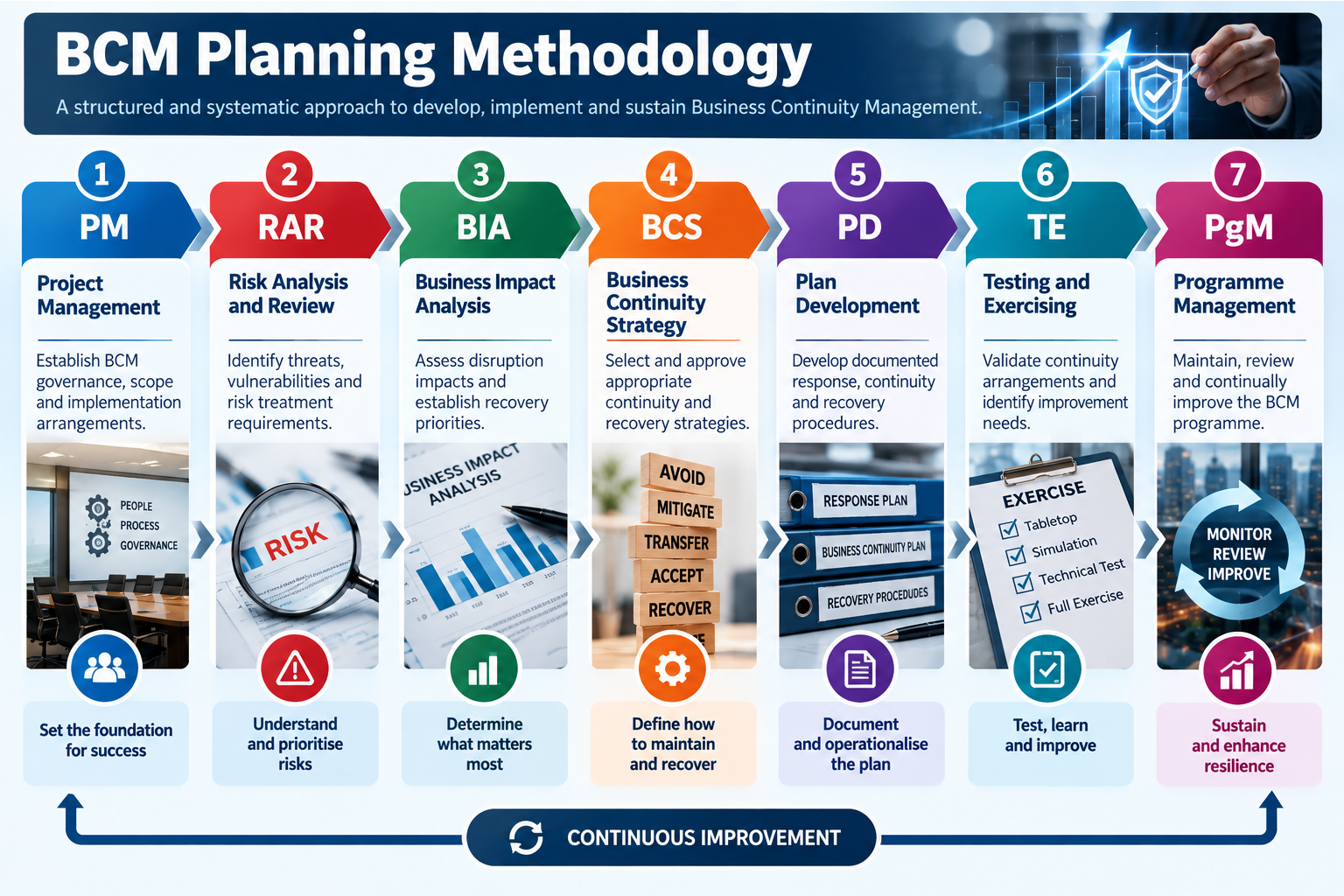
The proposed BCM Planning Methodology consists of seven integrated phases.
|
Phase |
Description |
Primary Deliverables |
|
Phase 1 |
Project Management (PM) |
BCM Project Charter, Governance Structure, Project Plan |
|
Phase 2 |
Risk Analysis and Review (RAR) |
Threat Assessment, Risk Register, Risk Treatment Recommendations |
|
Phase 3 |
Business Impact Analysis (BIA) |
Critical Business Functions, MBCO, RTO, RPO, Dependency Analysis |
|
Phase 4 |
Business Continuity Strategy (BCS) |
Recovery Strategies, Resource Requirements, Alternate Arrangements |
|
Phase 5 |
Plan Development (PD) |
BCM Plans, Department Recovery Plans, Crisis Management Plans |
|
Phase 6 |
Testing and Exercising (TE) |
Exercise Programme, Test Reports, Lessons Learned |
|
Phase 7 |
Programme Management (PgM) |
Maintenance Programme, Awareness, Training, Continuous Improvement |
These phases are iterative rather than strictly sequential. Outputs from one phase may require updates to previous phases as ALPS' operations, technologies, suppliers, and healthcare delivery environment continue to evolve.
The Seven-Phase BCM Planning Methodology
 Phase 1: Project Management (PM)
Objective
Establish the governance, resources, leadership commitment, and implementation roadmap required for developing ALPS Healthcare's Business Continuity Management programme.
Key Activities
![[BCM] [ALPS] [E2] [C2] Project Management](https://no-cache.hubspot.com/cta/default/3893111/2a25b902-93e0-4adc-9793-121a2849bfab.png) Obtain executive sponsorship.
Obtain executive sponsorship.- Establish BCM governance.
- Define project scope.
- Identify stakeholders.
- Develop implementation schedule.
- Allocate project resources.
- Define communication mechanisms.
- Monitor project progress.
Primary Deliverables
- BCM Policy
- Project Charter
- Steering Committee
- BCM Working Committee
- Project Schedule
- Communication Plan
- Resource Plan
ALPS-Specific Requirement
The project governance should include representatives from procurement, pharmaceutical supply management, warehousing, logistics operations, information technology, cybersecurity, quality assurance, supplier management, and corporate services, as well as representatives supporting Singapore's public healthcare institutions, to ensure that business continuity requirements reflect end-to-end healthcare supply chain operations.

Phase 2: Risk Analysis and Review (RAR)
Objective
Identify threats that could disrupt ALPS Healthcare's critical business functions and determine appropriate preventive and mitigation measures.
Key Activities
![[BCM] [ALPS] [E2] [C3] Risk Analysis and Review](https://no-cache.hubspot.com/cta/default/3893111/74b8cdd9-6407-4d41-bfa9-1c382a227c82.png) Identify external threats.
Identify external threats.- Assess vulnerabilities.
- Analyse likelihood.
- Analyse business consequences.
- Evaluate existing controls.
- Determine residual risks.
- Recommend risk treatment actions.
Primary Deliverables
- Enterprise Threat Catalogue
- Risk Register
- Risk Assessment Report
- Risk Treatment Plan
ALPS-Specific Requirement
The risk assessment should specifically evaluate threats affecting pharmaceutical procurement, medical supply shortages, supplier insolvency, international logistics disruptions, cold-chain failures, warehouse automation failures, cyberattacks affecting procurement systems, transportation disruptions, and disruptions impacting national healthcare supply resilience.

Phase 3: Business Impact Analysis (BIA)
Objective
Determine which business functions are critical and establish recovery priorities following disruptions.
Key Activities
![[BCM] [ALPS] [E2] [C4] Business Impact Analysis](https://no-cache.hubspot.com/cta/default/3893111/eedd40d9-b511-4e16-96de-58834c1e7d92.png) Identify Critical Business Functions.
Identify Critical Business Functions.- Determine Maximum Acceptable Outage.
- Determine Maximum Business Continuity Objective (MBCO).
- Establish Recovery Time Objectives (RTO).
- Determine Recovery Point Objectives (RPO).
- Identify resource dependencies.
- Assess operational impacts.
- Prioritise recovery.
Primary Deliverables
- Critical Business Function Catalogue
- Business Impact Assessment
- Dependency Analysis
- Recovery Objectives
- Resource Requirements
ALPS-Specific Requirement
The BIA should prioritise business functions supporting the uninterrupted procurement, storage, inventory management, cold-chain logistics, and distribution of pharmaceuticals, medical devices, laboratory supplies, and essential healthcare consumables to Singapore's public healthcare institutions.
Dependencies on suppliers, logistics providers, digital procurement platforms, warehouse management systems, and transport networks should be comprehensively analysed.

Phase 4: Business Continuity Strategy (BCS)
Objective
Develop practical recovery strategies enabling ALPS Healthcare to continue delivering critical services during disruptions.
Key Activities
![[BCM] [ALPS] [E2] [C5] Business Continuity Strategy](https://no-cache.hubspot.com/cta/default/3893111/404ab765-7f69-49dd-ac4a-b9079f065d1c.png) Evaluate recovery options.
Evaluate recovery options.- Develop people recovery strategies.
- Develop facility recovery strategies.
- Develop technology recovery strategies.
- Develop supplier continuity strategies.
- Develop logistics recovery strategies.
- Assess cost-benefit.
- Obtain management approval.
Primary Deliverables
- Business Continuity Strategy Report
- Resource Recovery Strategy
- Technology Recovery Strategy
- Supplier Continuity Strategy
- Alternate Facility Strategy
ALPS-Specific Requirement
Recovery strategies should include alternative pharmaceutical suppliers, diversified medical supply sources, emergency procurement procedures, secondary warehouse capabilities, alternative transportation arrangements, cold-chain contingency measures, mutual aid agreements, inventory buffering strategies, and resilient ICT infrastructure that supports procurement and warehouse operations.
Phase 5: Plan Development (PD)
Objective
Document the procedures necessary to respond to incidents and recover critical operations.
Key Activities
![[BCM] [ALPS] [E2] [C6] BCM Plan Development](https://no-cache.hubspot.com/cta/default/3893111/4df32844-f3fe-4e88-b9e0-c33cd4f354f5.png) Develop Crisis Management Plan.
Develop Crisis Management Plan.- Develop Business Continuity Plans.
- Develop Department Recovery Plans.
- Develop IT Disaster Recovery Plans.
- Develop communication procedures.
- Develop escalation procedures.
- Develop recovery checklists.
- Obtain plan approval.
Primary Deliverables
- Crisis Management Plan
- Business Continuity Plans
- Department Recovery Plans
- Emergency Response Procedures
- Communication Plans
- Recovery Checklists
ALPS-Specific Requirement
Plans should contain detailed procedures for responding to disruptions affecting procurement, warehouse operations, pharmaceutical inventory, cold-chain management, transportation, supplier failures, cyber incidents, and national healthcare supply emergencies.
Escalation procedures should support coordination with healthcare clusters, government agencies, suppliers, and logistics partners.
Phase 6: Testing and Exercising (TE)
Objective
Validate the effectiveness of the BCM programme through regular testing and exercising.
Key Activities
![[BCM] [ALPS] [E2] [C7] Testing and Exercising](https://no-cache.hubspot.com/cta/default/3893111/be2eeb3c-4b1a-4d42-bebd-0a30e1047952.png) Develop exercise programme.
Develop exercise programme.- Conduct tabletop exercises.
- Conduct simulations.
- Test recovery procedures.
- Test communication processes.
- Evaluate performance.
- Document lessons learned.
- Update plans.
Primary Deliverables
- Annual Exercise Programme
- Exercise Reports
- Improvement Register
- Corrective Action Plan
ALPS-Specific Requirement
Exercise scenarios should include pharmaceutical shortages, cyberattacks targeting procurement systems, warehouse fires, nationwide transportation disruptions, supplier bankruptcies, cold-chain failures, pandemics, ransomware incidents, and simultaneous disruptions across multiple healthcare supply locations to validate continuity of essential healthcare supplies.

Phase 7: Program Management (PgM)
Objective
Maintain and continually improve ALPS Healthcare's BCM programme after implementation.
Key Activities
![[BCM] [ALPS] [E2] [C8] Program Management](https://no-cache.hubspot.com/cta/default/3893111/52497940-4ed8-4ee5-b5e9-0a1b21e83f29.png) Maintain BCM documentation.
Maintain BCM documentation.- Conduct awareness programmes.
- Deliver staff training.
- Monitor organisational changes.
- Conduct internal reviews.
- Measure programme performance.
- Update plans.
- Promote continual improvement.
Primary Deliverables
- BCM Maintenance Programme
- Annual Review Schedule
- Awareness Programme
- Training Records
- Internal Audit Reports
- Management Review Reports
ALPS-Specific Requirement
The programme should establish periodic reviews of supplier resilience, warehouse operations, inventory strategies, logistics capabilities, cybersecurity controls, technology resilience, regulatory changes, and healthcare service delivery requirements.
BCM awareness should extend beyond ALPS employees to include critical suppliers, logistics providers, outsourced service providers, and key healthcare stakeholders where appropriate.
![[BCM] [ALPS] [3/4 Banner] Implementing Business Continuity Management for ALPS Healthcare](https://no-cache.hubspot.com/cta/default/3893111/5bb3d163-ccf4-4942-8e51-90cb0e0de84f.png)
Specific BCM Requirements for ALPS
Integration Across the Seven Phases
Although presented sequentially, the seven phases operate as an integrated management cycle.
- Project Management provides governance throughout the programme.
- Risk Analysis informs the Business Impact Analysis.
- The Business Impact Analysis determines recovery priorities.
- Business Continuity Strategies provide the solutions required to achieve recovery objectives.
- Plan Development documents those strategies.
- Testing validates the plans.
- Programme Management ensures continual improvement and long-term sustainability.
As ALPS Healthcare's operational environment evolves, changes identified during testing, incidents, supplier assessments, or organisational transformation should feed back into earlier phases to ensure the BCMS remains current and effective.
![x [Banner] [Summing] [OR] [E2] [C1] Overview of Operational Resilience Planning Methodology](https://no-cache.hubspot.com/cta/default/3893111/0c551e82-cf06-432c-8498-1d3c9bb2dece.png)
Business Continuity Management is fundamental to ALPS Healthcare's ability to support Singapore's healthcare system by ensuring the uninterrupted procurement, storage, and distribution of critical medical supplies during disruptive events.
Given ALPS' pivotal role within the national healthcare supply chain, resilience must extend beyond internal operations to encompass suppliers, logistics providers, technology platforms, healthcare institutions, and government stakeholders.
The seven-phase BCM Planning Methodology presented in this chapter provides a structured and practical roadmap for implementing an ISO 22301-aligned Business Continuity Management System tailored to ALPS Healthcare's operational context.
Each phase builds progressively upon the previous one, enabling the organisation to establish effective governance, understand operational risks, prioritise critical functions, develop robust recovery strategies, document executable plans, validate preparedness through exercises, and sustain continual improvement.
The subsequent chapters of this eBook examine each phase in greater detail, providing practical implementation guidance, templates, examples, and healthcare-specific recommendations to assist ALPS Healthcare in developing a mature, resilient, and continually improving BCM programme that supports Singapore's public healthcare ecosystem under both routine and extraordinary conditions.
![[BCM] [ALPS] [E2] [C9] Summary](https://no-cache.hubspot.com/cta/default/3893111/c702d1dd-d76e-4015-8be8-58641496151a.png)
![[BCM] [ALPS] [E2] [C10] Back Cover of eBook 2](https://no-cache.hubspot.com/cta/default/3893111/7f72c39b-5844-4487-92a5-c9d0f38f0bad.png)
More Information About Business Continuity Management Courses
To learn more about the course and schedule, click the buttons below for BCM-300 Business Continuity Management Implementer [BCM-3] and BCM-5000 Business Continuity Management Expert Implementer [BCM-5]


![Register [BL-B-3]*](https://no-cache.hubspot.com/cta/default/3893111/ac6cf073-4cdd-4541-91ed-889f731d5076.png)



![FAQ [BL-B-3]](https://no-cache.hubspot.com/cta/default/3893111/b3824ba1-7aa1-4eb6-bef8-94f57121c5ae.png)
![Email to Sales Team [BCM Institute]](https://no-cache.hubspot.com/cta/default/3893111/3c53daeb-2836-4843-b0e0-645baee2ab9e.png)


