

![[Audit] [Full Banner] BCM ISO 22301 Business Continuity Management System Audit eBook Series](https://no-cache.hubspot.com/cta/default/3893111/e61a0216-88fb-4044-a823-a13beaf4d0ea.png) Auditing Business Continuity Management: A Comprehensive Guide to Assessing BCM Programme Effectiveness
Auditing Business Continuity Management: A Comprehensive Guide to Assessing BCM Programme Effectiveness
Introduction
Auditing a Business Continuity Management (BCM) programme requires more than confirming that policies, Business Impact Analyses (BIAs), recovery strategies, business continuity plans and exercise records exist.
An effective audit should determine whether the organisation has established a coherent, sustainable BCM capability that can protect its priority activities and meet its defined recovery requirements when a disruption occurs.
This requires the auditor to examine the entire BCM lifecycle—from organisational context, leadership and governance through impact and risk assessment, continuity strategies, plans, resources, training and exercising to performance evaluation, management review and continual improvement.
More importantly, the auditor should establish traceability between business requirements and demonstrated recovery capability, ensuring that recovery objectives are supported by appropriate strategies, technology, people, facilities, suppliers and other dependencies.
By following the evidence from documented requirements through implementation, exercising and actual performance, the auditor can move beyond a compliance-based review and provide meaningful assurance on whether the organisation's BCM programme is genuinely capable of supporting resilience during a disruptive event.
 An auditor reviewing an organisation’s Business Continuity Management (BCM) programme should assess much more than whether a Business Continuity Plan exists.
The audit should determine whether BCM is appropriately governed, risk- and impact-based, implemented across the organisation, exercised, maintained, and able to deliver the required continuity outcomes during a disruption.
A useful way to structure the complete audit is around the BCM lifecycle and the management-system principles in ISO 22301.
Complete BCM Audit View
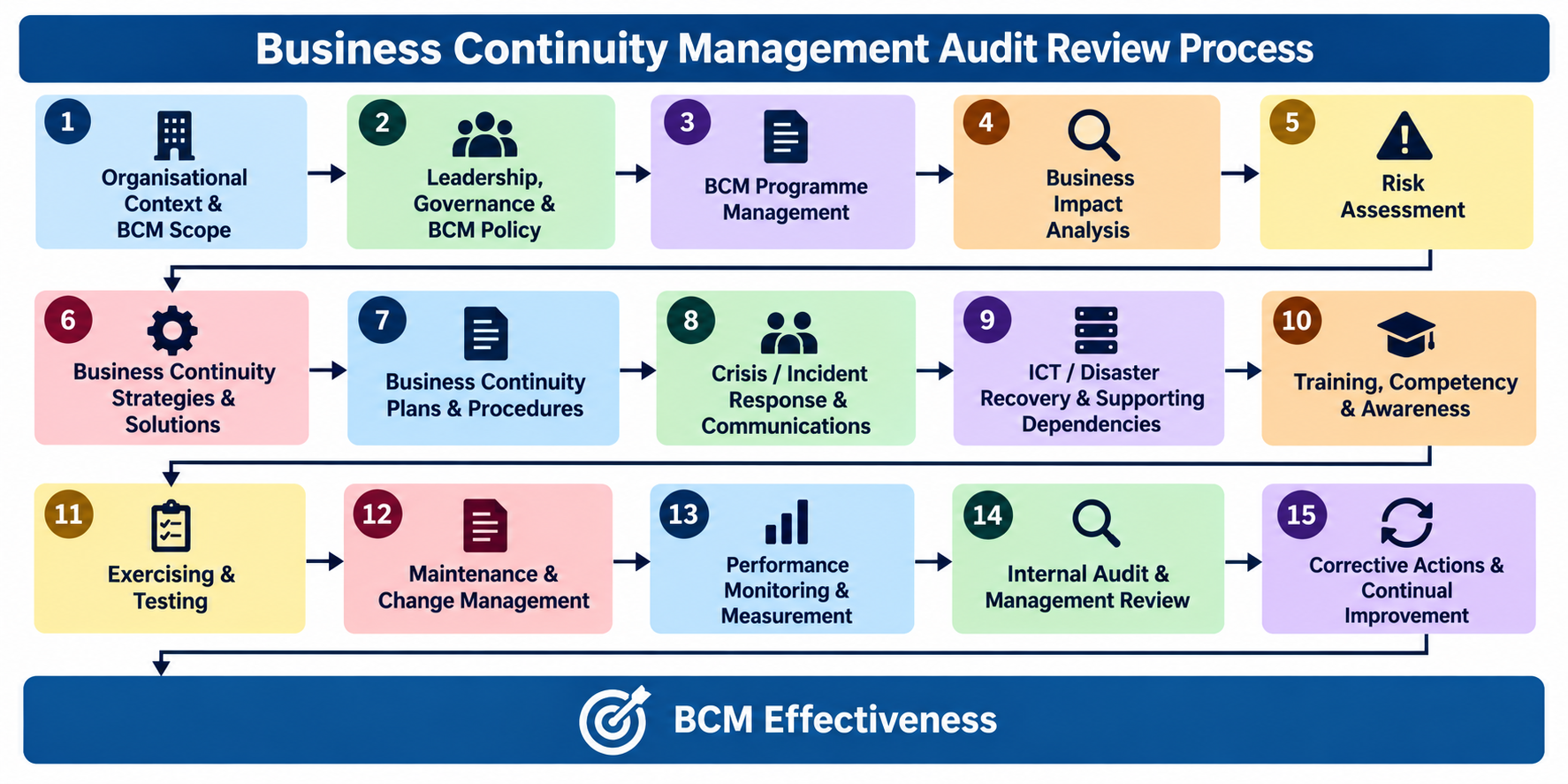
The key principle is that the auditor should follow the evidence chain from management intent to operational capability:
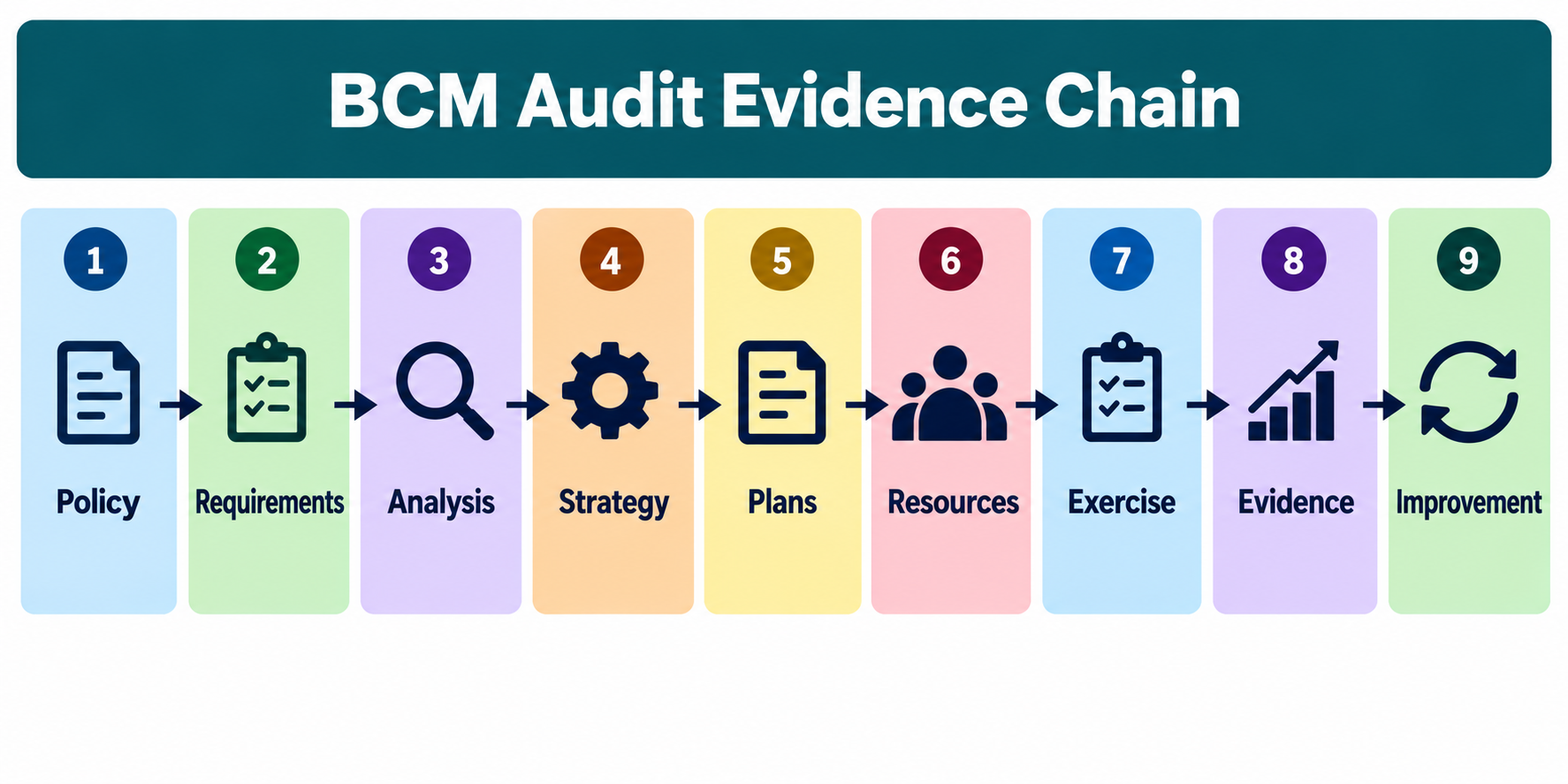
If any link is weak, the auditor should determine whether that weakness compromises the organisation's ability to recover its critical activities.
Organisational Context and BCM Scope
The audit starts by establishing whether the organisation has correctly determined what its BCM programme must protect.
The auditor examines organisational structure, products and services, legal and regulatory obligations, interested parties, locations, technology, outsourced services and major dependencies.
The auditor should ask whether the BCM scope is appropriate and whether it has excluded anything important.
Evidence includes the BCM scope statement, organisational context analysis, stakeholder requirements, regulatory requirements, and documented exclusions.
A common audit concern is a BCM programme that formally covers the organisation but practically covers only selected departments.
Leadership, Governance and BCM Policy
The auditor then establishes whether BCM has genuine senior-management ownership.
The review should cover the BCM policy, governance structure, management accountability, BCM steering committee, BCM programme sponsor, BCM manager/coordinator and responsibilities of business-function owners.
The auditor should determine whether management has provided sufficient authority, resources and oversight to implement BCM effectively.
Evidence may include policy approvals, committee terms of reference, organisation charts, meeting minutes, management decisions, budgets and BCM reporting.
BCM Programme Management
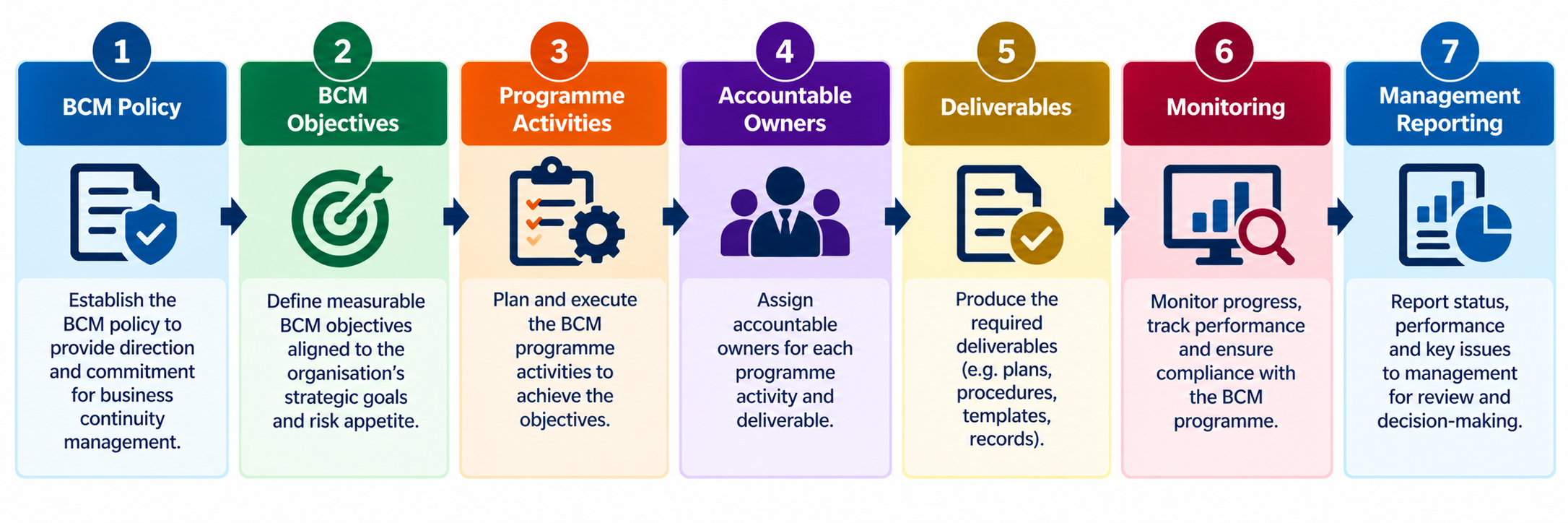
The auditor evaluates whether BCM operates as an ongoing management programme, rather than an annual plan-update exercise.
This includes programme objectives, implementation methodology, the annual BCM schedule, responsibilities, documentation standards, review cycles, reporting arrangements, performance indicators, and integration with risk management, crisis management, cybersecurity, IT disaster recovery, and third-party management.
The auditor should be able to trace:
Business Impact Analysis
The BIA is one of the most important audit areas because many subsequent BCM decisions depend on it.
The auditor determines whether the organisation has systematically identified its critical business functions, activities, processes, products and services and evaluated the consequences of disruption over time.
The audit should examine whether appropriate recovery requirements have been established, such as:
- Maximum Tolerable Period of Disruption (MTPD);
- Recovery Time Objective (RTO);
- Recovery Point Objective (RPO), where applicable;
- minimum business continuity objective or minimum acceptable service level;
- critical periods and deadlines;
- minimum resources;
- internal and external dependencies.
More importantly, the auditor should test whether these requirements are credible and consistent.
For example, if a business function requires recovery within four hours but its essential application has a 24-hour IT recovery target, the auditor has identified a significant alignment problem.
Risk Assessment
The auditor determines whether the organisation has identified and assessed threats and vulnerabilities that could disrupt critical activities.
This can include loss of premises, technology failure, cyberattack, utility outage, telecommunications failure, loss of key personnel, supply-chain disruption, pandemic, natural hazards and failure of critical third parties.
The important distinction is that:
BIA asks: "What must be recovered, and by when?"
Risk assessment asks: "What could disrupt it, and what controls or treatments are required?"
The auditor should ensure the organisation has not confused the two processes.
Business Continuity Strategies and Solutions
The auditor then asks whether the recovery requirements identified through the BIA have been translated into practical continuity solutions.
This can include alternate workplaces, remote working, workforce substitution, manual workarounds, alternative suppliers, reciprocal arrangements, redundant infrastructure, alternative communications, backup arrangements and technology recovery solutions.
A critical audit test is:
Can the selected strategy actually achieve the approved recovery requirement?
For example:
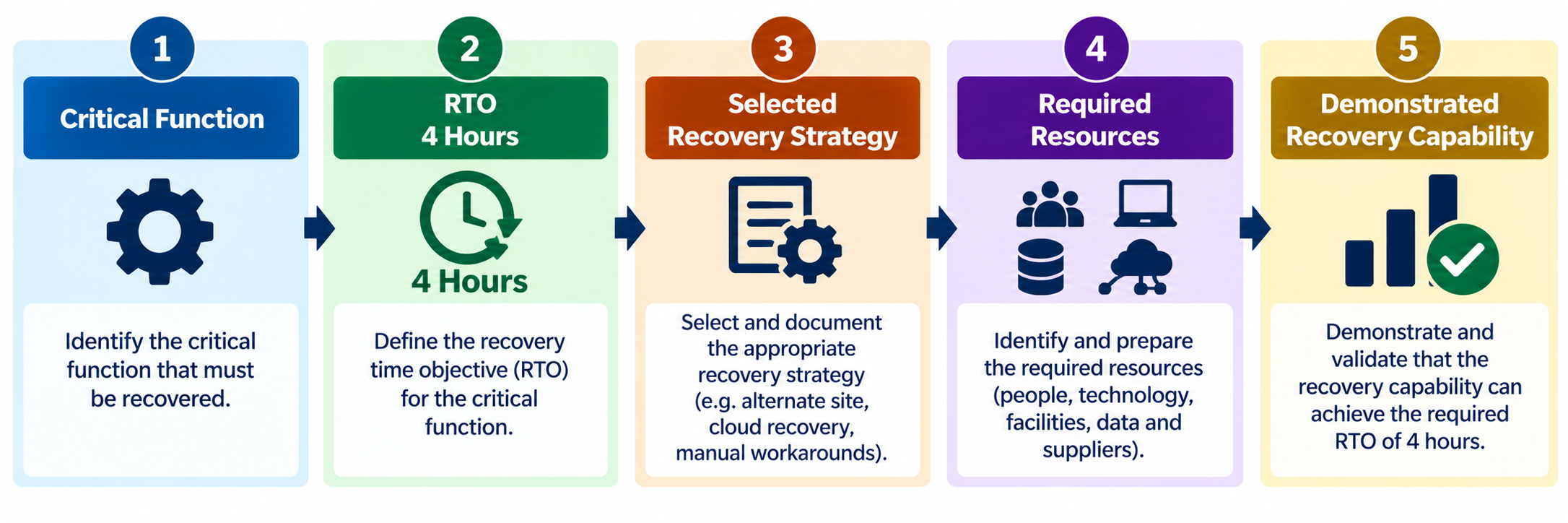
A documented strategy is not necessarily viable without sufficient people, facilities, technology, or suppliers.
Business Continuity Plans and Procedures
The auditor evaluates whether the organisation's plans convert strategies into executable procedures.
Plans should clearly identify activation criteria, authority to activate, roles and responsibilities, escalation procedures, contact information, recovery procedures, communication arrangements, resource requirements, dependencies, alternative locations and return-to-normal procedures.
Auditors should distinguish between documentation quality and operational usability.
A 150-page plan may meet documentation requirements but still fail if employees cannot determine what to do during the first 30 minutes of an incident.
Crisis/ Incident Response and Communications
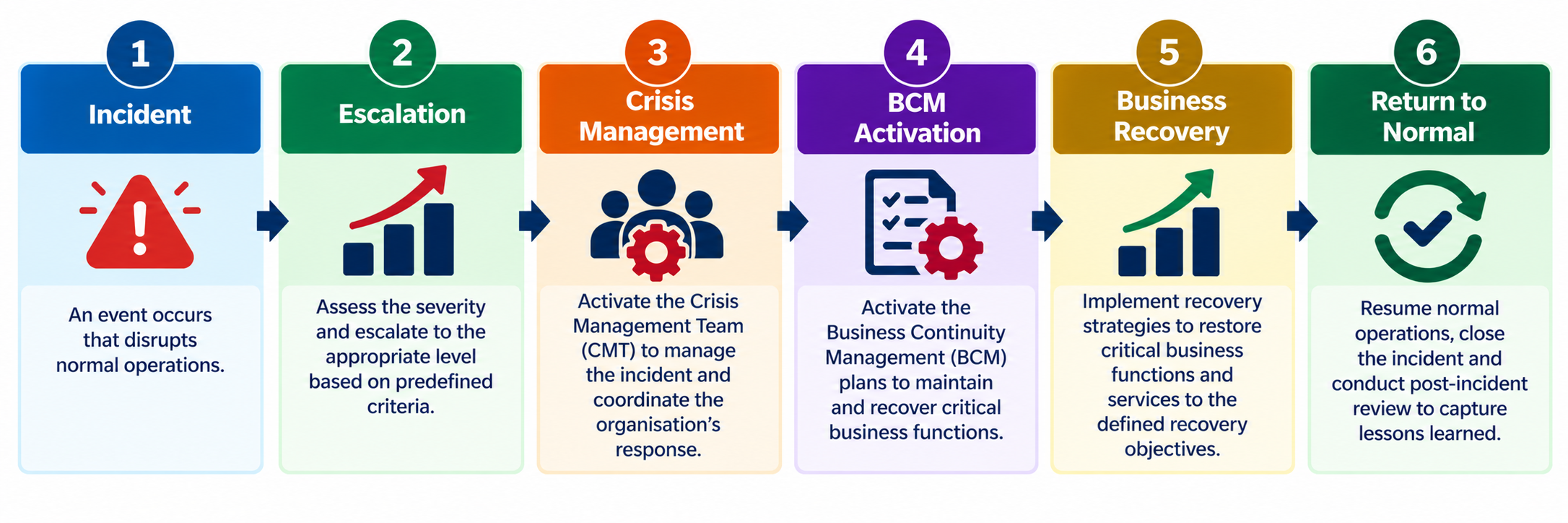
The auditor examines how BCM interfaces with incident and crisis management.
The review should cover detection, notification, escalation, assessment, activation, command and control, crisis management teams, business continuity teams, communications and decision-making authority.
The auditor should also examine arrangements for employees, customers, regulators, suppliers, media and other stakeholders.
The auditor should test the interfaces:
ICT Disaster Recovery and Dependencies
BCM cannot be audited independently of technology.
The auditor should trace critical business activities to supporting applications, infrastructure, telecommunications, data, cloud services and third parties.
For critical systems, review recovery requirements, backup arrangements, redundancy, disaster recovery plans, restoration procedures, DR testing and demonstrated RTO/RPO achievement.
One particularly valuable audit is the business-to-technology traceability test:
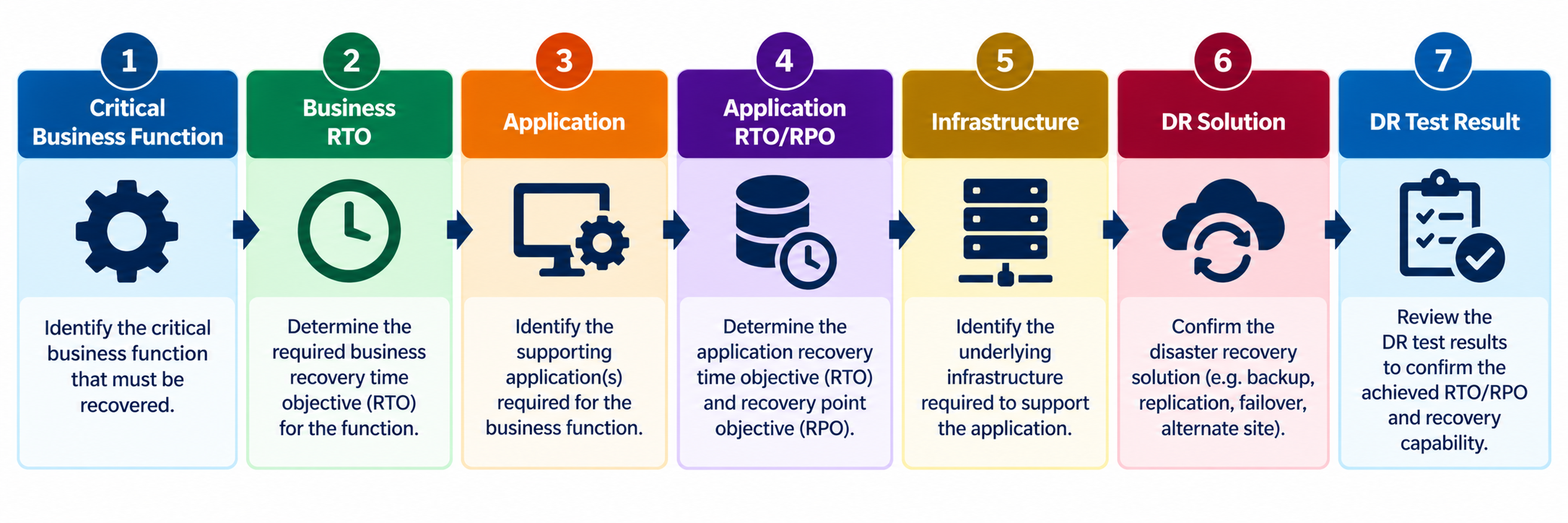
This often reveals gaps that individual BCM and IT audits miss.
Training, Competency and Awareness
The auditor determines whether personnel actually understand their continuity responsibilities.
This includes general BCM awareness and specialised training for BCM coordinators, plan owners, recovery teams, crisis-management personnel, and senior executives.
The audit should distinguish between attendance and competence. Completing an online BCM course does not necessarily demonstrate that a recovery-team member can perform their assigned responsibilities.
Exercising and Testing
This is where documented capability is challenged.
The auditor examines the exercise programme, objectives, scenarios, participation, frequency, complexity, records, observations and corrective actions.
Exercises may include call-tree tests, walkthroughs, tabletop exercises, simulations, alternate-site exercises, work-from-home exercises, supplier exercises, IT disaster recovery tests and integrated enterprise exercises.
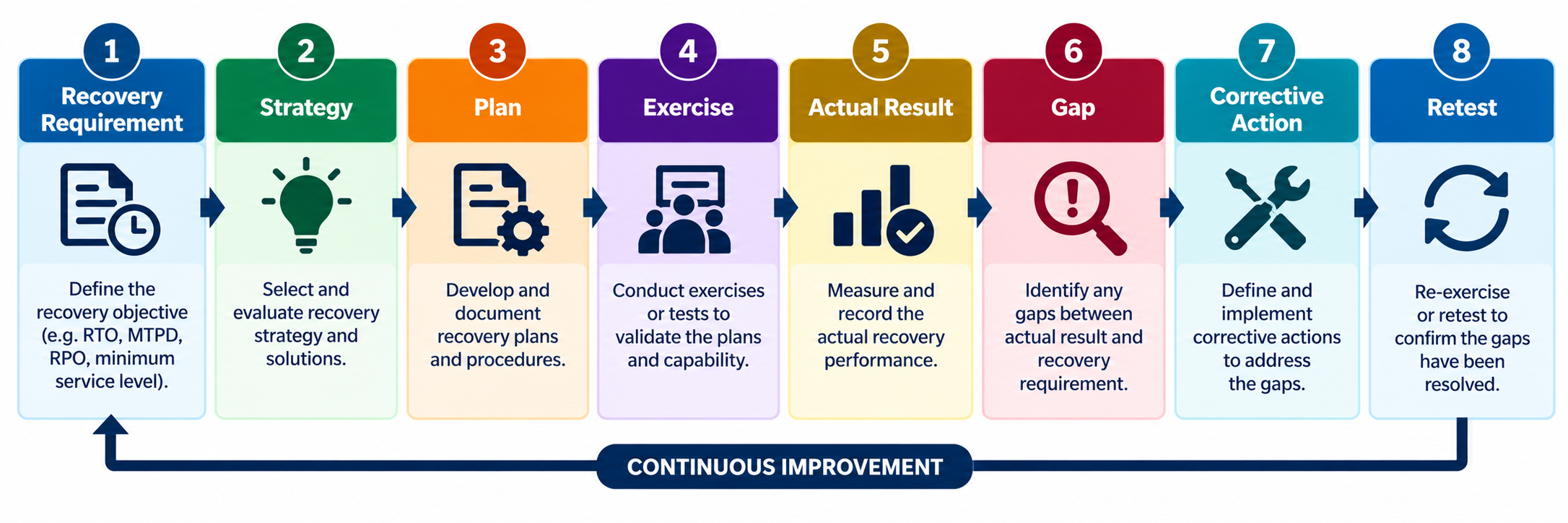
The auditor should determine whether exercises demonstrate that the organisation can meet its recovery objectives—not merely that an exercise took place.
The evidence chain becomes:
Maintenance and Change Management
BCM documentation can rapidly become obsolete.
The auditor determines whether organisational changes trigger BCM reviews. Examples include new systems, office relocations, restructuring, new products, outsourcing, supplier changes, mergers and acquisitions, regulatory changes and major technology transformations.
The auditor should sample plans and verify telephone numbers, personnel, locations, systems, suppliers and procedures rather than simply checking the document's "last reviewed" date.
Performance Monitoring and Measurement
Management needs evidence that BCM remains effective.
The auditor examines BCM metrics and reporting, potentially including BIA completion, plan currency, exercise completion, recovery-objective achievement, overdue corrective actions, training completion and unresolved BCM risks.
The stronger question is not simply:
"Does management receive BCM reports?"
It is:
"Does the information allow management to determine whether continuity capability is adequate?"
Internal Audit and Management Review
For a formal BCMS, the auditor reviews whether the organisation independently evaluates its own management system and whether top management periodically reviews its suitability, adequacy and effectiveness.
Management review should consider audit results, exercises, incidents, changing risks, performance measures, corrective actions, resources and improvement opportunities.
Evidence should demonstrate actual management consideration and decisions, not just minutes recording that "BCM was reviewed."
Corrective Action and Continual Improvement
Finally, the auditor examines whether weaknesses identified through incidents, exercises, audits, reviews and operational changes result in improvements.
A mature corrective-action process should establish:
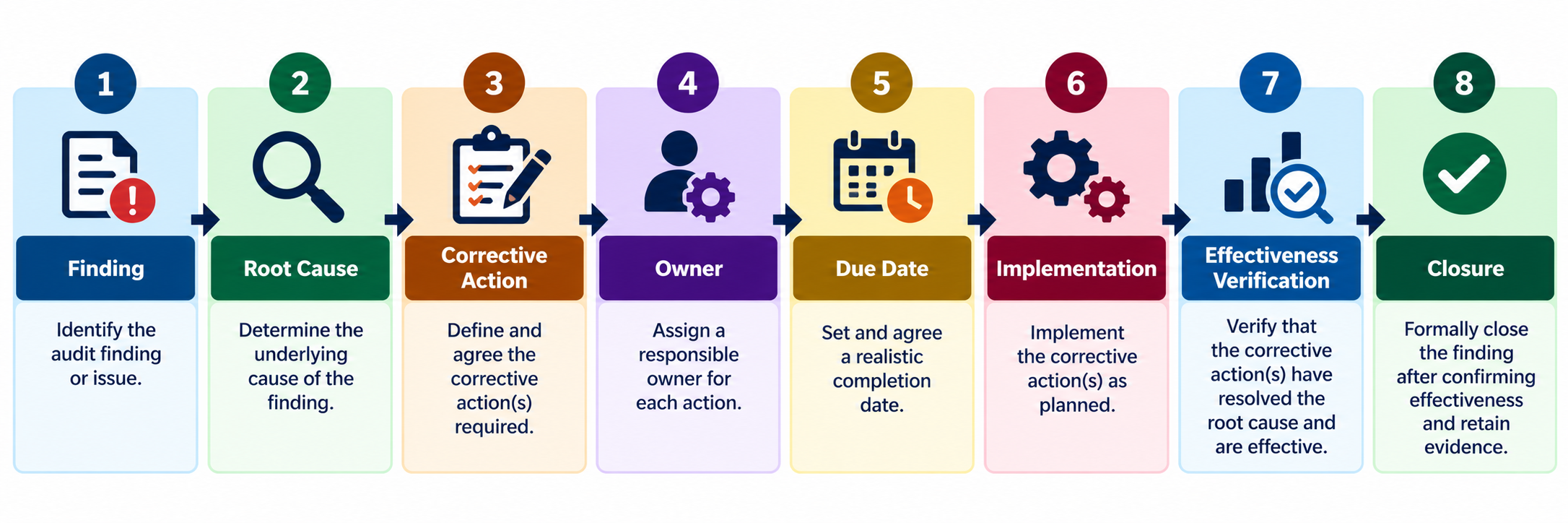
Closing a finding because an action was completed is insufficient if nobody verifies that the action corrected the underlying weakness.
The Auditor's End-to-End Traceability Test
Rather than auditing each BCM document independently, a strong auditor selects several critical business functions and traces them end to end.
For example:
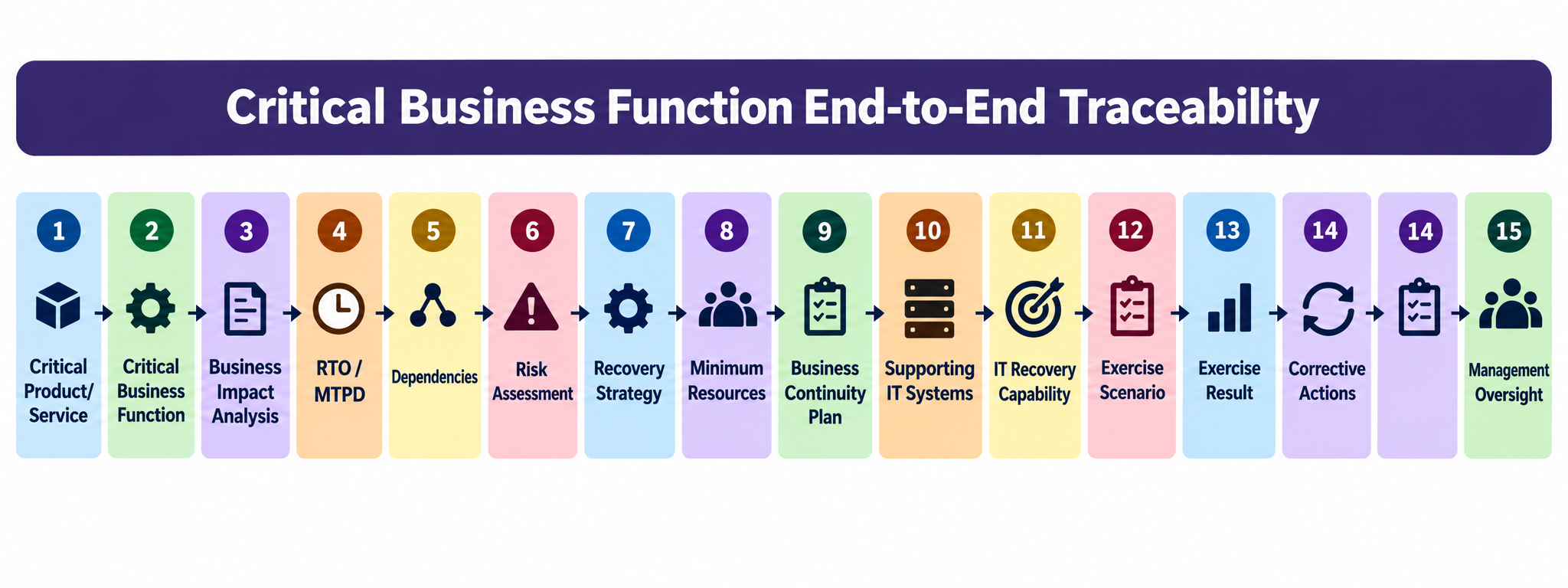
This provides a much more reliable indication of BCM effectiveness than a checklist-only audit.
Four Levels of Audit Evidence
The auditor should seek progressively stronger evidence:
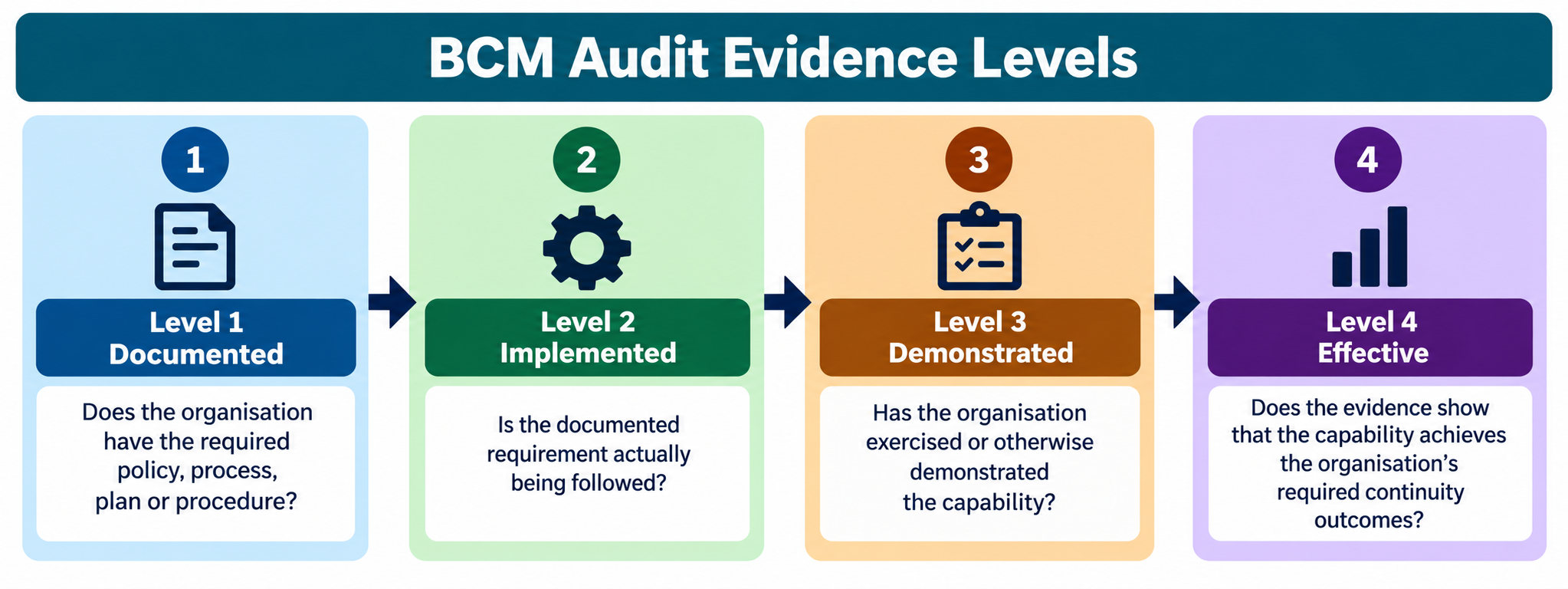
This distinction is important. A BCM programme can be fully documented but operationally ineffective.
Overall Auditor's View
Ultimately, the auditor is trying to answer five questions:
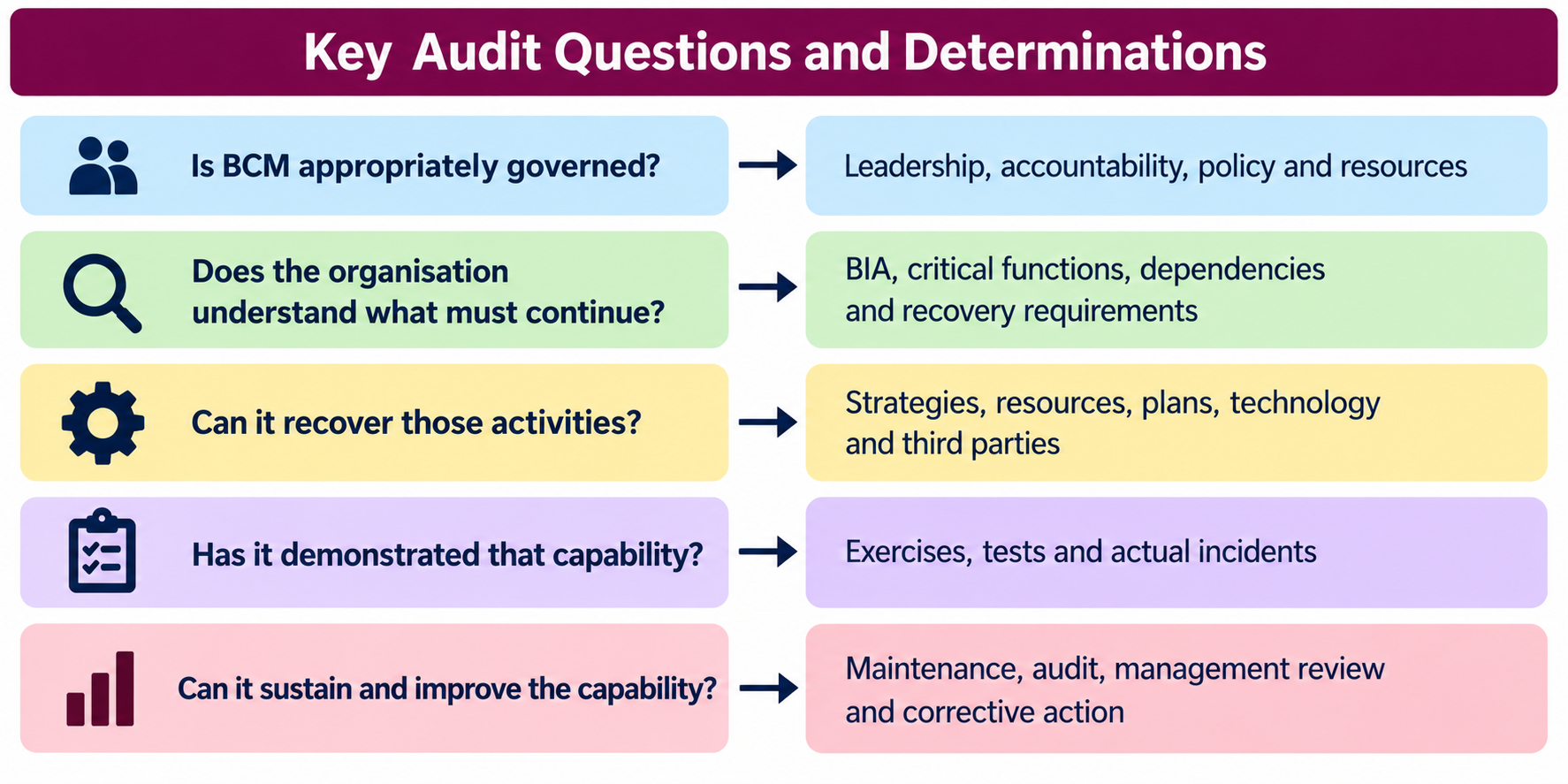
Therefore, the final audit conclusion should not merely state whether the organisation has complied with BCM documentation requirements.
It should provide assurance on whether:
The organisation has established, implemented, maintained and demonstrated a business continuity capability that is appropriate to its risks and capable of continuing and recovering its priority activities within approved recovery requirements following a disruption.

A comprehensive BCM audit ultimately seeks to answer a fundamental question: can the organisation demonstrate that its business continuity arrangements will enable its critical business functions and priority activities to continue or recover within their approved recovery requirements?
Answering this requires auditors to look beyond individual documents and examine the relationships between governance, BIA results, recovery objectives, risks, strategies, resources, plans, technology dependencies, exercises, actual recovery performance and corrective actions.
Effective auditing therefore follows an evidence chain from policy and requirements through implementation and demonstrated capability to measurable outcomes and continual improvement.
Findings should not end with identifying deficiencies; they should lead to root-cause analysis, accountable corrective actions, implementation, effectiveness verification, and closure.
Applied this way, BCM auditing becomes more than a compliance exercise.
It provides management with independent assurance that the organisation's continuity capability is appropriately designed, implemented, tested, maintained, and continually improved—and, most importantly, that it can support the organisation when a real disruption occurs.
More Information About Blended Learning Auditing BCMS Courses
BCM Institute offers two levels of BCM auditing courses: A-3 BCM-8030 ISO22301 BCMS Auditor [A-3] and the ISO22301 BCMS Lead Auditor [A-5].

![TMM [BL-A-5]](https://no-cache.hubspot.com/cta/default/3893111/e7af9322-15cb-412d-91b6-59cd388ee6e9.png)
![Register [BL-A-5]](https://no-cache.hubspot.com/cta/default/3893111/bb38417e-6241-4057-b90c-f319f31a494e.png)


![Email to Sales Team [BCM Institute]](https://no-cache.hubspot.com/cta/default/3893111/3c53daeb-2836-4843-b0e0-645baee2ab9e.png)


