---
title: [OR] [UOB] [E3] [C1] Starting Your OR Implementation for UOB Malaysia
description: [OR] [UOB] [E3] [C1] Starting Your OR Implementation for UOB Malaysia
image: https://blog.bcm-institute.org/hubfs/eBook%20Generic%20Morepost/OR/OR%20GEN%20E3%20Morepost/%5BOR%5D%20%5BGEN%5D%20%5BE3%5D%20%5BC1%5D%20Starting%20Your%20BCM%20Implementation.jpg
---
.
[](http://www.bcm-institute.org/)
- [Home](https://www.bcm-institute.org/)
- [About Us](https://www.bcm-institute.org/about-us-3/)
- [A President’s Perspective](https://www.bcm-institute.org/about-us/a-presidents-perspective/)
- [Our History](https://www.bcm-institute.org/about-us/our-history/)
- [Our Advisory Council](https://www.bcm-institute.org/about-us/our-advisory-council/)
- [Customers’ Testimonials](https://www.bcm-institute.org/about-us/customers-testimonials/)
- [Credential Verification](https://www.bcm-institute.org/about-us/credential-verification/)
- [Courses](https://blog.bcm-institute.org/blog/course-fees-for-blended-learning-courses-master-catalog)
- [ISO 22301 Business Continuity Management System Audit](https://blog.bcm-institute.org/audit/business-continuity-management-audit-courses)
- [ISO 22301 Business Continuity Management](https://blog.bcm-institute.org/bcm/business-continuity-management-courses)
- [Crisis Communication](https://blog.bcm-institute.org/crisis-communication/crisis-communication-courses)
- [Crisis Management](https://blog.bcm-institute.org/en/crisis-management/courses)
- [IT Disaster Recovery](https://blog.bcm-institute.org/it-disaster-recovery/courses)
- [Operational Resilience](https://blog.bcm-institute.org/operational-resilience/courses)
- [Operational Resilience Audit](https://blog.bcm-institute.org/operational-resilience-audit/courses)
- [Certification](https://blog.bcm-institute.org/certification/types-of-certifications-offered)
- [ISO 22301 BCMS Audit Certification](https://blog.bcm-institute.org/certification/business-continuity-management-audit-certification)
- [ISO22301 Business Continuity Management Certification](https://blog.bcm-institute.org/bcm/business-continuity-management-certification)
- [Crisis Communication Certification](https://blog.bcm-institute.org/crisis-communication/crisis-communication-certification)
- [Crisis Management Certification](https://blog.bcm-institute.org/en/crisis-management/crisis-management-certification)
- [IT Disaster Recovery Planning Certification](https://blog.bcm-institute.org/it-disaster-recovery/it-disaster-recovery-certification)
- [Operational Resilience Certification](https://blog.bcm-institute.org/operational-resilience/operational-resilience-certification)
- [Operational Resilience Audit Certification](https://blog.bcm-institute.org/operational-resilience-audit)
- [Seminars](https://blog.bcm-institute.org/meet-the-expert/mte-webinar-mainpage)
- [Store](https://www.bcm-institute.org/store-2/)
- [Contact Us](http://www.bcm-institute.org/about-us/contact-us/)
-
-
###### Strengthening Operational Resilience for UOB Malaysia
![BB OR \[C\] 16](https://blog.bcm-institute.org/hs-fs/hubfs/BB%20OR%20%5BAi%20Gen%20Blog%20Photo%5D/OR%20Pictures%20A/BB%20OR%20Folder%20C/BB%20OR%20%5BC%5D%2016.jpg?width=2000&height=1333&name=BB%20OR%20%5BC%5D%2016.jpg "BB OR [C] 16")
# \[OR\] \[UOB\] \[E3\] \[C1\] Starting Your OR Implementation for UOB Malaysia
***[](https://cta-redirect.hubspot.com/cta/redirect/3893111/e271cf44-389f-46c4-a177-a294d307424f)"Starting Your OR Implementation*”** marks the third and final instalment of the *Strengthening Operational Resilience for UOB Malaysia* series.
[](https://cta-redirect.hubspot.com/cta/redirect/3893111/79ab5db4-8d63-4802-aee2-4467d85f11f2)
Built on the foundational knowledge presented in the earlier two eBooks— Understanding Your Organisation and *Implementing OR Planning Methodology*—this edition shifts the focus from theory and frameworks to tangible execution.
This volume is designed as a reference and a playbook for Operational Resilience professionals, risk managers, and business unit leaders who drive OR initiatives across the bank.
It reflects UOB Malaysia's commitment to enhancing its ability to respond to, recover from, and adapt to operational disruptions in an increasingly complex and interconnected environment.
![\[OR\] \[E4\] \[C1\] Starting Your OR Implementation](https://blog.bcm-institute.org/hs-fs/hubfs/Banner%20Blog/%5BOR%5D%20%5BE4%5D%20%5BC1%5D%20Starting%20Your%20OR%20Implementation.png?width=1300&height=169&name=%5BOR%5D%20%5BE4%5D%20%5BC1%5D%20Starting%20Your%20OR%20Implementation.png)
[Dr Goh Moh Heng](https://blog.bcm-institute.org/ebook-or/author/dr-goh-moh-heng) Feb 12, 2026
###### Operational Resilience Certified Planner-Specialist-Expert
###### [![\[OR\] \[UOB\] Legal Disclaimer Banner](https://no-cache.hubspot.com/cta/default/3893111/ec7b4b30-0624-4946-8c53-52c1e6430f10.png)](https://cta-redirect.hubspot.com/cta/redirect/3893111/ec7b4b30-0624-4946-8c53-52c1e6430f10)
#### eBook 3: Chapter 1
![\[OR\] \[E4\] \[C1\] Starting Your OR Implementation](https://blog.bcm-institute.org/hs-fs/hubfs/Banner%20Blog/%5BOR%5D%20%5BE4%5D%20%5BC1%5D%20Starting%20Your%20OR%20Implementation.png?width=1300&height=169&name=%5BOR%5D%20%5BE4%5D%20%5BC1%5D%20Starting%20Your%20OR%20Implementation.png)
### Starting Your Operational Resilience (OR) Implementation at UOB Malaysia
#### Introduction
[](https://cta-redirect.hubspot.com/cta/redirect/3893111/79ab5db4-8d63-4802-aee2-4467d85f11f2)[![\[OR\] \[UOB\] \[E3\] \[C1\] Starting Your OR Implementation](https://no-cache.hubspot.com/cta/default/3893111/479998e5-409e-4176-bf50-2ec02ea0968c.png)](https://cta-redirect.hubspot.com/cta/redirect/3893111/479998e5-409e-4176-bf50-2ec02ea0968c)Operational resilience is no longer a conceptual framework or regulatory aspiration—it is an operational discipline that must be embedded into the day-to-day functioning of UOB Malaysia.
As a leading financial institution serving retail, business, and corporate customers across Malaysia, UOB Malaysia operates in an increasingly interconnected, technology-driven, and risk-sensitive environment.
The ability to continue delivering Critical Business Services (CBS) during disruption is fundamental to customer trust, regulatory confidence, and long-term sustainability.
[![\[OR\] \[Thin Banner\] \[E3\] Positioning of eBook 3 within the OR Journey](https://no-cache.hubspot.com/cta/default/3893111/78f340d2-c422-43df-aadb-d2347dde326e.png)](https://cta-redirect.hubspot.com/cta/redirect/3893111/78f340d2-c422-43df-aadb-d2347dde326e)
This eBook, “Starting Your OR Implementation,” marks the transition from understanding and design into structured execution. It builds upon:
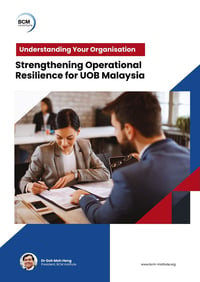
- eBook 1: “Understanding Your Organisation” – which established organisational context, governance structures, risk landscape, and service priorities; and
- eBook 2: “Implementing Operational Resilience for UOB Malaysia” – which introduced the Operational Resilience Planning Methodology and its implementation roadmap.
Where the earlier volumes focused on conceptual clarity and structural planning, this eBook 3 Starting Your Operational Resilience Implementation at UOB Malaysia drills down into the specific technical and operational requirements of Phase 2 of the Operational Resilience (OR) Planning Methodology.
This chapter prepares UOB Malaysia to move from framework alignment to disciplined, evidence-based execution.
#### [![\[OR\] \[Thin Banner\] \[E3\] From Planning to Execution](https://no-cache.hubspot.com/cta/default/3893111/06de788e-e841-48d3-92e8-735c9e4577f1.png)](https://cta-redirect.hubspot.com/cta/redirect/3893111/06de788e-e841-48d3-92e8-735c9e4577f1)
The five core stages of the “Plan” phase in the Operational Resilience Planning Methodology are central to this ebook. These stages form the backbone of OR implementation:
- **Identify Critical Business Services \[DP\]** Determining the business services that, if disrupted, could pose a significant risk to Metrobank’s customers, market integrity, or financial stability.
- **Map Dependency and Connectivity \[MD\]** Uncovering and documenting the relationships and interdependencies—both internal and external—that support the delivery of critical business services.
- **Map Processes and Resources \[MPR\]** Cataloguing the key operational elements—people, systems, data, and facilities—that underpin each critical business service's performance and continuity.
- **Establish Impact Tolerances \[ITo\]** Setting defined thresholds for disruption to determine how much stress a service can endure before unacceptable harm occurs.
- **Identify Severe but Plausible Scenarios** **\[SuPS\]**Identifying Severe but Plausible Scenarios that could critically impact each detailed process within the Critical Business Service
- **Perform Scenario Testing \[ST\]** Validating assumptions and capabilities by simulating disruptive scenarios to evaluate how well the bank can maintain or recover its critical business services.
[![\[OR\] \[Thin Banner\] \[E3\] Critical Business Services in Scope](https://no-cache.hubspot.com/cta/default/3893111/29b32779-5983-4232-9cfd-e121ad0db36f.png)](https://cta-redirect.hubspot.com/cta/redirect/3893111/29b32779-5983-4232-9cfd-e121ad0db36f)
Each stage is covered through submissions from UOB Malaysia’s core business units. These units have translated the methodology into practice, providing real-world insights into the challenges and solutions of each phase.
The submissions focus on the following **Critical Business Services (CBS)**, as defined by UOB Malaysia:
- CBS-1 Deposit & Savings Account Services
- CBS-2 Debit & Credit Card Services
- CBS-3 Digital & Mobile Banking Services (e.g., Internet Banking, Mobile Apps)
- CBS-4 Business Accounts & Cash Management
- CBS-5 Trade Finance & Foreign Exchange Services
- CBS-6 Digital Business Banking Platforms
- CBS-7 Corporate Lending & Financing Services
- CBS-8 Treasury & Market Services
- CBS-9 Wealth Management & Advisory Services
- CBS-10 Payment & Clearing Services
- CBS-11 Fraud Detection & Security Monitoring
#### **[![\[OR\] \[Thin Banner\] \[E3\] Why This eBook Is Provided](https://no-cache.hubspot.com/cta/default/3893111/9ec00e46-5d0d-4c1b-bfdc-5ea99b79f374.png)](https://cta-redirect.hubspot.com/cta/redirect/3893111/9ec00e46-5d0d-4c1b-bfdc-5ea99b79f374)**
This eBook is more than an internal knowledge asset—it is part of the value-added resources offered to organisations implementing or enhancing their OR capabilities through **BCM Institute’s training-led implementation** approach.
As part of the Institute’s competency-based certification courses, this publication supports practical understanding and skill development, enabling professionals to interpret the methodology and apply it effectively.
Whether embarking on your first OR initiative or refining an existing framework, this guide provides the clarity, structure, and examples necessary to advance your resilience efforts.
It translates the abstract concept of operational resilience into concrete actions, enabling organisations to proactively safeguard their critical functions against expected and unforeseen disruptions.
#### [![\[OR\] \[Thin Banner\] \[E3\] What the Reader Should Expect](https://no-cache.hubspot.com/cta/default/3893111/d09784e2-e60e-4eda-b723-0c111baa2754.png)](https://cta-redirect.hubspot.com/cta/redirect/3893111/d09784e2-e60e-4eda-b723-0c111baa2754)
In the following chapters, readers will find detailed documentation, observations, and best practices from across the organisation’s operational ecosystem.
These insights showcase the collaboration among Group Risk, business units, and the OR program office to operationalise resilience.
As you begin your OR implementation journey with this guide, remember: resilience is not a one-time project but a dynamic capability. It is strengthened by continuous learning, iterative improvement, and shared commitment across all levels of the organisation.
Let this volume be your companion as you turn strategy into practice—and plans into resilience.
[](https://cta-redirect.hubspot.com/cta/redirect/3893111/3aefb2d2-3110-47c1-ad4f-d3e6e5381066)
Blogs marked \[x\] are under construction.
| Strengthening Operational Resilience for UOB Malaysia |
| --- |
| **eBook 3: Starting Your OR Implementation** |
| **CBS** | **CBS-1 \[x\]** | **CBS-2 \[x\]** | **CBS-3 \[x\]** | **CBS-4 \[x\]** | **CBF-5 \[x\]** | **CBS-6 \[x\]** |
| --- | --- | --- | --- | --- | --- | --- |
| [![\[OR\] \[UOB\] \[E1\] \[C5\] Identifying Critical Business Services](https://no-cache.hubspot.com/cta/default/3893111/11e7aedb-6efd-421c-914b-d834aa56ddf0.png)](https://cta-redirect.hubspot.com/cta/redirect/3893111/11e7aedb-6efd-421c-914b-d834aa56ddf0) | [![\[OR\] \[GEN\] \[E3\] \[CBS\] \[DP\] Detailed Business Processes](https://no-cache.hubspot.com/cta/default/3893111/519cb0da-2e0c-4f0f-aebe-c24b997d12b6.png)](https://cta-redirect.hubspot.com/cta/redirect/3893111/519cb0da-2e0c-4f0f-aebe-c24b997d12b6) | [![\[OR\] \[GEN\] \[E3\] \[CBS\] \[DP\] Detailed Business Processes](https://no-cache.hubspot.com/cta/default/3893111/519cb0da-2e0c-4f0f-aebe-c24b997d12b6.png)](https://cta-redirect.hubspot.com/cta/redirect/3893111/519cb0da-2e0c-4f0f-aebe-c24b997d12b6) | [![\[OR\] \[GEN\] \[E3\] \[CBS\] \[DP\] Detailed Business Processes](https://no-cache.hubspot.com/cta/default/3893111/519cb0da-2e0c-4f0f-aebe-c24b997d12b6.png)](https://cta-redirect.hubspot.com/cta/redirect/3893111/519cb0da-2e0c-4f0f-aebe-c24b997d12b6) | [![\[OR\] \[GEN\] \[E3\] \[CBS\] \[DP\] Detailed Business Processes](https://no-cache.hubspot.com/cta/default/3893111/519cb0da-2e0c-4f0f-aebe-c24b997d12b6.png)](https://cta-redirect.hubspot.com/cta/redirect/3893111/519cb0da-2e0c-4f0f-aebe-c24b997d12b6) | [![\[OR\] \[GEN\] \[E3\] \[CBS\] \[DP\] Detailed Business Processes](https://no-cache.hubspot.com/cta/default/3893111/519cb0da-2e0c-4f0f-aebe-c24b997d12b6.png)](https://cta-redirect.hubspot.com/cta/redirect/3893111/519cb0da-2e0c-4f0f-aebe-c24b997d12b6) | [![\[OR\] \[GEN\] \[E3\] \[CBS\] \[DP\] Detailed Business Processes](https://no-cache.hubspot.com/cta/default/3893111/519cb0da-2e0c-4f0f-aebe-c24b997d12b6.png)](https://cta-redirect.hubspot.com/cta/redirect/3893111/519cb0da-2e0c-4f0f-aebe-c24b997d12b6) |
| **eBook 1** | **CBS-7 \[x\]** | **CBS-8 \[x\]** | **CBS-9 \[x\]** | **CBS-10 \[x\]** | **CBS-11 \[x\]** | **eBook 2** |
| [](https://cta-redirect.hubspot.com/cta/redirect/3893111/5d014f3e-78b6-4731-8d27-a2058f50598d) | [![\[OR\] \[GEN\] \[E3\] \[CBS\] \[DP\] Detailed Business Processes](https://no-cache.hubspot.com/cta/default/3893111/519cb0da-2e0c-4f0f-aebe-c24b997d12b6.png)](https://cta-redirect.hubspot.com/cta/redirect/3893111/519cb0da-2e0c-4f0f-aebe-c24b997d12b6) | [![\[OR\] \[GEN\] \[E3\] \[CBS\] \[DP\] Detailed Business Processes](https://no-cache.hubspot.com/cta/default/3893111/519cb0da-2e0c-4f0f-aebe-c24b997d12b6.png)](https://cta-redirect.hubspot.com/cta/redirect/3893111/519cb0da-2e0c-4f0f-aebe-c24b997d12b6) | [![\[OR\] \[GEN\] \[E3\] \[CBS\] \[DP\] Detailed Business Processes](https://no-cache.hubspot.com/cta/default/3893111/519cb0da-2e0c-4f0f-aebe-c24b997d12b6.png)](https://cta-redirect.hubspot.com/cta/redirect/3893111/519cb0da-2e0c-4f0f-aebe-c24b997d12b6) | [![\[OR\] \[GEN\] \[E3\] \[CBS\] \[DP\] Detailed Business Processes](https://no-cache.hubspot.com/cta/default/3893111/519cb0da-2e0c-4f0f-aebe-c24b997d12b6.png)](https://cta-redirect.hubspot.com/cta/redirect/3893111/519cb0da-2e0c-4f0f-aebe-c24b997d12b6) | **[![\[OR\] \[GEN\] \[E3\] \[CBS\] \[DP\] Detailed Business Processes](https://no-cache.hubspot.com/cta/default/3893111/519cb0da-2e0c-4f0f-aebe-c24b997d12b6.png)](https://cta-redirect.hubspot.com/cta/redirect/3893111/519cb0da-2e0c-4f0f-aebe-c24b997d12b6)** | [](https://cta-redirect.hubspot.com/cta/redirect/3893111/06127413-2aef-40e0-92a3-bc31cdae163c) |
| **Consolidated Report (CR)** | | | | | | |
| **CR** | **DP \[x\]** | **MD \[x\]** | **MPR \[x\]** | **ITo \[x\]** | **SuPS \[x\]** | **ST \[x\]** |
| [![\[OR\] \[UOB\] \[E3\] \[C1\] Starting Your OR Implementation](https://no-cache.hubspot.com/cta/default/3893111/479998e5-409e-4176-bf50-2ec02ea0968c.png)](https://cta-redirect.hubspot.com/cta/redirect/3893111/479998e5-409e-4176-bf50-2ec02ea0968c) | **[![\[OR\] \[GEN\] \[E3\] \[CR\] \[P1\] \[DP\] Detailed Processes (Sub-CBS)](https://no-cache.hubspot.com/cta/default/3893111/2ed59124-3a65-48e5-aa14-8596578585f9.png)](https://cta-redirect.hubspot.com/cta/redirect/3893111/2ed59124-3a65-48e5-aa14-8596578585f9)** | **[![\[OR\] \[GEN\] \[E3\] \[CR\] \[P2\] \[MD\] Map Dependency](https://no-cache.hubspot.com/cta/default/3893111/5341285b-11e4-4f7f-bdcd-af246434ddb3.png)](https://cta-redirect.hubspot.com/cta/redirect/3893111/5341285b-11e4-4f7f-bdcd-af246434ddb3)** | **[![\[OR\] \[GEN\] \[E3\] \[CR\] \[P3\] \[MPR\] Map Processes and Resources](https://no-cache.hubspot.com/cta/default/3893111/dfc007a2-14de-479a-ba96-c4a2cc531cee.png)](https://cta-redirect.hubspot.com/cta/redirect/3893111/dfc007a2-14de-479a-ba96-c4a2cc531cee)** | **[![\[OR\] \[GEN\] \[E3\] \[CR\] \[P4\] \[ITo\] Establish Impact Tolerance](https://no-cache.hubspot.com/cta/default/3893111/c922c2b8-e63b-4305-9e8c-e7491707b5bc.png)](https://cta-redirect.hubspot.com/cta/redirect/3893111/c922c2b8-e63b-4305-9e8c-e7491707b5bc)** | **[![\[OR\] \[GEN\] \[E3\] \[CR\] \[P5\] \[SuPS\] Identify Severe but Plausible Scenarios](https://no-cache.hubspot.com/cta/default/3893111/2447d25d-92f1-444d-87c8-55563195f14e.png)](https://cta-redirect.hubspot.com/cta/redirect/3893111/2447d25d-92f1-444d-87c8-55563195f14e)** | **[![\[OR\] \[GEN\] \[E3\] \[CR\] \[P6\] \[ST\] Perform Scenario Testing](https://no-cache.hubspot.com/cta/default/3893111/9cc4faa3-60cb-4b09-8582-f9edd8103ed0.png)](https://cta-redirect.hubspot.com/cta/redirect/3893111/9cc4faa3-60cb-4b09-8582-f9edd8103ed0)** |
**[](https://cta-redirect.hubspot.com/cta/redirect/3893111/084e620a-46c5-419a-82ed-6a681d15c0b6)[](https://cta-redirect.hubspot.com/cta/redirect/3893111/13a448f1-f09c-42da-a57e-0988e41658c5)**
For organisations looking to accelerate their journey, BCM Institute’s training and certification programs, including the **OR-5000 Operational Resilience Expert Implementer course**, provide in-depth insights and practical toolkits for effectively embedding this model.
---
#### More Information About OR-5000 \[OR-5\] or OR-300 \[OR-3\]
Gain Competency: For organisations looking to accelerate their journey, BCM Institute’s training and certification programs, including the OR-5000 Operational Resilience Expert Implementer course, provide in-depth insights and practical toolkits for effectively embedding this model.
To learn more about the course and schedule, click the buttons below for the \[OR-3\] OR-300 Operational Resilience Implementer course and the \[OR-5\] OR-5000 Operational Resilience Expert Implementer course.
| [](https://cta-redirect.hubspot.com/cta/redirect/3893111/3530eccb-515d-401e-afc2-3469e26d7fbf) | [](https://cta-redirect.hubspot.com/cta/redirect/3893111/fdd4fa9c-ed69-40c1-925f-4eb6a1c5c255) | [](https://cta-redirect.hubspot.com/cta/redirect/3893111/77a34b84-0a6d-44f8-b8d6-6ab04cdf5edd) |
| --- | --- | --- |
| [](https://cta-redirect.hubspot.com/cta/redirect/3893111/6e5c0cda-39b9-4bbd-b3d4-4cf46a790b14) | [](https://cta-redirect.hubspot.com/cta/redirect/3893111/a68a08aa-36d3-4216-9551-202c9fde06ea) | [![ \[BL-OR\] \[3-4-5\] View Schedule](https://no-cache.hubspot.com/cta/default/3893111/d0d733a1-16c0-4b68-a26d-adbfd4fc6069.png)](https://cta-redirect.hubspot.com/cta/redirect/3893111/d0d733a1-16c0-4b68-a26d-adbfd4fc6069) |
| [![\[BL-OR\] \[3\] FAQ OR-300](https://no-cache.hubspot.com/cta/default/3893111/f20c71b4-f5e8-4aa5-8056-c374ca33a091.png)](https://cta-redirect.hubspot.com/cta/redirect/3893111/f20c71b4-f5e8-4aa5-8056-c374ca33a091) | If you have any questions, click to contact us.[![Email to Sales Team \[BCM Institute\]](https://no-cache.hubspot.com/cta/default/3893111/3c53daeb-2836-4843-b0e0-645baee2ab9e.png)](https://cta-redirect.hubspot.com/cta/redirect/3893111/3c53daeb-2836-4843-b0e0-645baee2ab9e) | [](https://cta-redirect.hubspot.com/cta/redirect/3893111/7f2718a4-ea80-4f84-a319-dc2d4df37a46) |
| [](https://cta-redirect.hubspot.com/cta/redirect/3893111/74b1e556-8cd2-4a74-8821-db1804534955) | [](https://cta-redirect.hubspot.com/cta/redirect/3893111/f2bd8eb1-32d2-4732-9267-ea53223cf58f) | [](https://cta-redirect.hubspot.com/cta/redirect/3893111/084e620a-46c5-419a-82ed-6a681d15c0b6) |
#### **Your Comments Here:**
---

---

---
---


All rights reserved. Copyright 2026
```json
{
"@context" : "https://schema.org",
"@type" : "BlogPosting",
"author" : {
"@type" : "Person",
"name" : "Dr Goh Moh Heng",
"url" : "https://blog.bcm-institute.org/ebook-or/author/dr-goh-moh-heng"
},
"dateModified" : "2026-02-24T15:58:46.997Z",
"datePublished" : "2026-02-12T07:38:28.000Z",
"headline" : "[OR] [UOB] [E3] [C1] Starting Your OR Implementation for UOB Malaysia",
"mainEntityOfPage" : {
"@id" : "https://blog.bcm-institute.org/ebook-or/or-uob-e3-c1-starting-your-or-implementation-for-uob-malaysia",
"@type" : "WebPage"
},
"publisher" : {
"@type" : "Organization",
"logo" : {
"@type" : "ImageObject",
"url" : "https://blog.bcm-institute.org/hubfs/BCMI%20Logo.png"
},
"name" : "BCMI Pte Ltd"
}
}
```