

![[OR] [UOB] Legal Disclaimer Banner](https://no-cache.hubspot.com/cta/default/3893111/ec7b4b30-0624-4946-8c53-52c1e6430f10.png)
eBook2: Chapter1
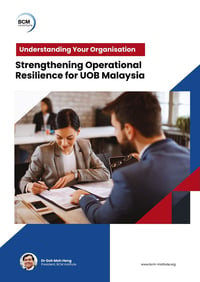
Operational Resilience in Practice: The UOB Malaysia's Three-Phase Framework
Introduction
![[OR] [UOB] [P1 to P3] [C1] OR Planning Methodology](https://no-cache.hubspot.com/cta/default/3893111/48361e77-55bf-4d1f-b7e2-62875e7ad395.png)
 Operational resilience is a critical capability for financial institutions navigating an increasingly complex and interconnected environment.
For UOB Malaysia, strengthening operational resilience is not just a regulatory requirement but a strategic imperative to ensure the continuity of essential business services, protect customer interests, and safeguard the broader financial system.
UOB Malaysia’s approach aligns with global best practices and adheres to the operational resilience guidelines issued by Bank Negara Malaysia (BNM), which emphasise robust risk management, governance, and continuity planning across all critical operations.
This chapter introduces the three phases of UOB Malaysia’s Operational Resilience Planning Methodology—Plan, Implement, and Sustain—providing a roadmap for embedding resilience into the organisation’ss operations.
Each phase comprises five structured stages that guide UOB Malaysia from assessing current capabilities to embedding a culture of resiliency throughout the organisation.
Purpose of the Chapter
 The objective of this chapter is to provide readers with a clear understanding of how UOB Malaysia operationalises resilience within its operations. By presenting the structured methodology, the chapter enables readers to:
-
Understand the rationale behind each phase and stage of the operational resilience planning process.
-
Appreciate the alignment of UOB Malaysia’s resilience efforts with BNM’s regulatory expectations, including governance, risk appetite, impact tolerances, scenario testing, and independent reviews.
-
Gain insights into practical steps the bank takes to sustain resilience culture and ensure continuous improvement.
This chapter provides readers with a foundation for navigating subsequent chapters, which detail the implementation and sustainment of operational resilience in practice.

Phase 1: Plan

The Plan phase establishes the foundation for operational resilience by assessing existing capabilities and defining an improvement roadmap. The five stages are:
-
Assess Capability and Maturity – Evaluate current operational resilience capabilities and benchmark maturity against industry standards and BNM guidelines.
-
Analyse Gap – Identify gaps between current capabilities and regulatory expectations or organisational objectives.
-
Develop Strategy and Roadmap – Formulate a strategic plan that prioritises resilience initiatives and allocates resources effectively to close identified gaps.
-
Confirm Risk Appetite – Align operational resilience objectives with UOB Malaysia’s overall risk appetite, ensuring tolerance levels for operational disruptions are clearly defined.
-
Develop and Embed Governance – Establish a governance framework to oversee operational resilience activities, ensuring accountability and compliance with BNM’s requirements for clear governance and oversight.
BNM compliance considerations during this phase include ensuring that governance structures clearly define roles and responsibilities for business continuity management and operational resilience across the organisation, consistent with BNM’s Business Continuity Management (BCM) policy framework.

Phase 2: Implement

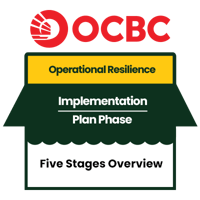
The Implement phase translates strategic plans into actionable steps to strengthen operational resilience. Its five stages are:
-
Identify Critical Business Services – Determine essential services whose disruption could significantly impact customers or the financial system.
-
Map Processes and Resources – Document processes, systems, and resources that support critical services, ensuring that dependencies are understood.
-
Set Impact Tolerance – Define the maximum tolerable disruption for each critical service, in line with BNM’s operational resilience guidance.
-
Conduct Scenario Testing – Test resilience measures through simulations and exercises to validate effectiveness.
-
Improve Lessons Learned – Analyse test outcomes to identify opportunities for improvement and update resilience plans accordingly.
Compliance examples at this stage include adherence to BNM expectations for scenario-based stress testing of critical business functions and regular review of contingency arrangements.
Phase 3: Sustain

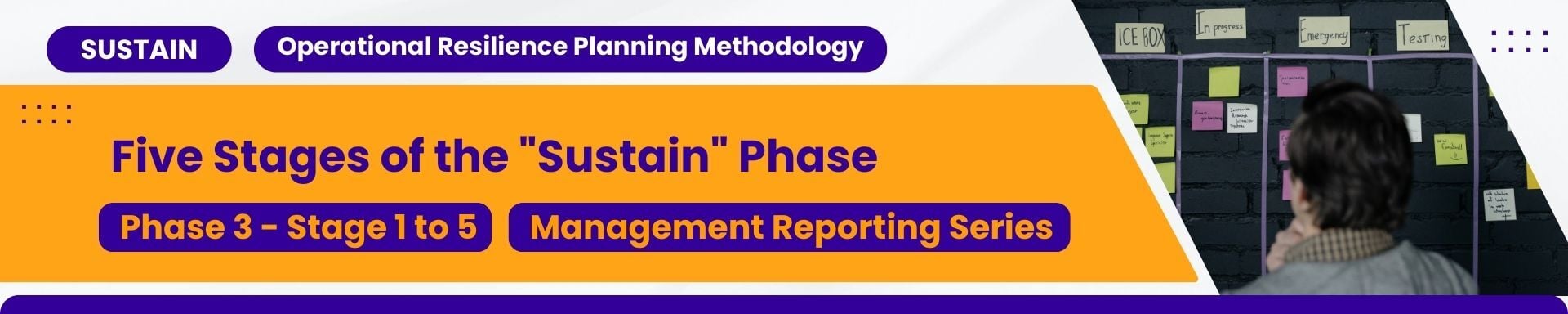
The Sustain phase focuses on embedding a culture of resilience and ensuring continuous improvement. Its five stages are:
-
Introduce Cultural Change – Foster awareness and commitment to resilience principles across the organisation.
-
Develop a communication strategy to communicate resilience objectives and updates to internal and external stakeholders.
-
Implement Training and Awareness – Conduct ongoing training programs to build capability in operational resilience practices.
-
Provide self–assessment - enable regular internal assessments to monitor adherence to resilience policies.
-
Conduct Independent Quality Review – Periodically assess the effectiveness of the resilience program through independent reviews to ensure compliance with BNM guidelines.
BNM mandates that banks maintain a strong culture of resilience, ensure employee awareness, and conduct periodic reviews to validate the adequacy of their operational resilience programs.
![x [Banner] [Summing] [OR] [E2] [C1] Overview of Operational Resilience Planning Methodology](https://no-cache.hubspot.com/cta/default/3893111/0c551e82-cf06-432c-8498-1d3c9bb2dece.png)
UOB Malaysia’s Operational Resilience Planning Methodology—structured into Plan, Implement, and Sustain phases—offers a comprehensive framework to manage operational risk and maintain business continuity in a dynamic financial environment.
By aligning its resilience efforts with BNM’s regulatory expectations, the bank not only strengthens its capacity to withstand disruptions but also safeguards customer interests and financial system stability.
Embedding governance, scenario testing, and continuous cultural reinforcement throughout the organisation ensures that operational resilience is not a one-time initiative but a sustainable and evolving capability.
Through this methodology, UOB Malaysia demonstrates that operational resilience is both a regulatory necessity and a strategic differentiator, reinforcing trust, reliability, and stability in an increasingly complex banking landscape.

Blogs marked [x] are under construction.
![[OR] [GEN] [P1] [S1-S5] [C2] Five Stages of the _Plan_ Phase](https://no-cache.hubspot.com/cta/default/3893111/78869693-baaa-48cf-836e-13950abc8b16.png)
![[OR] [GEN] [P2] [S1-S5] [C8] Five Stages of the _Implement_ Phase](https://no-cache.hubspot.com/cta/default/3893111/7b251fae-e788-4b59-885f-7079d4845475.png)
![[OR] [GEN] [E2] [P3] [C14] The Five Stages of the Sustain Phase](https://no-cache.hubspot.com/cta/default/3893111/931ae9fa-0925-4f30-ba78-fa9be7662fb7.png)
| C21 [x] | ||
![[OR] [GEN] [E2] [C21] [Back Cover] for eBook 2](https://no-cache.hubspot.com/cta/default/3893111/2e6b224b-6df5-4080-a611-383225744f4f.png) |
||
| C5 [x] | C6 [x] | C7 [x] |
![[OR] [GEN] [E2] [P1] [S3] [C5] Developing Strategy and Roadmap](https://no-cache.hubspot.com/cta/default/3893111/afe40ca7-42c1-448f-9ce7-74955f58c946.png) |
![[OR] [GEN] [E2] [P1] [S4] [C6] Confirming Risk Appetite](https://no-cache.hubspot.com/cta/default/3893111/7228dd2d-4764-4aee-8fb5-899bd5b28874.png) |
![[OR] [GEN] [E2] [P1] [S5] [C7] Developing and Embedding Governance](https://no-cache.hubspot.com/cta/default/3893111/e06994e8-b682-4809-b8b8-a7a4f82d0ec7.png) |
| C11 [x] | C12 [x] | C13 [x] |
![[OR] [GEN] [E2] [P2] [S3] [C11] Establishing Impact Tolerance](https://no-cache.hubspot.com/cta/default/3893111/54b6c9d1-e897-4530-8eb4-8419de7503aa.png) |
![[OR] [GEN] [E2] [P2] [S4] [C12] Performing Scenario Testing](https://no-cache.hubspot.com/cta/default/3893111/fe5cc4a9-b109-417e-ba78-651a6dc4f658.png) |
![[OR] [GEN] [E2] [P2] [S5] [C13] Improving Lessons Learned](https://no-cache.hubspot.com/cta/default/3893111/4e3235b4-3630-4359-89bb-8a3b3c098dc8.png) |
| C17 [x] | C18 [x] | C19 [x] |
![[OR] [GEN] [E2] [P3] [S3] C17] Implementing Training and Awareness](https://no-cache.hubspot.com/cta/default/3893111/1e095f66-dca9-4a83-9850-e459cebddbfa.png) |
![[OR] [GEN] [E2] [P3] [S4] [C18] Providing Self-Assessment](https://no-cache.hubspot.com/cta/default/3893111/076a795c-4733-4fb0-b260-fcec767fb221.png) |
![[OR] [GEN] [E2] [P3] [S5] [C19] Conducting Independent Quality Reviews](https://no-cache.hubspot.com/cta/default/3893111/2cff3f12-e08e-43cf-8ca6-aaa6efe33631.png) |
![[OR] [GEN] [E2] [C20] Conclusion for eBook 2](https://no-cache.hubspot.com/cta/default/3893111/fb88d7a9-cd61-4414-add4-e284049ff375.png)

![[OR] [GEN] [E2] [P1] [S1] [C3] Assessing Capability and Maturity](https://no-cache.hubspot.com/cta/default/3893111/3486f1a4-500e-42ee-a7e1-af2a6008f468.png)
![[OR] [GEN] [E2] [P1] [S2] [C4] Analysing Gaps](https://no-cache.hubspot.com/cta/default/3893111/2c0fd2b3-bb2b-47b6-ad44-5e88c8422b37.png)
![[OR] [GEN] [E2] [P2] [S1] [C9] Identifying Critical Business Services](https://no-cache.hubspot.com/cta/default/3893111/3ac7c230-3ce7-463a-813f-6907a49bdc35.png)
![[OR] [GEN] [E2] [P2] [S2] [C10] Mapping of Processes and Resources](https://no-cache.hubspot.com/cta/default/3893111/e7a81126-d48f-4c84-a7b5-db4324ef1b4f.png)
![[OR] [GEN] [E2] [P3] [S1] [C15] Introducing Cultural Change Management](https://no-cache.hubspot.com/cta/default/3893111/3909fd60-d099-4324-a1d2-2040171a7300.png)
![[OR] [GEN] [E2] [P3] [S2] [C16] Developing a Communication Strategy](https://no-cache.hubspot.com/cta/default/3893111/d3bcd703-2173-4eba-90c3-7d45da459f94.png)

 For organisations looking to accelerate their journey, BCM Institute’s training and certification programs, including the OR-5000 Operational Resilience Expert Implementer course, provide in-depth insights and practical toolkits for effectively embedding this model.
More Information About OR-5000 [OR-5] or OR-300 [OR-3]
Gain Competency: For organisations looking to accelerate their journey, BCM Institute’s training and certification programs, including the OR-5000 Operational Resilience Expert Implementer course, provide in-depth insights and practical toolkits for effectively embedding this model.
To learn more about the course and schedule, click the buttons below for the OR-300 Operational Resilience Implementer course and the OR-5000 Operational Resilience Expert Implementer course.


![[BL-OR] [3-4-5] View Schedule](https://no-cache.hubspot.com/cta/default/3893111/d0d733a1-16c0-4b68-a26d-adbfd4fc6069.png)
![[BL-OR] [3] FAQ OR-300](https://no-cache.hubspot.com/cta/default/3893111/f20c71b4-f5e8-4aa5-8056-c374ca33a091.png)
![Email to Sales Team [BCM Institute]](https://no-cache.hubspot.com/cta/default/3893111/3c53daeb-2836-4843-b0e0-645baee2ab9e.png)