---
title: [OR] [P2] [S4] [ST] [C7] Scenario Development Framework
description: [OR] [P2] [S4] [ST] [C7] Scenario Development Framework
image: https://blog.bcm-institute.org/hubfs/OR%20Conducting%20Scenario%20Testing%20P2%20Morepost/%5BOR%5D%20%5BP2%5D%20%5BS4%5D%20%5BST%5D%20%5BC7%5D%20Scenario%20Development%20Framework.jpg
---
. .
[](http://www.bcm-institute.org/)
- [Home](https://www.bcm-institute.org/)
- [About Us](https://www.bcm-institute.org/about-us-3/)
- [A President’s Perspective](https://www.bcm-institute.org/about-us/a-presidents-perspective/)
- [Our History](https://www.bcm-institute.org/about-us/our-history/)
- [Our Advisory Council](https://www.bcm-institute.org/about-us/our-advisory-council/)
- [Customers’ Testimonials](https://www.bcm-institute.org/about-us/customers-testimonials/)
- [Credential Verification](https://www.bcm-institute.org/about-us/credential-verification/)
- [Courses](https://blog.bcm-institute.org/blog/course-fees-for-blended-learning-courses-master-catalog)
- [ISO 22301 Business Continuity Management System Audit](https://blog.bcm-institute.org/audit/business-continuity-management-audit-courses)
- [ISO 22301 Business Continuity Management](https://blog.bcm-institute.org/bcm/business-continuity-management-courses)
- [Crisis Communication](https://blog.bcm-institute.org/crisis-communication/crisis-communication-courses)
- [Crisis Management](https://blog.bcm-institute.org/en/crisis-management/courses)
- [IT Disaster Recovery](https://blog.bcm-institute.org/it-disaster-recovery/courses)
- [Operational Resilience](https://blog.bcm-institute.org/operational-resilience/courses)
- [Operational Resilience Audit](https://blog.bcm-institute.org/operational-resilience-audit/courses)
- [Certification](https://blog.bcm-institute.org/certification/types-of-certifications-offered)
- [ISO 22301 BCMS Audit Certification](https://blog.bcm-institute.org/certification/business-continuity-management-audit-certification)
- [ISO22301 Business Continuity Management Certification](https://blog.bcm-institute.org/bcm/business-continuity-management-certification)
- [Crisis Communication Certification](https://blog.bcm-institute.org/crisis-communication/crisis-communication-certification)
- [Crisis Management Certification](https://blog.bcm-institute.org/en/crisis-management/crisis-management-certification)
- [IT Disaster Recovery Planning Certification](https://blog.bcm-institute.org/it-disaster-recovery/it-disaster-recovery-certification)
- [Operational Resilience Certification](https://blog.bcm-institute.org/operational-resilience/operational-resilience-certification)
- [Operational Resilience Audit Certification](https://blog.bcm-institute.org/operational-resilience-audit)
- [Seminars](https://blog.bcm-institute.org/meet-the-expert/mte-webinar-mainpage)
- [Store](https://www.bcm-institute.org/store-2/)
- [Contact Us](http://www.bcm-institute.org/about-us/contact-us/)
-
-
###### Conducting Scenario Testing: A Practical Guide for Operational Resilience Implementation
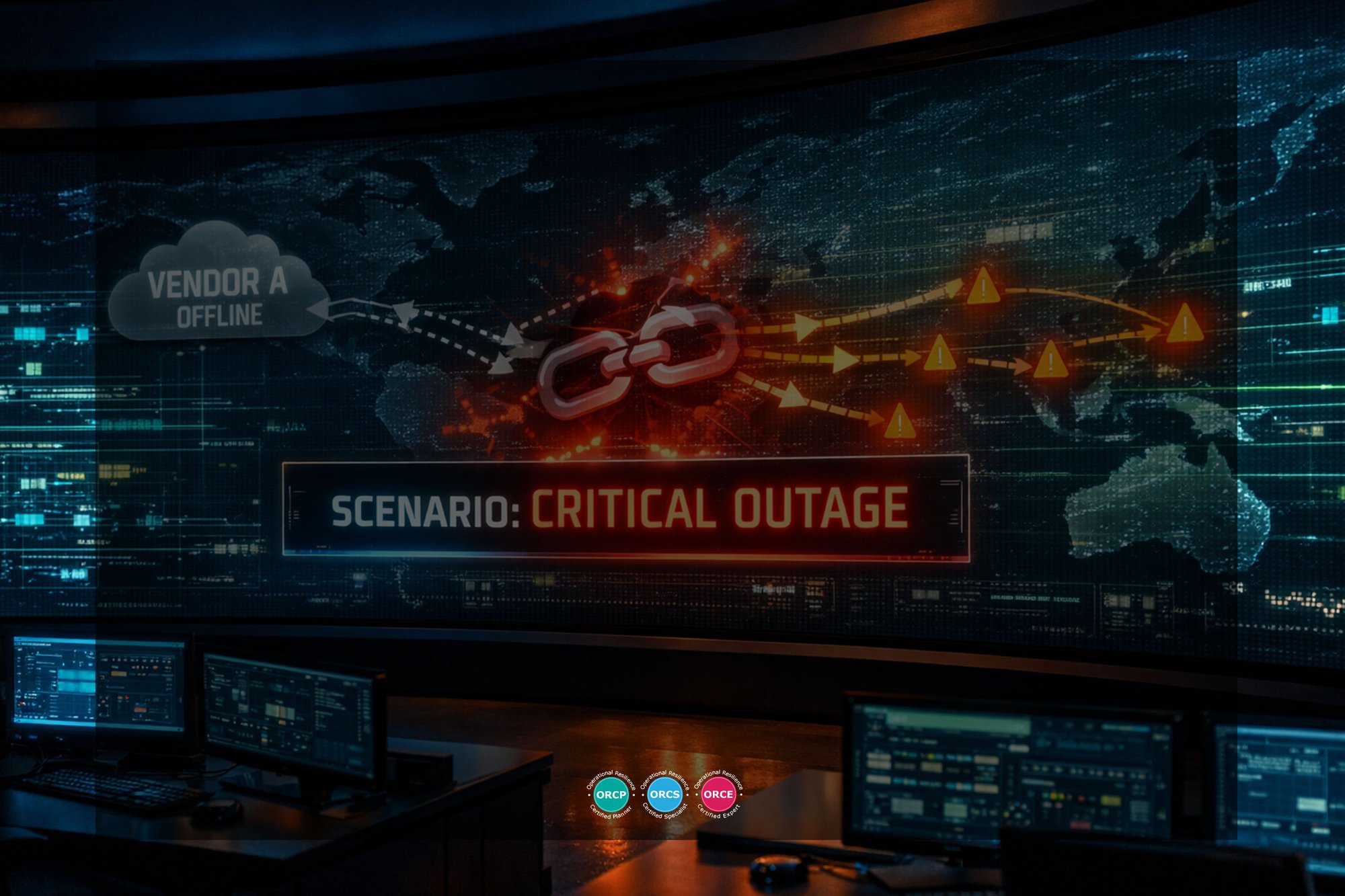
# \[OR\] \[P2\] \[S4\] \[ST\] \[C7\] Scenario Development Framework
[![Banner \[OR\] \[P2\] \[S4\] Conducting Scenario Testing](https://no-cache.hubspot.com/cta/default/3893111/a8ba87ed-c76c-4e8f-b4fa-4eb3aed30b67.png)](https://cta-redirect.hubspot.com/cta/redirect/3893111/a8ba87ed-c76c-4e8f-b4fa-4eb3aed30b67)
Designing severe but plausible scenarios is only the first step; organisations must also adopt a **structured and repeatable framework** to develop, document, and execute these scenarios effectively.
Without a consistent approach, scenario testing can become ad hoc, inconsistent, and difficult to evaluate or compare over time.
A well-defined scenario development framework ensures that scenarios are:
- **Comprehensive** (covering all relevant components)
- **Consistent** (standardised across the organisation)
- **Traceable** (linked to Critical Business Services and dependencies)
- **Actionable** (producing meaningful insights and outcomes)
This chapter introduces a practical framework for building robust scenarios, aligned with operational resilience methodology and supported by structured templates and examples.
[](https://cta-redirect.hubspot.com/cta/redirect/3893111/9589a5fd-463e-499e-a6db-cb1d11448796)
[Moh Heng Goh](https://blog.bcm-institute.org/ebook-or/author/moh-heng-goh) May 11, 2026
###### Operational Resilience Certified Planner-Specialist-Expert
### [](https://cta-redirect.hubspot.com/cta/redirect/3893111/58ea4ab9-998a-451c-bb54-801ae4cb782d)
### \[P2\] \[S4\] Chapter 7
### [![Banner \[OR\] \[P2\] \[S4\] Conducting Scenario Testing](https://no-cache.hubspot.com/cta/default/3893111/a8ba87ed-c76c-4e8f-b4fa-4eb3aed30b67.png)](https://cta-redirect.hubspot.com/cta/redirect/3893111/a8ba87ed-c76c-4e8f-b4fa-4eb3aed30b67)Scenario Development Framework
#### **Introduction**
[![\[OR\] \[P2\] \[S4\] \[ST\] \[C7\] Scenario Development Framework](https://no-cache.hubspot.com/cta/default/3893111/1976475f-5469-473c-a441-cb8c05247055.png)](https://cta-redirect.hubspot.com/cta/redirect/3893111/1976475f-5469-473c-a441-cb8c05247055)
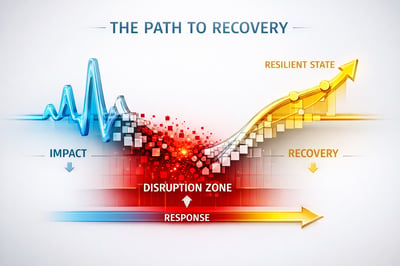Designing severe but plausible scenarios is only the first step; organisations must also adopt a **structured and repeatable framework** to develop, document, and execute these scenarios effectively.
Without a consistent approach, scenario testing can become ad hoc, inconsistent, and difficult to evaluate or compare over time.
A well-defined scenario development framework ensures that scenarios are:
- **Comprehensive** (covering all relevant components)
- **Consistent** (standardised across the organisation)
- **Traceable** (linked to Critical Business Services and dependencies)
- **Actionable** (producing meaningful insights and outcomes)
This chapter introduces a practical framework for building robust scenarios, aligned with operational resilience methodology and supported by structured templates and examples.
#### **Purpose of the Chapter**
The purpose of this chapter is to provide a structured approach to developing scenario testing cases, ensuring alignment with Critical Business Services (CBS), dependency mapping outputs, and impact tolerance objectives.
#### **Core Scenario Components**
A well-developed scenario must include several key components to ensure clarity, realism, and completeness.
##### **Trigger Event**
The trigger event is the **starting point of the scenario**, defining the initial disruption.
Examples include:
- Cyberattack (e.g., ransomware infection)
- Technology failure (e.g., core banking system outage)
- Third-party failure (e.g., payment processor downtime)
- External event (e.g., natural disaster, geopolitical disruption)
The trigger should be:
- Clearly defined
- Relevant to identified risks
- Capable of initiating a chain of disruptions
##### **Affected Critical Business Services (CBS)**
Each scenario must specify the **CBS being tested**.
This includes:
- Primary CBS was directly impacted
- Secondary CBS is indirectly affected through dependencies
Example:
- CBS-2: Payments & Funds Transfer Services
- CBS-1: Deposit and Account Services (indirect impact through transaction processing delays)
This ensures that the scenario remains **service-centric** and aligned with operational resilience objectives.
##### **Disruption Timeline**
The disruption timeline outlines how the scenario unfolds over time.
Typical elements include:
- **T0 (Trigger)**: Initial disruption event
- **T+1**: Immediate impact (e.g., system outage begins)
- **T+2**: Escalation (e.g., backlog of transactions, customer complaints)
- **T+3**: Secondary impacts (e.g., third-party failures, regulatory notifications)
- **T+4**: Recovery phase
A well-defined timeline:
- Introduces realism and progression
- Allows for scenario “injects” during testing
- Enables assessment of response and recovery timing
##### **Dependencies Impacted**
Scenarios must explicitly identify the **dependencies affected by the disruption**, based on mapping outputs.
Key dependency categories include:
- **People**: Key staff unavailability, decision-makers affected
- **Processes**: Disrupted workflows or manual workarounds
- **Technology**: System outages, data corruption, infrastructure failure
- **Third Parties**: Vendor outages, service provider failures
This ensures that the scenario reflects **end-to-end interdependencies**, rather than isolated failures.
#### **Scenario Documentation Template**
To ensure consistency and repeatability, organisations should adopt a **standardised scenario documentation template**.
**Recommended Scenario Template**
| Component | Description |
| --- | --- |
| Scenario ID | Unique identifier |
| Scenario Title | Descriptive name of the scenario |
| CBS Affected | Primary and secondary CBS |
| Trigger Event | Description of the initiating disruption |
| Scenario Description | Narrative of the scenario |
| Disruption Timeline | Step-by-step progression of events |
| Dependencies Impacted | People, process, technology, third-party |
| Impact Tolerance Metrics | MTD, MTDL, service degradation thresholds |
| Expected Outcomes | Objectives of the test |
| Key Injects | Planned scenario developments during testing |
| Participants | Business units and stakeholders involved |
| Success Criteria | Criteria for evaluating performance |
This template provides a **structured and auditable format**, supporting governance, regulatory review, and internal consistency.
#### **Alignment with Dependency Mapping Outputs**
Scenario development must be tightly aligned with the outputs from **dependency mapping (Stage 2)**.
##### **Key Alignment Areas**
- **Traceability**:
Each impacted dependency should be traceable to mapping tables (people, process, technology, third parties)
- **Critical Path Identification**:
Focus on dependencies that are essential to CBS delivery
- **Interdependency Validation**:
Ensure that scenarios reflect how disruptions propagate across interconnected components
##### **Example Alignment**
| Dependency Type | Mapping Output | Scenario Application |
| --- | --- | --- |
| Technology | Core payment system | Simulate system outage |
| Third Party | External clearing network | Introduce a delay in settlement |
| People | Operations team | Test reduced staffing scenario |
| Process | Payment reconciliation | Assess backlog handling |
By leveraging mapping outputs, scenarios become:
- **Data-driven**
- **Realistic**
- **Aligned with actual operational structures**
#### **Example Scenario Structures**
To illustrate the framework, the following are examples of structured scenarios.
##### **Example 1: Cyberattack on Payment Processing System**
**Scenario Title:** Ransomware Attack on Payments Platform
- **CBS Affected:**
- **Trigger Event:**
- **Timeline:**
- **Dependencies Impacted:**
- **Objective:**
##### **Example 2: Third-Party Service Outage**
**Scenario Title:** Failure of External Clearing Network
- **CBS Affected:**
- **Trigger Event:**
- **Timeline:**
- **Dependencies Impacted:**
- **Objective:**
##### **Example 3: Combined Scenario (Cascading Effects)**
**Scenario Title:** Cyberattack with Staff Unavailability
- **CBS Affected:**
- **Trigger Event:**
- **Timeline:**
- **Dependencies Impacted:**
- **Objective:**
[![Banner \[Summing\] \[OR\] \[E3\] Perform Scenario Testing](https://no-cache.hubspot.com/cta/default/3893111/11895c06-91e9-4cec-acb6-4356741952e4.png)](https://cta-redirect.hubspot.com/cta/redirect/3893111/11895c06-91e9-4cec-acb6-4356741952e4)
A structured scenario development framework is essential for ensuring that scenario testing is consistent, comprehensive, and aligned with operational resilience objectives.
By clearly defining scenario components, adopting standardised documentation templates, and aligning with dependency mapping outputs, organisations can develop scenarios that are both realistic and impactful.
Well-constructed scenarios enable organisations to test not only individual components but also the **complex interdependencies that underpin Critical Business Services**.
They provide the foundation for meaningful testing, robust evaluation, and continuous improvement.
Ultimately, a disciplined approach to scenario development transforms testing from a theoretical exercise into a **powerful tool for resilience validation and organisational learning**, ensuring that organisations are prepared for real-world disruptions.
[](https://cta-redirect.hubspot.com/cta/redirect/3893111/528ff540-9963-430c-9ca6-c102ce4270df)
| **C1** | **C2** | **C3** | **C4** | **C5** |
| --- | --- | --- | --- | --- |
| [![\[OR\] \[P2\] \[S4\] \[ST\] \[C1\] Introduction to Scenario Testing](https://no-cache.hubspot.com/cta/default/3893111/910c0230-708f-4661-a87e-56cb7cbd2b37.png)](https://cta-redirect.hubspot.com/cta/redirect/3893111/910c0230-708f-4661-a87e-56cb7cbd2b37) | [![\[OR\] \[P2\] \[S4\] \[ST\] \[C2\] Regulatory and Standards Context](https://no-cache.hubspot.com/cta/default/3893111/e21c745f-5f7c-4c8b-b845-7a8712b2a67d.png)](https://cta-redirect.hubspot.com/cta/redirect/3893111/e21c745f-5f7c-4c8b-b845-7a8712b2a67d) | [![\[OR\] \[P2\] \[S4\] \[ST\] \[C3\] Objectives of Scenario Testing](https://no-cache.hubspot.com/cta/default/3893111/d2eb2181-1303-4ca7-89a2-d717dc5e972f.png)](https://cta-redirect.hubspot.com/cta/redirect/3893111/d2eb2181-1303-4ca7-89a2-d717dc5e972f) | [![\[OR\] \[P2\] \[S4\] \[ST\] \[C4\] Scenario Testing within the Operational Resilience Framework](https://no-cache.hubspot.com/cta/default/3893111/c7c5fe26-c69a-4176-be52-c7ba8939ca8c.png)](https://cta-redirect.hubspot.com/cta/redirect/3893111/c7c5fe26-c69a-4176-be52-c7ba8939ca8c) | [![\[OR\] \[P2\] \[S4\] \[ST\] \[C5\] Types of Scenario Testing](https://no-cache.hubspot.com/cta/default/3893111/3756e6ec-bf7e-462f-9f8c-52d15f718c81.png)](https://cta-redirect.hubspot.com/cta/redirect/3893111/3756e6ec-bf7e-462f-9f8c-52d15f718c81) |
| **C6** | **C7** | **C8** | **C9** | **C10** |
| [![\[OR\] \[P2\] \[S4\] \[ST\] \[C6\] Designing Severe but Plausible Scenarios](https://no-cache.hubspot.com/cta/default/3893111/07cc13e4-e1eb-4bb4-b257-d155b9a30cd4.png)](https://cta-redirect.hubspot.com/cta/redirect/3893111/07cc13e4-e1eb-4bb4-b257-d155b9a30cd4) | [![\[OR\] \[P2\] \[S4\] \[ST\] \[C7\] Scenario Development Framework](https://no-cache.hubspot.com/cta/default/3893111/1976475f-5469-473c-a441-cb8c05247055.png)](https://cta-redirect.hubspot.com/cta/redirect/3893111/1976475f-5469-473c-a441-cb8c05247055) | [![\[OR\] \[P2\] \[S4\] \[ST\] \[C8\] Mapping Dependencies for Scenario Testing](https://no-cache.hubspot.com/cta/default/3893111/3934df2c-a632-4331-809e-62f4ac791efd.png)](https://cta-redirect.hubspot.com/cta/redirect/3893111/3934df2c-a632-4331-809e-62f4ac791efd) | [![\[OR\] \[P2\] \[S4\] \[ST\] \[C9\] Setting Testing Scope and Boundaries](https://no-cache.hubspot.com/cta/default/3893111/0ff8be42-fbfa-4777-880d-855094a0def4.png)](https://cta-redirect.hubspot.com/cta/redirect/3893111/0ff8be42-fbfa-4777-880d-855094a0def4) | [![\[OR\] \[P2\] \[S4\] \[ST\] \[C10\] Executing Scenario Testing](https://no-cache.hubspot.com/cta/default/3893111/b68def17-a3fd-412a-9a11-3e55c24c51f9.png)](https://cta-redirect.hubspot.com/cta/redirect/3893111/b68def17-a3fd-412a-9a11-3e55c24c51f9) |
| **C11** | **C12** | **C13** | **C14** | **C15** |
| [![\[OR\] \[P2\] \[S4\] \[ST\] \[C11\] Metrics and Evaluation of Results](https://no-cache.hubspot.com/cta/default/3893111/ca1ee7cd-3a0b-4460-8ed2-90b89f2d2761.png)](https://cta-redirect.hubspot.com/cta/redirect/3893111/ca1ee7cd-3a0b-4460-8ed2-90b89f2d2761) | [![\[OR\] \[P2\] \[S4\] \[ST\] \[C12\] Scenario Testing Output and Reporting](https://no-cache.hubspot.com/cta/default/3893111/36ab22b4-9316-413d-ab9c-5d945f6009b2.png)](https://cta-redirect.hubspot.com/cta/redirect/3893111/36ab22b4-9316-413d-ab9c-5d945f6009b2) | [![\[OR\] \[P2\] \[S4\] \[ST\] \[C13\] Common Challenges and Pitfalls](https://no-cache.hubspot.com/cta/default/3893111/9fb81eaf-a3eb-4192-b607-48c6ac3277da.png)](https://cta-redirect.hubspot.com/cta/redirect/3893111/9fb81eaf-a3eb-4192-b607-48c6ac3277da) | [![\[OR\] \[P2\] \[S4\] \[ST\] \[C14\] Overcoming Challenges in Scenario Testing](https://no-cache.hubspot.com/cta/default/3893111/f9660d67-9e43-45fe-a52d-4c9ca2812c83.png)](https://cta-redirect.hubspot.com/cta/redirect/3893111/f9660d67-9e43-45fe-a52d-4c9ca2812c83) | [![\[OR\] \[P2\] \[S4\] \[ST\] \[C15\] Integrating Scenario Testing with Risk Management and BCM](https://no-cache.hubspot.com/cta/default/3893111/2334c95f-f874-4b14-b348-779c63730269.png)](https://cta-redirect.hubspot.com/cta/redirect/3893111/2334c95f-f874-4b14-b348-779c63730269) |
| **C16** | **C17** | **C18** | **C19** | **C20** |
| [![\[OR\] \[P2\] \[S4\] \[ST\] \[C16\] Continuous Improvement and Lessons Learned](https://no-cache.hubspot.com/cta/default/3893111/62af1507-9de8-42d4-b519-adc3e945a7f3.png)](https://cta-redirect.hubspot.com/cta/redirect/3893111/62af1507-9de8-42d4-b519-adc3e945a7f3) | [![\[OR\] \[P2\] \[S4\] \[ST\] \[C17\] Practical Case Study (Banking Sector Example)](https://no-cache.hubspot.com/cta/default/3893111/fed5643b-1564-4177-a2d9-7fc4f4049a5c.png)](https://cta-redirect.hubspot.com/cta/redirect/3893111/fed5643b-1564-4177-a2d9-7fc4f4049a5c) | [![\[OR\] \[P2\] \[S4\] \[ST\] \[C18\] Future Trends in Scenario Testing](https://no-cache.hubspot.com/cta/default/3893111/c0547827-8e71-4c91-8c44-b4d2d2b81526.png)](https://cta-redirect.hubspot.com/cta/redirect/3893111/c0547827-8e71-4c91-8c44-b4d2d2b81526) | [![\[OR\] \[P2\] \[S4\] \[ST\] \[C19\] Key Takeaways and Call to Action](https://no-cache.hubspot.com/cta/default/3893111/8d431102-ed70-4707-ac87-e750e4db29de.png)](https://cta-redirect.hubspot.com/cta/redirect/3893111/8d431102-ed70-4707-ac87-e750e4db29de) | [![\[OR\] \[P2\] \[S4\] \[ST\] \[C20\] Back Cover](https://no-cache.hubspot.com/cta/default/3893111/fbb82511-9fd7-4ed9-aaa9-dc8aad0ea177.png)](https://cta-redirect.hubspot.com/cta/redirect/3893111/fbb82511-9fd7-4ed9-aaa9-dc8aad0ea177) |
#### More Information About OR-5000 \[OR-5\] or OR-300 \[OR-3\]
To learn more about the course and schedule, click the buttons below for the OR-300 Operational Resilience Implementer and OR-5000 Operational Resilience Expert Implementer courses.
| [](https://cta-redirect.hubspot.com/cta/redirect/3893111/3530eccb-515d-401e-afc2-3469e26d7fbf) | [](https://cta-redirect.hubspot.com/cta/redirect/3893111/fdd4fa9c-ed69-40c1-925f-4eb6a1c5c255) | [](https://cta-redirect.hubspot.com/cta/redirect/3893111/77a34b84-0a6d-44f8-b8d6-6ab04cdf5edd) |
| --- | --- | --- |
| [](https://cta-redirect.hubspot.com/cta/redirect/3893111/6e5c0cda-39b9-4bbd-b3d4-4cf46a790b14) | [](https://cta-redirect.hubspot.com/cta/redirect/3893111/a68a08aa-36d3-4216-9551-202c9fde06ea) | [![ \[BL-OR\] \[3-4-5\] View Schedule](https://no-cache.hubspot.com/cta/default/3893111/d0d733a1-16c0-4b68-a26d-adbfd4fc6069.png)](https://cta-redirect.hubspot.com/cta/redirect/3893111/d0d733a1-16c0-4b68-a26d-adbfd4fc6069) |
| [![\[BL-OR\] \[3\] FAQ OR-300](https://no-cache.hubspot.com/cta/default/3893111/f20c71b4-f5e8-4aa5-8056-c374ca33a091.png)](https://cta-redirect.hubspot.com/cta/redirect/3893111/f20c71b4-f5e8-4aa5-8056-c374ca33a091) | If you have any questions, click to contact us.[![Email to Sales Team \[BCM Institute\]](https://no-cache.hubspot.com/cta/default/3893111/3c53daeb-2836-4843-b0e0-645baee2ab9e.png)](https://cta-redirect.hubspot.com/cta/redirect/3893111/3c53daeb-2836-4843-b0e0-645baee2ab9e) | [](https://cta-redirect.hubspot.com/cta/redirect/3893111/7f2718a4-ea80-4f84-a319-dc2d4df37a46) |
| [](https://cta-redirect.hubspot.com/cta/redirect/3893111/74b1e556-8cd2-4a74-8821-db1804534955) | [](https://cta-redirect.hubspot.com/cta/redirect/3893111/f2bd8eb1-32d2-4732-9267-ea53223cf58f) | [](https://cta-redirect.hubspot.com/cta/redirect/3893111/084e620a-46c5-419a-82ed-6a681d15c0b6) |
#### **Comments:**
---

---

---
---


All rights reserved. Copyright 2026
```json
{
"@context" : "https://schema.org",
"@type" : "BlogPosting",
"author" : {
"@type" : "Person",
"name" : "Moh Heng Goh",
"url" : "https://blog.bcm-institute.org/ebook-or/author/moh-heng-goh"
},
"dateModified" : "2026-05-11T09:37:33.132Z",
"datePublished" : "2026-05-11T09:37:23.000Z",
"headline" : "[OR] [P2] [S4] [ST] [C7] Scenario Development Framework",
"mainEntityOfPage" : {
"@id" : "https://blog.bcm-institute.org/ebook-or/or-p2-s4-st-c7-scenario-development-framework",
"@type" : "WebPage"
},
"publisher" : {
"@type" : "Organization",
"logo" : {
"@type" : "ImageObject",
"url" : "https://blog.bcm-institute.org/hubfs/BCMI%20Logo.png"
},
"name" : "BCMI Pte Ltd"
}
}
```