

[P2] [S4] Chapter 3
![Banner [OR] [P2] [S4] Conducting Scenario Testing](https://no-cache.hubspot.com/cta/default/3893111/a8ba87ed-c76c-4e8f-b4fa-4eb3aed30b67.png) Objectives of Scenario Testing
Objectives of Scenario Testing
Introduction
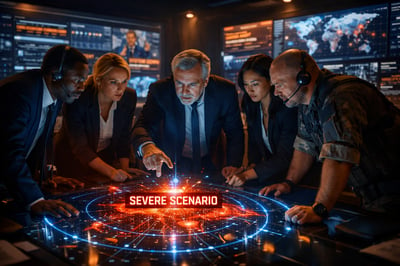
![[OR] [P2] [S4] [ST] [C3] Objectives of Scenario Testing](https://no-cache.hubspot.com/cta/default/3893111/d2eb2181-1303-4ca7-89a2-d717dc5e972f.png) Scenario testing is a cornerstone of operational resilience implementation, shifting organisations from theoretical preparedness to practical validation of their ability to withstand and recover from disruptions.
Scenario testing is a cornerstone of operational resilience implementation, shifting organisations from theoretical preparedness to practical validation of their ability to withstand and recover from disruptions.
Unlike traditional business continuity exercises that focus primarily on plan effectiveness, scenario testing evaluates whether Critical Business Services (CBS) can continue to operate within defined impact tolerances under severe but plausible conditions.
This reflects a fundamental transition from process-centric testing to service-centric resilience validation.
In today’s increasingly complex and interconnected operating environment, organisations face a wide spectrum of risks—from cyberattacks and technology failures to third-party disruptions and systemic crises.
Scenario testing provides a structured mechanism to simulate these disruptions, enabling organisations to assess their readiness, uncover weaknesses, and strengthen their resilience posture. It is not merely a compliance exercise but a strategic tool to ensure sustained service delivery and stakeholder confidence.
Purpose of the Chapter
The purpose of this chapter is to define the key objectives of scenario testing and to clarify what organisations should aim to achieve when designing and executing such tests as part of their operational resilience framework.
Validate Ability to Remain Within Impact Tolerance
The primary objective of scenario testing is to determine whether an organisation can continue delivering its critical services within predefined impact tolerance thresholds during a disruption.
This involves:
- Assessing whether service degradation remains within acceptable limits (e.g., downtime, data loss, transaction delays)
- Measuring actual performance against established thresholds such as Maximum Tolerable Downtime (MTD) and Maximum Tolerable Data Loss (MTDL)
- Identifying scenarios where tolerances are breached and understanding why
By testing against impact tolerances, organisations move beyond theoretical assumptions and gain empirical evidence of their resilience capabilities. This ensures that resilience strategies are not only documented but also operationally effective under stress conditions.
Identify Vulnerabilities and Single Points of Failure
Scenario testing is designed to expose weaknesses that may not be evident during normal operations or through static risk assessments.
Key focus areas include:
- Single points of failure in critical systems or processes
- Over-reliance on specific individuals or teams (key person risk)
- Technology dependencies with limited redundancy
- Third-party or vendor concentration risks
Through realistic disruption scenarios, organisations can uncover hidden vulnerabilities and prioritise remediation actions.
This objective is critical in preventing cascading failures that could significantly impact service delivery.
Test Interdependencies Across the Organisation
Operational resilience depends heavily on the seamless functioning of interconnected components across the organisation and its external ecosystem.
Scenario testing aims to validate these interdependencies.
The key dimensions include:
- People: Availability of skilled personnel, decision-makers, and operational teams
- Processes: Workflow continuity and process adaptability under disruption
- Technology: System performance, failover mechanisms, and data integrity
- Third Parties: Vendors, service providers, and outsourced functions
Testing interdependencies enables organisations to:
- Understand how disruptions propagate across systems and functions
- Identify critical dependency chains and bottlenecks
- Assess the resilience of the broader service delivery ecosystem
This objective reinforces the importance of end-to-end testing of CBS, rather than isolated component testing.
Assess Response, Recovery, and Decision-Making Capabilities
Scenario testing evaluates not only systems and processes but also the organisation’s human and governance response during a crisis.
This includes:
- Effectiveness of incident response and escalation procedures
- Timeliness and appropriateness of decision-making under pressure
- Coordination across business units, functions, and leadership teams
- Execution of recovery strategies and restoration of services
Particular emphasis is placed on:
- Crisis management capabilities, including communication and command structures
- Situational awareness, including access to accurate and timely information
- Adaptability, where teams must respond to evolving scenarios
By assessing these elements, organisations can determine whether their response frameworks are robust, agile, and capable of managing real-world disruptions.
Provide Evidence for Regulators and Senior Management
Regulators increasingly require organisations to demonstrate—not just assert—their resilience capabilities.
Scenario testing provides the evidence base for such assurance.
Key outcomes include:
- Documented results showing whether impact tolerances were met or breached
- Evidence of testing critical business services under severe but plausible conditions
- Identification of gaps and corresponding remediation plans
- Audit trails supporting regulatory reviews and supervisory assessments
For senior management and the Board, scenario testing provides:
- Clear visibility of organisational resilience strengths and weaknesses
- Data-driven insights to support strategic decision-making
- Assurance that resilience investments are effective
This objective ensures that scenario testing is integrated into governance, risk management, and regulatory compliance frameworks, reinforcing accountability at the highest levels.
![Banner [Summing] [OR] [E3] Perform Scenario Testing](https://no-cache.hubspot.com/cta/default/3893111/11895c06-91e9-4cec-acb6-4356741952e4.png)
Scenario testing serves multiple, interrelated objectives that collectively strengthen an organisation’s operational resilience.
It validates whether critical services can withstand disruption, uncovers vulnerabilities, tests interdependencies, evaluates response capabilities, and provides tangible evidence for stakeholders.
Importantly, these objectives reflect a shift from viewing testing as a periodic compliance activity to recognising it as a continuous, strategic capability.
When executed effectively, scenario testing not only identifies weaknesses but also drives improvement, enhances organisational learning, and builds confidence in the organisation’s ability to operate through disruption.
As organisations progress in their operational resilience journey, clearly defined objectives for scenario testing will ensure that testing activities remain focused, meaningful, and aligned with both regulatory expectations and real-world risk environments.

![[OR] [P2] [S4] [ST] [C1] Introduction to Scenario Testing](https://no-cache.hubspot.com/cta/default/3893111/910c0230-708f-4661-a87e-56cb7cbd2b37.png)
![[OR] [P2] [S4] [ST] [C2] Regulatory and Standards Context](https://no-cache.hubspot.com/cta/default/3893111/e21c745f-5f7c-4c8b-b845-7a8712b2a67d.png)
![[OR] [P2] [S4] [ST] [C4] Scenario Testing within the Operational Resilience Framework](https://no-cache.hubspot.com/cta/default/3893111/c7c5fe26-c69a-4176-be52-c7ba8939ca8c.png)
![[OR] [P2] [S4] [ST] [C5] Types of Scenario Testing](https://no-cache.hubspot.com/cta/default/3893111/3756e6ec-bf7e-462f-9f8c-52d15f718c81.png)
![[OR] [P2] [S4] [ST] [C6] Designing Severe but Plausible Scenarios](https://no-cache.hubspot.com/cta/default/3893111/07cc13e4-e1eb-4bb4-b257-d155b9a30cd4.png)
![[OR] [P2] [S4] [ST] [C7] Scenario Development Framework](https://no-cache.hubspot.com/cta/default/3893111/1976475f-5469-473c-a441-cb8c05247055.png)
![[OR] [P2] [S4] [ST] [C8] Mapping Dependencies for Scenario Testing](https://no-cache.hubspot.com/cta/default/3893111/3934df2c-a632-4331-809e-62f4ac791efd.png)
![[OR] [P2] [S4] [ST] [C9] Setting Testing Scope and Boundaries](https://no-cache.hubspot.com/cta/default/3893111/0ff8be42-fbfa-4777-880d-855094a0def4.png)
![[OR] [P2] [S4] [ST] [C10] Executing Scenario Testing](https://no-cache.hubspot.com/cta/default/3893111/b68def17-a3fd-412a-9a11-3e55c24c51f9.png)
![[OR] [P2] [S4] [ST] [C11] Metrics and Evaluation of Results](https://no-cache.hubspot.com/cta/default/3893111/ca1ee7cd-3a0b-4460-8ed2-90b89f2d2761.png)
![[OR] [P2] [S4] [ST] [C12] Scenario Testing Output and Reporting](https://no-cache.hubspot.com/cta/default/3893111/36ab22b4-9316-413d-ab9c-5d945f6009b2.png)
![[OR] [P2] [S4] [ST] [C13] Common Challenges and Pitfalls](https://no-cache.hubspot.com/cta/default/3893111/9fb81eaf-a3eb-4192-b607-48c6ac3277da.png)
![[OR] [P2] [S4] [ST] [C14] Overcoming Challenges in Scenario Testing](https://no-cache.hubspot.com/cta/default/3893111/f9660d67-9e43-45fe-a52d-4c9ca2812c83.png)
![[OR] [P2] [S4] [ST] [C15] Integrating Scenario Testing with Risk Management and BCM](https://no-cache.hubspot.com/cta/default/3893111/2334c95f-f874-4b14-b348-779c63730269.png)
![[OR] [P2] [S4] [ST] [C16] Continuous Improvement and Lessons Learned](https://no-cache.hubspot.com/cta/default/3893111/62af1507-9de8-42d4-b519-adc3e945a7f3.png)
![[OR] [P2] [S4] [ST] [C17] Practical Case Study (Banking Sector Example)](https://no-cache.hubspot.com/cta/default/3893111/fed5643b-1564-4177-a2d9-7fc4f4049a5c.png)
![[OR] [P2] [S4] [ST] [C18] Future Trends in Scenario Testing](https://no-cache.hubspot.com/cta/default/3893111/c0547827-8e71-4c91-8c44-b4d2d2b81526.png)
![[OR] [P2] [S4] [ST] [C19] Key Takeaways and Call to Action](https://no-cache.hubspot.com/cta/default/3893111/8d431102-ed70-4707-ac87-e750e4db29de.png)
![[OR] [P2] [S4] [ST] [C20] Back Cover](https://no-cache.hubspot.com/cta/default/3893111/fbb82511-9fd7-4ed9-aaa9-dc8aad0ea177.png)
More Information About OR-5000 [OR-5] or OR-300 [OR-3]
To learn more about the course and schedule, click the buttons below for the OR-300 Operational Resilience Implementer and OR-5000 Operational Resilience Expert Implementer courses.


![[BL-OR] [3-4-5] View Schedule](https://no-cache.hubspot.com/cta/default/3893111/d0d733a1-16c0-4b68-a26d-adbfd4fc6069.png)
![[BL-OR] [3] FAQ OR-300](https://no-cache.hubspot.com/cta/default/3893111/f20c71b4-f5e8-4aa5-8056-c374ca33a091.png)
![Email to Sales Team [BCM Institute]](https://no-cache.hubspot.com/cta/default/3893111/3c53daeb-2836-4843-b0e0-645baee2ab9e.png)







