

[P2] [S4] Chapter 19
![Banner [OR] [P2] [S4] Conducting Scenario Testing](https://no-cache.hubspot.com/cta/default/3893111/a8ba87ed-c76c-4e8f-b4fa-4eb3aed30b67.png) Key Takeaways and Call to Action
Key Takeaways and Call to Action
Introduction
![[OR] [P2] [S4] [ST] [C19] Key Takeaways and Call to Action](https://no-cache.hubspot.com/cta/default/3893111/8d431102-ed70-4707-ac87-e750e4db29de.png)
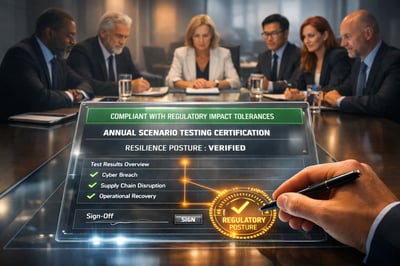
Scenario testing has emerged as a defining capability in operational resilience.
Throughout this eBook, we have explored its role in validating whether organisations can continue delivering Critical Business Services (CBS) within defined impact tolerances during disruption.
The journey from designing scenarios to executing tests, evaluating results, and embedding improvements highlights a fundamental shift: resilience is no longer about having plans—it is about proving performance under stress.
This final chapter consolidates the key takeaways and provides a practical call to action for organisations seeking to implement or enhance their scenario testing capability.
Purpose of the Chapter
The purpose of this chapter is to summarise the key concepts and drive implementation. It reinforces scenario testing as a core resilience capability, highlights the shift from compliance to resilience maturity, emphasises critical success factors, and provides a practical roadmap for organisations.
Scenario Testing as a Core Resilience Capability
Scenario testing is not a standalone activity—it is the central mechanism for validating operational resilience.
From Plans to Performance
Traditional approaches focused on:
- Documenting business continuity plans
- Defining recovery objectives
Modern resilience requires:
- Demonstrating the ability to operate under disruption
- Validating real-world response and recovery
Assurance to Stakeholders
Scenario testing assures:
- Regulators (evidence of resilience)
- Senior management (decision-making confidence)
- Customers (service continuity)
Continuous Validation
Resilience is not static. Scenario testing ensures that:
- Capabilities are regularly validated
- Changes in risk and environment are reflected
- Weaknesses are identified and addressed
Shift from Compliance to Resilience Maturity
A key theme across this eBook is the transition from compliance-driven testing to resilience maturity.
Compliance-Focused Approach
- Periodic testing to meet regulatory requirements
- Limited scope and complexity
- Focus on documentation and reporting
Resilience-Mature Approach
- Regular, risk-based scenario testing
- End-to-end validation of CBS
- Integration across risk, BCM, crisis management, and technology
- Continuous improvement and learning
Characteristics of Mature Organisations
Resilience-mature organisations:
- Test severe but plausible scenarios
- Use data and intelligence to design tests
- Engage senior leadership and cross-functional teams
- Embed testing into governance and strategy
This shift is essential to remain resilient in an increasingly complex risk landscape.
Critical Success Factors
Successful scenario testing programmes are built on several key principles.
Service-Centric Testing
- Focus on Critical Business Services (CBS) rather than individual processes
- Validate end-to-end service delivery
- Measure outcomes based on customer and stakeholder impact
Severe but Plausible Scenarios
- Design realistic and challenging scenarios
- Incorporate cascading failures and interdependencies
- Reflect both internal and external risk factors
Integration Across Resilience Pillars
- Align with Operational Risk Management
- Validate Business Continuity and Crisis Management capabilities
- Incorporate cyber and third-party risks
Strong Governance and Leadership
- Ensure board and senior management oversight
- Define clear accountability and ownership
- Integrate scenario testing into governance frameworks
Continuous Improvement
- Capture lessons learned from each test
- Update CBS mapping and impact tolerances
- Implement and track remediation actions
These success factors ensure that scenario testing delivers meaningful and sustained value.
Practical Roadmap for Implementation
Organisations at different stages of maturity can adopt a structured roadmap to implement or enhance scenario testing.
Step 1: Establish Foundations
- Identify Critical Business Services (CBS)
- Define impact tolerances (e.g., downtime, customer impact)
- Map dependencies (people, process, technology, third-party)
- Establish governance and ownership
Step 2: Design Scenario Testing Framework
- Develop scenario testing policy and methodology
- Define scope and prioritisation criteria
- Design severe but plausible scenarios
- Establish metrics and success criteria
Step 3: Execute Scenario Testing
- Conduct structured scenario exercises
- Involve cross-functional teams and leadership
- Simulate realistic disruptions with injects and escalation
- Capture real-time observations and performance data
Step 4: Evaluate and Report Results
- Measure performance against impact tolerance
- Conduct qualitative and quantitative assessments
- Perform gap analysis and root cause identification
- Produce structured reports and dashboards
Step 5: Implement Improvements
- Develop remediation action plans
- Update risk registers and controls
- Enhance BCM, crisis management, and technology capabilities
- Strengthen third-party resilience
Step 6: Embed Continuous Improvement
- Conduct post-exercise reviews
- Update CBS mapping and impact tolerances
- Refine scenarios based on emerging risks
- Track progress and maturity over time
Step 7: Advance to the Mature State
- Expand to enterprise-wide and ecosystem testing
- Leverage technology and analytics
- Integrate real-time monitoring
- Participate in sector-wide resilience initiatives
Call to Action
Organisations must move decisively to embed scenario testing as a core resilience capability. The following actions are recommended:
Assess Your Current State
- Evaluate your current scenario testing maturity
- Identify gaps in scope, execution, and integration
Start Small, Scale
- Begin with focused scenarios on key CBS
- Gradually increase complexity and scope
Engage Leadership
- Secure commitment from senior management and the board
- Involve leadership in scenario execution and decision-making
Invest in Capability and Tools
- Build internal expertise in scenario design and execution
- Leverage technology for simulation and analytics
Integrate Across the Organisation
- Align scenario testing with risk, BCM, crisis, and cyber functions
- Break down silos and enhance collaboration
Commit to Continuous Improvement
- Treat every test as a learning opportunity
- Embed lessons learned into strategy and operations
![Banner [Summing] [OR] [E3] Perform Scenario Testing](https://no-cache.hubspot.com/cta/default/3893111/11895c06-91e9-4cec-acb6-4356741952e4.png)
Scenario testing is no longer optional—it is a strategic imperative for organisations seeking to achieve operational resilience. It provides the means to validate capabilities, identify weaknesses, and build confidence in the organisation’s ability to withstand disruption.
By adopting a service-centric, integrated, and continuously improving approach, organisations can move beyond compliance and achieve true resilience maturity. The roadmap outlined in this chapter offers a practical path forward.
The call to action is clear: start, scale, and sustain scenario testing as a core organisational capability—ensuring that critical business services can be delivered, no matter the disruption.

![[OR] [P2] [S4] [ST] [C1] Introduction to Scenario Testing](https://no-cache.hubspot.com/cta/default/3893111/910c0230-708f-4661-a87e-56cb7cbd2b37.png)
![[OR] [P2] [S4] [ST] [C2] Regulatory and Standards Context](https://no-cache.hubspot.com/cta/default/3893111/e21c745f-5f7c-4c8b-b845-7a8712b2a67d.png)
![[OR] [P2] [S4] [ST] [C3] Objectives of Scenario Testing](https://no-cache.hubspot.com/cta/default/3893111/d2eb2181-1303-4ca7-89a2-d717dc5e972f.png)
![[OR] [P2] [S4] [ST] [C4] Scenario Testing within the Operational Resilience Framework](https://no-cache.hubspot.com/cta/default/3893111/c7c5fe26-c69a-4176-be52-c7ba8939ca8c.png)
![[OR] [P2] [S4] [ST] [C5] Types of Scenario Testing](https://no-cache.hubspot.com/cta/default/3893111/3756e6ec-bf7e-462f-9f8c-52d15f718c81.png)
![[OR] [P2] [S4] [ST] [C6] Designing Severe but Plausible Scenarios](https://no-cache.hubspot.com/cta/default/3893111/07cc13e4-e1eb-4bb4-b257-d155b9a30cd4.png)
![[OR] [P2] [S4] [ST] [C7] Scenario Development Framework](https://no-cache.hubspot.com/cta/default/3893111/1976475f-5469-473c-a441-cb8c05247055.png)
![[OR] [P2] [S4] [ST] [C8] Mapping Dependencies for Scenario Testing](https://no-cache.hubspot.com/cta/default/3893111/3934df2c-a632-4331-809e-62f4ac791efd.png)
![[OR] [P2] [S4] [ST] [C9] Setting Testing Scope and Boundaries](https://no-cache.hubspot.com/cta/default/3893111/0ff8be42-fbfa-4777-880d-855094a0def4.png)
![[OR] [P2] [S4] [ST] [C10] Executing Scenario Testing](https://no-cache.hubspot.com/cta/default/3893111/b68def17-a3fd-412a-9a11-3e55c24c51f9.png)
![[OR] [P2] [S4] [ST] [C11] Metrics and Evaluation of Results](https://no-cache.hubspot.com/cta/default/3893111/ca1ee7cd-3a0b-4460-8ed2-90b89f2d2761.png)
![[OR] [P2] [S4] [ST] [C12] Scenario Testing Output and Reporting](https://no-cache.hubspot.com/cta/default/3893111/36ab22b4-9316-413d-ab9c-5d945f6009b2.png)
![[OR] [P2] [S4] [ST] [C13] Common Challenges and Pitfalls](https://no-cache.hubspot.com/cta/default/3893111/9fb81eaf-a3eb-4192-b607-48c6ac3277da.png)
![[OR] [P2] [S4] [ST] [C14] Overcoming Challenges in Scenario Testing](https://no-cache.hubspot.com/cta/default/3893111/f9660d67-9e43-45fe-a52d-4c9ca2812c83.png)
![[OR] [P2] [S4] [ST] [C15] Integrating Scenario Testing with Risk Management and BCM](https://no-cache.hubspot.com/cta/default/3893111/2334c95f-f874-4b14-b348-779c63730269.png)
![[OR] [P2] [S4] [ST] [C16] Continuous Improvement and Lessons Learned](https://no-cache.hubspot.com/cta/default/3893111/62af1507-9de8-42d4-b519-adc3e945a7f3.png)
![[OR] [P2] [S4] [ST] [C17] Practical Case Study (Banking Sector Example)](https://no-cache.hubspot.com/cta/default/3893111/fed5643b-1564-4177-a2d9-7fc4f4049a5c.png)
![[OR] [P2] [S4] [ST] [C18] Future Trends in Scenario Testing](https://no-cache.hubspot.com/cta/default/3893111/c0547827-8e71-4c91-8c44-b4d2d2b81526.png)
![[OR] [P2] [S4] [ST] [C20] Back Cover](https://no-cache.hubspot.com/cta/default/3893111/fbb82511-9fd7-4ed9-aaa9-dc8aad0ea177.png)
More Information About OR-5000 [OR-5] or OR-300 [OR-3]
To learn more about the course and schedule, click the buttons below for the OR-300 Operational Resilience Implementer and OR-5000 Operational Resilience Expert Implementer courses.


![[BL-OR] [3-4-5] View Schedule](https://no-cache.hubspot.com/cta/default/3893111/d0d733a1-16c0-4b68-a26d-adbfd4fc6069.png)
![[BL-OR] [3] FAQ OR-300](https://no-cache.hubspot.com/cta/default/3893111/f20c71b4-f5e8-4aa5-8056-c374ca33a091.png)
![Email to Sales Team [BCM Institute]](https://no-cache.hubspot.com/cta/default/3893111/3c53daeb-2836-4843-b0e0-645baee2ab9e.png)