
[P2] [S4] Chapter 18
![Banner [OR] [P2] [S4] Conducting Scenario Testing](https://no-cache.hubspot.com/cta/default/3893111/a8ba87ed-c76c-4e8f-b4fa-4eb3aed30b67.png) Future Trends in Scenario Testing
Future Trends in Scenario Testing
Introduction
![[OR] [P2] [S4] [ST] [C18] Future Trends in Scenario Testing](https://no-cache.hubspot.com/cta/default/3893111/c0547827-8e71-4c91-8c44-b4d2d2b81526.png)
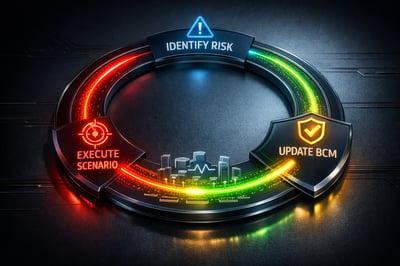
Scenario testing is rapidly evolving from a periodic validation exercise into a dynamic, intelligence-driven capability at the heart of operational resilience.
As organisations become more digital, interconnected, and exposed to complex risks, traditional testing approaches are no longer sufficient.
Regulators, stakeholders, and customers increasingly expect organisations not only to respond to disruption but to anticipate, adapt, and continuously validate resilience in real time.
This evolution is driving new practices, technologies, and expectations that are reshaping how scenario testing is designed, executed, and integrated into organisational strategy.
Purpose of the Chapter
The purpose of this chapter is to explore evolving practices in scenario testing.
It highlights key future trends, including increasing regulatory scrutiny, the use of artificial intelligence and predictive analytics, real-time resilience monitoring, sector-wide testing, and deeper integration with digital and cyber resilience.
Increasing Regulatory Scrutiny and Expectations
Regulators globally are placing greater emphasis on demonstrable resilience, with scenario testing serving as a primary tool for validation.
Shift from Compliance to Evidence-Based Resilience
Regulatory expectations are evolving from:
- Reviewing policies and plans
to - Requiring evidence of performance under stress
Organisations must now demonstrate:
- End-to-end testing of Critical Business Services (CBS)
- Alignment with defined impact tolerances
- Evidence of continuous improvement
More Frequent and Rigorous Testing
Future expectations include:
- Increased frequency of scenario testing
- More complex and severe scenarios
- Mandatory inclusion of cyber and third-party disruptions
Supervisory and Regulatory-Led Testing
Regulators may:
- Conduct industry-wide stress tests
- Require participation in coordinated exercises
- Request detailed scenario testing reports and evidence
Focus on Accountability and Governance
There will be a stronger emphasis on:
- Board and senior management accountability
- Clear ownership of resilience outcomes
- Integration of testing into governance frameworks
Use of AI and Predictive Analytics in Testing
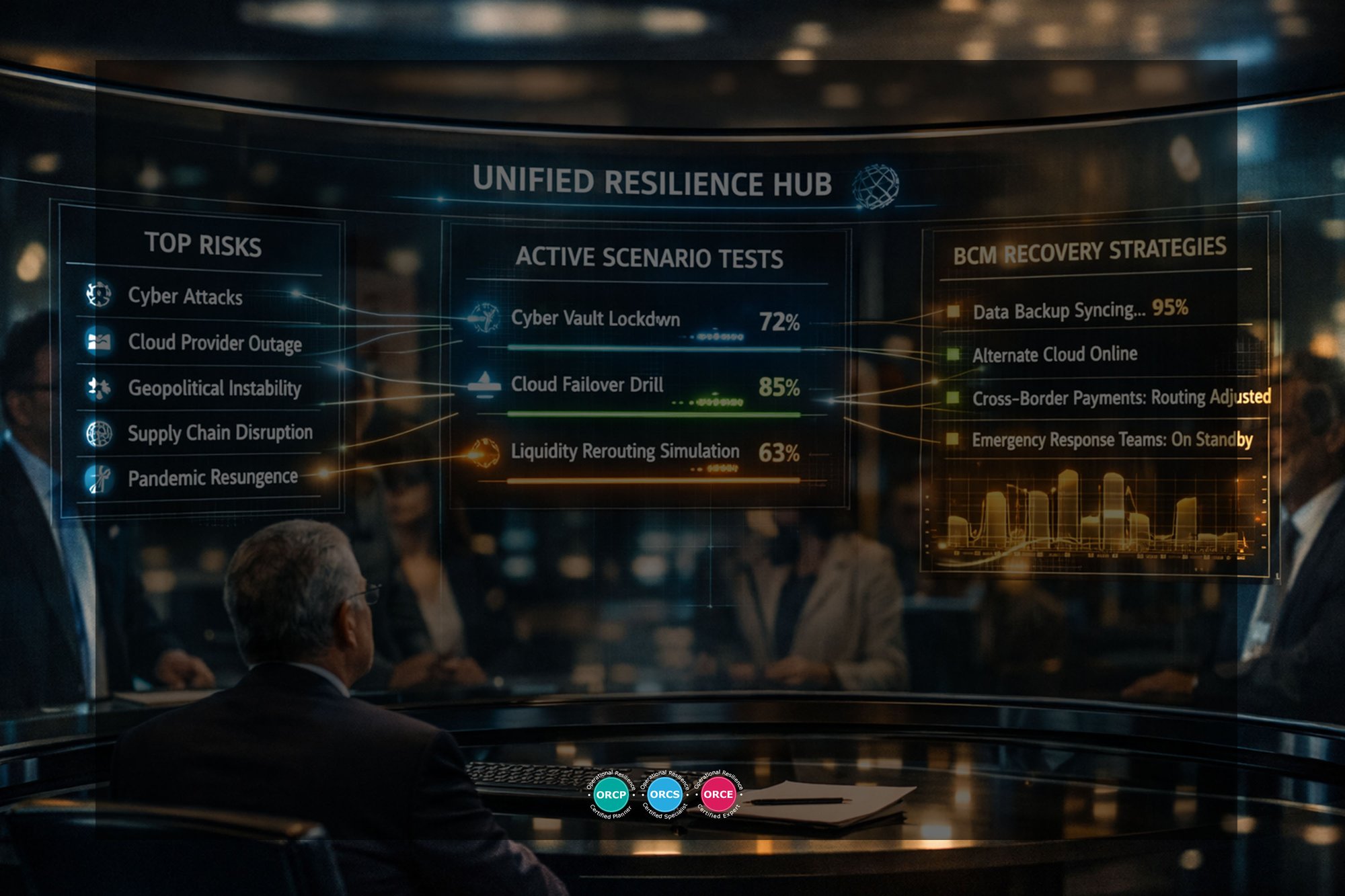
Artificial intelligence (AI) and advanced analytics are transforming scenario testing from reactive simulation to predictive resilience management.
AI-Driven Scenario Design
AI can be used to:
- Analyse historical incidents and risk data
- Identify emerging threats and patterns
- Generate complex, multi-layered scenarios
This enhances the realism and relevance of testing.
Predictive Risk Modelling
Predictive analytics enables organisations to:
- Anticipate potential disruptions
- Assess the likelihood and impact of scenarios
- Identify vulnerabilities before they materialise
Dynamic Scenario Adjustment
AI-powered tools can:
- Adjust scenarios in real time based on participant actions
- Introduce adaptive injects
- Simulate evolving threat landscapes
Enhanced Decision Support
AI can support decision-making by:
- Providing real-time insights during testing
- Recommending response actions
- Highlighting potential outcomes of decisions
Challenges and Considerations
While promising, organisations must address:
- Data quality and availability
- Model transparency and explainability
- Over-reliance on automated decision-making
AI should augment, not replace, human judgment.
Real-Time Resilience Monitoring
Scenario testing is moving beyond periodic exercises toward continuous validation of resilience.
From Periodic Testing to Continuous Monitoring
Traditional approach:
- Annual or periodic scenario tests
Emerging approach:
- Continuous monitoring of resilience indicators
Real-Time Metrics and Dashboards
Organisations are increasingly using:
- Real-time dashboards tracking service performance
- Automated alerts for threshold breaches
- Continuous measurement of key resilience metrics
Integration with Operational Systems
Resilience monitoring is being embedded into:
- IT and infrastructure monitoring tools
- Incident management systems
- Risk management platforms
Early Warning Capabilities
Real-time monitoring enables:
- Early detection of potential disruptions
- Proactive intervention before impact tolerance is breached
- Faster response and recovery
Continuous Validation
Organisations can simulate scenarios in live or near-live environments, enabling:
- Ongoing testing of resilience capabilities
- Immediate feedback and adjustment
Sector-Wide and Systemic Resilience Testing
As financial systems and industries become more interconnected, resilience is no longer confined to individual organisations.
Industry-Level Testing Initiatives
Regulators and industry bodies are increasingly:
- Organising sector-wide scenario testing exercises
- Simulating systemic risks (e.g., payment system failures, cyberattacks)
- Encouraging collaboration among institutions
Cross-Organisation Dependencies
Scenario testing is expanding to include:
- Interbank payment networks
- Shared service providers
- Critical infrastructure (e.g., telecommunications, cloud services)
Systemic Risk Assessment
Sector-wide testing helps identify:
- Concentration risks
- Cascading failures across institutions
- Weaknesses in shared infrastructure
Collaborative Resilience
Future resilience strategies will emphasise:
- Information sharing between organisations
- Joint response and recovery planning
- Coordinated crisis management
Regulatory Expectations
Participation in sector-wide testing may become:
- Mandatory for systemically important institutions
- A key component of supervisory assessments
Integration with Digital and Cyber Resilience
Digital transformation is reshaping the operational landscape, making integration with cyber and technology resilience essential.
Increasing Digital Dependency
Organisations rely heavily on:
- Cloud computing
- APIs and digital platforms
- Real-time data processing
This increases exposure to technology and cyber risks.
Convergence of Scenario Testing and Cyber Exercises
Future scenario testing will:
- Integrate cyberattack simulations with operational disruption scenarios
- Test both technical and business responses
- Combine IT incident response with crisis management
Testing Complex Technology Ecosystems
Scenario testing will need to address:
- Multi-cloud environments
- Third-party technology providers
- Interconnected digital platforms
Cyber-Physical Convergence
In some sectors, scenario testing will extend to:
- Physical infrastructure disruptions linked to cyber events
- Internet of Things (IoT) vulnerabilities
- Critical infrastructure resilience
Resilience by Design
Organisations will increasingly:
- Embed resilience into system design
- Use testing insights to inform architecture decisions
- Adopt proactive rather than reactive resilience strategies
Towards Predictive and Adaptive Resilience
The future of scenario testing lies in moving from reactive testing to predictive and adaptive resilience.
Predictive Capabilities
Organisations will:
- Use data and analytics to anticipate disruptions
- Identify vulnerabilities before they are exploited
- Simulate potential future scenarios
Adaptive Response Mechanisms
Systems and processes will:
- Automatically adjust to disruptions
- Enable faster and more flexible responses
- Reduce reliance on manual intervention
Continuous Learning
Scenario testing will become part of a continuous learning cycle:
- Insights from testing inform future scenarios
- Organisations evolve based on experience
- Resilience capability improves over time
Strategic Integration
Scenario testing will be integrated into:
- Strategic planning
- Investment decisions
- Digital transformation initiatives
This elevates resilience from an operational concern to a strategic priority.
![Banner [Summing] [OR] [E3] Perform Scenario Testing](https://no-cache.hubspot.com/cta/default/3893111/11895c06-91e9-4cec-acb6-4356741952e4.png)
Scenario testing is undergoing a significant transformation, driven by increasing regulatory expectations, technological advancements, and the growing complexity of operational environments. Future trends point toward a more dynamic, data-driven, and integrated approach—where testing is continuous, predictive, and embedded into organisational strategy.
By embracing these trends, organisations can move beyond traditional testing approaches and develop advanced resilience capabilities. This enables them not only to respond effectively to disruptions but to anticipate and adapt to emerging risks, ensuring the sustained delivery of critical business services in an increasingly uncertain world.

![[OR] [P2] [S4] [ST] [C1] Introduction to Scenario Testing](https://no-cache.hubspot.com/cta/default/3893111/910c0230-708f-4661-a87e-56cb7cbd2b37.png)
![[OR] [P2] [S4] [ST] [C2] Regulatory and Standards Context](https://no-cache.hubspot.com/cta/default/3893111/e21c745f-5f7c-4c8b-b845-7a8712b2a67d.png)
![[OR] [P2] [S4] [ST] [C3] Objectives of Scenario Testing](https://no-cache.hubspot.com/cta/default/3893111/d2eb2181-1303-4ca7-89a2-d717dc5e972f.png)
![[OR] [P2] [S4] [ST] [C4] Scenario Testing within the Operational Resilience Framework](https://no-cache.hubspot.com/cta/default/3893111/c7c5fe26-c69a-4176-be52-c7ba8939ca8c.png)
![[OR] [P2] [S4] [ST] [C5] Types of Scenario Testing](https://no-cache.hubspot.com/cta/default/3893111/3756e6ec-bf7e-462f-9f8c-52d15f718c81.png)
![[OR] [P2] [S4] [ST] [C6] Designing Severe but Plausible Scenarios](https://no-cache.hubspot.com/cta/default/3893111/07cc13e4-e1eb-4bb4-b257-d155b9a30cd4.png)
![[OR] [P2] [S4] [ST] [C7] Scenario Development Framework](https://no-cache.hubspot.com/cta/default/3893111/1976475f-5469-473c-a441-cb8c05247055.png)
![[OR] [P2] [S4] [ST] [C8] Mapping Dependencies for Scenario Testing](https://no-cache.hubspot.com/cta/default/3893111/3934df2c-a632-4331-809e-62f4ac791efd.png)
![[OR] [P2] [S4] [ST] [C9] Setting Testing Scope and Boundaries](https://no-cache.hubspot.com/cta/default/3893111/0ff8be42-fbfa-4777-880d-855094a0def4.png)
![[OR] [P2] [S4] [ST] [C10] Executing Scenario Testing](https://no-cache.hubspot.com/cta/default/3893111/b68def17-a3fd-412a-9a11-3e55c24c51f9.png)
![[OR] [P2] [S4] [ST] [C11] Metrics and Evaluation of Results](https://no-cache.hubspot.com/cta/default/3893111/ca1ee7cd-3a0b-4460-8ed2-90b89f2d2761.png)
![[OR] [P2] [S4] [ST] [C12] Scenario Testing Output and Reporting](https://no-cache.hubspot.com/cta/default/3893111/36ab22b4-9316-413d-ab9c-5d945f6009b2.png)
![[OR] [P2] [S4] [ST] [C13] Common Challenges and Pitfalls](https://no-cache.hubspot.com/cta/default/3893111/9fb81eaf-a3eb-4192-b607-48c6ac3277da.png)
![[OR] [P2] [S4] [ST] [C14] Overcoming Challenges in Scenario Testing](https://no-cache.hubspot.com/cta/default/3893111/f9660d67-9e43-45fe-a52d-4c9ca2812c83.png)
![[OR] [P2] [S4] [ST] [C15] Integrating Scenario Testing with Risk Management and BCM](https://no-cache.hubspot.com/cta/default/3893111/2334c95f-f874-4b14-b348-779c63730269.png)
![[OR] [P2] [S4] [ST] [C16] Continuous Improvement and Lessons Learned](https://no-cache.hubspot.com/cta/default/3893111/62af1507-9de8-42d4-b519-adc3e945a7f3.png)
![[OR] [P2] [S4] [ST] [C17] Practical Case Study (Banking Sector Example)](https://no-cache.hubspot.com/cta/default/3893111/fed5643b-1564-4177-a2d9-7fc4f4049a5c.png)
![[OR] [P2] [S4] [ST] [C19] Key Takeaways and Call to Action](https://no-cache.hubspot.com/cta/default/3893111/8d431102-ed70-4707-ac87-e750e4db29de.png)
![[OR] [P2] [S4] [ST] [C20] Back Cover](https://no-cache.hubspot.com/cta/default/3893111/fbb82511-9fd7-4ed9-aaa9-dc8aad0ea177.png)
More Information About OR-5000 [OR-5] or OR-300 [OR-3]
To learn more about the course and schedule, click the buttons below for the OR-300 Operational Resilience Implementer and OR-5000 Operational Resilience Expert Implementer courses.


![[BL-OR] [3-4-5] View Schedule](https://no-cache.hubspot.com/cta/default/3893111/d0d733a1-16c0-4b68-a26d-adbfd4fc6069.png)
![[BL-OR] [3] FAQ OR-300](https://no-cache.hubspot.com/cta/default/3893111/f20c71b4-f5e8-4aa5-8056-c374ca33a091.png)
![Email to Sales Team [BCM Institute]](https://no-cache.hubspot.com/cta/default/3893111/3c53daeb-2836-4843-b0e0-645baee2ab9e.png)