---
title: [OR] [P2] [S4] [ST] [C15] Integrating Scenario Testing with Risk Management and BCM
description: [OR] [P2] [S4] [ST] [C15] Integrating Scenario Testing with Risk Management and BCM
image: https://blog.bcm-institute.org/hubfs/OR%20Conducting%20Scenario%20Testing%20P2%20Morepost/%5BOR%5D%20%5BP2%5D%20%5BS4%5D%20%5BST%5D%20%5BC15%5D%20Integrating%20Scenario%20Testing%20with%20Risk%20Management%20and%20BCM.jpg
---
. .
[](http://www.bcm-institute.org/)
- [Home](https://www.bcm-institute.org/)
- [About Us](https://www.bcm-institute.org/about-us-3/)
- [A President’s Perspective](https://www.bcm-institute.org/about-us/a-presidents-perspective/)
- [Our History](https://www.bcm-institute.org/about-us/our-history/)
- [Our Advisory Council](https://www.bcm-institute.org/about-us/our-advisory-council/)
- [Customers’ Testimonials](https://www.bcm-institute.org/about-us/customers-testimonials/)
- [Credential Verification](https://www.bcm-institute.org/about-us/credential-verification/)
- [Courses](https://blog.bcm-institute.org/blog/course-fees-for-blended-learning-courses-master-catalog)
- [ISO 22301 Business Continuity Management System Audit](https://blog.bcm-institute.org/audit/business-continuity-management-audit-courses)
- [ISO 22301 Business Continuity Management](https://blog.bcm-institute.org/bcm/business-continuity-management-courses)
- [Crisis Communication](https://blog.bcm-institute.org/crisis-communication/crisis-communication-courses)
- [Crisis Management](https://blog.bcm-institute.org/en/crisis-management/courses)
- [IT Disaster Recovery](https://blog.bcm-institute.org/it-disaster-recovery/courses)
- [Operational Resilience](https://blog.bcm-institute.org/operational-resilience/courses)
- [Operational Resilience Audit](https://blog.bcm-institute.org/operational-resilience-audit/courses)
- [Certification](https://blog.bcm-institute.org/certification/types-of-certifications-offered)
- [ISO 22301 BCMS Audit Certification](https://blog.bcm-institute.org/certification/business-continuity-management-audit-certification)
- [ISO22301 Business Continuity Management Certification](https://blog.bcm-institute.org/bcm/business-continuity-management-certification)
- [Crisis Communication Certification](https://blog.bcm-institute.org/crisis-communication/crisis-communication-certification)
- [Crisis Management Certification](https://blog.bcm-institute.org/en/crisis-management/crisis-management-certification)
- [IT Disaster Recovery Planning Certification](https://blog.bcm-institute.org/it-disaster-recovery/it-disaster-recovery-certification)
- [Operational Resilience Certification](https://blog.bcm-institute.org/operational-resilience/operational-resilience-certification)
- [Operational Resilience Audit Certification](https://blog.bcm-institute.org/operational-resilience-audit)
- [Seminars](https://blog.bcm-institute.org/meet-the-expert/mte-webinar-mainpage)
- [Store](https://www.bcm-institute.org/store-2/)
- [Contact Us](http://www.bcm-institute.org/about-us/contact-us/)
-
-
###### Conducting Scenario Testing: A Practical Guide for Operational Resilience Implementation

# \[OR\] \[P2\] \[S4\] \[ST\] \[C15\] Integrating Scenario Testing with Risk Management and BCM
[![Banner \[OR\] \[P2\] \[S4\] Conducting Scenario Testing](https://no-cache.hubspot.com/cta/default/3893111/a8ba87ed-c76c-4e8f-b4fa-4eb3aed30b67.png)](https://cta-redirect.hubspot.com/cta/redirect/3893111/a8ba87ed-c76c-4e8f-b4fa-4eb3aed30b67)
Scenario testing does not operate in isolation. Its true value is realised when it is fully integrated with the organisation’s broader resilience and risk management ecosystem.
Operational resilience is built on multiple interdependent pillars—Operational Risk Management, Business Continuity Management (BCM), Crisis Management, Cyber Resilience, and Third-Party Risk Management.
Scenario testing acts as the **validation mechanism** that connects and tests these components collectively.
Without integration, organisations risk fragmented efforts—where risks are identified, plans are developed, but their effectiveness is never validated holistically and realistically. Integration ensures that scenario testing becomes a unifying activity that aligns strategy, execution, and continuous improvement across resilience disciplines.
[](https://cta-redirect.hubspot.com/cta/redirect/3893111/9589a5fd-463e-499e-a6db-cb1d11448796)
[Moh Heng Goh](https://blog.bcm-institute.org/ebook-or/author/moh-heng-goh) May 12, 2026
###### Operational Resilience Certified Planner-Specialist-Expert
### [](https://cta-redirect.hubspot.com/cta/redirect/3893111/58ea4ab9-998a-451c-bb54-801ae4cb782d)
### \[P2\] \[S4\] Chapter 15
### [![Banner \[OR\] \[P2\] \[S4\] Conducting Scenario Testing](https://no-cache.hubspot.com/cta/default/3893111/a8ba87ed-c76c-4e8f-b4fa-4eb3aed30b67.png)](https://cta-redirect.hubspot.com/cta/redirect/3893111/a8ba87ed-c76c-4e8f-b4fa-4eb3aed30b67)Integrating Scenario Testing with Risk Management and BCM
#### **Introduction**
[![\[OR\] \[P2\] \[S4\] \[ST\] \[C15\] Integrating Scenario Testing with Risk Management and BCM](https://no-cache.hubspot.com/cta/default/3893111/2334c95f-f874-4b14-b348-779c63730269.png)](https://cta-redirect.hubspot.com/cta/redirect/3893111/2334c95f-f874-4b14-b348-779c63730269)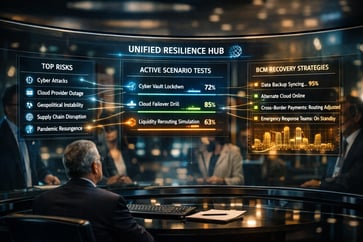
Scenario testing does not operate in isolation. Its true value is realised when it is fully integrated with the organisation’s broader resilience and risk management ecosystem.
Operational resilience is built on multiple interdependent pillars—Operational Risk Management, Business Continuity Management (BCM), Crisis Management, Cyber Resilience, and Third-Party Risk Management.
Scenario testing acts as the **validation mechanism** that connects and tests these components collectively.
Without integration, organisations risk fragmented efforts—where risks are identified, plans are developed, but their effectiveness is never validated holistically and realistically. Integration ensures that scenario testing becomes a unifying activity that aligns strategy, execution, and continuous improvement across resilience disciplines.
#### **Purpose of the Chapter**
The purpose of this chapter is to align scenario testing with other resilience pillars. It outlines how scenario testing integrates with Operational Risk Management, aligns with the BCM lifecycle, links to Crisis Management (ISO 22361), and supports Cyber Resilience and Third-Party Risk Management.
#### **Integration with Operational Risk Management**
Operational Risk Management (ORM) focuses on identifying, assessing, and mitigating risks that may disrupt business operations. Scenario testing complements ORM by validating how these risks materialise and are managed in practice.
##### **Linking Scenario Testing to Risk Identification**
Scenario testing should be informed by ORM outputs, including:
- Risk registers and risk assessments
- Key Risk Indicators (KRIs)
- Historical loss events and near-misses
High-risk areas identified through ORM should be prioritised for scenario testing.
##### **Validating Risk Controls**
Scenario testing enables organisations to test whether existing controls are effective under stress:
- Are preventive controls sufficient to avoid disruption?
- Do detective controls identify incidents promptly?
- Are corrective controls effective in restoring operations?
This provides real-world validation of risk mitigation strategies.
##### **Feedback Loop into ORM**
Testing outcomes should feed back into ORM by:
- Updating risk assessments and ratings
- Refining KRIs and thresholds
- Identifying new or emerging risks
This creates a dynamic and responsive risk management framework.
##### **From Static Risk Assessment to Dynamic Validation**
While ORM provides a static view of risk exposure, scenario testing introduces:
- Dynamic, real-time evaluation
- Validation of assumptions
- Insights into interdependencies and cascading failures
Together, they provide a comprehensive view of operational risk.
#### **Alignment with Business Continuity Management Lifecycle**
Scenario testing is a core component of the **Business Continuity Management (BCM) lifecycle**, particularly within the testing and exercising phase.
##### **Role of Scenario Testing in BCM**
Within BCM, scenario testing is used to:
- Validate Business Continuity Plans (BCPs)
- Test recovery strategies and capabilities
- Assess the readiness of teams and resources
It ensures that plans developed during BCM are practical and effective.
##### **Alignment with BCM Phases**
Scenario testing should align with key BCM phases:
**a. Risk Analysis and Review (RAR)**
- Scenarios are derived from identified threats and risks
**b. Business Impact Analysis (BIA)**
- Impact tolerance and recovery objectives guide testing criteria
**c. Business Continuity Strategy (BCS)**
- Strategies (e.g., alternate sites, redundancy) are validated
**d. Plan Development (PD)**
- Plans are tested for clarity, completeness, and usability
**e. Testing and Exercising**
- Scenario testing validates the entire BCM framework
##### **Enhancing BCM Through Scenario Testing**
Scenario testing helps organisations:
- Identify gaps in continuity plans
- Improve recovery procedures
- Enhance coordination across teams
It transforms BCM from a documentation exercise into a practical capability.
#### **Link to Crisis Management (ISO 22361)**
Scenario testing plays a critical role in validating **Crisis Management (CM)** capabilities, particularly in alignment with ISO 22361.
##### **Transition from Incident to Crisis**
Scenario testing should simulate the escalation from:
- Operational incident →
- Major disruption →
- Crisis requiring strategic management
This tests the organisation’s ability to recognise and respond to escalating severity.
##### **Testing Crisis Management Structures**
Scenario testing should validate:
- Activation of Crisis Management Teams (CMT)
- Command and control structures
- Decision-making under uncertainty
- Coordination between tactical and strategic levels
##### **Crisis Communication**
Effective communication is a key focus area, including:
- Internal communication across teams
- External communication with customers and stakeholders
- Regulatory and media engagement
##### **Alignment with ISO 22361 Principles**
Scenario testing should reflect key ISO 22361 principles, such as:
- Leadership and decision-making
- Situational awareness
- Stakeholder communication
- Continuous learning and improvement
##### **Strengthening Crisis Readiness**
By integrating scenario testing with CM, organisations can:
- Improve crisis response speed and effectiveness
- Build leadership confidence
- Enhance organisational resilience under extreme conditions
#### **Integration with Cyber Resilience**
Cyber resilience is a critical pillar of operational resilience, particularly in today’s digital environment. Scenario testing provides a mechanism to validate cyber incident response and recovery capabilities.
##### **Testing Cyber Scenarios**
Common scenarios include:
- Ransomware attacks
- Distributed Denial of Service (DDoS) attacks
- Data breaches
- System compromises
##### **Validating Cyber Response Capabilities**
Scenario testing assesses:
- Detection and response times
- Effectiveness of incident response teams
- System recovery and data restoration
- Communication with stakeholders and regulators
##### **Integration with Technology Risk Management**
Scenario testing should align with technology risk frameworks by:
- Testing system resilience and failover capabilities
- Validating backup and recovery processes
- Assessing dependencies on cloud and digital infrastructure
##### **Cyber Resilience Beyond Technology**
Cyber scenarios should also test:
- Decision-making at the leadership level
- Coordination between IT and business teams
- Reputational and regulatory impacts
This ensures a holistic approach to cyber resilience.
#### **Integration with Third-Party Risk Management**
Modern organisations rely heavily on third-party providers, making third-party risk a critical component of operational resilience.
##### **Testing Third-Party Dependencies**
Scenario testing should include disruptions involving:
- Cloud service providers
- Payment networks
- Outsourced service providers
- Supply chain partners
##### **Assessing Third-Party Resilience**
Testing should evaluate:
- Vendor response capabilities
- Communication and coordination mechanisms
- Contractual obligations and service level agreements (SLAs)
- Availability of alternate providers
##### **Involving Third Parties in Testing**
Where feasible, organisations should:
- Include key vendors in scenario exercises
- Conduct joint testing activities
- Share lessons learned and improvement plans
##### **Managing Concentration Risk**
Scenario testing helps identify:
- Over-reliance on specific vendors
- Lack of redundancy or diversification
- Systemic risks across the ecosystem
##### **Strengthening Third-Party Resilience**
Integration ensures that third-party risks are not only identified but also actively tested and managed.
#### **Achieving Integrated Resilience**
The ultimate goal of integration is to achieve a unified and coordinated resilience capability.
##### **Breaking Down Silos**
Integration ensures that:
- Risk, BCM, CM, cyber, and third-party teams work together
- Information flows seamlessly across functions
- Decisions are aligned and coordinated
##### **End-to-End Validation**
Scenario testing provides:
- A holistic view of resilience across CBS
- Validation of interdependencies and interactions
- Assurance that the organisation can operate under disruption
##### **Continuous Improvement Across Pillars**
Insights from scenario testing should:
- Enhance risk management practices
- Improve continuity and crisis plans
- Strengthen cyber and third-party controls
##### **Governance and Oversight**
Integrated scenario testing should be governed through:
- Cross-functional committees
- Unified reporting frameworks
- Shared accountability for outcomes
[![Banner \[Summing\] \[OR\] \[E3\] Perform Scenario Testing](https://no-cache.hubspot.com/cta/default/3893111/11895c06-91e9-4cec-acb6-4356741952e4.png)](https://cta-redirect.hubspot.com/cta/redirect/3893111/11895c06-91e9-4cec-acb6-4356741952e4)
Integrating scenario testing with Operational Risk Management, Business Continuity Management, Crisis Management, Cyber Resilience, and Third-Party Risk Management is essential for building a comprehensive operational resilience capability.
Scenario testing serves as the bridge that connects these pillars, transforming them from individual frameworks into a cohesive system capable of withstanding disruption. By aligning testing with risk identification, validating continuity and crisis response, and incorporating cyber and third-party considerations, organisations can achieve true end-to-end resilience.
Ultimately, integration ensures that scenario testing is not just an isolated activity, but a central mechanism for validating and strengthening the organisation’s ability to deliver critical business services under adverse conditions.
[](https://cta-redirect.hubspot.com/cta/redirect/3893111/528ff540-9963-430c-9ca6-c102ce4270df)
| **C1** | **C2** | **C3** | **C4** | **C5** |
| --- | --- | --- | --- | --- |
| [![\[OR\] \[P2\] \[S4\] \[ST\] \[C1\] Introduction to Scenario Testing](https://no-cache.hubspot.com/cta/default/3893111/910c0230-708f-4661-a87e-56cb7cbd2b37.png)](https://cta-redirect.hubspot.com/cta/redirect/3893111/910c0230-708f-4661-a87e-56cb7cbd2b37) | [![\[OR\] \[P2\] \[S4\] \[ST\] \[C2\] Regulatory and Standards Context](https://no-cache.hubspot.com/cta/default/3893111/e21c745f-5f7c-4c8b-b845-7a8712b2a67d.png)](https://cta-redirect.hubspot.com/cta/redirect/3893111/e21c745f-5f7c-4c8b-b845-7a8712b2a67d) | [![\[OR\] \[P2\] \[S4\] \[ST\] \[C3\] Objectives of Scenario Testing](https://no-cache.hubspot.com/cta/default/3893111/d2eb2181-1303-4ca7-89a2-d717dc5e972f.png)](https://cta-redirect.hubspot.com/cta/redirect/3893111/d2eb2181-1303-4ca7-89a2-d717dc5e972f) | [![\[OR\] \[P2\] \[S4\] \[ST\] \[C4\] Scenario Testing within the Operational Resilience Framework](https://no-cache.hubspot.com/cta/default/3893111/c7c5fe26-c69a-4176-be52-c7ba8939ca8c.png)](https://cta-redirect.hubspot.com/cta/redirect/3893111/c7c5fe26-c69a-4176-be52-c7ba8939ca8c) | [![\[OR\] \[P2\] \[S4\] \[ST\] \[C5\] Types of Scenario Testing](https://no-cache.hubspot.com/cta/default/3893111/3756e6ec-bf7e-462f-9f8c-52d15f718c81.png)](https://cta-redirect.hubspot.com/cta/redirect/3893111/3756e6ec-bf7e-462f-9f8c-52d15f718c81) |
| **C6** | **C7** | **C8** | **C9** | **C10** |
| [![\[OR\] \[P2\] \[S4\] \[ST\] \[C6\] Designing Severe but Plausible Scenarios](https://no-cache.hubspot.com/cta/default/3893111/07cc13e4-e1eb-4bb4-b257-d155b9a30cd4.png)](https://cta-redirect.hubspot.com/cta/redirect/3893111/07cc13e4-e1eb-4bb4-b257-d155b9a30cd4) | [![\[OR\] \[P2\] \[S4\] \[ST\] \[C7\] Scenario Development Framework](https://no-cache.hubspot.com/cta/default/3893111/1976475f-5469-473c-a441-cb8c05247055.png)](https://cta-redirect.hubspot.com/cta/redirect/3893111/1976475f-5469-473c-a441-cb8c05247055) | [![\[OR\] \[P2\] \[S4\] \[ST\] \[C8\] Mapping Dependencies for Scenario Testing](https://no-cache.hubspot.com/cta/default/3893111/3934df2c-a632-4331-809e-62f4ac791efd.png)](https://cta-redirect.hubspot.com/cta/redirect/3893111/3934df2c-a632-4331-809e-62f4ac791efd) | [![\[OR\] \[P2\] \[S4\] \[ST\] \[C9\] Setting Testing Scope and Boundaries](https://no-cache.hubspot.com/cta/default/3893111/0ff8be42-fbfa-4777-880d-855094a0def4.png)](https://cta-redirect.hubspot.com/cta/redirect/3893111/0ff8be42-fbfa-4777-880d-855094a0def4) | [![\[OR\] \[P2\] \[S4\] \[ST\] \[C10\] Executing Scenario Testing](https://no-cache.hubspot.com/cta/default/3893111/b68def17-a3fd-412a-9a11-3e55c24c51f9.png)](https://cta-redirect.hubspot.com/cta/redirect/3893111/b68def17-a3fd-412a-9a11-3e55c24c51f9) |
| **C11** | **C12** | **C13** | **C14** | **C15** |
| [![\[OR\] \[P2\] \[S4\] \[ST\] \[C11\] Metrics and Evaluation of Results](https://no-cache.hubspot.com/cta/default/3893111/ca1ee7cd-3a0b-4460-8ed2-90b89f2d2761.png)](https://cta-redirect.hubspot.com/cta/redirect/3893111/ca1ee7cd-3a0b-4460-8ed2-90b89f2d2761) | [![\[OR\] \[P2\] \[S4\] \[ST\] \[C12\] Scenario Testing Output and Reporting](https://no-cache.hubspot.com/cta/default/3893111/36ab22b4-9316-413d-ab9c-5d945f6009b2.png)](https://cta-redirect.hubspot.com/cta/redirect/3893111/36ab22b4-9316-413d-ab9c-5d945f6009b2) | [![\[OR\] \[P2\] \[S4\] \[ST\] \[C13\] Common Challenges and Pitfalls](https://no-cache.hubspot.com/cta/default/3893111/9fb81eaf-a3eb-4192-b607-48c6ac3277da.png)](https://cta-redirect.hubspot.com/cta/redirect/3893111/9fb81eaf-a3eb-4192-b607-48c6ac3277da) | [![\[OR\] \[P2\] \[S4\] \[ST\] \[C14\] Overcoming Challenges in Scenario Testing](https://no-cache.hubspot.com/cta/default/3893111/f9660d67-9e43-45fe-a52d-4c9ca2812c83.png)](https://cta-redirect.hubspot.com/cta/redirect/3893111/f9660d67-9e43-45fe-a52d-4c9ca2812c83) | [![\[OR\] \[P2\] \[S4\] \[ST\] \[C15\] Integrating Scenario Testing with Risk Management and BCM](https://no-cache.hubspot.com/cta/default/3893111/2334c95f-f874-4b14-b348-779c63730269.png)](https://cta-redirect.hubspot.com/cta/redirect/3893111/2334c95f-f874-4b14-b348-779c63730269) |
| **C16** | **C17** | **C18** | **C19** | **C20** |
| [![\[OR\] \[P2\] \[S4\] \[ST\] \[C16\] Continuous Improvement and Lessons Learned](https://no-cache.hubspot.com/cta/default/3893111/62af1507-9de8-42d4-b519-adc3e945a7f3.png)](https://cta-redirect.hubspot.com/cta/redirect/3893111/62af1507-9de8-42d4-b519-adc3e945a7f3) | [![\[OR\] \[P2\] \[S4\] \[ST\] \[C17\] Practical Case Study (Banking Sector Example)](https://no-cache.hubspot.com/cta/default/3893111/fed5643b-1564-4177-a2d9-7fc4f4049a5c.png)](https://cta-redirect.hubspot.com/cta/redirect/3893111/fed5643b-1564-4177-a2d9-7fc4f4049a5c) | [![\[OR\] \[P2\] \[S4\] \[ST\] \[C18\] Future Trends in Scenario Testing](https://no-cache.hubspot.com/cta/default/3893111/c0547827-8e71-4c91-8c44-b4d2d2b81526.png)](https://cta-redirect.hubspot.com/cta/redirect/3893111/c0547827-8e71-4c91-8c44-b4d2d2b81526) | [![\[OR\] \[P2\] \[S4\] \[ST\] \[C19\] Key Takeaways and Call to Action](https://no-cache.hubspot.com/cta/default/3893111/8d431102-ed70-4707-ac87-e750e4db29de.png)](https://cta-redirect.hubspot.com/cta/redirect/3893111/8d431102-ed70-4707-ac87-e750e4db29de) | [![\[OR\] \[P2\] \[S4\] \[ST\] \[C20\] Back Cover](https://no-cache.hubspot.com/cta/default/3893111/fbb82511-9fd7-4ed9-aaa9-dc8aad0ea177.png)](https://cta-redirect.hubspot.com/cta/redirect/3893111/fbb82511-9fd7-4ed9-aaa9-dc8aad0ea177) |
#### More Information About OR-5000 \[OR-5\] or OR-300 \[OR-3\]
To learn more about the course and schedule, click the buttons below for the OR-300 Operational Resilience Implementer and OR-5000 Operational Resilience Expert Implementer courses.
| [](https://cta-redirect.hubspot.com/cta/redirect/3893111/3530eccb-515d-401e-afc2-3469e26d7fbf) | [](https://cta-redirect.hubspot.com/cta/redirect/3893111/fdd4fa9c-ed69-40c1-925f-4eb6a1c5c255) | [](https://cta-redirect.hubspot.com/cta/redirect/3893111/77a34b84-0a6d-44f8-b8d6-6ab04cdf5edd) |
| --- | --- | --- |
| [](https://cta-redirect.hubspot.com/cta/redirect/3893111/6e5c0cda-39b9-4bbd-b3d4-4cf46a790b14) | [](https://cta-redirect.hubspot.com/cta/redirect/3893111/a68a08aa-36d3-4216-9551-202c9fde06ea) | [![ \[BL-OR\] \[3-4-5\] View Schedule](https://no-cache.hubspot.com/cta/default/3893111/d0d733a1-16c0-4b68-a26d-adbfd4fc6069.png)](https://cta-redirect.hubspot.com/cta/redirect/3893111/d0d733a1-16c0-4b68-a26d-adbfd4fc6069) |
| [![\[BL-OR\] \[3\] FAQ OR-300](https://no-cache.hubspot.com/cta/default/3893111/f20c71b4-f5e8-4aa5-8056-c374ca33a091.png)](https://cta-redirect.hubspot.com/cta/redirect/3893111/f20c71b4-f5e8-4aa5-8056-c374ca33a091) | If you have any questions, click to contact us.[![Email to Sales Team \[BCM Institute\]](https://no-cache.hubspot.com/cta/default/3893111/3c53daeb-2836-4843-b0e0-645baee2ab9e.png)](https://cta-redirect.hubspot.com/cta/redirect/3893111/3c53daeb-2836-4843-b0e0-645baee2ab9e) | [](https://cta-redirect.hubspot.com/cta/redirect/3893111/7f2718a4-ea80-4f84-a319-dc2d4df37a46) |
| [](https://cta-redirect.hubspot.com/cta/redirect/3893111/74b1e556-8cd2-4a74-8821-db1804534955) | [](https://cta-redirect.hubspot.com/cta/redirect/3893111/f2bd8eb1-32d2-4732-9267-ea53223cf58f) | [](https://cta-redirect.hubspot.com/cta/redirect/3893111/084e620a-46c5-419a-82ed-6a681d15c0b6) |
#### **Comments:**

---

---

---

---


All rights reserved. Copyright 2026
```json
{
"@context" : "https://schema.org",
"@type" : "BlogPosting",
"author" : {
"@type" : "Person",
"name" : "Moh Heng Goh",
"url" : "https://blog.bcm-institute.org/ebook-or/author/moh-heng-goh"
},
"dateModified" : "2026-05-12T06:44:45.756Z",
"datePublished" : "2026-05-12T06:44:38.000Z",
"headline" : "[OR] [P2] [S4] [ST] [C15] Integrating Scenario Testing with Risk Management and BCM",
"mainEntityOfPage" : {
"@id" : "https://blog.bcm-institute.org/ebook-or/or-p2-s4-st-c15-integrating-scenario-testing-with-risk-management-and-bcm",
"@type" : "WebPage"
},
"publisher" : {
"@type" : "Organization",
"logo" : {
"@type" : "ImageObject",
"url" : "https://blog.bcm-institute.org/hubfs/BCMI%20Logo.png"
},
"name" : "BCMI Pte Ltd"
}
}
```