---
title: [OR] [P2] [S4] [ST] [C10] Executing Scenario Testing
description: [OR] [P2] [S4] [ST] [C10] Executing Scenario Testing
image: https://blog.bcm-institute.org/hubfs/OR%20Conducting%20Scenario%20Testing%20P2%20Morepost/%5BOR%5D%20%5BP2%5D%20%5BS4%5D%20%5BST%5D%20%5BC10%5D%20Executing%20Scenario%20Testing.jpg
---
. .
[](http://www.bcm-institute.org/)
- [Home](https://www.bcm-institute.org/)
- [About Us](https://www.bcm-institute.org/about-us-3/)
- [A President’s Perspective](https://www.bcm-institute.org/about-us/a-presidents-perspective/)
- [Our History](https://www.bcm-institute.org/about-us/our-history/)
- [Our Advisory Council](https://www.bcm-institute.org/about-us/our-advisory-council/)
- [Customers’ Testimonials](https://www.bcm-institute.org/about-us/customers-testimonials/)
- [Credential Verification](https://www.bcm-institute.org/about-us/credential-verification/)
- [Courses](https://blog.bcm-institute.org/blog/course-fees-for-blended-learning-courses-master-catalog)
- [ISO 22301 Business Continuity Management System Audit](https://blog.bcm-institute.org/audit/business-continuity-management-audit-courses)
- [ISO 22301 Business Continuity Management](https://blog.bcm-institute.org/bcm/business-continuity-management-courses)
- [Crisis Communication](https://blog.bcm-institute.org/crisis-communication/crisis-communication-courses)
- [Crisis Management](https://blog.bcm-institute.org/en/crisis-management/courses)
- [IT Disaster Recovery](https://blog.bcm-institute.org/it-disaster-recovery/courses)
- [Operational Resilience](https://blog.bcm-institute.org/operational-resilience/courses)
- [Operational Resilience Audit](https://blog.bcm-institute.org/operational-resilience-audit/courses)
- [Certification](https://blog.bcm-institute.org/certification/types-of-certifications-offered)
- [ISO 22301 BCMS Audit Certification](https://blog.bcm-institute.org/certification/business-continuity-management-audit-certification)
- [ISO22301 Business Continuity Management Certification](https://blog.bcm-institute.org/bcm/business-continuity-management-certification)
- [Crisis Communication Certification](https://blog.bcm-institute.org/crisis-communication/crisis-communication-certification)
- [Crisis Management Certification](https://blog.bcm-institute.org/en/crisis-management/crisis-management-certification)
- [IT Disaster Recovery Planning Certification](https://blog.bcm-institute.org/it-disaster-recovery/it-disaster-recovery-certification)
- [Operational Resilience Certification](https://blog.bcm-institute.org/operational-resilience/operational-resilience-certification)
- [Operational Resilience Audit Certification](https://blog.bcm-institute.org/operational-resilience-audit)
- [Seminars](https://blog.bcm-institute.org/meet-the-expert/mte-webinar-mainpage)
- [Store](https://www.bcm-institute.org/store-2/)
- [Contact Us](http://www.bcm-institute.org/about-us/contact-us/)
-
-
###### Conducting Scenario Testing: A Practical Guide for Operational Resilience Implementation
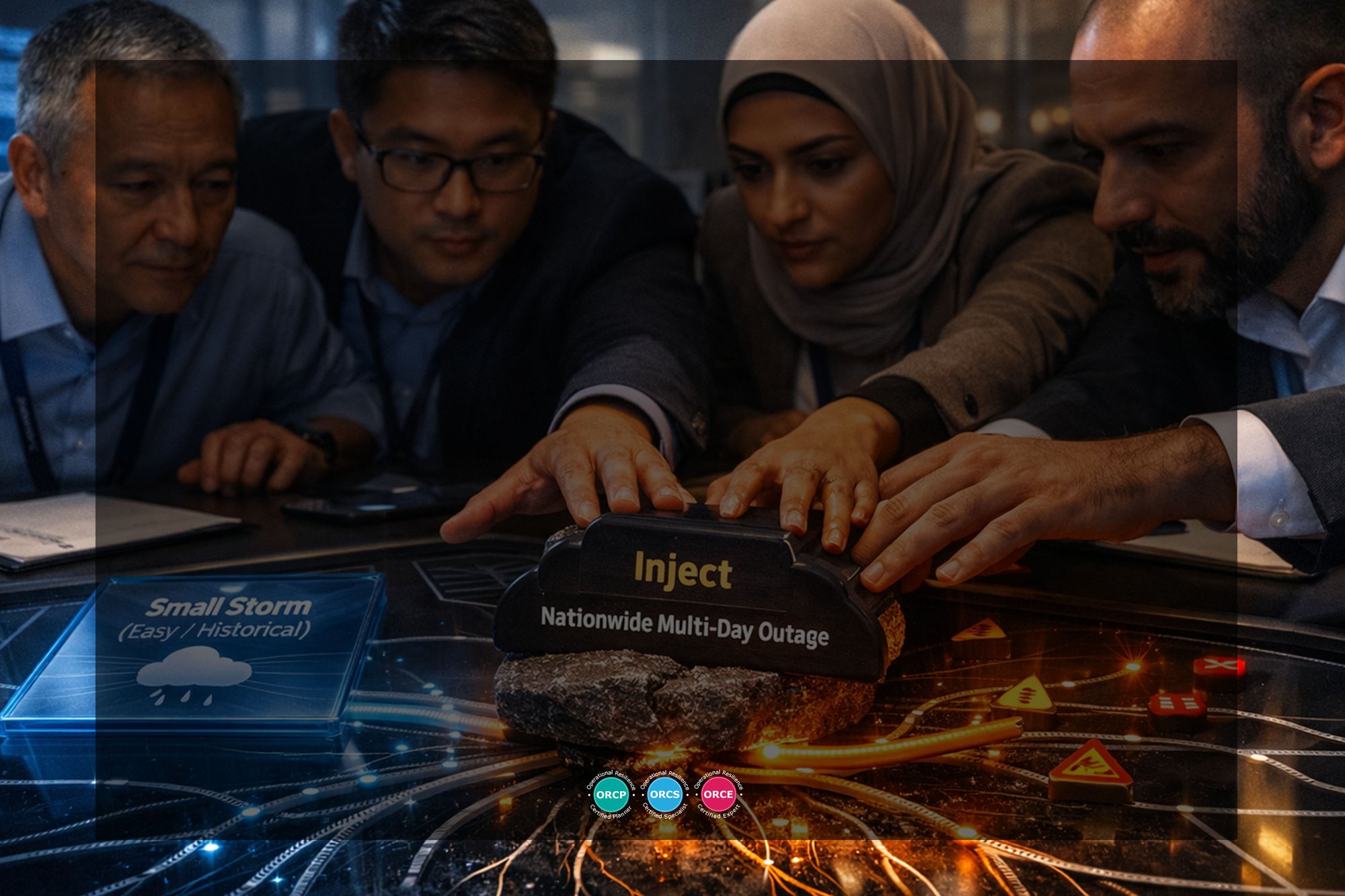
# \[OR\] \[P2\] \[S4\] \[ST\] \[C10\] Executing Scenario Testing
[![Banner \[OR\] \[P2\] \[S4\] Conducting Scenario Testing](https://no-cache.hubspot.com/cta/default/3893111/a8ba87ed-c76c-4e8f-b4fa-4eb3aed30b67.png)](https://cta-redirect.hubspot.com/cta/redirect/3893111/a8ba87ed-c76c-4e8f-b4fa-4eb3aed30b67)
Designing a scenario is only half the journey—true value is realised during execution.
Scenario testing execution transforms theoretical resilience planning into observable performance, where organisations validate their ability to respond, adapt, and recover under simulated disruption.
It is during execution that decision-making, coordination, and operational capabilities are tested in real time.
Effective execution requires discipline, structure, and clarity. Without proper planning and coordination, scenario testing can become disorganised, producing limited insights.
Conversely, well-executed tests provide rich, actionable evidence of resilience capability and expose gaps that may not be visible during planning.
[](https://cta-redirect.hubspot.com/cta/redirect/3893111/9589a5fd-463e-499e-a6db-cb1d11448796)
[Moh Heng Goh](https://blog.bcm-institute.org/ebook-or/author/moh-heng-goh) May 11, 2026
###### Operational Resilience Certified Planner-Specialist-Expert
### [](https://cta-redirect.hubspot.com/cta/redirect/3893111/58ea4ab9-998a-451c-bb54-801ae4cb782d)
### \[P2\] \[S4\] Chapter 10
### [![Banner \[OR\] \[P2\] \[S4\] Conducting Scenario Testing](https://no-cache.hubspot.com/cta/default/3893111/a8ba87ed-c76c-4e8f-b4fa-4eb3aed30b67.png)](https://cta-redirect.hubspot.com/cta/redirect/3893111/a8ba87ed-c76c-4e8f-b4fa-4eb3aed30b67)Executing Scenario Testing
#### **Introduction**
[![\[OR\] \[P2\] \[S4\] \[ST\] \[C10\] Executing Scenario Testing](https://no-cache.hubspot.com/cta/default/3893111/b68def17-a3fd-412a-9a11-3e55c24c51f9.png)](https://cta-redirect.hubspot.com/cta/redirect/3893111/b68def17-a3fd-412a-9a11-3e55c24c51f9)
Designing a scenario is only half the journey—true value is realised during execution.
Scenario testing execution transforms theoretical resilience planning into observable performance, where organisations validate their ability to respond, adapt, and recover under simulated disruption.
It is during execution that decision-making, coordination, and operational capabilities are tested in real time.
Effective execution requires discipline, structure, and clarity. Without proper planning and coordination, scenario testing can become disorganised, producing limited insights.
Conversely, well-executed tests provide rich, actionable evidence of resilience capability and expose gaps that may not be visible during planning.
#### **Purpose of the Chapter**
The purpose of this chapter is to guide the execution of scenario testing. It outlines how to plan and prepare for tests, define roles and responsibilities, run scenarios using structured injects and escalation points, capture real-time observations, and effectively manage stakeholder participation.
#### **Test Planning and Preparation**
Successful execution begins long before the test is conducted. Preparation ensures that the scenario is realistic, structured, and aligned with organisational objectives.
##### **Defining Test Objectives**
Each scenario test must have clearly defined objectives, such as:
- Validating the ability to remain within impact tolerance
- Assessing response and recovery capabilities
- Testing coordination across teams and functions
- Evaluating third-party and technology dependencies
Objectives should be aligned with the **Critical Business Services (CBS)** being tested.
##### **Developing the Test Plan**
A comprehensive test plan should include:
- Scenario description and scope
- Timeline and sequence of events
- Key injects and triggers
- Roles and participants
- Success criteria and evaluation metrics
The test plan acts as the central reference document for all stakeholders.
##### **Pre-Test Briefing**
All participants should be briefed before execution. The briefing should cover:
- Objectives and expected outcomes
- Scenario overview and assumptions
- Roles and responsibilities
- Rules of engagement (e.g., simulation boundaries)
This ensures consistency in understanding and reduces confusion during execution.
##### **Logistics and Readiness Checks**
Before the test begins, organisations should confirm:
- Availability of participants and facilitators
- Communication channels (e.g., crisis communication tools)
- Simulation tools or injection delivery mechanisms
- Documentation templates for capturing observations
A readiness checklist helps ensure smooth execution.
#### **Roles and Responsibilities**
A clear definition of roles is essential to avoid confusion and ensure effective coordination during the test.
##### **Key Roles in Scenario Testing**
**a. Test Director / Exercise Lead**
- Oversees the entire test
- Ensures objectives are met
- Controls the pace and progression of the scenario
**b. Facilitators / Controllers**
- Deliver instructions and guide the scenario flow
- Monitor participant responses
- Ensure the scenario remains aligned to objectives
**c. Participants (Business and Support Functions)**
- Represent operational teams responsible for CBS delivery
- Execute response and recovery actions
- Make decisions based on evolving scenario conditions
**d. Observers / Evaluators**
- Monitor actions and behaviours
- Capture observations against predefined criteria
- Provide an independent assessment of performance
##### **Role of Crisis Management Teams**
Scenario testing should actively involve **Crisis Management Teams (CMT)** where applicable. Their responsibilities include:
- Assessing the severity of the incident
- Declaring a crisis when thresholds are met
- Activating crisis management structures
- Coordinating communication internally and externally
- Making strategic decisions under pressure
Testing the CMT is critical, as resilience failures often arise from decision-making gaps rather than technical failures.
##### **Importance of Clear Accountability**
Each participant must understand:
- Their specific role in the scenario
- Decision-making authority
- Escalation responsibilities
This ensures a realistic simulation of organisational response.
#### **Running the Scenario**
Execution involves simulating the disruption through structured events and monitoring how the organisation responds.
##### **Use of Injects**
**Injects** are pre-defined inputs introduced during the scenario to simulate events. Examples include:
- System outage notifications
- Customer complaints or media inquiries
- Regulatory intervention messages
- Escalating technical failures
Injects should be:
- Timed and sequenced
- Realistic and aligned to the scenario narrative
- Designed to trigger specific actions or decisions
##### **Escalation Mechanisms**
As the scenario progresses, escalation points should be triggered to test:
- Incident escalation procedures
- Activation of crisis management teams
- Communication to senior management and regulators
Escalation ensures that the scenario evolves in complexity and tests organisational responsiveness at different levels.
##### **Decision Points**
Scenario execution should include critical decision points where participants must:
- Choose between alternative actions
- Prioritise limited resources
- Balance operational recovery with customer and regulatory considerations
These decision points are key to evaluating leadership effectiveness and organisational judgement.
##### **Maintaining Scenario Flow**
The Test Director and facilitators must:
- Control the pace of the scenario
- Adjust injects based on participant responses
- Ensure the scenario remains challenging but achievable
Flexibility is important to keep the scenario dynamic and engaging.
#### **Capturing Real-Time Observations and Actions**
One of the most critical aspects of execution is capturing what happens during the test. Without proper documentation, valuable insights may be lost.
##### **Observation Framework**
Observers should capture:
- Actions taken by participants
- Timelines of key events and responses
- Decision-making processes
- Communication effectiveness
- Deviations from expected procedures
##### **Tools for Capturing Observations**
Common tools include:
- Observation logs
- Event timelines
- Video or audio recordings (where appropriate)
- Collaboration platforms for real-time note-taking
##### **Focus Areas for Observation**
Observers should pay attention to:
- Speed and accuracy of response
- Coordination across teams
- Effectiveness of escalation
- Adherence to plans and procedures
- Gaps in capability or resources
##### **Importance of Real-Time Capture**
Capturing observations in real time ensures:
- Accuracy of data
- Immediate identification of issues
- Rich inputs for post-test analysis and improvement
#### **Managing Stakeholder Participation**
Scenario testing often involves multiple stakeholders across the organisation and beyond. Effective management of participation is essential.
##### **Identifying Stakeholders**
Stakeholders may include:
- Business units responsible for CBS
- IT and technology teams
- Risk and compliance functions
- Crisis management teams
- Third-party service providers
- Senior management
##### **Engagement and Communication**
Stakeholders should be:
- Engaged early in the planning process
- Clearly informed of their roles
- Supported during the test with guidance and facilitation
Effective communication ensures alignment and participation.
##### **Managing Participation Dynamics**
During execution, facilitators must:
- Encourage active participation
- Prevent dominance by certain individuals
- Ensure all relevant perspectives are considered
Balanced participation leads to more realistic outcomes.
##### **Handling External Stakeholders**
When involving third parties or regulators:
- Define participation boundaries clearly
- Ensure confidentiality and data protection
- Align expectations and objectives
This is particularly important for ecosystem-wide testing.
[![Banner \[Summing\] \[OR\] \[E3\] Perform Scenario Testing](https://no-cache.hubspot.com/cta/default/3893111/11895c06-91e9-4cec-acb6-4356741952e4.png)](https://cta-redirect.hubspot.com/cta/redirect/3893111/11895c06-91e9-4cec-acb6-4356741952e4)
Executing scenario testing is where resilience is truly validated. It transforms planning into action and reveals how well an organisation can respond under pressure.
Through structured planning, clearly defined roles, disciplined execution, and effective observation, organisations can gain deep insights into their operational resilience capabilities.
By managing stakeholder participation and capturing real-time actions, scenario testing becomes more than a compliance exercise—it becomes a powerful mechanism for learning, improvement, and strengthening resilience.
Ultimately, well-executed scenario testing enables organisations to build confidence in their ability to withstand disruption and continue delivering critical services within defined impact tolerances.
[](https://cta-redirect.hubspot.com/cta/redirect/3893111/528ff540-9963-430c-9ca6-c102ce4270df)
| **C1** | **C2** | **C3** | **C4** | **C5** |
| --- | --- | --- | --- | --- |
| [![\[OR\] \[P2\] \[S4\] \[ST\] \[C1\] Introduction to Scenario Testing](https://no-cache.hubspot.com/cta/default/3893111/910c0230-708f-4661-a87e-56cb7cbd2b37.png)](https://cta-redirect.hubspot.com/cta/redirect/3893111/910c0230-708f-4661-a87e-56cb7cbd2b37) | [![\[OR\] \[P2\] \[S4\] \[ST\] \[C2\] Regulatory and Standards Context](https://no-cache.hubspot.com/cta/default/3893111/e21c745f-5f7c-4c8b-b845-7a8712b2a67d.png)](https://cta-redirect.hubspot.com/cta/redirect/3893111/e21c745f-5f7c-4c8b-b845-7a8712b2a67d) | [![\[OR\] \[P2\] \[S4\] \[ST\] \[C3\] Objectives of Scenario Testing](https://no-cache.hubspot.com/cta/default/3893111/d2eb2181-1303-4ca7-89a2-d717dc5e972f.png)](https://cta-redirect.hubspot.com/cta/redirect/3893111/d2eb2181-1303-4ca7-89a2-d717dc5e972f) | [![\[OR\] \[P2\] \[S4\] \[ST\] \[C4\] Scenario Testing within the Operational Resilience Framework](https://no-cache.hubspot.com/cta/default/3893111/c7c5fe26-c69a-4176-be52-c7ba8939ca8c.png)](https://cta-redirect.hubspot.com/cta/redirect/3893111/c7c5fe26-c69a-4176-be52-c7ba8939ca8c) | [![\[OR\] \[P2\] \[S4\] \[ST\] \[C5\] Types of Scenario Testing](https://no-cache.hubspot.com/cta/default/3893111/3756e6ec-bf7e-462f-9f8c-52d15f718c81.png)](https://cta-redirect.hubspot.com/cta/redirect/3893111/3756e6ec-bf7e-462f-9f8c-52d15f718c81) |
| **C6** | **C7** | **C8** | **C9** | **C10** |
| [![\[OR\] \[P2\] \[S4\] \[ST\] \[C6\] Designing Severe but Plausible Scenarios](https://no-cache.hubspot.com/cta/default/3893111/07cc13e4-e1eb-4bb4-b257-d155b9a30cd4.png)](https://cta-redirect.hubspot.com/cta/redirect/3893111/07cc13e4-e1eb-4bb4-b257-d155b9a30cd4) | [![\[OR\] \[P2\] \[S4\] \[ST\] \[C7\] Scenario Development Framework](https://no-cache.hubspot.com/cta/default/3893111/1976475f-5469-473c-a441-cb8c05247055.png)](https://cta-redirect.hubspot.com/cta/redirect/3893111/1976475f-5469-473c-a441-cb8c05247055) | [![\[OR\] \[P2\] \[S4\] \[ST\] \[C8\] Mapping Dependencies for Scenario Testing](https://no-cache.hubspot.com/cta/default/3893111/3934df2c-a632-4331-809e-62f4ac791efd.png)](https://cta-redirect.hubspot.com/cta/redirect/3893111/3934df2c-a632-4331-809e-62f4ac791efd) | [![\[OR\] \[P2\] \[S4\] \[ST\] \[C9\] Setting Testing Scope and Boundaries](https://no-cache.hubspot.com/cta/default/3893111/0ff8be42-fbfa-4777-880d-855094a0def4.png)](https://cta-redirect.hubspot.com/cta/redirect/3893111/0ff8be42-fbfa-4777-880d-855094a0def4) | [![\[OR\] \[P2\] \[S4\] \[ST\] \[C10\] Executing Scenario Testing](https://no-cache.hubspot.com/cta/default/3893111/b68def17-a3fd-412a-9a11-3e55c24c51f9.png)](https://cta-redirect.hubspot.com/cta/redirect/3893111/b68def17-a3fd-412a-9a11-3e55c24c51f9) |
| **C11** | **C12** | **C13** | **C14** | **C15** |
| [![\[OR\] \[P2\] \[S4\] \[ST\] \[C11\] Metrics and Evaluation of Results](https://no-cache.hubspot.com/cta/default/3893111/ca1ee7cd-3a0b-4460-8ed2-90b89f2d2761.png)](https://cta-redirect.hubspot.com/cta/redirect/3893111/ca1ee7cd-3a0b-4460-8ed2-90b89f2d2761) | [![\[OR\] \[P2\] \[S4\] \[ST\] \[C12\] Scenario Testing Output and Reporting](https://no-cache.hubspot.com/cta/default/3893111/36ab22b4-9316-413d-ab9c-5d945f6009b2.png)](https://cta-redirect.hubspot.com/cta/redirect/3893111/36ab22b4-9316-413d-ab9c-5d945f6009b2) | [![\[OR\] \[P2\] \[S4\] \[ST\] \[C13\] Common Challenges and Pitfalls](https://no-cache.hubspot.com/cta/default/3893111/9fb81eaf-a3eb-4192-b607-48c6ac3277da.png)](https://cta-redirect.hubspot.com/cta/redirect/3893111/9fb81eaf-a3eb-4192-b607-48c6ac3277da) | [![\[OR\] \[P2\] \[S4\] \[ST\] \[C14\] Overcoming Challenges in Scenario Testing](https://no-cache.hubspot.com/cta/default/3893111/f9660d67-9e43-45fe-a52d-4c9ca2812c83.png)](https://cta-redirect.hubspot.com/cta/redirect/3893111/f9660d67-9e43-45fe-a52d-4c9ca2812c83) | [![\[OR\] \[P2\] \[S4\] \[ST\] \[C15\] Integrating Scenario Testing with Risk Management and BCM](https://no-cache.hubspot.com/cta/default/3893111/2334c95f-f874-4b14-b348-779c63730269.png)](https://cta-redirect.hubspot.com/cta/redirect/3893111/2334c95f-f874-4b14-b348-779c63730269) |
| **C16** | **C17** | **C18** | **C19** | **C20** |
| [![\[OR\] \[P2\] \[S4\] \[ST\] \[C16\] Continuous Improvement and Lessons Learned](https://no-cache.hubspot.com/cta/default/3893111/62af1507-9de8-42d4-b519-adc3e945a7f3.png)](https://cta-redirect.hubspot.com/cta/redirect/3893111/62af1507-9de8-42d4-b519-adc3e945a7f3) | [![\[OR\] \[P2\] \[S4\] \[ST\] \[C17\] Practical Case Study (Banking Sector Example)](https://no-cache.hubspot.com/cta/default/3893111/fed5643b-1564-4177-a2d9-7fc4f4049a5c.png)](https://cta-redirect.hubspot.com/cta/redirect/3893111/fed5643b-1564-4177-a2d9-7fc4f4049a5c) | [![\[OR\] \[P2\] \[S4\] \[ST\] \[C18\] Future Trends in Scenario Testing](https://no-cache.hubspot.com/cta/default/3893111/c0547827-8e71-4c91-8c44-b4d2d2b81526.png)](https://cta-redirect.hubspot.com/cta/redirect/3893111/c0547827-8e71-4c91-8c44-b4d2d2b81526) | [![\[OR\] \[P2\] \[S4\] \[ST\] \[C19\] Key Takeaways and Call to Action](https://no-cache.hubspot.com/cta/default/3893111/8d431102-ed70-4707-ac87-e750e4db29de.png)](https://cta-redirect.hubspot.com/cta/redirect/3893111/8d431102-ed70-4707-ac87-e750e4db29de) | [![\[OR\] \[P2\] \[S4\] \[ST\] \[C20\] Back Cover](https://no-cache.hubspot.com/cta/default/3893111/fbb82511-9fd7-4ed9-aaa9-dc8aad0ea177.png)](https://cta-redirect.hubspot.com/cta/redirect/3893111/fbb82511-9fd7-4ed9-aaa9-dc8aad0ea177) |
#### More Information About OR-5000 \[OR-5\] or OR-300 \[OR-3\]
To learn more about the course and schedule, click the buttons below for the OR-300 Operational Resilience Implementer and OR-5000 Operational Resilience Expert Implementer courses.
| [](https://cta-redirect.hubspot.com/cta/redirect/3893111/3530eccb-515d-401e-afc2-3469e26d7fbf) | [](https://cta-redirect.hubspot.com/cta/redirect/3893111/fdd4fa9c-ed69-40c1-925f-4eb6a1c5c255) | [](https://cta-redirect.hubspot.com/cta/redirect/3893111/77a34b84-0a6d-44f8-b8d6-6ab04cdf5edd) |
| --- | --- | --- |
| [](https://cta-redirect.hubspot.com/cta/redirect/3893111/6e5c0cda-39b9-4bbd-b3d4-4cf46a790b14) | [](https://cta-redirect.hubspot.com/cta/redirect/3893111/a68a08aa-36d3-4216-9551-202c9fde06ea) | [![ \[BL-OR\] \[3-4-5\] View Schedule](https://no-cache.hubspot.com/cta/default/3893111/d0d733a1-16c0-4b68-a26d-adbfd4fc6069.png)](https://cta-redirect.hubspot.com/cta/redirect/3893111/d0d733a1-16c0-4b68-a26d-adbfd4fc6069) |
| [![\[BL-OR\] \[3\] FAQ OR-300](https://no-cache.hubspot.com/cta/default/3893111/f20c71b4-f5e8-4aa5-8056-c374ca33a091.png)](https://cta-redirect.hubspot.com/cta/redirect/3893111/f20c71b4-f5e8-4aa5-8056-c374ca33a091) | If you have any questions, click to contact us.[![Email to Sales Team \[BCM Institute\]](https://no-cache.hubspot.com/cta/default/3893111/3c53daeb-2836-4843-b0e0-645baee2ab9e.png)](https://cta-redirect.hubspot.com/cta/redirect/3893111/3c53daeb-2836-4843-b0e0-645baee2ab9e) | [](https://cta-redirect.hubspot.com/cta/redirect/3893111/7f2718a4-ea80-4f84-a319-dc2d4df37a46) |
| [](https://cta-redirect.hubspot.com/cta/redirect/3893111/74b1e556-8cd2-4a74-8821-db1804534955) | [](https://cta-redirect.hubspot.com/cta/redirect/3893111/f2bd8eb1-32d2-4732-9267-ea53223cf58f) | [](https://cta-redirect.hubspot.com/cta/redirect/3893111/084e620a-46c5-419a-82ed-6a681d15c0b6) |
#### **Comments:**
---

---

---
---


All rights reserved. Copyright 2026
```json
{
"@context" : "https://schema.org",
"@type" : "BlogPosting",
"author" : {
"@type" : "Person",
"name" : "Moh Heng Goh",
"url" : "https://blog.bcm-institute.org/ebook-or/author/moh-heng-goh"
},
"dateModified" : "2026-05-12T07:27:29.985Z",
"datePublished" : "2026-05-11T10:09:32.000Z",
"headline" : "[OR] [P2] [S4] [ST] [C10] Executing Scenario Testing",
"mainEntityOfPage" : {
"@id" : "https://blog.bcm-institute.org/ebook-or/or-p2-s4-st-c10-executing-scenario-testing",
"@type" : "WebPage"
},
"publisher" : {
"@type" : "Organization",
"logo" : {
"@type" : "ImageObject",
"url" : "https://blog.bcm-institute.org/hubfs/BCMI%20Logo.png"
},
"name" : "BCMI Pte Ltd"
}
}
```