---
title: [OR] [P2] [S3] [ITo] [C9] Role of Dependency Mapping in Impact Tolerance
description: [OR] [P2] [S3] [ITo] [C9] Role of Dependency Mapping in Impact Tolerance
image: https://blog.bcm-institute.org/hubfs/OR%20Setting%20Impact%20Tolerances%20P2%20Morepost/%5BOR%5D%20%5BP2%5D%20%5BS3%5D%20%5BITo%5D%20%5BC9%5D%20Role%20of%20Dependency%20Mapping%20in%20Impact%20Tolerance.jpg
---
. .
[](http://www.bcm-institute.org/)
- [Home](https://www.bcm-institute.org/)
- [About Us](https://www.bcm-institute.org/about-us-3/)
- [A President’s Perspective](https://www.bcm-institute.org/about-us/a-presidents-perspective/)
- [Our History](https://www.bcm-institute.org/about-us/our-history/)
- [Our Advisory Council](https://www.bcm-institute.org/about-us/our-advisory-council/)
- [Customers’ Testimonials](https://www.bcm-institute.org/about-us/customers-testimonials/)
- [Credential Verification](https://www.bcm-institute.org/about-us/credential-verification/)
- [Courses](https://blog.bcm-institute.org/blog/course-fees-for-blended-learning-courses-master-catalog)
- [ISO 22301 Business Continuity Management System Audit](https://blog.bcm-institute.org/audit/business-continuity-management-audit-courses)
- [ISO 22301 Business Continuity Management](https://blog.bcm-institute.org/bcm/business-continuity-management-courses)
- [Crisis Communication](https://blog.bcm-institute.org/crisis-communication/crisis-communication-courses)
- [Crisis Management](https://blog.bcm-institute.org/en/crisis-management/courses)
- [IT Disaster Recovery](https://blog.bcm-institute.org/it-disaster-recovery/courses)
- [Operational Resilience](https://blog.bcm-institute.org/operational-resilience/courses)
- [Operational Resilience Audit](https://blog.bcm-institute.org/operational-resilience-audit/courses)
- [Certification](https://blog.bcm-institute.org/certification/types-of-certifications-offered)
- [ISO 22301 BCMS Audit Certification](https://blog.bcm-institute.org/certification/business-continuity-management-audit-certification)
- [ISO22301 Business Continuity Management Certification](https://blog.bcm-institute.org/bcm/business-continuity-management-certification)
- [Crisis Communication Certification](https://blog.bcm-institute.org/crisis-communication/crisis-communication-certification)
- [Crisis Management Certification](https://blog.bcm-institute.org/en/crisis-management/crisis-management-certification)
- [IT Disaster Recovery Planning Certification](https://blog.bcm-institute.org/it-disaster-recovery/it-disaster-recovery-certification)
- [Operational Resilience Certification](https://blog.bcm-institute.org/operational-resilience/operational-resilience-certification)
- [Operational Resilience Audit Certification](https://blog.bcm-institute.org/operational-resilience-audit)
- [Seminars](https://blog.bcm-institute.org/meet-the-expert/mte-webinar-mainpage)
- [Store](https://www.bcm-institute.org/store-2/)
- [Contact Us](http://www.bcm-institute.org/about-us/contact-us/)
-
-
###### Setting Impact Tolerances: A Practical Guide for Operational Resilience Implementation
# \[OR\] \[P2\] \[S3\] \[ITo\] \[C9\] Role of Dependency Mapping in Impact Tolerance
[](https://cta-redirect.hubspot.com/cta/redirect/3893111/b130e2d2-651f-4fd6-af68-9a5a85e124da)
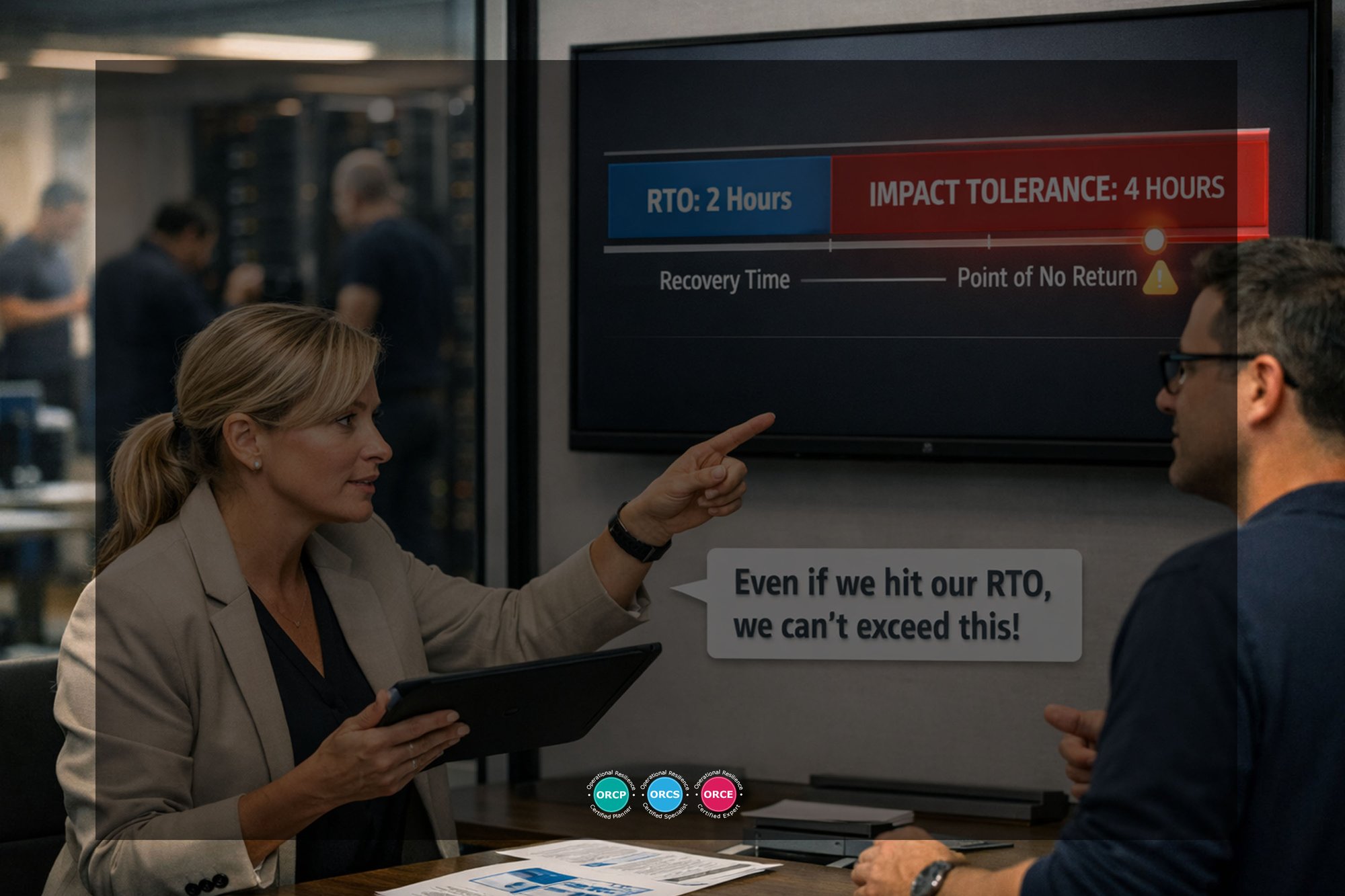
Impact tolerance cannot be set in isolation. It must reflect the **true operating reality of how a Critical Business Service (CBS) is delivered**, including all the underlying interconnections and dependencies that enable it to function.
Many organisations initially set impact tolerances based on assumed recovery capabilities or high-level process views. However, without detailed **dependency mapping**, these tolerances often prove unrealistic when tested under stress.
Hidden dependencies, single points of failure, and cascading disruptions can quickly invalidate even well-defined thresholds.
This chapter explains how dependency mapping provides the **foundation for realistic, evidence-based impact tolerance** by revealing how services are supported and where vulnerabilities exist.
[](https://cta-redirect.hubspot.com/cta/redirect/3893111/e5fad794-08a2-4f8b-ba94-5d32e15ba9bc)
[Moh Heng Goh](https://blog.bcm-institute.org/ebook-or/author/moh-heng-goh) May 8, 2026
###### Operational Resilience Certified Planner-Specialist-Expert
#### [](https://cta-redirect.hubspot.com/cta/redirect/3893111/00e8044a-8a62-4f8f-be7c-9c267d8b3dfc)
### \[P2\] \[S3\] Chapter 9
### [](https://cta-redirect.hubspot.com/cta/redirect/3893111/b130e2d2-651f-4fd6-af68-9a5a85e124da)
### **Role of Dependency Mapping in Impact Tolerance**
#### **Introduction**
[![\[OR\] \[P2\] \[S3\] \[ITo\] \[C9\] Role of Dependency Mapping in Impact Tolerance](https://no-cache.hubspot.com/cta/default/3893111/d35fd8b0-e936-4ab3-9706-4366bfcb8cbe.png)](https://cta-redirect.hubspot.com/cta/redirect/3893111/d35fd8b0-e936-4ab3-9706-4366bfcb8cbe)
Impact tolerance cannot be set in isolation. It must reflect the **true operating reality of how a Critical Business Service (CBS) is delivered**, including all the underlying interconnections and dependencies that enable it to function.
Many organisations initially set impact tolerances based on assumed recovery capabilities or high-level process views. However, without detailed **dependency mapping**, these tolerances often prove unrealistic when tested under stress.
Hidden dependencies, single points of failure, and cascading disruptions can quickly invalidate even well-defined thresholds.
This chapter explains how dependency mapping provides the **foundation for realistic, evidence-based impact tolerance** by revealing how services are supported and where vulnerabilities exist.
#### **Purpose of the Chapter**
The purpose of this chapter is to:
- Highlight the importance of mapping interconnections and dependencies
- Identify hidden vulnerabilities that influence impact tolerance
- Explain how dependency mapping supports tolerance calibration
- Demonstrate the role of process-resource mapping in resilience analysis
- Provide practical templates for integrating mapping into impact tolerance assessment
#### **Understanding Dependency Mapping**
Dependency mapping is the process of identifying and documenting all components required to deliver a CBS. It provides a **holistic, end-to-end view** of how services operate.
A complete dependency map covers four key domains:
##### **People**
- Frontline staff (e.g., branch, call centre)
- Operations teams
- Technology and support staff
- Subject matter experts and key personnel
**Key Considerations:**
- Availability of skilled resources
- Cross-training and backup capability
- Reliance on key individuals
##### **Process**
- Business workflows and procedures
- Manual and automated processes
- Control mechanisms and approvals
**Key Considerations:**
- Process complexity
- Dependency on sequential steps
- Manual intervention requirements
##### **Technology**
- Core systems and applications
- Infrastructure (servers, networks, databases)
- Interfaces and integration layers
**Key Considerations:**
- System resilience and redundancy
- Recovery capabilities (failover, backup)
- Inter-system dependencies
##### **Third Parties**
- Outsourced service providers
- Cloud and technology vendors
- Payment networks and clearing houses
- Data providers and utilities
**Key Considerations:**
- Vendor reliability and SLAs
- Concentration risk
- Limited control over recovery timelines
#### **Dependency Mapping and Impact Tolerance**
Dependency mapping directly influences how impact tolerance is defined.
##### **Key Linkages**
| Mapping Insight | Impact on Tolerance |
| --- | --- |
| Critical dependency identified | May reduce acceptable downtime |
| Multiple dependencies | Increases risk of failure |
| Lack of redundancy | Requires stricter tolerance or remediation |
| Strong resilience capability | Supports more confident tolerance setting |
Without mapping, organisations risk:
- Underestimating disruption impact
- Overestimating recovery capability
- Setting tolerances that are **not achievable in practice**
#### **Identifying Single Points of Failure**
A **Single Point of Failure (SPOF)** is any component whose failure would cause a service disruption.
##### **Examples**
| Dependency Type | Single Point of Failure Example |
| --- | --- |
| People | Only one staff member has critical system knowledge |
| Process | Manual approval step with no backup approver |
| Technology | Single data centre hosting the core banking system |
| Third Party | Sole provider for payment gateway services |
##### **Impact on Tolerance**
SPOFs significantly increase the likelihood of:
- Rapid service disruption
- Extended downtime
- Breach of impact tolerance
##### **Mitigation Strategies**
- Introduce redundancy (e.g., backup systems, alternate vendors)
- Cross-train staff
- Automate manual processes
- Diversify third-party dependencies
Identifying SPOFs is critical to ensuring that impact tolerances are **realistic and achievable**.
#### **Cascading Failure Analysis**
Disruptions rarely occur in isolation. Failure in one component can trigger a chain reaction across multiple services.
##### **Example of Cascading Failure**
1. Cloud provider outage
2. Digital banking platform becomes unavailable
3. Payment initiation fails
4. Clearing and settlement are delayed
5. Customer transactions disrupted
6. Regulatory reporting impacted
**Key Observations**
- Dependencies are **interconnected and interdependent**
- Failure can propagate across CBS and Sub-CBS
- Impact escalates rapidly beyond initial disruption
##### **Role in Impact Tolerance**
Cascading failure analysis helps organisations:
- Understand **how quickly disruption spreads**
- Identify **critical nodes in the dependency chain**
- Set tolerances that account for **end-to-end service impact**
This ensures that tolerances are not based on isolated components but reflect **full service delivery risk**.
#### **Integration with Dependency Mapping Tables**
Dependency mapping should be documented using structured tables to support analysis and decision-making.
##### **Example: Dependency Mapping Table**
| Sub-CBS Code | Sub-CBS | Dependency Type | Dependency Detail | Connectivity |
| --- | --- | --- | --- | --- |
| 1.6 | Deposit Transactions Processing | Technology | Core banking system | Processes all deposit transactions |
| 1.6 | Deposit Transactions Processing | Third Party | ATM network provider | Enables ATM deposit services |
| 2.1 | Payment Initiation | Technology | Payment gateway | Routes payment instructions |
| 2.7 | Clearing and Settlement | Third Party | Clearing house | Settles interbank transactions |
##### **Key Benefits**
- Provides **clear visibility of dependencies**
- Enables identification of **critical components**
- Supports **scenario testing and impact analysis**
- Links directly to **impact tolerance assessment**
#### **Integration with Process-Resource Mapping**
Dependency mapping is closely linked to **process-resource mapping**, which provides a deeper view of how services operate.
##### **Example: Process-Resource Mapping Table**
| Sub-CBS Code | Sub-CBS | Processes | People | Technology | Third Parties | Upstream / Downstream Dependencies |
| --- | --- | --- | --- | --- | --- | --- |
| 1.1 | Customer Onboarding | Application, verification, approval | Onboarding team, compliance | CRM, KYC system | eKYC provider | Account opening, digital access |
| 1.6 | Deposit Transactions | Deposit capture, validation, posting | Operations, branch staff | Core banking, ATM switch | ATM network | Account balance, reporting |
| 2.7 | Clearing and Settlement | Clearing, settlement, reconciliation | Payments ops, treasury | Payment switch, RTGS | Clearing house | Liquidity, customer notification |
##### **Role in Impact Tolerance**
Process-resource mapping enables organisations to:
- Quantify **how disruptions affect each resource layer**
- Identify **bottlenecks and constraints**
- Assess **manual workaround feasibility**
- Understand **recovery sequencing requirements**
This level of detail is essential for setting **accurate and defensible tolerances**.
#### **Practical Application in Impact Tolerance Setting**
Dependency mapping informs multiple aspects of tolerance setting:
##### **Defining Realistic Time Thresholds**
- If recovery depends on multiple systems, downtime may increase
- If redundancy exists, tolerance can be tighter
##### **Assessing Data Loss Tolerance**
- Data replication capabilities influence MTDL
- Single data storage points increase risk
##### **Evaluating Service Capacity**
- Availability of people and systems affects throughput
- Third-party limitations may constrain recovery speed
##### **Supporting Scenario Testing**
- Identifies failure points to include in scenarios
- Enables realistic simulation of disruptions
#### **Common Challenges**
| Challenge | Description |
| --- | --- |
| Incomplete mapping | Missing dependencies lead to inaccurate tolerance |
| Siloed information | Lack of cross-functional visibility |
| Outdated mapping | Changes in systems or vendors not reflected |
| Over-complex mapping | Excessive detail without actionable insights |
| Lack of ownership | No clear accountability for maintaining maps |
#### **Best Practices**
To maximise effectiveness:
- Maintain **end-to-end service view**, not siloed components
- Regularly update mapping to reflect changes
- Involve **cross-functional stakeholders**
- Focus on **critical dependencies**, not every detail
- Align mapping outputs with **scenario testing and tolerance setting**
- Use mapping as a **living document**, not a one-time exercise
#### [![Banner \[Summing\] \[OR\] \[E3\] Establish Impact Tolerance](https://no-cache.hubspot.com/cta/default/3893111/5e80e50f-5e3e-44ea-8c43-16bf42d4f3b5.png)](https://cta-redirect.hubspot.com/cta/redirect/3893111/5e80e50f-5e3e-44ea-8c43-16bf42d4f3b5)
Dependency mapping is a critical enabler of effective impact tolerance setting. It reveals the interconnections that underpin service delivery, identifies hidden vulnerabilities, and highlights where disruptions are most likely to occur and propagate.
By systematically mapping people, processes, technology, and third-party dependencies, organisations can uncover single points of failure, analyse cascading impacts, and ensure that impact tolerances are grounded in operational reality.
Ultimately, dependency mapping transforms impact tolerance from an abstract concept into a **practical, evidence-based capability**, ensuring that organisations can confidently define, test, and operate within their resilience thresholds.
In the next chapter, we will explore how to **embed impact tolerance into governance, monitoring, and reporting frameworks**, ensuring sustained oversight and continuous improvement.
[](https://cta-redirect.hubspot.com/cta/redirect/3893111/05996af2-38e1-4f05-96c6-6f5d6469c9de)
| **C1** | **C2** | **C3** | **C4** | **C5** | **C6** |
| --- | --- | --- | --- | --- | --- |
| [![\[OR\] \[P2\] \[S3\] \[ITo\] \[C1\] Introduction to Impact Tolerance](https://no-cache.hubspot.com/cta/default/3893111/a2d06a13-c2ac-4e0a-b8ea-c5afcab91844.png)](https://cta-redirect.hubspot.com/cta/redirect/3893111/a2d06a13-c2ac-4e0a-b8ea-c5afcab91844) | [![\[OR\] \[P2\] \[S3\] \[ITo\] \[C2\] Regulatory and Standards Landscape](https://no-cache.hubspot.com/cta/default/3893111/04df8f17-629c-458f-af01-67e3da528b63.png)](https://cta-redirect.hubspot.com/cta/redirect/3893111/04df8f17-629c-458f-af01-67e3da528b63) | [![\[OR\] \[P2\] \[S3\] \[ITo\] \[C3\] Understanding Impact Tolerance in Context](https://no-cache.hubspot.com/cta/default/3893111/ea66bac0-7b34-4d56-9c93-c33c8f7964bc.png)](https://cta-redirect.hubspot.com/cta/redirect/3893111/ea66bac0-7b34-4d56-9c93-c33c8f7964bc) | [![\[OR\] \[P2\] \[S3\] \[ITo\] \[C4\] Linking Impact Tolerance to Critical Business Services (CBS)](https://no-cache.hubspot.com/cta/default/3893111/24ceb290-50c2-4af4-be00-41894f00c7cb.png)](https://cta-redirect.hubspot.com/cta/redirect/3893111/24ceb290-50c2-4af4-be00-41894f00c7cb) | [![\[OR\] \[P2\] \[S3\] \[ITo\] \[C5\] Key Components of Impact Tolerance](https://no-cache.hubspot.com/cta/default/3893111/6e9d8a15-c0a3-4e28-b9a4-c2dcc3e2081e.png)](https://cta-redirect.hubspot.com/cta/redirect/3893111/6e9d8a15-c0a3-4e28-b9a4-c2dcc3e2081e) | [![\[OR\] \[P2\] \[S3\] \[ITo\] \[C6\] Methodology for Setting Impact Tolerance](https://no-cache.hubspot.com/cta/default/3893111/77526e47-fc15-4c7b-bf03-cadd672b40db.png)](https://cta-redirect.hubspot.com/cta/redirect/3893111/77526e47-fc15-4c7b-bf03-cadd672b40db) |
| **C7** | **C8** | **C9** | **C10** | **C11** | **C12 ** |
| [![\[OR\] \[P2\] \[S3\] \[ITo\] \[C7\] Impact Tolerance Assessment Framework](https://no-cache.hubspot.com/cta/default/3893111/abf28462-aba4-4970-81be-55cf66dc6147.png)](https://cta-redirect.hubspot.com/cta/redirect/3893111/abf28462-aba4-4970-81be-55cf66dc6147) | [![\[OR\] \[P2\] \[S3\] \[ITo\] \[C8\] Scenario-Based Calibration of Impact Tolerance](https://no-cache.hubspot.com/cta/default/3893111/23b3a54d-37ce-494b-acb1-33b3cc5e1655.png)](https://cta-redirect.hubspot.com/cta/redirect/3893111/23b3a54d-37ce-494b-acb1-33b3cc5e1655) | [![\[OR\] \[P2\] \[S3\] \[ITo\] \[C9\] Role of Dependency Mapping in Impact Tolerance](https://no-cache.hubspot.com/cta/default/3893111/d35fd8b0-e936-4ab3-9706-4366bfcb8cbe.png)](https://cta-redirect.hubspot.com/cta/redirect/3893111/d35fd8b0-e936-4ab3-9706-4366bfcb8cbe) | [![\[OR\] \[P2\] \[S3\] \[ITo\] \[C10\] Governance, Ownership, and Accountability](https://no-cache.hubspot.com/cta/default/3893111/de12fefd-b6c6-4156-83a9-5d19ca5bc508.png)](https://cta-redirect.hubspot.com/cta/redirect/3893111/de12fefd-b6c6-4156-83a9-5d19ca5bc508) | [![\[OR\] \[P2\] \[S3\] \[ITo\] \[C11\] Integration with Operational Resilience Framework](https://no-cache.hubspot.com/cta/default/3893111/84d3d3c4-0647-4ffd-99b4-a20a12526019.png)](https://cta-redirect.hubspot.com/cta/redirect/3893111/84d3d3c4-0647-4ffd-99b4-a20a12526019) | [![\[OR\] \[P2\] \[S3\] \[ITo\] \[C12\] Testing and Validation of Impact Tolerances](https://no-cache.hubspot.com/cta/default/3893111/9a9cb7eb-1ca3-4790-b39e-f6b0035a1eae.png)](https://cta-redirect.hubspot.com/cta/redirect/3893111/9a9cb7eb-1ca3-4790-b39e-f6b0035a1eae) |
| **C13** | **C14** | **C15** | **C16** | **C17** | **C18** |
| [![\[OR\] \[P2\] \[S3\] \[ITo\] \[C13\] Monitoring, Metrics, and Continuous Improvement](https://no-cache.hubspot.com/cta/default/3893111/1a32f981-3a16-427a-a63f-5a40ab93ea21.png)](https://cta-redirect.hubspot.com/cta/redirect/3893111/1a32f981-3a16-427a-a63f-5a40ab93ea21) | [![\[OR\] \[P2\] \[S3\] \[ITo\] \[C14\] Common Challenges and Pitfalls](https://no-cache.hubspot.com/cta/default/3893111/8831463d-a357-4203-806b-fb31ef71d615.png)](https://cta-redirect.hubspot.com/cta/redirect/3893111/8831463d-a357-4203-806b-fb31ef71d615) | [![\[OR\] \[P2\] \[S3\] \[ITo\] \[C15\] Practical Case Study (Banking Sector Example)](https://no-cache.hubspot.com/cta/default/3893111/fef15761-14c6-4e2b-b157-554cceb33d14.png)](https://cta-redirect.hubspot.com/cta/redirect/3893111/fef15761-14c6-4e2b-b157-554cceb33d14) | [![\[OR\] \[P2\] \[S3\] \[ITo\] \[C16\] Future Trends in Impact Tolerance](https://no-cache.hubspot.com/cta/default/3893111/b6a701db-167e-4630-88ad-de0d43deb322.png)](https://cta-redirect.hubspot.com/cta/redirect/3893111/b6a701db-167e-4630-88ad-de0d43deb322) | [![\[OR\] \[P2\] \[S3\] \[ITo\] \[C17\] Key Takeaways and Call to Action](https://no-cache.hubspot.com/cta/default/3893111/bf49e0c2-33a3-48bc-97d2-eb939aed77bd.png)](https://cta-redirect.hubspot.com/cta/redirect/3893111/bf49e0c2-33a3-48bc-97d2-eb939aed77bd) | [![\[OR\] \[P2\] \[S3\] \[ITo\] \[C18\] Back Cover](https://no-cache.hubspot.com/cta/default/3893111/3623335d-0b26-4ee7-afbf-0d431358b390.png)](https://cta-redirect.hubspot.com/cta/redirect/3893111/3623335d-0b26-4ee7-afbf-0d431358b390) |
#### More Information About OR-5000 \[OR-5\] or OR-300 \[OR-3\]
To learn more about the course and schedule, click the buttons below for the OR-300 Operational Resilience Implementer course and the OR-5000 Operational Resilience Expert Implementer course.
| [](https://cta-redirect.hubspot.com/cta/redirect/3893111/3530eccb-515d-401e-afc2-3469e26d7fbf) | [](https://cta-redirect.hubspot.com/cta/redirect/3893111/fdd4fa9c-ed69-40c1-925f-4eb6a1c5c255) | [](https://cta-redirect.hubspot.com/cta/redirect/3893111/77a34b84-0a6d-44f8-b8d6-6ab04cdf5edd) |
| --- | --- | --- |
| [](https://cta-redirect.hubspot.com/cta/redirect/3893111/6e5c0cda-39b9-4bbd-b3d4-4cf46a790b14) | [](https://cta-redirect.hubspot.com/cta/redirect/3893111/a68a08aa-36d3-4216-9551-202c9fde06ea) | [![ \[BL-OR\] \[3-4-5\] View Schedule](https://no-cache.hubspot.com/cta/default/3893111/d0d733a1-16c0-4b68-a26d-adbfd4fc6069.png)](https://cta-redirect.hubspot.com/cta/redirect/3893111/d0d733a1-16c0-4b68-a26d-adbfd4fc6069) |
| [![\[BL-OR\] \[3\] FAQ OR-300](https://no-cache.hubspot.com/cta/default/3893111/f20c71b4-f5e8-4aa5-8056-c374ca33a091.png)](https://cta-redirect.hubspot.com/cta/redirect/3893111/f20c71b4-f5e8-4aa5-8056-c374ca33a091) | If you have any questions, click to contact us.[![Email to Sales Team \[BCM Institute\]](https://no-cache.hubspot.com/cta/default/3893111/3c53daeb-2836-4843-b0e0-645baee2ab9e.png)](https://cta-redirect.hubspot.com/cta/redirect/3893111/3c53daeb-2836-4843-b0e0-645baee2ab9e) | [](https://cta-redirect.hubspot.com/cta/redirect/3893111/7f2718a4-ea80-4f84-a319-dc2d4df37a46) |
| [](https://cta-redirect.hubspot.com/cta/redirect/3893111/74b1e556-8cd2-4a74-8821-db1804534955) | [](https://cta-redirect.hubspot.com/cta/redirect/3893111/f2bd8eb1-32d2-4732-9267-ea53223cf58f) | [](https://cta-redirect.hubspot.com/cta/redirect/3893111/084e620a-46c5-419a-82ed-6a681d15c0b6) |
#### **Comments:**

---

---

---

---


All rights reserved. Copyright 2026
```json
{
"@context" : "https://schema.org",
"@type" : "BlogPosting",
"author" : {
"@type" : "Person",
"name" : "Moh Heng Goh",
"url" : "https://blog.bcm-institute.org/ebook-or/author/moh-heng-goh"
},
"dateModified" : "2026-05-11T07:38:48.231Z",
"datePublished" : "2026-05-08T09:50:01.000Z",
"headline" : "[OR] [P2] [S3] [ITo] [C9] Role of Dependency Mapping in Impact Tolerance",
"mainEntityOfPage" : {
"@id" : "https://blog.bcm-institute.org/ebook-or/or-p2-s3-ito-c9-role-of-dependency-mapping-in-impact-tolerance",
"@type" : "WebPage"
},
"publisher" : {
"@type" : "Organization",
"logo" : {
"@type" : "ImageObject",
"url" : "https://blog.bcm-institute.org/hubfs/BCMI%20Logo.png"
},
"name" : "BCMI Pte Ltd"
}
}
```