

[P2] [S3] Chapter 3
Understanding Impact Tolerance in Context
Introduction
![[OR] [P2] [S3] [ITo] [C3] Understanding Impact Tolerance in Context](https://no-cache.hubspot.com/cta/default/3893111/ea66bac0-7b34-4d56-9c93-c33c8f7964bc.png)
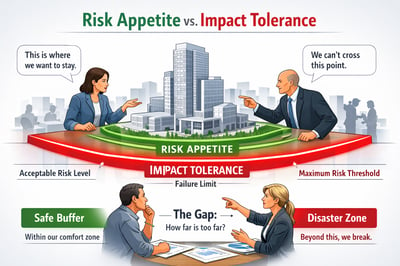 Impact tolerance is often misunderstood when organisations attempt to align it with existing risk and continuity frameworks. While it builds upon established concepts such as risk appetite, Recovery Time Objective (RTO), and Recovery Point Objective (RPO), it represents a fundamental shift in perspective—from managing risks and recovering systems to ensuring that critical services remain within acceptable levels of disruption.
To implement impact tolerance effectively, organisations must clearly understand how it differs from related concepts and how it integrates into the broader operational resilience framework. Without this clarity, there is a risk of misinterpreting impact tolerance as simply a rebranding of existing metrics, rather than recognising it as a distinct, outcome-driven construct.
Purpose of the Chapter
This chapter aims to clarify how impact tolerance differs from related concepts, enabling organisations to:
- Distinguish impact tolerance from traditional risk and continuity metrics
- Understand its role within operational resilience
- Identify the key dimensions used to define and measure tolerance
- Position impact tolerance as an outcome-based metric aligned to service delivery
Differences Between Key Concepts
Risk Appetite vs Impact Tolerance
Although often used interchangeably, risk appetite and impact tolerance serve different purposes.
Risk Appetite
- Defines the amount and type of risk an organisation is willing to accept in pursuit of its objectives
- Forward-looking and strategic
- Covers a broad range of risks (financial, operational, strategic, compliance)
- Expressed in qualitative and quantitative terms
Impact Tolerance
- Defines the maximum level of disruption that can be tolerated for a specific Critical Business Service
- Focused on outcomes during disruption, not risk-taking decisions
- Service-specific and operational
- Measured through disruption thresholds (e.g., time, data, customer impact)
Key Distinction
|
Risk Appetite |
Impact Tolerance |
|
Willingness to take risks |
Ability to withstand disruption |
|
Strategic and forward-looking |
Operational and scenario-based |
|
Organisation-wide |
Service-specific |
|
Focus on risk exposure |
Focus on impact outcomes |
In essence:
Risk appetite defines what risks you are willing to take, while impact tolerance defines what disruption you cannot afford to exceed.
RTO/RPO vs Impact Tolerance
Traditional Business Continuity Management (BCM) metrics such as RTO and RPO remain important, but they are not equivalent to impact tolerance.
Recovery Time Objective (RTO)
- The target time to restore a system or process after disruption
Recovery Point Objective (RPO)
- The maximum acceptable amount of data loss
These metrics are:
- System- or process-centric
- Focused on recovery performance
- Internally driven
Impact Tolerance
- Focuses on the maximum acceptable disruption to a service
- Defined based on external impact, particularly on customers and stakeholders
- May incorporate multiple RTOs and RPOs across interdependent systems
Key Distinction
|
RTO/RPO |
Impact Tolerance |
|
Recovery targets |
Disruption limits |
|
System/process level |
Service level |
|
Internal operational focus |
External outcome focus |
|
Component-specific |
End-to-end service view |
In practice:
An organisation may meet its RTOs for individual systems but still breach its impact tolerance if the overall service disruption exceeds acceptable limits.
Service Availability vs Service Survivability
Another critical distinction lies between service availability and service survivability.
Service Availability
- Measures uptime or the percentage of time a service is operational
- Focuses on normal operating conditions
- Often defined through Service Level Agreements (SLAs)
Service Survivability
- Refers to the ability of a service to continue functioning within acceptable limits during disruption
- Focuses on stress conditions and adverse scenarios
- Directly linked to impact tolerance
Key Distinction
|
Service Availability |
Service Survivability |
|
Normal operations |
Disrupted conditions |
|
Uptime metrics |
Tolerance thresholds |
|
SLA-driven |
Scenario-driven |
|
Binary (up/down) |
Gradual degradation |
Impact tolerance is fundamentally about service survivability, not just availability. It recognises that during disruption:
- Services may degrade
- Partial functionality may be acceptable
- The key is to remain within defined tolerance thresholds
Key Dimensions of Impact Tolerance
Impact tolerance is multi-dimensional and must be defined across several measurable aspects to ensure completeness and accuracy.
Time-Based Dimension (Maximum Tolerable Downtime – MTD)
This dimension defines the maximum duration a service can be disrupted before the impact becomes unacceptable.
- Core component of impact tolerance
- Reflects the urgency of recovery
- Varies by service criticality
Example:
A real-time payment service may have an MTD of 2 hours, while a non-critical reporting service may tolerate 24 hours.
Data-Based Dimension (Maximum Tolerable Data Loss – MTDL)
This dimension defines the maximum acceptable loss of data during a disruption.
- Critical for data integrity and trust
- Particularly important in financial and digital services
- Often linked to RPO but aligned to service-level outcomes
Example:
A trading platform may require near-zero data loss, while a batch processing system may tolerate limited data gaps.
Volume-Based Dimension (Transaction Capacity)
This dimension considers the volume of transactions or service capacity that must be maintained during disruption.
- Recognises that services may operate at reduced capacity
- Defines acceptable levels of degradation
- Important for high-volume services such as payments or trading
Example:
A service may tolerate operating at 60% capacity for a limited period without breaching impact tolerance.
Customer Impact Thresholds
This dimension defines the maximum level of disruption experienced by customers.
- Number or percentage of customers affected
- Duration of impact
- Severity of service degradation
Example:
No more than 20% of customers should experience a disruption exceeding 1 hour.
Impact Tolerance as an Outcome-Based Metric
One of the most defining characteristics of impact tolerance is that it is an outcome-based metric.
Unlike traditional metrics that focus on internal processes or system recovery, impact tolerance focuses on:
- What happens to the customer
- What consequences arise from the disruption
- Whether the organisation remains within acceptable impact levels
Key Attributes of Outcome-Based Metrics:
- Customer-centric: Measures real-world impact on service users
- Holistic: Considers end-to-end service delivery
- Scenario-driven: Tested under severe but plausible conditions
- Decision-enabling: Supports prioritisation and investment decisions
Why This Matters
An organisation may:
- Recover systems within RTO
- Maintain infrastructure performance
…but still fail operational resilience objectives if:
- Customers experience prolonged disruption
- Regulatory obligations are breached
- Market confidence is affected
Impact tolerance ensures that success is defined not by recovery alone, but by maintaining acceptable outcomes during disruption.
![Banner [Summing] [OR] [E3] Establish Impact Tolerance](https://no-cache.hubspot.com/cta/default/3893111/5e80e50f-5e3e-44ea-8c43-16bf42d4f3b5.png)
Understanding impact tolerance in context is critical to its effective implementation. By distinguishing it from risk appetite, traditional BCM metrics, and service availability concepts, organisations can avoid common misconceptions and apply it correctly.
Impact tolerance introduces a service-centric, outcome-driven approach that aligns resilience efforts with what truly matters—the ability to sustain critical services within acceptable limits under stress.
By defining impact tolerance across key dimensions—time, data, volume, and customer impact—organisations can establish clear, measurable thresholds that guide resilience strategies and decision-making.
In the next chapter, we will explore how impact tolerance is linked to Critical Business Services (CBS), forming the foundation for practical implementation within the operational resilience framework.

![[OR] [P2] [S3] [ITo] [C1] Introduction to Impact Tolerance](https://no-cache.hubspot.com/cta/default/3893111/a2d06a13-c2ac-4e0a-b8ea-c5afcab91844.png)
![[OR] [P2] [S3] [ITo] [C2] Regulatory and Standards Landscape](https://no-cache.hubspot.com/cta/default/3893111/04df8f17-629c-458f-af01-67e3da528b63.png)
![[OR] [P2] [S3] [ITo] [C4] Linking Impact Tolerance to Critical Business Services (CBS)](https://no-cache.hubspot.com/cta/default/3893111/24ceb290-50c2-4af4-be00-41894f00c7cb.png)
![[OR] [P2] [S3] [ITo] [C5] Key Components of Impact Tolerance](https://no-cache.hubspot.com/cta/default/3893111/6e9d8a15-c0a3-4e28-b9a4-c2dcc3e2081e.png)
![[OR] [P2] [S3] [ITo] [C6] Methodology for Setting Impact Tolerance](https://no-cache.hubspot.com/cta/default/3893111/77526e47-fc15-4c7b-bf03-cadd672b40db.png)
![[OR] [P2] [S3] [ITo] [C7] Impact Tolerance Assessment Framework](https://no-cache.hubspot.com/cta/default/3893111/abf28462-aba4-4970-81be-55cf66dc6147.png)
![[OR] [P2] [S3] [ITo] [C8] Scenario-Based Calibration of Impact Tolerance](https://no-cache.hubspot.com/cta/default/3893111/23b3a54d-37ce-494b-acb1-33b3cc5e1655.png)
![[OR] [P2] [S3] [ITo] [C9] Role of Dependency Mapping in Impact Tolerance](https://no-cache.hubspot.com/cta/default/3893111/d35fd8b0-e936-4ab3-9706-4366bfcb8cbe.png)
![[OR] [P2] [S3] [ITo] [C10] Governance, Ownership, and Accountability](https://no-cache.hubspot.com/cta/default/3893111/de12fefd-b6c6-4156-83a9-5d19ca5bc508.png)
![[OR] [P2] [S3] [ITo] [C11] Integration with Operational Resilience Framework](https://no-cache.hubspot.com/cta/default/3893111/84d3d3c4-0647-4ffd-99b4-a20a12526019.png)
![[OR] [P2] [S3] [ITo] [C12] Testing and Validation of Impact Tolerances](https://no-cache.hubspot.com/cta/default/3893111/9a9cb7eb-1ca3-4790-b39e-f6b0035a1eae.png)
![[OR] [P2] [S3] [ITo] [C13] Monitoring, Metrics, and Continuous Improvement](https://no-cache.hubspot.com/cta/default/3893111/1a32f981-3a16-427a-a63f-5a40ab93ea21.png)
![[OR] [P2] [S3] [ITo] [C14] Common Challenges and Pitfalls](https://no-cache.hubspot.com/cta/default/3893111/8831463d-a357-4203-806b-fb31ef71d615.png)
![[OR] [P2] [S3] [ITo] [C15] Practical Case Study (Banking Sector Example)](https://no-cache.hubspot.com/cta/default/3893111/fef15761-14c6-4e2b-b157-554cceb33d14.png)
![[OR] [P2] [S3] [ITo] [C16] Future Trends in Impact Tolerance](https://no-cache.hubspot.com/cta/default/3893111/b6a701db-167e-4630-88ad-de0d43deb322.png)
![[OR] [P2] [S3] [ITo] [C17] Key Takeaways and Call to Action](https://no-cache.hubspot.com/cta/default/3893111/bf49e0c2-33a3-48bc-97d2-eb939aed77bd.png)
![[OR] [P2] [S3] [ITo] [C18] Back Cover](https://no-cache.hubspot.com/cta/default/3893111/3623335d-0b26-4ee7-afbf-0d431358b390.png)
More Information About OR-5000 [OR-5] or OR-300 [OR-3]
To learn more about the course and schedule, click the buttons below for the OR-300 Operational Resilience Implementer course and the OR-5000 Operational Resilience Expert Implementer course.


![[BL-OR] [3-4-5] View Schedule](https://no-cache.hubspot.com/cta/default/3893111/d0d733a1-16c0-4b68-a26d-adbfd4fc6069.png)
![[BL-OR] [3] FAQ OR-300](https://no-cache.hubspot.com/cta/default/3893111/f20c71b4-f5e8-4aa5-8056-c374ca33a091.png)
![Email to Sales Team [BCM Institute]](https://no-cache.hubspot.com/cta/default/3893111/3c53daeb-2836-4843-b0e0-645baee2ab9e.png)