


[P2] [S3] Chapter 11
Integration with Operational Resilience Framework
Introduction
![[OR] [P2] [S3] [ITo] [C11] Integration with Operational Resilience Framework](https://no-cache.hubspot.com/cta/default/3893111/84d3d3c4-0647-4ffd-99b4-a20a12526019.png)
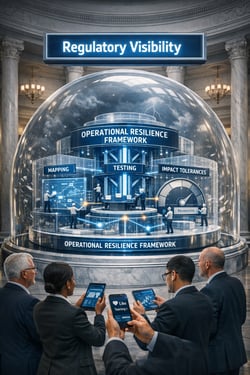 Impact tolerance is not a standalone concept—it is the anchor point that connects multiple resilience disciplines into a unified operational resilience framework. Without integration, organisations risk fragmentation, where different functions operate with inconsistent assumptions about acceptable disruption, recovery priorities, and customer outcomes.
To be effective, impact tolerance must be embedded across key resilience pillars, ensuring that all functions work toward a common objective: maintaining critical business services within defined disruption thresholds.
This chapter explains how impact tolerance integrates with core components of the operational resilience framework and how it aligns with broader organisational risk and response mechanisms.
Purpose of the Chapter
The purpose of this chapter is to:
- Embed impact tolerance within the broader operational resilience framework
- Explain linkages with key resilience disciplines
- Align impact tolerance with risk appetite and recovery strategies
- Ensure consistency between tolerance thresholds and incident response actions
Integration with Core Operational Resilience Pillars
Impact tolerance acts as a unifying metric across the core pillars of operational resilience.
Integration with Operational Risk Management (ORM)
Operational Risk Management focuses on identifying, assessing, and mitigating risks that could disrupt business operations.
Linkages:
- Impact tolerance defines the maximum acceptable disruption, guiding risk prioritisation
- ORM identifies risks that could cause tolerance breaches
- Risk assessments incorporate likelihood vs consequence aligned to tolerance thresholds
- Key Risk Indicators (KRIs) can be calibrated to signal approaching tolerance limits
Outcome:
ORM shifts from generic risk scoring to service impact-driven risk management
Integration with Business Continuity Management (BCM)
Business Continuity Management provides strategies and plans to recover from disruptions.
Linkages:
- Impact tolerance replaces or complements traditional metrics such as RTO and MTPD
- BCM strategies must ensure recovery within defined tolerance thresholds
- Business Impact Analysis (BIA) supports tolerance definition
- Continuity plans are designed to maintain or restore service within tolerance
Outcome:
BCM evolves from recovery-focused planning to service continuity within acceptable disruption limits
Integration with Crisis Management
Crisis Management focuses on decision-making, escalation, and coordination during major disruptions.
Linkages:
- Impact tolerance defines when an incident escalates into a crisis
- Breach or near-breach of tolerance triggers crisis activation
- Crisis management teams use tolerance thresholds to prioritise actions
- Communication strategies align with customer and regulatory impact thresholds
Outcome:
Crisis Management becomes threshold-driven, enabling a timely and proportionate response
Integration with Cyber Resilience
Cyber resilience ensures the organisation can withstand and recover from cyber incidents.
Linkages:
- Cyber scenarios are tested against impact tolerance thresholds
- Recovery capabilities (e.g., system restoration, data recovery) must meet MTD and MTDL
- Detection and response times must prevent tolerance breaches
- Cyber resilience strategies align with critical service protection
Outcome:
Cyber resilience shifts from technical recovery to service impact containment
Integration with Third-Party Risk Management (TPRM)
Third-party dependencies are critical to service delivery and must align with impact tolerance.
Linkages:
- Vendor SLAs must support the organisation’s impact tolerance thresholds
- Dependency mapping identifies critical third-party risks
- Scenario testing includes third-party failure scenarios
- Exit and substitution strategies must ensure continuity within tolerance
Outcome:
Third-party risk management becomes impact-driven rather than contract-driven
Alignment with Risk Appetite Statements
Impact tolerance must align with the organisation’s risk appetite framework.
Relationship Between Risk Appetite and Impact Tolerance
|
Element |
Description |
|
Risk Appetite |
The level of risk the organisation is willing to accept |
|
Impact Tolerance |
The level of disruption the organisation is willing to tolerate |
Key Alignment Principles
- Impact tolerance operationalises risk appetite at the service level
- Tolerances must reflect customer, financial, and regulatory priorities
- Conservative risk appetite → tighter impact tolerances
- Higher risk appetite → more flexible tolerances (within regulatory limits)
Example
- Risk Appetite Statement:
“The organisation has zero tolerance for disruption to critical payment services that may impact financial stability.” - Corresponding Impact Tolerance:
“Payment services must not be unavailable for more than 1 hour and must maintain at least 90% transaction processing capacity.”
Alignment with Recovery Strategies
Recovery strategies must be designed to ensure that services remain within impact tolerance.
Key Linkages
|
Recovery Strategy Component |
Alignment with Impact Tolerance |
|
System Recovery |
Must meet MTD requirements |
|
Data Recovery |
Must meet MTDL requirements |
|
Alternate Sites |
Must support service continuity within tolerance |
|
Manual Workarounds |
Must sustain operations until recovery |
|
Resource Allocation |
Must prioritise CBS nearing tolerance limits |
Key Principle
Recovery strategies are only effective if they enable the organisation to remain within its impact tolerance
Integration with Incident Response
Incident response is the operational mechanism that ensures impact tolerance is actively managed during disruptions.
Role of Impact Tolerance in Incident Response
- Defines thresholds for escalation
- Guides prioritisation of response actions
- Provides clear triggers for decision-making
- Enables real-time monitoring of service impact
Incident Escalation Based on Tolerance
|
Condition |
Response Action |
|
Early disruption |
Incident management activated |
|
Approaching tolerance |
Escalation to senior management |
|
Near breach |
Crisis management activation |
|
Breach |
Full crisis response and regulatory notification |
Monitoring During Incidents
Organisations should monitor:
- Service availability vs tolerance thresholds
- Transaction volumes and backlog
- Customer impact indicators
- System performance metrics
- Third-party service status
Key Outcome
Incident response becomes threshold-driven and data-informed, rather than reactive
Integrated Operational Resilience View
The integration of impact tolerance across all pillars creates a cohesive framework:
|
Pillar |
Role of Impact Tolerance |
|
Operational Risk Management |
Defines acceptable disruption thresholds |
|
Business Continuity Management |
Ensures recovery within tolerance |
|
Crisis Management |
Provides escalation triggers |
|
Cyber Resilience |
Protects critical services from cyber disruption |
|
Third-Party Risk Management |
Aligns vendor resilience with tolerance |
Common Challenges in Integration
|
Challenge |
Description |
|
Siloed functions |
Lack of coordination across resilience pillars |
|
Misaligned metrics |
Different functions using inconsistent thresholds |
|
Weak governance |
Limited oversight and accountability |
|
Incomplete integration |
Impact tolerance is not embedded into processes |
|
Over-reliance on BCM |
Failure to integrate with ORM, cyber, and TPRM |
Best Practices
- Establish common impact tolerance metrics across all functions
- Align tolerance with risk appetite and strategic objectives
- Integrate tolerance into policies, procedures, and frameworks
- Ensure cross-functional collaboration
- Use scenario testing to validate integration
- Embed tolerance into incident response and monitoring systems
- Continuously review and refine integration
![Banner [Summing] [OR] [E3] Establish Impact Tolerance](https://no-cache.hubspot.com/cta/default/3893111/5e80e50f-5e3e-44ea-8c43-16bf42d4f3b5.png)
Impact tolerance serves as the central integrating mechanism within the operational resilience framework. By linking operational risk, business continuity, crisis management, cyber resilience, and third-party risk management, it ensures that all functions operate with a shared understanding of acceptable disruption and service priorities.
When aligned with risk appetite, recovery strategies, and incident response processes, impact tolerance transforms resilience from a collection of siloed activities into a cohesive, outcome-driven capability.
Ultimately, integration ensures that organisations are not only prepared to respond to disruptions but can manage them consistently, effectively, and within clearly defined limits—delivering resilience that is both practical and defensible.

![[OR] [P2] [S3] [ITo] [C1] Introduction to Impact Tolerance](https://no-cache.hubspot.com/cta/default/3893111/a2d06a13-c2ac-4e0a-b8ea-c5afcab91844.png)
![[OR] [P2] [S3] [ITo] [C2] Regulatory and Standards Landscape](https://no-cache.hubspot.com/cta/default/3893111/04df8f17-629c-458f-af01-67e3da528b63.png)
![[OR] [P2] [S3] [ITo] [C3] Understanding Impact Tolerance in Context](https://no-cache.hubspot.com/cta/default/3893111/ea66bac0-7b34-4d56-9c93-c33c8f7964bc.png)
![[OR] [P2] [S3] [ITo] [C4] Linking Impact Tolerance to Critical Business Services (CBS)](https://no-cache.hubspot.com/cta/default/3893111/24ceb290-50c2-4af4-be00-41894f00c7cb.png)
![[OR] [P2] [S3] [ITo] [C5] Key Components of Impact Tolerance](https://no-cache.hubspot.com/cta/default/3893111/6e9d8a15-c0a3-4e28-b9a4-c2dcc3e2081e.png)
![[OR] [P2] [S3] [ITo] [C6] Methodology for Setting Impact Tolerance](https://no-cache.hubspot.com/cta/default/3893111/77526e47-fc15-4c7b-bf03-cadd672b40db.png)
![[OR] [P2] [S3] [ITo] [C7] Impact Tolerance Assessment Framework](https://no-cache.hubspot.com/cta/default/3893111/abf28462-aba4-4970-81be-55cf66dc6147.png)
![[OR] [P2] [S3] [ITo] [C8] Scenario-Based Calibration of Impact Tolerance](https://no-cache.hubspot.com/cta/default/3893111/23b3a54d-37ce-494b-acb1-33b3cc5e1655.png)
![[OR] [P2] [S3] [ITo] [C9] Role of Dependency Mapping in Impact Tolerance](https://no-cache.hubspot.com/cta/default/3893111/d35fd8b0-e936-4ab3-9706-4366bfcb8cbe.png)
![[OR] [P2] [S3] [ITo] [C10] Governance, Ownership, and Accountability](https://no-cache.hubspot.com/cta/default/3893111/de12fefd-b6c6-4156-83a9-5d19ca5bc508.png)
![[OR] [P2] [S3] [ITo] [C12] Testing and Validation of Impact Tolerances](https://no-cache.hubspot.com/cta/default/3893111/9a9cb7eb-1ca3-4790-b39e-f6b0035a1eae.png)
![[OR] [P2] [S3] [ITo] [C13] Monitoring, Metrics, and Continuous Improvement](https://no-cache.hubspot.com/cta/default/3893111/1a32f981-3a16-427a-a63f-5a40ab93ea21.png)
![[OR] [P2] [S3] [ITo] [C14] Common Challenges and Pitfalls](https://no-cache.hubspot.com/cta/default/3893111/8831463d-a357-4203-806b-fb31ef71d615.png)
![[OR] [P2] [S3] [ITo] [C15] Practical Case Study (Banking Sector Example)](https://no-cache.hubspot.com/cta/default/3893111/fef15761-14c6-4e2b-b157-554cceb33d14.png)
![[OR] [P2] [S3] [ITo] [C16] Future Trends in Impact Tolerance](https://no-cache.hubspot.com/cta/default/3893111/b6a701db-167e-4630-88ad-de0d43deb322.png)
![[OR] [P2] [S3] [ITo] [C17] Key Takeaways and Call to Action](https://no-cache.hubspot.com/cta/default/3893111/bf49e0c2-33a3-48bc-97d2-eb939aed77bd.png)
![[OR] [P2] [S3] [ITo] [C18] Back Cover](https://no-cache.hubspot.com/cta/default/3893111/3623335d-0b26-4ee7-afbf-0d431358b390.png)
More Information About OR-5000 [OR-5] or OR-300 [OR-3]
To learn more about the course and schedule, click the buttons below for the OR-300 Operational Resilience Implementer course and the OR-5000 Operational Resilience Expert Implementer course.


![[BL-OR] [3-4-5] View Schedule](https://no-cache.hubspot.com/cta/default/3893111/d0d733a1-16c0-4b68-a26d-adbfd4fc6069.png)
![[BL-OR] [3] FAQ OR-300](https://no-cache.hubspot.com/cta/default/3893111/f20c71b4-f5e8-4aa5-8056-c374ca33a091.png)
![Email to Sales Team [BCM Institute]](https://no-cache.hubspot.com/cta/default/3893111/3c53daeb-2836-4843-b0e0-645baee2ab9e.png)