


[P2] [S2] Chapter 14
Mapping Third-Party and Supply Chain Dependencies
Introduction
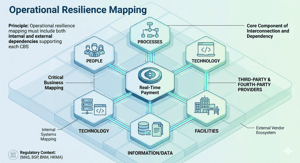
In modern operating environments, organisations increasingly rely on third-party providers and extended supply chains to deliver Critical Business Services (CBS). While outsourcing and external partnerships enable efficiency, scalability, and innovation, they also introduce complex interdependencies and systemic risks that must be actively managed.![[OR] [P2] [S2] [MII] [C14] Mapping Third-Party and Supply Chain Dependencies](https://no-cache.hubspot.com/cta/default/3893111/0c13b720-3d3e-4452-91e4-b9533260b3a4.png)
Operational resilience frameworks now require organisations to move beyond internal mapping and develop a comprehensive understanding of third-party and supply chain dependencies. This includes not only direct vendors (third parties), but also their subcontractors and service providers (fourth parties), which often remain less visible yet critically important.
This chapter explores how to map third-party and supply chain dependencies, with a focus on:
- Third-party risk concentration
- Fourth-party visibility challenges
- Outsourcing risks
Purpose of the Chapter

The purpose of this chapter is to:
- Highlight the importance of mapping external dependencies
- Identify key risks associated with third-party and supply chain reliance
- Provide structured approaches to mapping and analysing these dependencies
- Strengthen integration between third-party risk management (TPRM) and operational resilience
Understanding Third-Party and Supply Chain Dependencies
Definition of Third-Party Dependencies
Third-party dependencies refer to external vendors and service providers that support the delivery of CBS. These may include:
- Cloud service providers
- Payment processors
- IT outsourcing partners
- Data service providers
- Logistics and operational vendors
Definition of Fourth-Party Dependencies
Fourth-party dependencies refer to:
- Subcontractors or service providers used by third parties
These dependencies are often:
- Indirect
- Less visible
- Outside the organisation’s direct control
Supply Chain Perspective
From a supply chain perspective, dependencies extend across:
- Multiple tiers of service providers
- Cross-border infrastructure
- Industry ecosystems (e.g., payment networks, telecom providers)
This creates a complex, interconnected network that must be mapped and understood.
Third-Party Risk Concentration
Definition
Third-party risk concentration occurs when:
Multiple CBS or operational processes rely heavily on a single vendor or a small group of vendors.
Examples
- A single cloud provider hosting multiple critical systems
- One payment gateway supporting multiple transaction services
- A shared outsourcing partner managing multiple business functions
Identification Through Mapping
Mapping enables organisations to:
- Identify vendors supporting multiple CBS
- Detect clustering of dependencies
- Understand the extent of reliance on specific providers
Risk Implications
Concentration risk increases:
- Impact severity in case of vendor failure
- Systemic exposure across multiple services
- Recovery complexity, especially when alternatives are limited
Mitigation Strategies
- Diversify vendors and service providers
- Implement multi-cloud or multi-vendor strategies
- Establish contingency arrangements
- Strengthen vendor resilience assessments
Fourth-Party Visibility Challenges
Nature of the Challenge
Fourth-party dependencies introduce significant challenges due to:
- Limited contractual relationships
- Lack of direct oversight
- Insufficient transparency
Organisations often rely on third parties without fully understanding:
- Who their subcontractors are
- How services are delivered at deeper levels
- Where risks may be concentrated
Examples
- A cloud provider relying on multiple subcontracted data centres
- A payment processor using external infrastructure providers
- An outsourcing partner subcontracting operational tasks
Mapping Considerations
To address fourth-party risks, organisations should:
- Request visibility into vendor supply chains
- Include fourth-party disclosures in contracts
- Identify critical fourth-party dependencies supporting CBS
Risk Implications
Lack of visibility leads to:
- Hidden concentration risks
- Undetected vulnerabilities
- Limited ability to assess resilience
In a disruption scenario, organisations may:
- Be impacted by failures outside their direct control
- Lack the information needed for effective response
Mitigation Strategies
- Strengthen contractual requirements for transparency
- Conduct due diligence on critical vendors
- Require third parties to maintain their own resilience frameworks
- Integrate fourth-party considerations into TPRM processes
Outsourcing Risks
Definition
Outsourcing risks arise when organisations transfer operational activities to external providers, creating dependencies that may impact CBS delivery.
Types of Outsourcing Risks
Operational Risk
- Failure of vendor operations impacting service delivery
Technology Risk
- System outages or cyber incidents affecting outsourced platforms
Compliance Risk
- Vendor failure to meet regulatory requirements
Reputational Risk
- Negative impact due to vendor performance or incidents
Identification Through Mapping
Mapping helps organisations:
- Identify outsourced processes within each CBS
- Understand how outsourced activities integrate with internal operations
- Assess dependency strength and criticality
Risk Implications
Outsourcing introduces:
- Reduced direct control over operations
- Increased reliance on vendor resilience capabilities
- Potential misalignment of priorities between organisation and vendor
Mitigation Strategies
- Define clear service level agreements (SLAs)
- Establish performance monitoring mechanisms
- Include resilience requirements in contracts
- Conduct regular vendor testing and audits
Integrating Third-Party Mapping into Operational Resilience
Link to Critical Business Services
All third-party dependencies must be:
- Mapped to specific CBS
- Assessed based on their impact on service delivery
Link to Impact Tolerance
Third-party dependencies influence:
- Maximum tolerable downtime
- Recovery capabilities
- Service continuity
Link to Scenario Testing
Mapping enables organisations to design scenarios such as:
- Vendor outages
- Supply chain disruptions
- Cyber incidents affecting third parties
Link to Recovery Planning
Effective mapping ensures:
- Clear understanding of recovery responsibilities
- Coordination between organisation and vendors
- Realistic recovery timelines
Practical Mapping Structure for Third-Party Dependencies
A structured approach to mapping third-party dependencies may include:
|
Sub-CBS Code |
Sub-CBS |
Third Party |
Service Provided |
Fourth Party (if known) |
Dependency Criticality |
Concentration Risk |
This enables:
- Clear visibility of vendor relationships
- Identification of critical dependencies
- Assessment of concentration and systemic risks

Third-party and supply chain dependencies are among the most significant sources of operational risk in today’s interconnected environment. Mapping these dependencies is essential to understanding how Critical Business Services are delivered and where vulnerabilities exist.
By addressing:
- Third-party risk concentration
- Fourth-party visibility challenges
- Outsourcing risks
Organisations can:
- Enhance visibility across their external ecosystem
- Identify hidden and systemic risks
- Strengthen resilience across the supply chain
Ultimately, operational resilience is not limited to internal capabilities—it depends on the resilience of the entire ecosystem. Effective mapping of third-party and supply chain dependencies ensures that organisations are prepared not only for internal disruptions, but also for failures across their extended network of partners and providers.
In the next chapter, we will explore how to map digital and cloud dependencies, focusing on technology-driven interconnections that increasingly define modern operational resilience.

![[OR] [P2] [S2] [MII] [C1] Introduction to Interconnections and Interdependencies](https://no-cache.hubspot.com/cta/default/3893111/8cbaf41b-9671-404d-83b3-9a20c9fd69f7.png)
![[OR] [P2] [S2] [MII] [C2] Why Mapping is Critical for Operational Resilience](https://no-cache.hubspot.com/cta/default/3893111/a7625fb5-1205-4fc5-97d4-4b7492c2b25f.png)
![[OR] [P2] [S2] [MII] [C3] Core Components of Interconnections and Dependencies](https://no-cache.hubspot.com/cta/default/3893111/38a3cbd4-322a-41bd-974f-5090a2ce52aa.png)
![[OR] [P2] [S2] [MII] [C4] Step 1 – Define Scope of Mapping](https://no-cache.hubspot.com/cta/default/3893111/69cc922b-c86c-4242-b85b-315a3f941e12.png)
![[OR] [P2] [S2] [MII] [C5] Step 2- Identify Data Sources](https://no-cache.hubspot.com/cta/default/3893111/622d0fcc-71bf-4c3b-a569-213cb48bd1db.png)
![[OR] [P2] [S2] [MII] [C6] Step 3 – Develop Mapping Framework](https://no-cache.hubspot.com/cta/default/3893111/95581d69-3824-4acd-accf-03c2cab43765.png)
![[OR] [P2] [S2] [MII] [C7] Step 4 – Map Processes and Resources](https://no-cache.hubspot.com/cta/default/3893111/a4ffedf2-c795-41e9-9a8b-c5e24eea7159.png)
![[OR] [P2] [S2] [MII] [C8] Step 5 – Map Interconnections and Interdependencies](https://no-cache.hubspot.com/cta/default/3893111/10f06848-f21f-457d-aa80-ca4e3b20ce9e.png)
![[OR] [P2] [S2] [MII] [C9] Step 6 – Validate Mapping](https://no-cache.hubspot.com/cta/default/3893111/57d7a65a-a462-4919-9324-53e0bb207f3e.png)
![[OR] [P2] [S2] [MII] [C10] Step 7 – Analyse Mapping Outputs](https://no-cache.hubspot.com/cta/default/3893111/44bbb252-fdf5-4026-90ba-cbbdbe9c099a.png)
![[OR] [P2] [S2] [MII] [C11] Mapping Tools and Techniques](https://no-cache.hubspot.com/cta/default/3893111/d2fab757-0d78-42dd-8553-044eead7390e.png)
![[OR] [P2] [S2] [MII] [C12] Standard Templates and Data Structures](https://no-cache.hubspot.com/cta/default/3893111/4f04214c-3a0f-4bed-b2f8-6352c6d3cda0.png)
![[OR] [P2] [S2] [MII] [C13] Integration with Operational Resilience Framework](https://no-cache.hubspot.com/cta/default/3893111/c9628dd2-bbcb-4b54-b5b5-490066640d6d.png)
![[OR] [P2] [S2] [MII] [C15] Mapping for Digital and Cloud Environments](https://no-cache.hubspot.com/cta/default/3893111/1c90de74-af6b-44d3-ae4f-26d01eac3cf7.png)
![[OR] [P2] [S2] [MII] [C16] Common Challenges and Pitfalls](https://no-cache.hubspot.com/cta/default/3893111/32bbd8d7-f947-42ac-9db9-b88b0b156813.png)
![[OR] [P2] [S2] [MII] [C17] Case Study – Banking Sector CBS Mapping](https://no-cache.hubspot.com/cta/default/3893111/5a846fed-f810-4f6b-a1d8-0c2100f0eeac.png)
![[OR] [P2] [S2] [MII] [C18] Governance and Ownership of Mapping](https://no-cache.hubspot.com/cta/default/3893111/44ed11f0-5263-4485-98db-725a423c5fd6.png)
![[OR] [P2] [S2] [MII] [C19] Using Mapping for Scenario Testing](https://no-cache.hubspot.com/cta/default/3893111/b7bf0bc8-b382-4892-821d-c7c867303f14.png)
![[OR] [P2] [S2] [MII] [C20] Maintaining and Updating Mapping](https://no-cache.hubspot.com/cta/default/3893111/41d34d1f-78bd-4346-845e-b0b86232cfa6.png)
![[OR] [P2] [S2] [MII] [C21] Key Takeaways and Future Direction](https://no-cache.hubspot.com/cta/default/3893111/d8414f6b-4b4e-4a50-adb3-963546f13951.png)
![[OR] [P2] [S2] [MII] [C22] Back Cover](https://no-cache.hubspot.com/cta/default/3893111/0f96fecf-9a98-4404-8377-d37c1233df10.png)
More Information About OR-5000 [OR-5] or OR-300 [OR-3]
To learn more about the course and schedule, click the buttons below for the OR-300 Operational Resilience Implementer course and the OR-5000 Operational Resilience Expert Implementer course.


![[BL-OR] [3-4-5] View Schedule](https://no-cache.hubspot.com/cta/default/3893111/d0d733a1-16c0-4b68-a26d-adbfd4fc6069.png)
![[BL-OR] [3] FAQ OR-300](https://no-cache.hubspot.com/cta/default/3893111/f20c71b4-f5e8-4aa5-8056-c374ca33a091.png)
![Email to Sales Team [BCM Institute]](https://no-cache.hubspot.com/cta/default/3893111/3c53daeb-2836-4843-b0e0-645baee2ab9e.png)