

[P2] [S2] Chapter 1
 Introduction to Interconnections and Interdependencies
Introduction
 Operational resilience has evolved beyond traditional risk management and business continuity practices, focusing on an organisation’s ability to deliver critical services amid disruption.
At the heart of this capability lies a fundamental requirement: understanding how the organisation's components are connected and interdependent.
This is where mapping interconnections and interdependencies becomes essential.![[OR] [P2] [S2] [MII] [C1] Introduction to Interconnections and Interdependencies](https://no-cache.hubspot.com/cta/default/3893111/8cbaf41b-9671-404d-83b3-9a20c9fd69f7.png)
Modern organisations—particularly financial institutions—operate within highly complex ecosystems. These ecosystems span internal functions, technology platforms, third-party providers, and cross-border infrastructures.
Disruptions rarely occur in isolation; instead, they propagate through interconnected systems, often leading to cascading failures.
Without a clear understanding of these relationships, organisations cannot effectively anticipate, withstand, or recover from disruptions.
 This chapter introduces the foundational concepts of interconnections and interdependencies, explains their role in operational resilience, and establishes their critical linkage to Critical Business Services (CBS).
It also highlights the importance of adopting a service-centric perspective, which is a key principle underpinning modern regulatory expectations and operational resilience frameworks.
Purpose of the Chapter
 The purpose of this chapter is to:
- Define interconnections and interdependencies in the context of operational resilience
- Explain their strategic and operational importance
- Establish their linkage to Critical Business Services (CBS)
- Introduce the shift from a process-centric to a service-centric approach in resilience planning
Definition of Interconnections and Interdependencies
Interconnections
Interconnections refer to the linkages and interactions among various components within an organisation or between an organisation and external entities.
These connections describe how different elements communicate, exchange data, or rely on each other to function effectively.
Examples include:
- Integration between core banking systems and payment platforms
- Data flows between front-end customer channels and backend processing systems
- Communication links between operational teams and third-party service providers
Interdependencies
Interdependencies refer to the mutual reliance among interconnected components, in which the functioning of one element depends on the availability or performance of another.
These dependencies can exist across multiple dimensions:
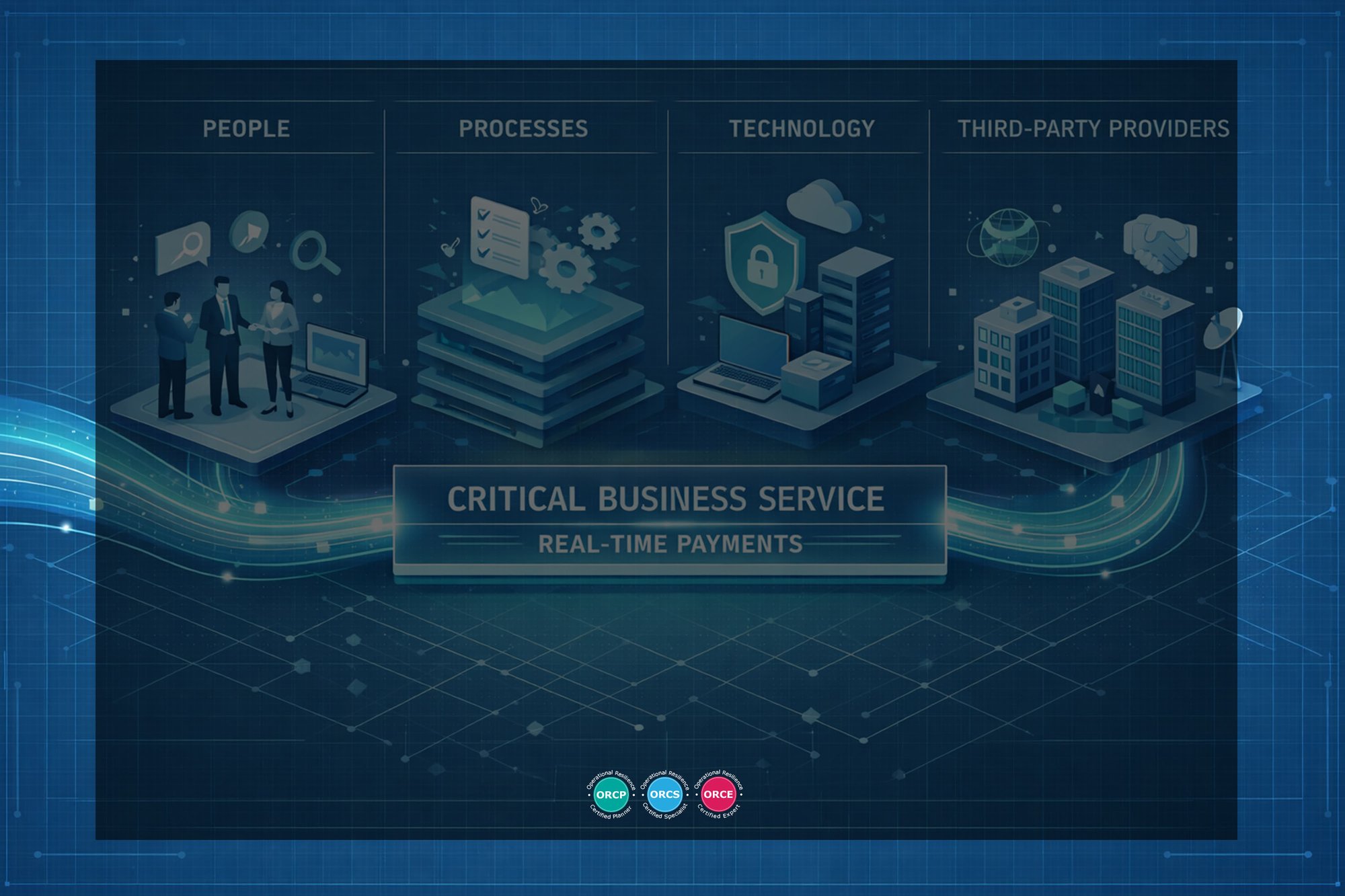
- People: Key personnel, subject matter experts
- Processes: Operational workflows and procedures
- Technology: Applications, infrastructure, networks
- Facilities: Physical locations and data centres
- Third Parties: Vendors, outsourcing partners, service providers
Key Distinction
- Interconnections describe how components are linked
- Interdependencies describe how components rely on each other
Together, they form a networked ecosystem that supports the delivery of business services.
Role in Operational Resilience
Understanding interconnections and interdependencies is central to achieving operational resilience. It enables organisations to move beyond siloed views of risk and develop a holistic understanding of service delivery.
Enhancing Visibility of Risk
Mapping interconnections provides visibility into:
- Hidden dependencies
- Concentration risks
- Single points of failure
This visibility allows organisations to proactively identify vulnerabilities before disruptions occur.
Understanding Cascading Impacts
Disruptions in one component can trigger chain reactions across interconnected systems. For example:
- A technology outage may impact multiple business processes
- A third-party failure may disrupt several critical services simultaneously
Interdependency mapping helps organisations understand:
- Upstream impacts (what feeds into a process)
- Downstream impacts (what is affected when a process fails)
Supporting Resilience Decision-Making
By understanding interdependencies, organisations can:
- Prioritise critical resources
- Allocate investments effectively
- Design targeted recovery strategies
Enabling Scenario Testing
Interconnections and interdependencies form the foundation for:
- Severe but plausible scenario design
- End-to-end service testing
- Impact tolerance validation
Without accurate mapping, scenario testing becomes superficial and fails to reflect real-world complexities.
Link to Critical Business Services (CBS)
Operational resilience frameworks emphasise the identification and protection of Critical Business Services (CBS)—the services that, if disrupted, would cause intolerable harm to customers, the organisation, or the broader financial system.
CBS as the Anchor Point
Interconnection mapping is anchored on CBS, not individual processes or systems. This ensures that resilience efforts are aligned with:
- Customer outcomes
- Regulatory expectations
- Systemic importance
Mapping End-to-End Service Delivery
For each CBS, organisations must map:
- All supporting processes
- All enabling resources
- All internal and external dependencies
This creates a complete view of how the service is delivered from initiation to completion.
Supporting Key Resilience Activities
Interconnections and interdependencies mapping directly support:
- Impact Tolerance Setting: Identifying the maximum acceptable disruption
- Scenario Testing: Assessing resilience under stress conditions
- Business Continuity Planning: Designing recovery strategies
Example
For a CBS such as Payments and Funds Transfer Services, mapping would include:
- Customer initiation channels (mobile, internet banking)
- Authentication systems
- Payment processing engines
- Clearing and settlement networks
- Third-party payment gateways
Each of these components is interconnected and interdependent, forming the service delivery chain.
Importance of a Service-Centric vs Process-Centric View
Traditional Process-Centric Approach
Historically, organisations focused on:
- Individual processes
- Departmental functions
- System-level recovery
This approach often resulted in:
- Fragmented understanding
- Siloed risk management
- Gaps in end-to-end resilience
Service-Centric Approach
Operational resilience requires a shift to a service-centric perspective, where the focus is on:
- End-to-end delivery of services
- Customer and stakeholder outcomes
- Integrated cross-functional dependencies
Key Differences
|
Process-Centric View |
Service-Centric View |
|
Focus on internal activities |
Focus on external service outcomes |
|
Siloed departmental perspective |
End-to-end organisational view |
|
Limited dependency visibility |
Full interdependency mapping |
|
Recovery of individual components |
Continuity of the entire service |
Why the Shift is Critical
A service-centric approach ensures that:
- Critical services remain available even if individual components fail
- Dependencies across functions and entities are fully understood
- Resilience strategies are aligned with real-world service delivery
This aligns with regulatory expectations that organisations must demonstrate the ability to deliver critical services under disruption, rather than simply recover individual systems or processes.

Interconnections and interdependencies form the foundation of operational resilience. They provide the visibility and understanding required to manage complexity, anticipate disruptions, and ensure continuity of critical services.
By defining how components are linked and how they depend on one another, organisations can shift from reactive recovery planning to proactive resilience management.
This capability is essential in today’s interconnected environment, where disruptions can rapidly cascade across systems, functions, and external partners.
Most importantly, this chapter establishes the need for a service-centric approach, anchored on Critical Business Services.
This perspective ensures that resilience efforts are aligned with what truly matters—the sustained delivery of services to customers and stakeholders.
In the following chapters, we will build on these foundations by exploring the methodologies, tools, and practical steps required to map interconnections and interdependencies effectively, in alignment with the Operational Resilience Planning Methodology (OR-P2-S2).

![[OR] [P2] [S2] [MII] [C2] Why Mapping is Critical for Operational Resilience](https://no-cache.hubspot.com/cta/default/3893111/a7625fb5-1205-4fc5-97d4-4b7492c2b25f.png)
![[OR] [P2] [S2] [MII] [C3] Core Components of Interconnections and Dependencies](https://no-cache.hubspot.com/cta/default/3893111/38a3cbd4-322a-41bd-974f-5090a2ce52aa.png)
![[OR] [P2] [S2] [MII] [C4] Step 1 – Define Scope of Mapping](https://no-cache.hubspot.com/cta/default/3893111/69cc922b-c86c-4242-b85b-315a3f941e12.png)
![[OR] [P2] [S2] [MII] [C5] Step 2- Identify Data Sources](https://no-cache.hubspot.com/cta/default/3893111/622d0fcc-71bf-4c3b-a569-213cb48bd1db.png)
![[OR] [P2] [S2] [MII] [C6] Step 3 – Develop Mapping Framework](https://no-cache.hubspot.com/cta/default/3893111/95581d69-3824-4acd-accf-03c2cab43765.png)
![[OR] [P2] [S2] [MII] [C7] Step 4 – Map Processes and Resources](https://no-cache.hubspot.com/cta/default/3893111/a4ffedf2-c795-41e9-9a8b-c5e24eea7159.png)
![[OR] [P2] [S2] [MII] [C8] Step 5 – Map Interconnections and Interdependencies](https://no-cache.hubspot.com/cta/default/3893111/10f06848-f21f-457d-aa80-ca4e3b20ce9e.png)
![[OR] [P2] [S2] [MII] [C9] Step 6 – Validate Mapping](https://no-cache.hubspot.com/cta/default/3893111/57d7a65a-a462-4919-9324-53e0bb207f3e.png)
![[OR] [P2] [S2] [MII] [C10] Step 7 – Analyse Mapping Outputs](https://no-cache.hubspot.com/cta/default/3893111/44bbb252-fdf5-4026-90ba-cbbdbe9c099a.png)
![[OR] [P2] [S2] [MII] [C11] Mapping Tools and Techniques](https://no-cache.hubspot.com/cta/default/3893111/d2fab757-0d78-42dd-8553-044eead7390e.png)
![[OR] [P2] [S2] [MII] [C12] Standard Templates and Data Structures](https://no-cache.hubspot.com/cta/default/3893111/4f04214c-3a0f-4bed-b2f8-6352c6d3cda0.png)
![[OR] [P2] [S2] [MII] [C13] Integration with Operational Resilience Framework](https://no-cache.hubspot.com/cta/default/3893111/c9628dd2-bbcb-4b54-b5b5-490066640d6d.png)
![[OR] [P2] [S2] [MII] [C14] Mapping Third-Party and Supply Chain Dependencies](https://no-cache.hubspot.com/cta/default/3893111/0c13b720-3d3e-4452-91e4-b9533260b3a4.png)
![[OR] [P2] [S2] [MII] [C15] Mapping for Digital and Cloud Environments](https://no-cache.hubspot.com/cta/default/3893111/1c90de74-af6b-44d3-ae4f-26d01eac3cf7.png)
![[OR] [P2] [S2] [MII] [C16] Common Challenges and Pitfalls](https://no-cache.hubspot.com/cta/default/3893111/32bbd8d7-f947-42ac-9db9-b88b0b156813.png)
![[OR] [P2] [S2] [MII] [C17] Case Study – Banking Sector CBS Mapping](https://no-cache.hubspot.com/cta/default/3893111/5a846fed-f810-4f6b-a1d8-0c2100f0eeac.png)
![[OR] [P2] [S2] [MII] [C18] Governance and Ownership of Mapping](https://no-cache.hubspot.com/cta/default/3893111/44ed11f0-5263-4485-98db-725a423c5fd6.png)
![[OR] [P2] [S2] [MII] [C19] Using Mapping for Scenario Testing](https://no-cache.hubspot.com/cta/default/3893111/b7bf0bc8-b382-4892-821d-c7c867303f14.png)
![[OR] [P2] [S2] [MII] [C20] Maintaining and Updating Mapping](https://no-cache.hubspot.com/cta/default/3893111/41d34d1f-78bd-4346-845e-b0b86232cfa6.png)
![[OR] [P2] [S2] [MII] [C21] Key Takeaways and Future Direction](https://no-cache.hubspot.com/cta/default/3893111/d8414f6b-4b4e-4a50-adb3-963546f13951.png)
![[OR] [P2] [S2] [MII] [C22] Back Cover](https://no-cache.hubspot.com/cta/default/3893111/0f96fecf-9a98-4404-8377-d37c1233df10.png)
More Information About OR-5000 [OR-5] or OR-300 [OR-3]
To learn more about the course and schedule, click the buttons below for the OR-300 Operational Resilience Implementer course and the OR-5000 Operational Resilience Expert Implementer course.


![[BL-OR] [3-4-5] View Schedule](https://no-cache.hubspot.com/cta/default/3893111/d0d733a1-16c0-4b68-a26d-adbfd4fc6069.png)
![[BL-OR] [3] FAQ OR-300](https://no-cache.hubspot.com/cta/default/3893111/f20c71b4-f5e8-4aa5-8056-c374ca33a091.png)
![Email to Sales Team [BCM Institute]](https://no-cache.hubspot.com/cta/default/3893111/3c53daeb-2836-4843-b0e0-645baee2ab9e.png)







