---
title: [OR] [P2] [S1] [CBS] [C6] Tools and Techniques
description: [OR] [P2] [S1] [CBS] [C6] Tools and Techniques
image: https://blog.bcm-institute.org/hubfs/OR%20Critical%20Business%20Services%20P2%20Morepost/%5BOR%5D%20%5BP2%5D%20%5BS1%5D%20%5BCBS%5D%20%5BC6%5D%20Tools%20and%20Techniques.png
---
. .
[](http://www.bcm-institute.org/)
- [Home](https://www.bcm-institute.org/)
- [About Us](https://www.bcm-institute.org/about-us-3/)
- [A President’s Perspective](https://www.bcm-institute.org/about-us/a-presidents-perspective/)
- [Our History](https://www.bcm-institute.org/about-us/our-history/)
- [Our Advisory Council](https://www.bcm-institute.org/about-us/our-advisory-council/)
- [Customers’ Testimonials](https://www.bcm-institute.org/about-us/customers-testimonials/)
- [Credential Verification](https://www.bcm-institute.org/about-us/credential-verification/)
- [Courses](https://blog.bcm-institute.org/blog/course-fees-for-blended-learning-courses-master-catalog)
- [ISO 22301 Business Continuity Management System Audit](https://blog.bcm-institute.org/audit/business-continuity-management-audit-courses)
- [ISO 22301 Business Continuity Management](https://blog.bcm-institute.org/bcm/business-continuity-management-courses)
- [Crisis Communication](https://blog.bcm-institute.org/crisis-communication/crisis-communication-courses)
- [Crisis Management](https://blog.bcm-institute.org/en/crisis-management/courses)
- [IT Disaster Recovery](https://blog.bcm-institute.org/it-disaster-recovery/courses)
- [Operational Resilience](https://blog.bcm-institute.org/operational-resilience/courses)
- [Operational Resilience Audit](https://blog.bcm-institute.org/operational-resilience-audit/courses)
- [Certification](https://blog.bcm-institute.org/certification/types-of-certifications-offered)
- [ISO 22301 BCMS Audit Certification](https://blog.bcm-institute.org/certification/business-continuity-management-audit-certification)
- [ISO22301 Business Continuity Management Certification](https://blog.bcm-institute.org/bcm/business-continuity-management-certification)
- [Crisis Communication Certification](https://blog.bcm-institute.org/crisis-communication/crisis-communication-certification)
- [Crisis Management Certification](https://blog.bcm-institute.org/en/crisis-management/crisis-management-certification)
- [IT Disaster Recovery Planning Certification](https://blog.bcm-institute.org/it-disaster-recovery/it-disaster-recovery-certification)
- [Operational Resilience Certification](https://blog.bcm-institute.org/operational-resilience/operational-resilience-certification)
- [Operational Resilience Audit Certification](https://blog.bcm-institute.org/operational-resilience-audit)
- [Seminars](https://blog.bcm-institute.org/meet-the-expert/mte-webinar-mainpage)
- [Store](https://www.bcm-institute.org/store-2/)
- [Contact Us](http://www.bcm-institute.org/about-us/contact-us/)
-
-
###### Identifying Critical Business Services: The Foundation of Operational Resilience
# \[OR\] \[P2\] \[S1\] \[CBS\] \[C6\] Tools and Techniques
[![Banner \[OR\] \[P2\] \[S1\] Identifying Critical Business Services](https://no-cache.hubspot.com/cta/default/3893111/335a527a-d781-4d44-b44f-b7a4676d3379.png)](https://cta-redirect.hubspot.com/cta/redirect/3893111/335a527a-d781-4d44-b44f-b7a4676d3379)
[](https://cta-redirect.hubspot.com/cta/redirect/3893111/327d1e38-3d2b-46f8-ba67-6c87867c7caa)Identifying Critical Business Services (CBS) is not a purely theoretical exercise—it requires structured, practical tools and collaborative techniques to ensure accuracy, consistency, and alignment with operational resilience objectives.
The following tools and techniques provide organisations with the means to systematically identify, validate, and refine their CBS, while ensuring alignment with regulatory expectations and business realities.
[![\[OR\] \[Pillar\] \[Thin Banner\] Operational Risk Management](https://no-cache.hubspot.com/cta/default/3893111/05f77efd-5703-4216-a89a-5d22943fa1f3.png)](https://cta-redirect.hubspot.com/cta/redirect/3893111/05f77efd-5703-4216-a89a-5d22943fa1f3)
[Moh Heng Goh](https://blog.bcm-institute.org/ebook-or/author/moh-heng-goh) Apr 21, 2026
###### Operational Resilience Certified Planner-Specialist-Expert
### [](https://cta-redirect.hubspot.com/cta/redirect/3893111/51659e94-db97-4e76-bfc4-5cae0e0a7e0c)
### \[P2\] \[S1\] Chapter 6
### [![\[OR\] \[P2\] \[S1\] \[CBS\] \[Banner\] Identifying Critical Business Services](https://no-cache.hubspot.com/cta/default/3893111/f5244393-5a7d-455a-94f2-d843b5d524bc.png)](https://cta-redirect.hubspot.com/cta/redirect/3893111/f5244393-5a7d-455a-94f2-d843b5d524bc)
### Tools and Techniques
#### **Introduction**
[](https://cta-redirect.hubspot.com/cta/redirect/3893111/0d09d714-62e2-471f-9526-a7c054f9bc21)Identifying Critical Business Services (CBS) is not a purely theoretical exercise—it requires structured, practical tools and collaborative techniques to ensure accuracy, consistency, and alignment with operational resilience objectives.
The following tools and techniques provide organisations with the means to systematically identify, validate, and refine their CBS, while ensuring alignment with regulatory expectations and business realities.
#### **Workshops and Facilitated Sessions**
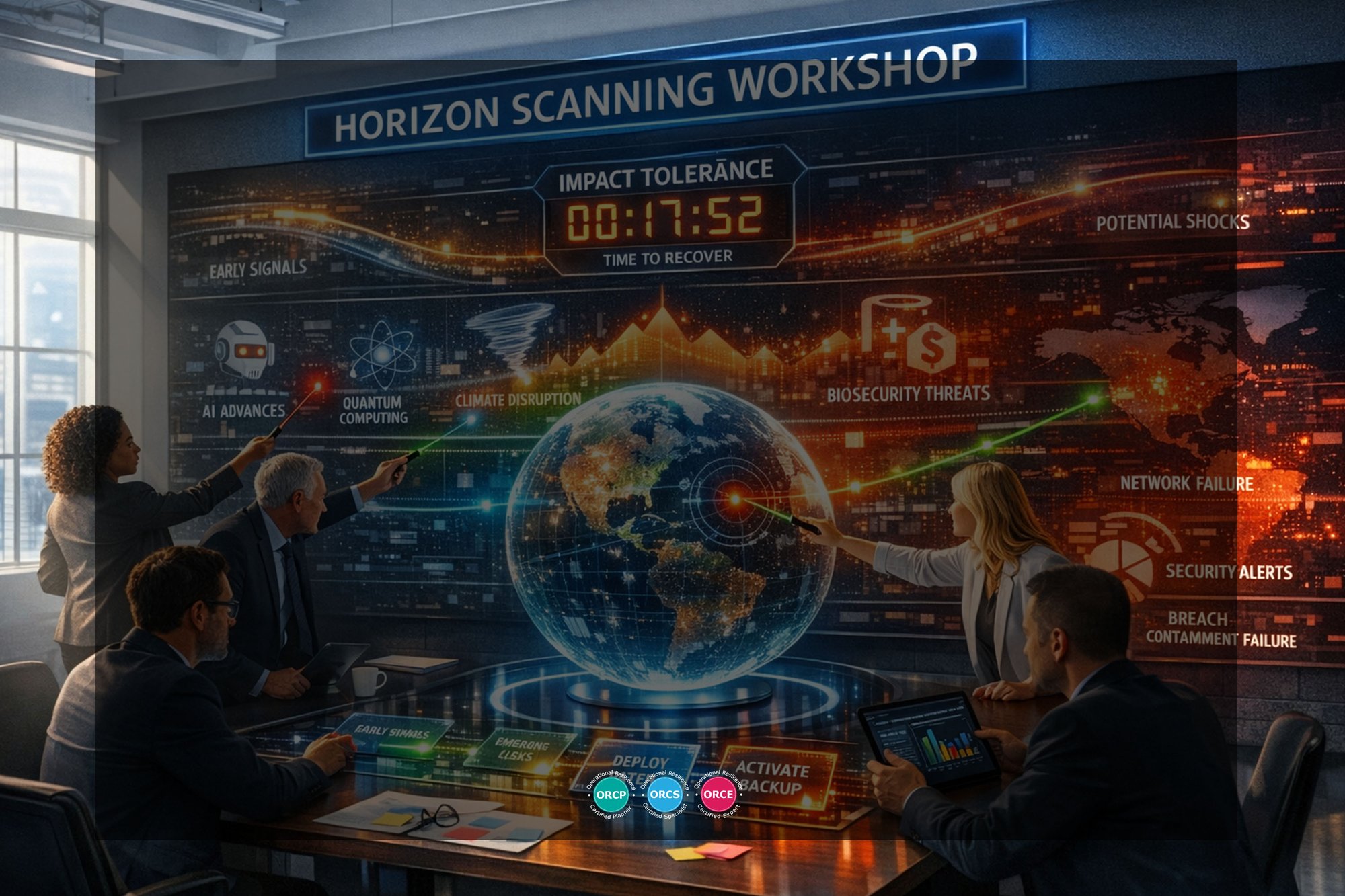
Workshops are one of the most effective techniques for identifying CBS, as they bring together stakeholders from across the organisation to develop a shared understanding of services and their criticality.
These sessions typically involve representatives from business units, operations, IT, risk management, compliance, and third-party management. A structured facilitation approach ensures that discussions remain focused on outcomes rather than internal processes, reinforcing the service-centric perspective required in operational resilience.
Key benefits include:
- Encouraging cross-functional collaboration and breaking down silos
- Challenging assumptions about what is “critical.”
- Achieving consensus on service definitions and boundaries
Facilitated workshops often use guided templates, predefined criteria, and real-life disruption scenarios to stimulate discussion and ensure consistency in outputs.
#### **Service Mapping Templates**
Service mapping templates provide a structured way to define and document each business service from an end-to-end perspective. These templates help organisations clearly articulate how a service is delivered and what resources are required.
A typical service mapping template includes:
- Service name and description
- Start and end points (customer trigger to outcome delivery)
- Key processes involved
- Supporting resources (people, technology, facilities)
- Third-party dependencies
- Upstream and downstream interactions
By standardising service documentation, organisations can ensure consistency across business units and create a solid foundation for subsequent activities, such as dependency mapping and scenario testing.
#### **Business Impact Analysis (BIA) Integration**
Business Impact Analysis (BIA) is a well-established component of Business Continuity Management and plays a critical role in CBS identification.
Integrating BIA results allows organisations to leverage existing data on critical processes, recovery priorities, and impact thresholds.
Through BIA integration, organisations can:
- Identify services that support critical business functions
- Quantify the impact of service disruption (financial, operational, reputational)
- Align CBS identification with Recovery Time Objectives (RTOs) and Maximum Tolerable Downtime (MTD)
However, it is important to note that BIA traditionally focuses on internal processes, whereas CBS identification requires a shift toward customer-facing outcomes.
Therefore, BIA outputs should be adapted and reinterpreted through a service-centric lens.
#### **Customer Journey Mapping**
Customer journey mapping is a powerful technique that helps organisations visualise how customers interact with a service across multiple touchpoints. This approach reinforces the principle that CBS should be defined by customer outcomes rather than by internal organisational structures.
By mapping the customer journey, organisations can:
- Identify critical moments where service disruption would have the greatest impact
- Understand dependencies across channels (e.g., digital, branch, call centre)
- Highlight pain points and vulnerabilities in service delivery
This technique is particularly valuable in industries such as banking, telecommunications, and healthcare, where customer experience is closely tied to service continuity.
#### **Scenario Analysis (Severe but Plausible Disruptions)**
Scenario analysis involves evaluating how business services would perform under severe but plausible disruption scenarios. This technique is essential for testing whether identified services truly meet the criteria of being “critical.”
Examples of scenarios include:
- Cyberattacks affecting core systems
- Third-party service provider failure
- Natural disasters impacting physical operations
- Pandemic or workforce disruption
By applying these scenarios, organisations can:
- Validate the criticality of services based on real-world impact
- Identify hidden dependencies and vulnerabilities
- Refine CBS definitions and prioritisation
Scenario analysis also creates a direct linkage between CBS identification and later stages of operational resilience, such as impact tolerance setting and scenario testing.
**[![Banner \[Summing\] \[OR\] \[E1\] \[C5\] Identifying Critical Business Services](https://no-cache.hubspot.com/cta/default/3893111/d4f76ec3-d236-4b43-994d-728dbeb2e9d1.png)](https://cta-redirect.hubspot.com/cta/redirect/3893111/d4f76ec3-d236-4b43-994d-728dbeb2e9d1)**
The tools and techniques outlined above provide a practical and structured approach to identifying Critical Business Services.
While each tool serves a specific purpose, their true value lies in their combined application—integrating workshops, mapping, analysis, and scenario-based validation into a cohesive methodology.
Ultimately, organisations that effectively leverage these tools will achieve a more accurate, defensible, and regulator-aligned identification of CBS. This, in turn, ensures that operational resilience efforts are focused on what truly matters: maintaining the delivery of critical services to customers and stakeholders under all conditions.
[![\[OR\] \[Pillar\] \[Thin Banner\] Operational Risk Management](https://no-cache.hubspot.com/cta/default/3893111/05f77efd-5703-4216-a89a-5d22943fa1f3.png)](https://cta-redirect.hubspot.com/cta/redirect/3893111/05f77efd-5703-4216-a89a-5d22943fa1f3)
| **C1** | **C2** | **C3** | **C4** | **C5** | **C6** |
| --- | --- | --- | --- | --- | --- |
| [](https://cta-redirect.hubspot.com/cta/redirect/3893111/9209b90a-6f30-44d4-8312-7e07d8e15e58) | [](https://cta-redirect.hubspot.com/cta/redirect/3893111/0bd2a7d8-3e51-4108-afae-863ea1091523) | [](https://cta-redirect.hubspot.com/cta/redirect/3893111/71523836-ca82-45c7-8cf6-9cdb8f2ddf7d) | [](https://cta-redirect.hubspot.com/cta/redirect/3893111/9eccbeab-f423-4f60-861d-53925fefc630) | [](https://cta-redirect.hubspot.com/cta/redirect/3893111/52fce9d7-691a-4cd3-abfd-cfdb229c704c) | [](https://cta-redirect.hubspot.com/cta/redirect/3893111/0d09d714-62e2-471f-9526-a7c054f9bc21) |
| **C7** | **C8** | **C9** | **C10** | **C11** | ** C12** |
| [](https://cta-redirect.hubspot.com/cta/redirect/3893111/fa7fd783-a1f2-4964-9116-94e4e67ea8dd) | [](https://cta-redirect.hubspot.com/cta/redirect/3893111/90c32cff-7453-47c3-ba0e-30bd7f2d1b47) | [![\[OR\] \[P2\] \[S1\] \[CBS\] \[C9\] Integration with Or Framework](https://no-cache.hubspot.com/cta/default/3893111/29dc7521-86eb-42d3-abba-483c80477470.png)](https://cta-redirect.hubspot.com/cta/redirect/3893111/29dc7521-86eb-42d3-abba-483c80477470) | [](https://cta-redirect.hubspot.com/cta/redirect/3893111/c35c8551-7ed5-4184-81ce-358c4d8a3e49) | [](https://cta-redirect.hubspot.com/cta/redirect/3893111/b81baa15-cf37-474c-abfb-39be84eecf15) | [![\[OR\] \[P2\] \[S1\] \[CBS\] \[C12\] Back Cover](https://no-cache.hubspot.com/cta/default/3893111/7f5b225c-e74e-4b73-b9a6-ec1454e1a198.png)](https://cta-redirect.hubspot.com/cta/redirect/3893111/7f5b225c-e74e-4b73-b9a6-ec1454e1a198) |
#### More Information About OR-5000 \[OR-5\] or OR-300 \[OR-3\]
To learn more about the course and schedule, click the buttons below for the OR-300 Operational Resilience Implementer course and the OR-5000 Operational Resilience Expert Implementer course.
| [](https://cta-redirect.hubspot.com/cta/redirect/3893111/3530eccb-515d-401e-afc2-3469e26d7fbf) | [](https://cta-redirect.hubspot.com/cta/redirect/3893111/fdd4fa9c-ed69-40c1-925f-4eb6a1c5c255) | [](https://cta-redirect.hubspot.com/cta/redirect/3893111/77a34b84-0a6d-44f8-b8d6-6ab04cdf5edd) |
| --- | --- | --- |
| [](https://cta-redirect.hubspot.com/cta/redirect/3893111/6e5c0cda-39b9-4bbd-b3d4-4cf46a790b14) | [](https://cta-redirect.hubspot.com/cta/redirect/3893111/a68a08aa-36d3-4216-9551-202c9fde06ea) | [![ \[BL-OR\] \[3-4-5\] View Schedule](https://no-cache.hubspot.com/cta/default/3893111/d0d733a1-16c0-4b68-a26d-adbfd4fc6069.png)](https://cta-redirect.hubspot.com/cta/redirect/3893111/d0d733a1-16c0-4b68-a26d-adbfd4fc6069) |
| [![\[BL-OR\] \[3\] FAQ OR-300](https://no-cache.hubspot.com/cta/default/3893111/f20c71b4-f5e8-4aa5-8056-c374ca33a091.png)](https://cta-redirect.hubspot.com/cta/redirect/3893111/f20c71b4-f5e8-4aa5-8056-c374ca33a091) | If you have any questions, click to contact us.[![Email to Sales Team \[BCM Institute\]](https://no-cache.hubspot.com/cta/default/3893111/3c53daeb-2836-4843-b0e0-645baee2ab9e.png)](https://cta-redirect.hubspot.com/cta/redirect/3893111/3c53daeb-2836-4843-b0e0-645baee2ab9e) | [](https://cta-redirect.hubspot.com/cta/redirect/3893111/7f2718a4-ea80-4f84-a319-dc2d4df37a46) |
| [](https://cta-redirect.hubspot.com/cta/redirect/3893111/74b1e556-8cd2-4a74-8821-db1804534955) | [](https://cta-redirect.hubspot.com/cta/redirect/3893111/f2bd8eb1-32d2-4732-9267-ea53223cf58f) | [](https://cta-redirect.hubspot.com/cta/redirect/3893111/084e620a-46c5-419a-82ed-6a681d15c0b6) |
#### **Comments:**
---

---

---
---


All rights reserved. Copyright 2026
```json
{
"@context" : "https://schema.org",
"@type" : "BlogPosting",
"author" : {
"@type" : "Person",
"name" : "Moh Heng Goh",
"url" : "https://blog.bcm-institute.org/ebook-or/author/moh-heng-goh"
},
"dateModified" : "2026-05-11T07:15:42.876Z",
"datePublished" : "2026-04-21T06:43:10.000Z",
"headline" : "[OR] [P2] [S1] [CBS] [C6] Tools and Techniques",
"mainEntityOfPage" : {
"@id" : "https://blog.bcm-institute.org/ebook-or/or-p2-s1-cbs-c6-tools-and-techniques",
"@type" : "WebPage"
},
"publisher" : {
"@type" : "Organization",
"logo" : {
"@type" : "ImageObject",
"url" : "https://blog.bcm-institute.org/hubfs/BCMI%20Logo.png"
},
"name" : "BCMI Pte Ltd"
}
}
```