---
title: [OR] [P2] [S1] [CBS] [C10] Governance and Continuous Review
description: [OR] [P2] [S1] [CBS] [C10] Governance and Continuous Review
image: https://blog.bcm-institute.org/hubfs/OR%20Critical%20Business%20Services%20P2%20Morepost/%5BOR%5D%20%5BP2%5D%20%5BS1%5D%20%5BCBS%5D%20%5BC10%5D%20Governance%20and%20Continuous%20Review.png
---
. .
[](http://www.bcm-institute.org/)
- [Home](https://www.bcm-institute.org/)
- [About Us](https://www.bcm-institute.org/about-us-3/)
- [A President’s Perspective](https://www.bcm-institute.org/about-us/a-presidents-perspective/)
- [Our History](https://www.bcm-institute.org/about-us/our-history/)
- [Our Advisory Council](https://www.bcm-institute.org/about-us/our-advisory-council/)
- [Customers’ Testimonials](https://www.bcm-institute.org/about-us/customers-testimonials/)
- [Credential Verification](https://www.bcm-institute.org/about-us/credential-verification/)
- [Courses](https://blog.bcm-institute.org/blog/course-fees-for-blended-learning-courses-master-catalog)
- [ISO 22301 Business Continuity Management System Audit](https://blog.bcm-institute.org/audit/business-continuity-management-audit-courses)
- [ISO 22301 Business Continuity Management](https://blog.bcm-institute.org/bcm/business-continuity-management-courses)
- [Crisis Communication](https://blog.bcm-institute.org/crisis-communication/crisis-communication-courses)
- [Crisis Management](https://blog.bcm-institute.org/en/crisis-management/courses)
- [IT Disaster Recovery](https://blog.bcm-institute.org/it-disaster-recovery/courses)
- [Operational Resilience](https://blog.bcm-institute.org/operational-resilience/courses)
- [Operational Resilience Audit](https://blog.bcm-institute.org/operational-resilience-audit/courses)
- [Certification](https://blog.bcm-institute.org/certification/types-of-certifications-offered)
- [ISO 22301 BCMS Audit Certification](https://blog.bcm-institute.org/certification/business-continuity-management-audit-certification)
- [ISO22301 Business Continuity Management Certification](https://blog.bcm-institute.org/bcm/business-continuity-management-certification)
- [Crisis Communication Certification](https://blog.bcm-institute.org/crisis-communication/crisis-communication-certification)
- [Crisis Management Certification](https://blog.bcm-institute.org/en/crisis-management/crisis-management-certification)
- [IT Disaster Recovery Planning Certification](https://blog.bcm-institute.org/it-disaster-recovery/it-disaster-recovery-certification)
- [Operational Resilience Certification](https://blog.bcm-institute.org/operational-resilience/operational-resilience-certification)
- [Operational Resilience Audit Certification](https://blog.bcm-institute.org/operational-resilience-audit)
- [Seminars](https://blog.bcm-institute.org/meet-the-expert/mte-webinar-mainpage)
- [Store](https://www.bcm-institute.org/store-2/)
- [Contact Us](http://www.bcm-institute.org/about-us/contact-us/)
-
-
###### Identifying Critical Business Services: The Foundation of Operational Resilience
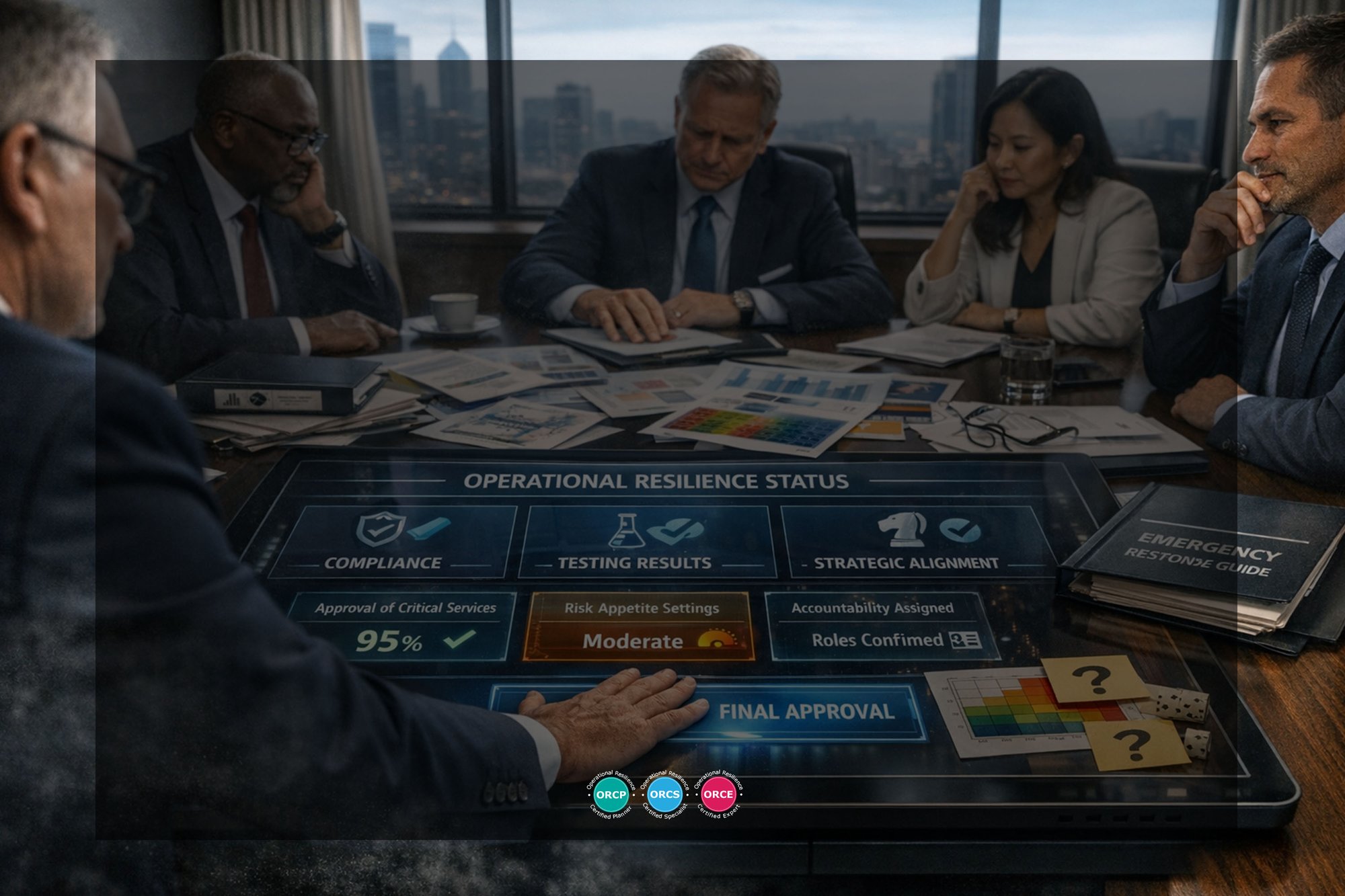
# \[OR\] \[P2\] \[S1\] \[CBS\] \[C10\] Governance and Continuous Review
[![Banner \[OR\] \[P2\] \[S1\] Identifying Critical Business Services](https://no-cache.hubspot.com/cta/default/3893111/335a527a-d781-4d44-b44f-b7a4676d3379.png)](https://cta-redirect.hubspot.com/cta/redirect/3893111/335a527a-d781-4d44-b44f-b7a4676d3379)Effective governance and continuous review are essential to ensure that the identification and management of Critical Business Services (CBS) remain relevant, accurate, and aligned with the organisation’s evolving risk landscape. Without strong governance, CBS identification risks becoming outdated, inconsistent, or disconnected from strategic priorities and regulatory expectations.
This section outlines how organisations can establish robust governance structures and embed continuous review mechanisms to sustain the effectiveness of their CBS framework.[![\[OR\] \[Pillar\] \[Thin Banner\] Operational Risk Management](https://no-cache.hubspot.com/cta/default/3893111/05f77efd-5703-4216-a89a-5d22943fa1f3.png)](https://cta-redirect.hubspot.com/cta/redirect/3893111/05f77efd-5703-4216-a89a-5d22943fa1f3)
[Moh Heng Goh](https://blog.bcm-institute.org/ebook-or/author/moh-heng-goh) Apr 21, 2026
###### Operational Resilience Certified Planner-Specialist-Expert
### [](https://cta-redirect.hubspot.com/cta/redirect/3893111/51659e94-db97-4e76-bfc4-5cae0e0a7e0c)
### \[P2\] \[S1\] Chapter 10
[![\[OR\] \[P2\] \[S1\] \[CBS\] \[Banner\] Identifying Critical Business Services](https://no-cache.hubspot.com/cta/default/3893111/f5244393-5a7d-455a-94f2-d843b5d524bc.png)](https://cta-redirect.hubspot.com/cta/redirect/3893111/f5244393-5a7d-455a-94f2-d843b5d524bc)
### Governance and Continuous Review
#### **Introduction**
[](https://cta-redirect.hubspot.com/cta/redirect/3893111/c35c8551-7ed5-4184-81ce-358c4d8a3e49)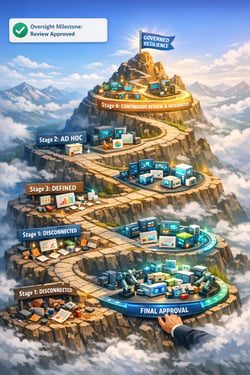Effective governance and continuous review are essential to ensure that the identification and management of Critical Business Services (CBS) remain relevant, accurate, and aligned with the organisation’s evolving risk landscape. Without strong governance, CBS identification risks becoming outdated, inconsistent, or disconnected from strategic priorities and regulatory expectations.
This section outlines how organisations can establish robust governance structures and embed continuous review mechanisms to sustain the effectiveness of their CBS framework.
#### **Ownership of CBS**
A clear ownership model is fundamental to the governance of CBS. Ownership should be defined at multiple levels to ensure accountability and effective oversight.
Typical ownership structure includes:
- **Business Owners (First Line of Defence):**
Responsible for defining, maintaining, and delivering CBS. They ensure that services operate within defined impact tolerances and that dependencies are accurately documented.
- **Risk and Compliance Functions (Second Line of Defence):**
Provide oversight, challenge, and independent validation of CBS identification, criteria, and methodologies. They ensure alignment with regulatory expectations and organisational risk appetite.
- **Internal Audit (Third Line of Defence):**
Conduct independent reviews of the CBS framework, governance processes, and effectiveness of controls.
Clear delineation of responsibilities ensures that CBS governance is not fragmented and that accountability is embedded across the organisation.
#### **Governance Structure and Oversight**
CBS identification and management should be embedded within the organisation’s broader governance framework, with oversight provided by senior management and board-level committees.
Key governance elements include:
- **Executive Risk Committees:** Review and approve the list of CBS and associated impact tolerances
- **Operational Resilience Steering Committees:** Oversee implementation and integration across business units
- **Board-Level Oversight:** Ensure alignment with strategic objectives and regulatory expectations
Regular reporting should be established to provide visibility on:
- Changes to CBS
- Performance against impact tolerances
- Outcomes of scenario testing and incidents
This structured oversight ensures that CBS remains a strategic priority rather than an operational afterthought.
#### **Periodic Review and Update of CBS**
CBS should not be static. Organisations must conduct periodic reviews to ensure that the list of CBS reflects current business operations and risk exposures.
Typical review cycles include:
- **Annual Reviews:** Comprehensive reassessment of all business services and their criticality
- **Interim Reviews:** Targeted updates based on specific triggers or changes
During reviews, organisations should:
- Reassess criticality criteria and thresholds
- Validate service boundaries and dependencies
- Incorporate lessons learned from incidents and testing
Regular reviews ensure that CBS identification remains accurate and aligned with the organisation’s operating environment.
#### **Trigger-Based Reviews**
In addition to periodic reviews, CBS should be reassessed when specific events or changes occur. These triggers ensure that the framework remains responsive to dynamic conditions.
Common triggers include:
- Introduction of new products or services
- Significant changes in business models or operating structures
- Regulatory updates or new guidelines
- Major incidents or disruption events
- Changes in third-party arrangements or outsourcing
Trigger-based reviews allow organisations to proactively adjust their CBS framework rather than relying solely on scheduled assessments.
#### **Embedding CBS into Enterprise Risk Management (ERM)**
To ensure sustainability, CBS must be embedded in the broader Enterprise Risk Management (ERM) framework. This integration ensures that CBS considerations are reflected in risk assessments, control design, and strategic decision-making.
Key integration points include:
- **Risk Identification and Assessment:** CBS informs which risks are prioritised
- **Control Frameworks:** Controls are designed to protect critical services
- **Risk Appetite Statements:** Aligned with impact tolerances for CBS
- **Incident Management:** Prioritisation based on affected CBS
Embedding CBS into ERM ensures that operational resilience is not treated as a standalone initiative but as an integral part of the organisation’s risk management approach.
#### **Documentation, Auditability, and Version Control**
Proper documentation is critical for transparency, auditability, and regulatory compliance. Organisations must maintain clear and up-to-date records of:
- CBS definitions and boundaries
- Criticality criteria and scoring methodologies
- Approval and governance decisions
- Changes and updates over time
Version control mechanisms should be implemented to track revisions and ensure that historical records are preserved for audit and regulatory review.
**[![Banner \[Summing\] \[OR\] \[E1\] \[C5\] Identifying Critical Business Services](https://no-cache.hubspot.com/cta/default/3893111/d4f76ec3-d236-4b43-994d-728dbeb2e9d1.png)](https://cta-redirect.hubspot.com/cta/redirect/3893111/d4f76ec3-d236-4b43-994d-728dbeb2e9d1)**
Strong governance and continuous review mechanisms are essential to sustain the effectiveness of Critical Business Services within an operational resilience framework. By establishing clear ownership, robust oversight, and structured review processes, organisations can ensure that their CBS framework remains relevant, accurate, and aligned with both business objectives and regulatory expectations.
Ultimately, governance transforms CBS from a one-time identification exercise into a living framework—one that evolves with the organisation and continues to support the delivery of critical services under all conditions.
[![\[OR\] \[Pillar\] \[Thin Banner\] Operational Risk Management](https://no-cache.hubspot.com/cta/default/3893111/05f77efd-5703-4216-a89a-5d22943fa1f3.png)](https://cta-redirect.hubspot.com/cta/redirect/3893111/05f77efd-5703-4216-a89a-5d22943fa1f3)
| **C1** | **C2** | **C3** | **C4** | **C5** | **C6** |
| --- | --- | --- | --- | --- | --- |
| [](https://cta-redirect.hubspot.com/cta/redirect/3893111/9209b90a-6f30-44d4-8312-7e07d8e15e58) | [](https://cta-redirect.hubspot.com/cta/redirect/3893111/0bd2a7d8-3e51-4108-afae-863ea1091523) | [](https://cta-redirect.hubspot.com/cta/redirect/3893111/71523836-ca82-45c7-8cf6-9cdb8f2ddf7d) | [](https://cta-redirect.hubspot.com/cta/redirect/3893111/9eccbeab-f423-4f60-861d-53925fefc630) | [](https://cta-redirect.hubspot.com/cta/redirect/3893111/52fce9d7-691a-4cd3-abfd-cfdb229c704c) | [](https://cta-redirect.hubspot.com/cta/redirect/3893111/0d09d714-62e2-471f-9526-a7c054f9bc21) |
| **C7** | **C8** | **C9** | **C10** | **C11** | ** C12** |
| [](https://cta-redirect.hubspot.com/cta/redirect/3893111/fa7fd783-a1f2-4964-9116-94e4e67ea8dd) | [](https://cta-redirect.hubspot.com/cta/redirect/3893111/90c32cff-7453-47c3-ba0e-30bd7f2d1b47) | [![\[OR\] \[P2\] \[S1\] \[CBS\] \[C9\] Integration with Or Framework](https://no-cache.hubspot.com/cta/default/3893111/29dc7521-86eb-42d3-abba-483c80477470.png)](https://cta-redirect.hubspot.com/cta/redirect/3893111/29dc7521-86eb-42d3-abba-483c80477470) | [](https://cta-redirect.hubspot.com/cta/redirect/3893111/c35c8551-7ed5-4184-81ce-358c4d8a3e49) | [](https://cta-redirect.hubspot.com/cta/redirect/3893111/b81baa15-cf37-474c-abfb-39be84eecf15) | [![\[OR\] \[P2\] \[S1\] \[CBS\] \[C12\] Back Cover](https://no-cache.hubspot.com/cta/default/3893111/7f5b225c-e74e-4b73-b9a6-ec1454e1a198.png)](https://cta-redirect.hubspot.com/cta/redirect/3893111/7f5b225c-e74e-4b73-b9a6-ec1454e1a198) |
#### More Information About OR-5000 \[OR-5\] or OR-300 \[OR-3\]
To learn more about the course and schedule, click the buttons below for the OR-300 Operational Resilience Implementer course and the OR-5000 Operational Resilience Expert Implementer course.
| [](https://cta-redirect.hubspot.com/cta/redirect/3893111/3530eccb-515d-401e-afc2-3469e26d7fbf) | [](https://cta-redirect.hubspot.com/cta/redirect/3893111/fdd4fa9c-ed69-40c1-925f-4eb6a1c5c255) | [](https://cta-redirect.hubspot.com/cta/redirect/3893111/77a34b84-0a6d-44f8-b8d6-6ab04cdf5edd) |
| --- | --- | --- |
| [](https://cta-redirect.hubspot.com/cta/redirect/3893111/6e5c0cda-39b9-4bbd-b3d4-4cf46a790b14) | [](https://cta-redirect.hubspot.com/cta/redirect/3893111/a68a08aa-36d3-4216-9551-202c9fde06ea) | [![ \[BL-OR\] \[3-4-5\] View Schedule](https://no-cache.hubspot.com/cta/default/3893111/d0d733a1-16c0-4b68-a26d-adbfd4fc6069.png)](https://cta-redirect.hubspot.com/cta/redirect/3893111/d0d733a1-16c0-4b68-a26d-adbfd4fc6069) |
| [![\[BL-OR\] \[3\] FAQ OR-300](https://no-cache.hubspot.com/cta/default/3893111/f20c71b4-f5e8-4aa5-8056-c374ca33a091.png)](https://cta-redirect.hubspot.com/cta/redirect/3893111/f20c71b4-f5e8-4aa5-8056-c374ca33a091) | If you have any questions, click to contact us.[![Email to Sales Team \[BCM Institute\]](https://no-cache.hubspot.com/cta/default/3893111/3c53daeb-2836-4843-b0e0-645baee2ab9e.png)](https://cta-redirect.hubspot.com/cta/redirect/3893111/3c53daeb-2836-4843-b0e0-645baee2ab9e) | [](https://cta-redirect.hubspot.com/cta/redirect/3893111/7f2718a4-ea80-4f84-a319-dc2d4df37a46) |
| [](https://cta-redirect.hubspot.com/cta/redirect/3893111/74b1e556-8cd2-4a74-8821-db1804534955) | [](https://cta-redirect.hubspot.com/cta/redirect/3893111/f2bd8eb1-32d2-4732-9267-ea53223cf58f) | [](https://cta-redirect.hubspot.com/cta/redirect/3893111/084e620a-46c5-419a-82ed-6a681d15c0b6) |
#### **Comments:**

---

---

---

---


All rights reserved. Copyright 2026
```json
{
"@context" : "https://schema.org",
"@type" : "BlogPosting",
"author" : {
"@type" : "Person",
"name" : "Moh Heng Goh",
"url" : "https://blog.bcm-institute.org/ebook-or/author/moh-heng-goh"
},
"dateModified" : "2026-05-11T07:13:49.163Z",
"datePublished" : "2026-04-21T07:00:32.000Z",
"headline" : "[OR] [P2] [S1] [CBS] [C10] Governance and Continuous Review",
"mainEntityOfPage" : {
"@id" : "https://blog.bcm-institute.org/ebook-or/or-p2-s1-cbs-c10-governance-and-continuous-review",
"@type" : "WebPage"
},
"publisher" : {
"@type" : "Organization",
"logo" : {
"@type" : "ImageObject",
"url" : "https://blog.bcm-institute.org/hubfs/BCMI%20Logo.png"
},
"name" : "BCMI Pte Ltd"
}
}
```