Regulatory Audit Checklist
BNM BCM, RMiT, ORM (Operational Resilience)


This chapter contains a Regulatory Audit Checklist for Operational Resilience and BCM tailored for financial institutions regulated by Bank Negara Malaysia (BNM).
It is aligned primarily to:
-
BNM Policy Document on Business Continuity Management (PD-BCM, 19 Dec 2022)
-
BNM Risk Management in Technology (RMiT)
-
BNM Operational Risk expectations (including OR governance and internal controls)
-
BNM Discussion Paper on Operational Resilience (2025)
The checklist follows your preferred Plan → Implement → Test → Improve lifecycle and mirrors supervisory expectations for audit, compliance validation, and regulatory readiness.
Section 1. Governance, Oversight, and Accountability
|
Audit Area |
Audit Checklist Questions |
BNM OR Focus |
Evidence Required |
Rating |
|
Board Accountability |
Has the Board approved an Operational Resilience framework and clearly articulated resilience outcomes? |
Board accountability for resilience outcomes |
Board minutes, OR policy |
|
|
Senior Management Ownership |
Is senior management accountable for ensuring the continuity of critical business services? |
Senior management responsibility |
Governance documents |
|
|
Resilience Strategy |
Is there a documented operational resilience strategy aligned to business objectives? |
Strategic alignment |
Strategy papers |
|
|
Risk Appetite |
Has the institution defined risk appetite, including disruption tolerance thresholds? |
Outcome-based tolerance |
Risk appetite statement |
|
|
Governance Structure |
Are roles and responsibilities clearly defined across the organisation? |
Clear accountability model |
Org charts, RACI |
|
|
Enterprise Integration |
Is operational resilience integrated across risk, BCM, IT, and business functions? |
Integrated resilience approach |
Framework documents |
|
|
Group & Cross-Border Governance |
Is governance applied consistently across subsidiaries and cross-border operations? |
Cross-border resilience |
Group policies |
|
Section 2. Identification of Critical Business Services
|
Audit Area |
Audit Checklist Questions |
BNM OR Focus |
Evidence Required |
Rating |
|
CBS Identification |
Has the institution identified its Critical Business Services (CBS)? |
Service-centric resilience |
CBS inventory |
|
|
External Outcome Focus |
Are CBS defined based on the delivery of outcomes to customers and stakeholders? |
Outcome-based approach |
CBS definitions |
|
|
Systemic Importance |
Are services assessed for systemic importance and their impact on financial stability? |
Financial system stability |
Service classification |
|
|
Approval |
Are CBS approved by senior management and the Board? |
Governance oversight |
Approval records |
|
|
Periodic Review |
Are CBS regularly reviewed to reflect changes in business and environment? |
Dynamic resilience |
Review logs |
|
Section 3. Mapping of Interconnections and Dependencies
|
Audit Area |
Audit Checklist Questions |
BNM OR Focus |
Evidence Required |
Rating |
|
End-to-End Mapping |
Are CBS mapped end-to-end across processes, systems, people, and third parties? |
End-to-end visibility |
Process maps |
|
|
Dependency Identification |
Are all dependencies (internal and external) identified? |
Dependency transparency |
Dependency tables |
|
|
Interconnectedness |
Are interconnections across financial ecosystem participants identified? |
Ecosystem resilience |
Architecture diagrams |
|
|
Third-Party Mapping |
Are third parties linked to specific CBS and dependencies? |
Third-party integration |
Vendor mapping |
|
|
Concentration Risk |
Are concentration risks and single points of failure identified? |
Concentration risk management |
Risk assessments |
|
|
Dynamic Updates |
Are mappings updated following material changes? |
Change responsiveness |
Change logs |
|
Section 4. Impact Tolerance and Disruption Thresholds
|
Audit Area |
Audit Checklist Questions |
BNM OR Focus |
Evidence Required |
Rating |
|
Impact Tolerance Definition |
Are impact tolerances defined for each CBS? |
Outcome-based resilience thresholds |
Impact tolerance statements |
|
|
Measurable Metrics |
Are tolerances expressed in measurable terms (e.g., time, service degradation)? |
Quantifiable outcomes |
BIA outputs |
|
|
Severe Disruption Thresholds |
Are thresholds defined for severe but plausible disruptions? |
Stress threshold definition |
Scenario definitions |
|
|
Multi-Dimensional Impact |
Are tolerances based on customer harm, financial loss, or regulatory impact? |
Holistic impact view |
Impact analysis |
|
|
Approval |
Are tolerances approved at appropriate governance levels? |
Governance oversight |
Approval records |
|
|
Alignment with Risk Appetite |
Are tolerances aligned with risk appetite and strategy? |
Strategic alignment |
Risk appetite documents |
|
Section 5. Risk Identification, Assessment, and Control (ORM Integration)
|
Audit Area |
Audit Checklist Questions |
BNM OR Focus |
Evidence Required |
Rating |
|
Risk Framework |
Is there a comprehensive risk management framework supporting operational resilience? |
Integrated risk management |
ORM policy |
|
|
Risk Identification |
Are risks identified across CBS, dependencies, and the ecosystem? |
End-to-end risk visibility |
Risk registers |
|
|
Emerging Risks |
Are emerging risks (cyber, digitalisation, climate, geopolitical) assessed? |
Forward-looking risk assessment |
Risk reports |
|
|
Risk Assessment |
Are risks assessed based on likelihood and impact? |
Risk quantification |
Risk assessment reports |
|
|
Control Effectiveness |
Are controls implemented and regularly assessed? |
Control assurance |
Control testing reports |
|
|
Residual Risk Monitoring |
Are residual risks monitored against tolerance thresholds? |
Risk monitoring |
Risk dashboards |
|
Section 6. Scenario Testing – Severe but Plausible Scenarios
|
Audit Area |
Audit Checklist Questions |
BNM OR Focus |
Evidence Required |
Rating |
|
Testing Programme |
Is there a structured scenario testing programme? |
Testing discipline |
Testing plan |
|
|
Scenario Design |
Are scenarios severe but plausible and aligned to the risk profile? |
Realistic stress scenarios |
Scenario library |
|
|
End-to-End Testing |
Are CBS tests end-to-end against disruption thresholds? |
Outcome validation |
Test reports |
|
|
Impact Tolerance Validation |
Do tests validate whether tolerances can be maintained? |
Outcome measurement |
Test evaluation |
|
|
Cross-Entity Testing |
Are scenarios tested across business units and jurisdictions? |
Group resilience |
Test documentation |
|
|
Third-Party Inclusion |
Are third parties included in testing? |
Ecosystem resilience |
Participation records |
|
|
Remediation |
Are gaps identified and tracked to closure? |
Continuous improvement |
Action logs |
|
Section 7. Business Continuity and Recovery Capabilities
|
Audit Area |
Audit Checklist Questions |
BNM OR Focus |
Evidence Required |
Rating |
|
BCM Alignment |
Is BCM aligned with operational resilience outcomes? |
Outcome-based BCM |
BCM policy |
|
|
Recovery Strategies |
Are recovery strategies defined for CBS? |
Service continuity |
Strategy documents |
|
|
Resource Readiness |
Are resources available to support recovery? |
Operational readiness |
Resource inventories |
|
|
Recovery Effectiveness |
Can CBS be restored within defined tolerances? |
Outcome validation |
Test results |
|
Section 8. Technology and Cyber Resilience
|
Audit Area |
Audit Checklist Questions |
BNM OR Focus |
Evidence Required |
Rating |
|
System Resilience |
Are systems designed with resilience (redundancy, failover)? |
Technology resilience |
Architecture diagrams |
|
|
Cyber Integration |
Is cyber resilience integrated into operational resilience? |
Cyber resilience integration |
Cyber frameworks |
|
|
Monitoring |
Are systems continuously monitored for disruptions? |
Real-time monitoring |
Monitoring dashboards |
|
|
Cloud Dependencies |
Are cloud and digital dependencies assessed for resilience risk? |
Digital resilience |
Cloud risk assessments |
|
|
Data Recovery |
Are data protection and recovery mechanisms effective? |
Data resilience |
Backup logs |
|
Section 9. Third-Party and Ecosystem Risk Management
|
Audit Area |
Audit Checklist Questions |
BNM OR Focus |
Evidence Required |
Rating |
|
Vendor Criticality |
Are critical third parties identified? |
Third-party criticality |
Vendor inventory |
|
|
Due Diligence |
Are third parties assessed for resilience capability? |
Pre-engagement assessment |
Due diligence reports |
|
|
Contractual Controls |
Are resilience expectations embedded in contracts? |
Contractual assurance |
Contracts |
|
|
Continuous Monitoring |
Are third-party risks continuously monitored? |
Ongoing oversight |
Performance reports |
|
|
Concentration Risk |
Is the concentration risk across providers assessed? |
Systemic risk |
Risk analysis |
|
|
Exit Strategy |
Are contingency and exit plans defined? |
Continuity planning |
Exit plans |
|
Section 10. Incident and Crisis Management
|
Audit Area |
Audit Checklist Questions |
BNM OR Focus |
Evidence Required |
Rating |
|
Incident Framework |
Is there a formal incident management framework? |
Incident response capability |
Incident procedures |
|
|
Escalation Protocol |
Are escalation thresholds defined? |
Timely response |
Escalation matrix |
|
|
Crisis Governance |
Is there a crisis management structure? |
Leadership during crisis |
Org charts |
|
|
Communication |
Are communication protocols defined for stakeholders? |
Stakeholder management |
Communication plans |
|
|
Regulatory Engagement |
Are procedures in place for regulatory communication? |
Supervisory engagement |
Reporting procedures |
|
|
Post-Incident Review |
Are lessons learned captured and applied? |
Continuous improvement |
Review reports |
|
Section 11. Continuous Improvement, Metrics, and Assurance
|
Audit Area |
Audit Checklist Questions |
BNM OR Focus |
Evidence Required |
Rating |
|
Improvement Framework |
Is there a structured, continuous improvement process? |
Ongoing resilience enhancement |
Improvement logs |
|
|
Metrics |
Are resilience KPIs/KRIs defined and monitored? |
Measurable resilience |
Dashboards |
|
|
Independent Assurance |
Is operational resilience subject to independent review/audit? |
Assurance function |
Audit reports |
|
|
Issue Tracking |
Are issues tracked to closure? |
Accountability |
Issue logs |
|
|
Regulatory Alignment |
Are frameworks reviewed against evolving regulatory expectations? |
Supervisory alignment |
Gap analysis |
|
Section 12. Change Management and Future Readiness
|
Audit Area |
Audit Checklist Questions |
BNM OR Focus |
Evidence Required |
Rating |
|
Change Framework |
Is there a formal change management process? |
Governance |
Change policies |
|
|
Risk Assessment |
Are changes assessed for resilience impact? |
Risk-informed change |
Change risk assessments |
|
|
Innovation Risk |
Are risks from digitalisation, AI, and innovation assessed? |
Future risk readiness |
Risk reports |
|
|
Strategic Roadmap |
Is there a forward-looking operational resilience roadmap? |
Strategic resilience |
Roadmap documents |
|
Scoring and Audit Interpretation
Rating Scale
For each question, assign:
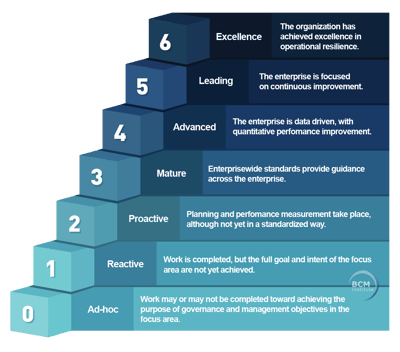 Level 0: Ad-hoc: Reactive, unstructured processes. Non-Compliant
 - Level 1: Reactive: Basic frameworks with sporadic execution. (Documented but inconsistent)
- Level 2: Proactive: Formal policies and dedicated teams. (Documented)
- Level 3: Mature: Anticipatory risk management. (Consistent execution)
- Level 4: Advanced: Integrated, data-driven strategies. (Measured and monitored)
- Level 5: Leading: Predictive analytics and automation. (Continuous improvement and leading practice)
- Level 6: Excellence: Industry leadership through innovation.
Audit Outcome Categories
- Regulatory Gap (L0–L2): Immediate remediation required
- Compliant (L3-L4): Meets MAS minimum expectations
- Mature (L5–L6): Demonstrates strong resilience capability

Key Takeaways (Aligned to MAS Direction)
This checklist reflects the BNM 2025 direction toward outcome-based operational resilience, where institutions are expected to:
- Ensure continuous delivery of critical business services
- Operate within defined disruption thresholds under stress
- Manage ecosystem-wide dependencies and systemic risks
- Demonstrate measurable resilience capability through testing and metrics
More Information About Blended Learning OR-5000 [BL-OR-5] or OR-300 [BL-OR-3]
To learn more about the course and schedule, click the buttons below for the OR-3 Blended Learning OR-300 Operational Resilience Implementer course and the OR-5 Blended Learning OR-5000 Operational Resilience Expert Implementer course.


![[BL-OR] [3-4-5] View Schedule](https://no-cache.hubspot.com/cta/default/3893111/d0d733a1-16c0-4b68-a26d-adbfd4fc6069.png)
![[BL-OR] [3] FAQ OR-300](https://no-cache.hubspot.com/cta/default/3893111/f20c71b4-f5e8-4aa5-8056-c374ca33a091.png)
![Email to Sales Team [BCM Institute]](https://no-cache.hubspot.com/cta/default/3893111/3c53daeb-2836-4843-b0e0-645baee2ab9e.png)