![[OR] [MLRE] [Full Banner] Building Organisational Resilience An Operational Resilience Guide for Malaysian Life Reinsurance](https://no-cache.hubspot.com/cta/default/3893111/6898dbc1-274c-4300-9b8e-97cdd96a7a30.png)

![x [OR] [MLRE] Legal Disclaimer Banner](https://no-cache.hubspot.com/cta/default/3893111/141492be-2bd8-434d-a664-dfdf2c7480ba.png)
eBook 2: Chapter 1
Building Organisational Resilience: An Operational Resilience Guide for Malaysian Life Reinsurance
Introduction
![x eBook Cover [OR] [MLRE] [E2] [2D]](https://no-cache.hubspot.com/cta/default/3893111/ed7d1196-f3a8-4102-a15e-9cc9d3c0d773.png)

As a licensed reinsurer under the supervision of Bank Negara Malaysia (BNM), its ability to continue delivering critical reinsurance services during severe but plausible disruptions is no longer viewed purely as a business continuity capability—it is a regulatory, financial, and systemic expectation.
The evolving threat landscape facing reinsurers today includes:
- Market volatility and concentration risks
- Technology and cyber disruptions are affecting underwriting, claims, and actuarial systems
- Third-party dependencies across cedants, brokers, data providers, and reinsurers
- Operational strain arising from pandemics, climate-related catastrophes, and geopolitical instability
In response, BNM’s 2025 Discussion Paper on Operational Resilience reinforces a fundamental shift:
Financial institutions must move beyond recovery-based thinking to ensure the continuity of critical business services within defined impact tolerances.
This eBook is designed to help Malaysian Life Reinsurance operationalise this expectation in a structured, defensible, and regulator-ready manner.
The Three-Phase Operational Resilience PlanningMethodology
This guide adopts a three-phase Operational Resilience Planning Methodology—Plan, Implement, and Sustain—to ensure resilience is not treated as a one-off compliance exercise, but as an embedded organisational capability.
This methodology aligns conceptually with:
- BNM’s expectations on critical business services, impact tolerance, and scenario testing
- International supervisory approaches (e.g. UK PRA, Basel principles)
- Existing BCM, risk management, and governance frameworks are commonly used by Malaysian insurers and reinsurers

Phase 1: Plan – Establishing the Foundation for Resilience
 The Plan phase focuses on building clarity, alignment, and governance before execution begins. For Malaysian LifeReinsurance, this phase ensures that operational resilience is anchored to enterprise risk management, Board oversight, and regulatory expectations.
The five stages of the Plan phase are:
- Assess Capability and Maturity
Establishes a baseline understanding of current resilience capabilities across BCM, IT DR, third-party risk, crisis management, and operational risk.
BNM alignment example: Demonstrates proportionality and self-awareness expected under the 2025 Discussion Paper.
- Analyse Gap
Identifies gaps between current practices and BNM’s expectations—particularly around service-based thinking versus asset-based recovery planning.
- Develop Strategy and Roadmap
Translates regulatory intent into a phased, achievable roadmap that considers organisational size, complexity, and systemic importance.
- Confirm Risk Appetite
Defines the level of disruption Malaysian Life Reinsurance is willing to tolerate for its critical services, consistent with Board-approved risk appetite statements.
BNM alignment example: Supports impact tolerance calibration and Board accountability.
- Develop and Embed Governance
Establishes ownership, escalation, reporting, and assurance structures—ensuring operational resilience is overseen at senior management and Board levels.
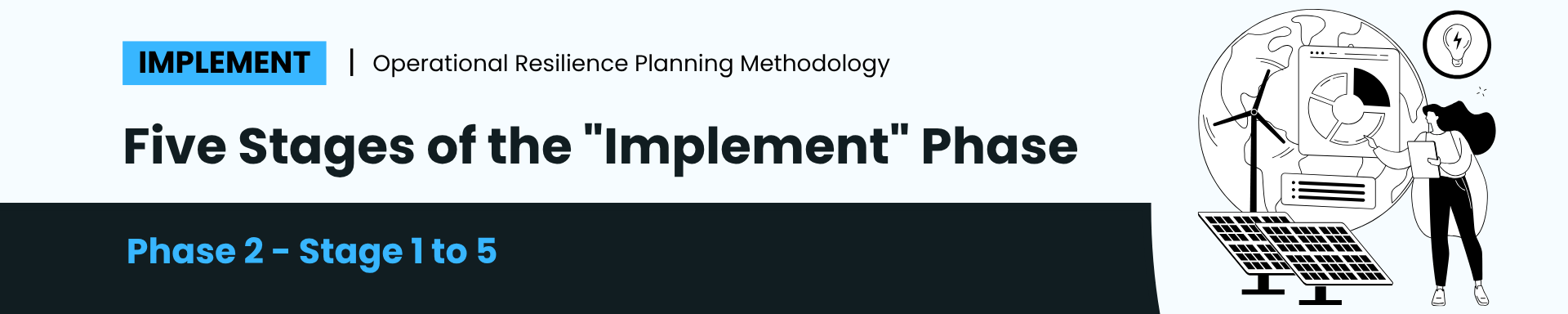
Phase 2: Implement – Operationalising Resilience
 The Implement phase converts strategy into tangible, testable outcomes. This phase is where Malaysian Life Reinsurance demonstrates that resilience is measurable, repeatable, and evidence-based.
The five stages of the Implement phase are:
- Identify Critical Business Services
Focuses on services delivered to cedants and the financial system (e.g. treaty underwriting, claims settlement, retrocession management).
BNM alignment example: Shifts focus from internal functions to services whose disruption could cause intolerable harm.
- Map Processes and Resources
Identifies dependencies across people, processes, technology, facilities, data, and third parties.
BNM alignment example: Meets supervisory expectations on end-to-end dependency mapping.
- Set Impact Tolerance
Defines maximum tolerable disruption levels (e.g. time, volume, data integrity) for each critical business service.
- Conduct Scenario Testing
Test severe but plausible scenarios such as cyber incidents, third-party failures, or pandemic-related absenteeism.
BNM alignment example: Moves beyond checklist testing towards outcome-based resilience validation.
- Improve Lesson Learnt
Ensures test outcomes lead to concrete remediation actions, reinforcing continuous improvement.

Phase 3: Sustain – Embedding Resilience into the Organisation
 The Sustain phase ensures that operational resilience becomes part of how Malaysian Life Reinsurance operates, not a standalone regulatory initiative.
The five stages of the Sustain phase are:
- Introduce Cultural Change
Reinforces resilience ownership across underwriting, claims, actuarial, IT, and support functions.
- Develop Communication Strategy
Ensures consistent messaging to staff, senior management, the Board, and regulators.
- Implement Training and Awareness
Builds competence in operational resilience concepts, roles, and responsibilities.
- Provide Self-Assessment
Enables regular internal reviews against BNM expectations and internal standards.
- Conduct an Independent Quality Review
Assures internal audit or independent review—supporting regulatory confidence and Board oversight.
Purpose of This eBook
This eBook serves three critical purposes for Malaysian Life Reinsurance:
- Translate BNM’s operational resilience expectations into actionable steps
- Provide a structured methodology aligned to local regulatory realities
- Enable defensible decision-making supported by governance, evidence, and outcomes
![x [Banner] [Summing] [OR] [E2] [C1] Overview of Operational Resilience Planning Methodology](https://no-cache.hubspot.com/cta/default/3893111/0c551e82-cf06-432c-8498-1d3c9bb2dece.png)
From Regulatory Expectation to Organisational Capability
Operational resilience is no longer defined by how quickly Malaysian Life Reinsurance can recover its systems; it is defined by whether critical reinsurance services continue to operate within tolerable limits during disruptions.
BNM’s 2025 Discussion Paper on Operational Resilience makes this clear:
- Boards are accountable for resilience outcomes
- Institutions must understand service-level vulnerabilities
- Testing must demonstrate real-world survivability
- Resilience must be continuously improved, not periodically reviewed
Through the Plan–Implement–Sustain methodology outlined in this guide, Malaysian Life Reinsurance can:
- Establish strong governance and strategic alignment
- Demonstrate compliance through evidence-based implementation
- Build confidence with regulators, cedants, and stakeholders
- Strengthen its role as a resilient participant in Malaysia’s financial system
Most importantly, this approach ensures that operational resilience becomes a living capability—embedded in culture, decision-making, and day-to-day operations—supporting not only regulatory compliance, but long-term organisational sustainability.

Blogs marked [x] are under construction.
![[OR] [MLRE] [34 Banner] Building Organisational Resilience An Operational Resilience Guide for Malaysian Life Reinsurance](https://no-cache.hubspot.com/cta/default/3893111/cf0d3512-4dc7-4e6e-96a9-74e9c30a002c.png)
![[OR] [GEN] [P1] [S1-S5] [C2] Five Stages of the _Plan_ Phase](https://no-cache.hubspot.com/cta/default/3893111/78869693-baaa-48cf-836e-13950abc8b16.png)
![[OR] [GEN] [P2] [S1-S5] [C8] Five Stages of the _Implement_ Phase](https://no-cache.hubspot.com/cta/default/3893111/7b251fae-e788-4b59-885f-7079d4845475.png)
![[OR] [GEN] [E2] [P3] [C14] The Five Stages of the Sustain Phase](https://no-cache.hubspot.com/cta/default/3893111/931ae9fa-0925-4f30-ba78-fa9be7662fb7.png)
| eBook 3 | ||
![x eBook Cover [OR] [MLRE] [E3] [2D]](https://no-cache.hubspot.com/cta/default/3893111/348b67fd-8cd8-4a0c-afc0-f436a721f1d6.png) |
||
| C5 [x] | C6 [x] | C7 [x] |
![[OR] [GEN] [E2] [P1] [S3] [C5] Developing Strategy and Roadmap](https://no-cache.hubspot.com/cta/default/3893111/afe40ca7-42c1-448f-9ce7-74955f58c946.png) |
![[OR] [GEN] [E2] [P1] [S4] [C6] Confirming Risk Appetite](https://no-cache.hubspot.com/cta/default/3893111/7228dd2d-4764-4aee-8fb5-899bd5b28874.png) |
![[OR] [GEN] [E2] [P1] [S5] [C7] Developing and Embedding Governance](https://no-cache.hubspot.com/cta/default/3893111/e06994e8-b682-4809-b8b8-a7a4f82d0ec7.png) |
| C11 [x] | C12 [x] | C13 [x] |
![[OR] [GEN] [E2] [P2] [S3] [C11] Establishing Impact Tolerance](https://no-cache.hubspot.com/cta/default/3893111/54b6c9d1-e897-4530-8eb4-8419de7503aa.png) |
![[OR] [GEN] [E2] [P2] [S4] [C12] Performing Scenario Testing](https://no-cache.hubspot.com/cta/default/3893111/fe5cc4a9-b109-417e-ba78-651a6dc4f658.png) |
![[OR] [GEN] [E2] [P2] [S5] [C13] Improving Lessons Learned](https://no-cache.hubspot.com/cta/default/3893111/4e3235b4-3630-4359-89bb-8a3b3c098dc8.png) |
| C17 [x] | C18 [x] | C19 [x] |
![[OR] [GEN] [E2] [P3] [S3] C17] Implementing Training and Awareness](https://no-cache.hubspot.com/cta/default/3893111/1e095f66-dca9-4a83-9850-e459cebddbfa.png) |
![[OR] [GEN] [E2] [P3] [S4] [C18] Providing Self-Assessment](https://no-cache.hubspot.com/cta/default/3893111/076a795c-4733-4fb0-b260-fcec767fb221.png) |
![[OR] [GEN] [E2] [P3] [S5] [C19] Conducting Independent Quality Reviews](https://no-cache.hubspot.com/cta/default/3893111/2cff3f12-e08e-43cf-8ca6-aaa6efe33631.png) |

![[OR] [GEN] [E2] [C20] Conclusion for eBook 2](https://no-cache.hubspot.com/cta/default/3893111/fb88d7a9-cd61-4414-add4-e284049ff375.png)
![[OR] [GEN] [E2] [C21] [Back Cover] for eBook 2](https://no-cache.hubspot.com/cta/default/3893111/2e6b224b-6df5-4080-a611-383225744f4f.png)
![[OR] [GEN] [E2] [P1] [S1] [C3] Assessing Capability and Maturity](https://no-cache.hubspot.com/cta/default/3893111/3486f1a4-500e-42ee-a7e1-af2a6008f468.png)
![[OR] [GEN] [E2] [P1] [S2] [C4] Analysing Gaps](https://no-cache.hubspot.com/cta/default/3893111/2c0fd2b3-bb2b-47b6-ad44-5e88c8422b37.png)
![[OR] [GEN] [E2] [P2] [S1] [C9] Identifying Critical Business Services](https://no-cache.hubspot.com/cta/default/3893111/3ac7c230-3ce7-463a-813f-6907a49bdc35.png)
![[OR] [GEN] [E2] [P2] [S2] [C10] Mapping of Processes and Resources](https://no-cache.hubspot.com/cta/default/3893111/e7a81126-d48f-4c84-a7b5-db4324ef1b4f.png)
![[OR] [GEN] [E2] [P3] [S1] [C15] Introducing Cultural Change Management](https://no-cache.hubspot.com/cta/default/3893111/3909fd60-d099-4324-a1d2-2040171a7300.png)
![[OR] [GEN] [E2] [P3] [S2] [C16] Developing a Communication Strategy](https://no-cache.hubspot.com/cta/default/3893111/d3bcd703-2173-4eba-90c3-7d45da459f94.png)


For organisations looking to accelerate their journey, BCM Institute’s training and certification programs, including the OR-5000 Operational Resilience Expert Implementer course, provide in-depth insights and practical toolkits for effectively embedding this model.
More Information About OR-5000 [OR-5] or OR-300 [OR-3]
To learn more about the course and schedule, click the buttons below for the OR-300 Operational Resilience Implementer course and the OR-5000 Operational Resilience Expert Implementer course.


![[BL-OR] [3-4-5] View Schedule](https://no-cache.hubspot.com/cta/default/3893111/d0d733a1-16c0-4b68-a26d-adbfd4fc6069.png)
![[BL-OR] [3] FAQ OR-300](https://no-cache.hubspot.com/cta/default/3893111/f20c71b4-f5e8-4aa5-8056-c374ca33a091.png)
![Email to Sales Team [BCM Institute]](https://no-cache.hubspot.com/cta/default/3893111/3c53daeb-2836-4843-b0e0-645baee2ab9e.png)